In the 19th century, astronomers encountered a problem that seemed like a minor error but had far-reaching implications. Observations showed that Mercury's orbit was slowly rotating in space: its perihelion point shifted by approximately 574 arcseconds per century. However, Newtonian (classical) mechanics predicted a shift of 531 arcseconds, due to the gravitational influence of the other planets in the solar system. 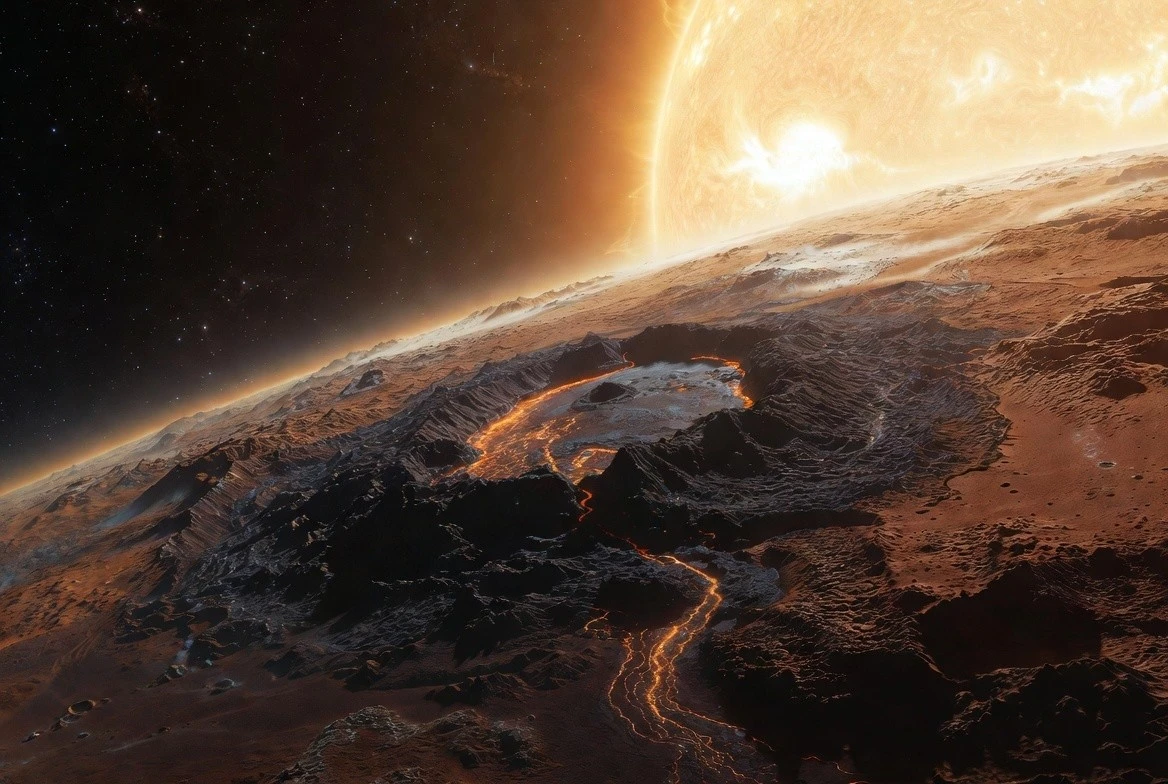
Some scientists at the time linked the remaining 43 arcseconds per century to another source of gravity, which no one had yet been able to directly observe. Thus, the hypothesis of a planet called Vulcan—an invisible body between the Sun and Mercury—was born. The explanation sounded quite convincing: the planet was small and difficult to observe due to the Sun's brightness, but when new telescopes and more sensitive instruments became available, Vulcan's existence would certainly be confirmed.
However, not all inquisitive minds shared this concept. A bolder idea emerged: perhaps the problem isn't a "hidden planet," but rather that our classical theory of gravity may be incomplete.
The answer was discovered in the 20th century. Albert Einstein's general theory of relativity provided a natural explanation for the anomaly: near a massive body (the Sun), spacetime curves, and the orbit of a planet (Mercury) precesses more strongly than predicted by the Newtonian model. Those "extra" 43 arcseconds per century turned out not to be evidence of the existence of another planet, but a direct effect of relativistic gravity, which views gravity not as a force, but as a result of the curvature of spacetime caused by mass-energy.
What's really between the Sun and Mercury?
The planet Vulcan doesn't exist, but that doesn't mean the space between the Sun and Mercury must be completely sterile. Theoretically, there's a region of dynamic stability within Mercury's orbit where "vulcanoids"—small asteroids orbiting at a relatively safe distance from the sun—could exist. 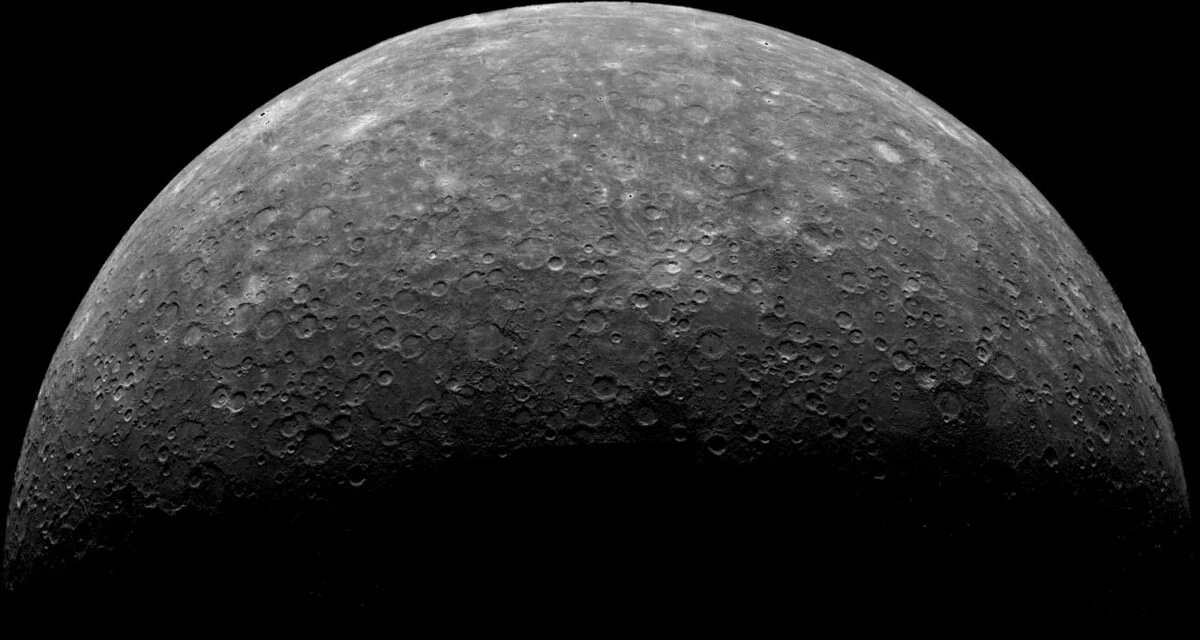
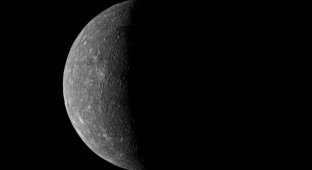
Mercury "through the eyes" of NASA's Mariner 10 spacecraft, March 1974
They were searched for in data from spacecraft and specialized solar observatories, but nothing massive was found. Modern astronomy rules out the existence of vulcanoids larger than six kilometers in diameter, so if anything orbits between Mercury and the Sun, it's likely very small, simply lost in the solar glare.
The story of Vulcan is an important reminder: if observations don't match calculations, don't rush to radical explanations. Sometimes this suggests that our current theory doesn't fully describe reality and requires revision.
A striking example is the observations of NASA's James Webb Space Telescope, which discovered "impossible" mature galaxies in the early Universe. This isn't proof that the Big Bang didn't happen, but it is a strong argument that our understanding of the birth and evolution of galaxies needs to be refined.
Add your comment
You might be interested in:












Protective film Removing it with a power screwdriver

How to start a 102-liter engine

When a child plays hide-and-seek at a professional level

Man sets up bedroom camera and discovers the reason for his

Super dads who swoop in to save the day

Precision carpentry

Looks like it's time to buy WinRAR

How to hang wallpaper neatly

Athlete in Bavarian dress flies over a lake on a hydrofoil
