A Cat in a Pram, a Kitten in a Soldier's Pocket, and Mark Twain with a Feline on His Lap: Authentic Vintage Photos (30 Photos)
Cats stepped into the camera’s frame almost immediately after photography was invented—and they’ve stayed there ever since. Long before the internet, memes, and pet influencers with millions of followers, people were already posing with their feline companions for family portraits, taking them to the front lines, and walking them on leashes. These 30 black-and-white photographs from across the decades offer living proof that our affection for cats hasn’t changed one bit over the past century and a half. 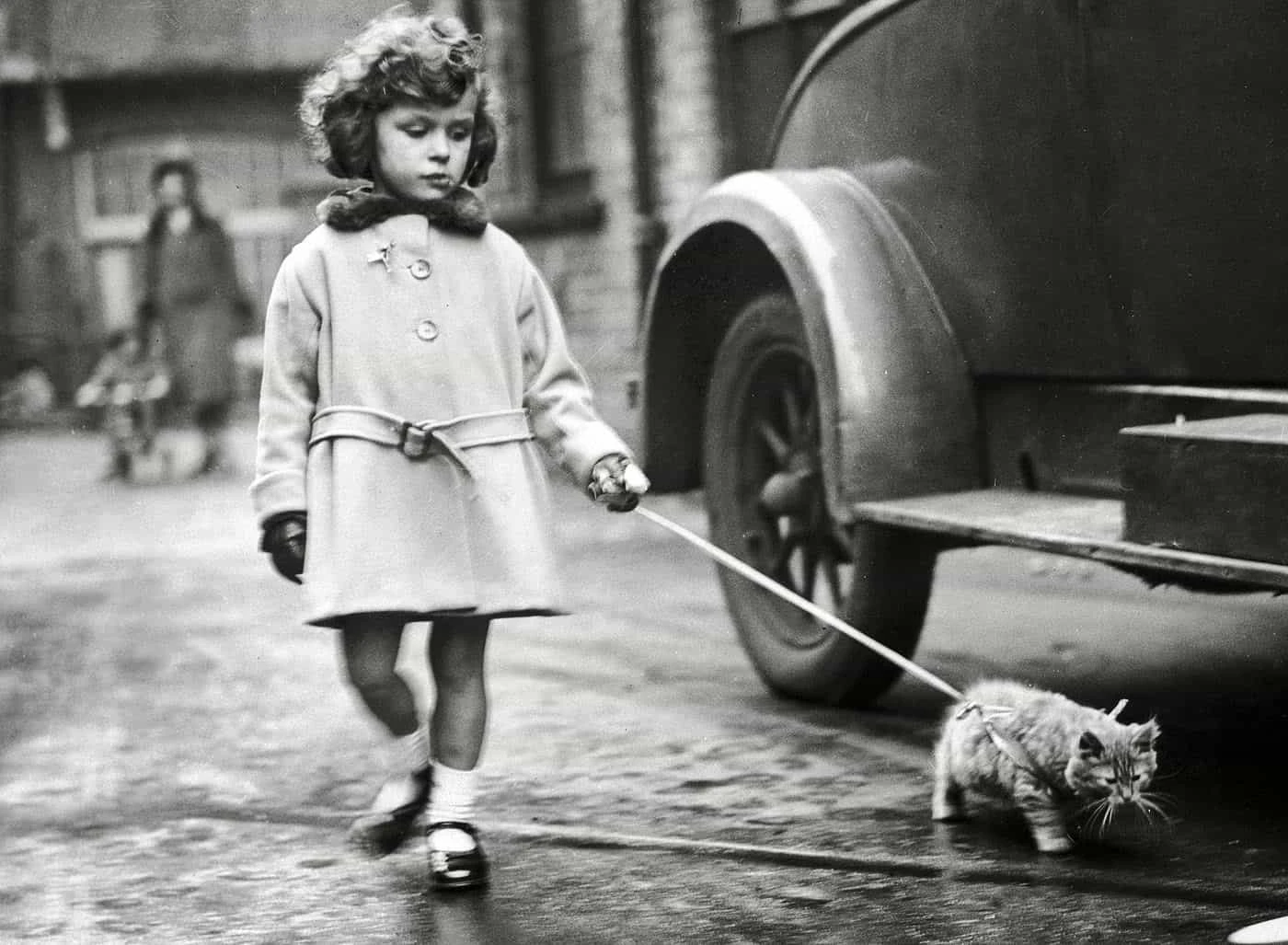
London’s East End, circa 1902. A young girl cradles a tabby cat on a flight of stone steps. The photograph was taken by Horace Warner, a Sunday school teacher and amateur photographer who documented the daily lives of children in one of the British capital's poorest quarters. His series, *Spitalfields Nippers*—"nipper" being London street slang for a child—stands as a rare historical document: out of 240 photographs, only thirty have survived. 
Spitalfields, London. From Horace Warner's *Spitalfields Nippers* series, circa 1902
Mark Twain was one of the most celebrated cat lovers in literary history. At various points in his life, he shared his home with up to 19 cats at a time, giving them names that might make other owners balk: Satan, Beelzebub, Pestilence, Sin, and Sour Mash. Whenever the author traveled away from home, he would actually rent cats just to keep himself company. His all-time favorite was a cat named Bambino. 
Mark Twain with one of his feline companions. The author kept up to 19 cats at once
London, 1940–1941, during the Blitz—the sustained German bombing campaign against the British capital. The letter "R" on the Civil Defence worker’s helmet stands for Rescue. In his arms is a cat pulled alive from the rubble. While saving animals was never listed among the official duties of Civil Defence units, workers routinely pulled four-legged survivors from the ruins anyway. 
London, 1940–1941. A Civil Defence rescue worker cradles a kitten found in the wreckage after an air raid
A German soldier near Stalingrad tucks a tiny kitten into his tunic pocket. Stray cats turned up around military encampments everywhere—they kept rat populations down, and in return, soldiers fed and fussed over them. A few quiet minutes with a kitten during a lull in the fighting offered a welcome dose of comfort. 
A kitten in a pocket: a simple comfort amid the brutality of war
Circa 1891, painter and photographer Thomas Eakins captured his student Amelia Van Buren engrossed in a book, with a cat perched comfortably on her shoulder looking utterly pleased with itself. Van Buren studied at the Pennsylvania Academy of the Fine Arts and went on to become an accomplished photographer in her own right. In the shot, she is absorbed in her reading, paying no mind to the lens—while the cat gladly steals the scene. 
Amelia Van Buren. Portrait by Thomas Eakins, circa 1891
Rosa Rolanda was an American dancer, choreographer, photographer, and painter, born in California in 1895. In the 1920s, she toured Europe with the Ziegfeld Follies and sat for Man Ray in Paris. She later relocated to Mexico, joined the inner circle of Frida Kahlo and Diego Rivera, and lived there until her death in 1970. This picture captures the early days of her artistic career. 
Rosa Rolanda—dancer, photographer, and painter. Early 20th century
The 1920s. A dapper gentleman in a suit, with a cat sprawled across his lap—content and thoroughly at home. Nothing is known about either the man or the cat, but the posture says it all: this feline had clearly staked a claim on the finest lap in the house. 
The 1920s. A cat claims a prime lap with zero intention of moving
Documentary photographer Emil Gataullin captures rural life—quiet, unhurried, and authentic. In this shot, an elderly woman leans down to kiss her dog while two cats wait patiently alongside. A simple glimpse into village routine, and an enduring portrait of human-animal affection. 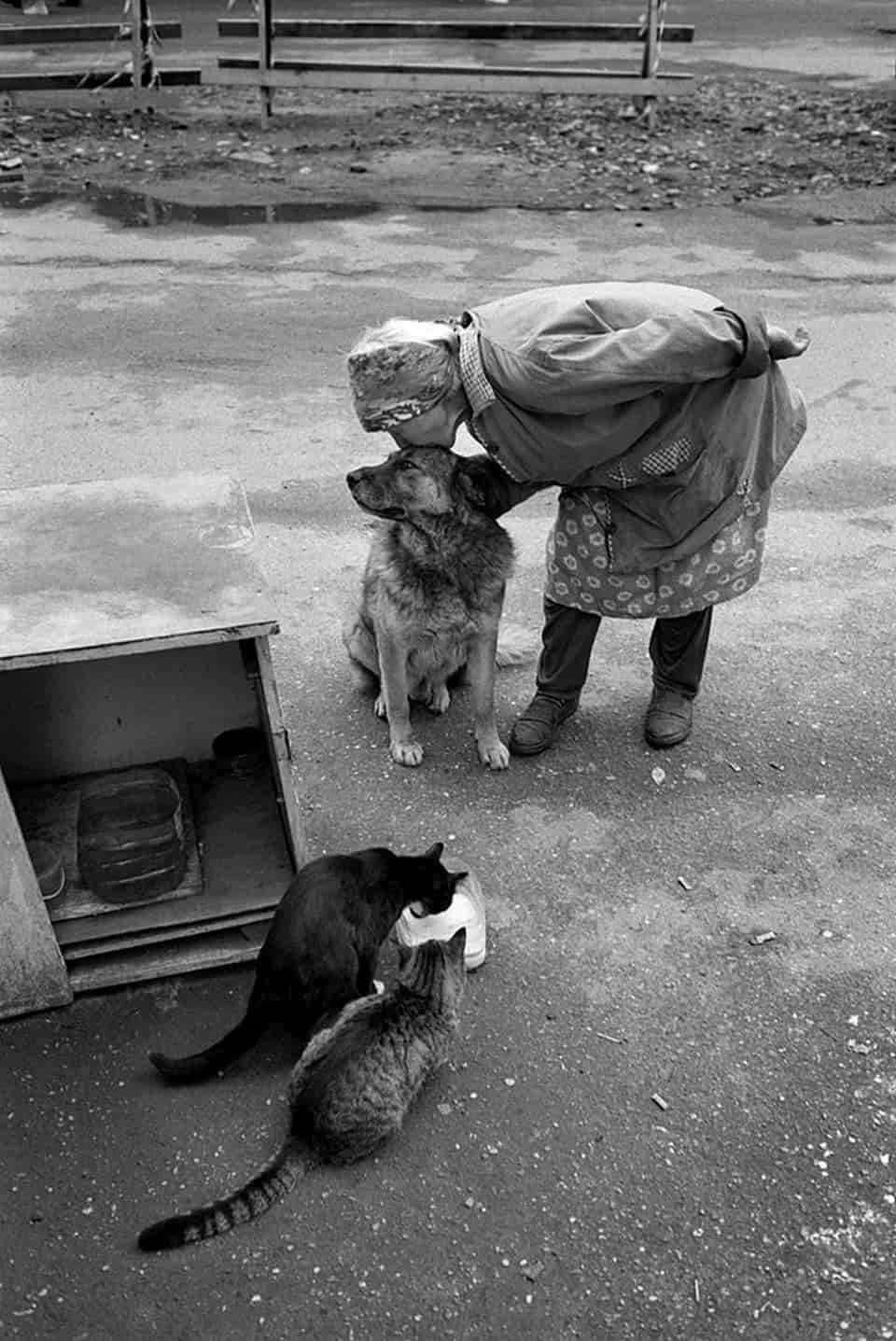
Photo by Emil Gataullin. Country life—a dog, two cats, and human warmth
July 29, 1925. Lafayette Street in Lower Manhattan, New York City. A mother cat named Blackie ferries her kittens across the busy thoroughfare—one by one. A traffic policeman halts the stream of vehicles to let her pass safely. Photographer Harry Warnecke of the *New York Daily News* caught the moment, and the heartwarming image soon made headlines across the country. 
New York, July 29, 1925. Blackie carries her kittens across as traffic is brought to a standstill
A striped tabby strikes a pose for pioneering photographer Jessie Tarbox Beals—composed, calm, and full of dignity. Taken between 1903 and 1928, the image is now held in the Harvard University Library collection. Beals was one of America's first female photojournalists, and judging by the cat's regal demeanor, he seemed well aware of the occasion. 
Photo by Jessie Tarbox Beals, 1903–1928. Preserved in the Harvard Library collection
Finland-Swedish poet Edith Södergran poses with her cat Totti, circa 1917. Södergran was one of the central figures of Nordic modernism. She wrote in Swedish, lived in grinding poverty, and died of tuberculosis in 1923 at just 31 years old. Cats held a special place in her life and verse—part of the natural world with which she often felt a deeper bond than with people. 
Edith Södergran with her cat Totti, circa 1917
December 2, 1931. The National Cat Club Show at London's Crystal Palace. A young exhibitor walks her kitten on a leash past parked cars, captured here by Fox Photos. As it turns out, walking a cat on a leash is hardly a modern invention.
London, Crystal Palace, December 2, 1931. Cat show exhibitor with a kitten on a leash
Paris in the 1930s. An elderly woman feeds street cats right on the sidewalk. The photograph was taken by Hungarian-American master André Kertész, celebrated for finding poignant humanity in ordinary urban moments. The piece is titled *Le repas des chats* ("The Cats' Meal"). 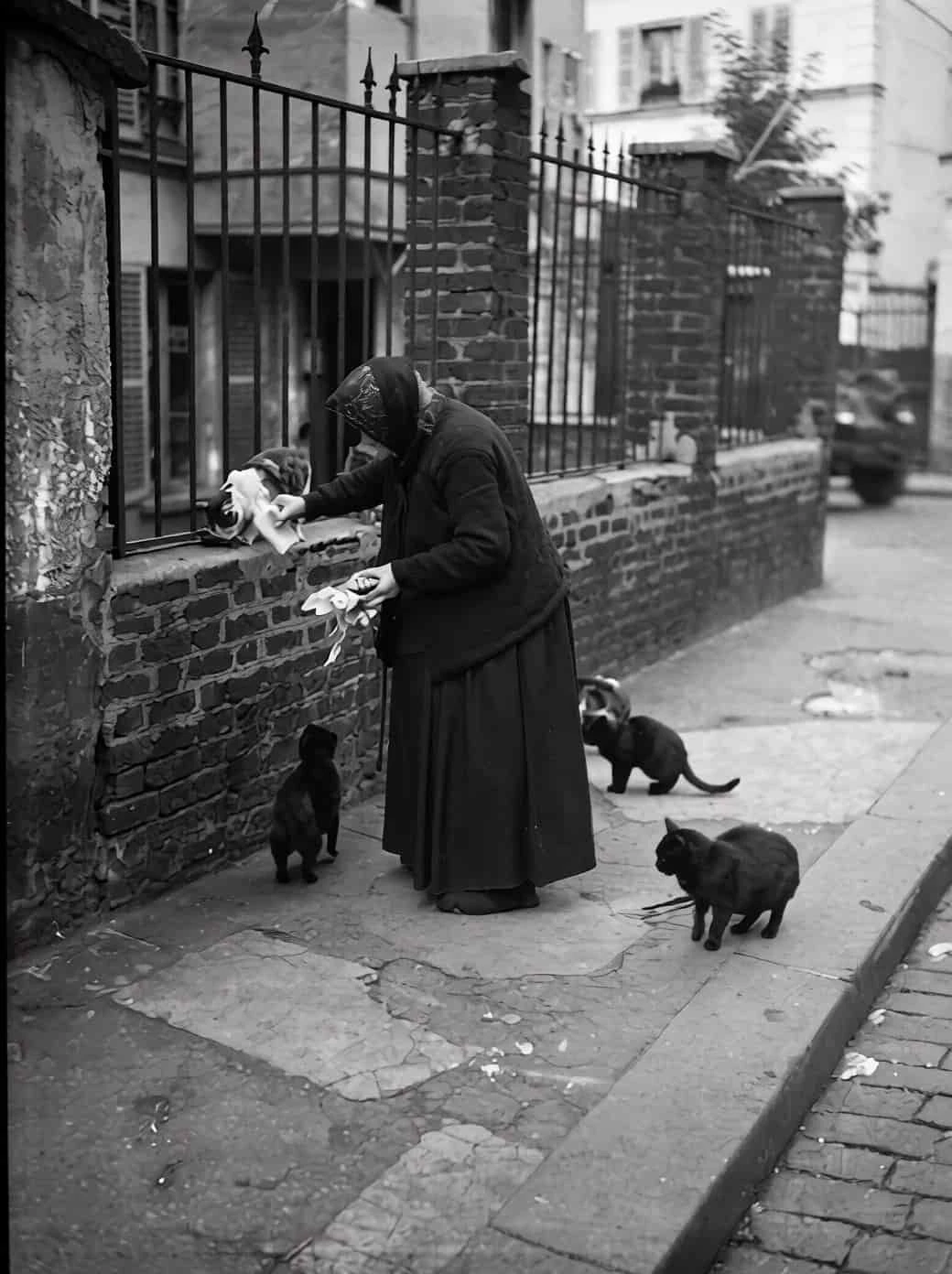
André Kertész. *Le repas des chats* ("The Cats' Meal"), Paris, 1930s
Another Parisian scene, circa 1938: an elderly woman wheels a baby pram full of cats along the pavement. The photograph is attributed to Brassaï, the legendary chronicler who captured nighttime Paris and its eclectic characters from the 1930s onward. The woman’s identity is lost to history, but the cats in the carriage appear thoroughly content. 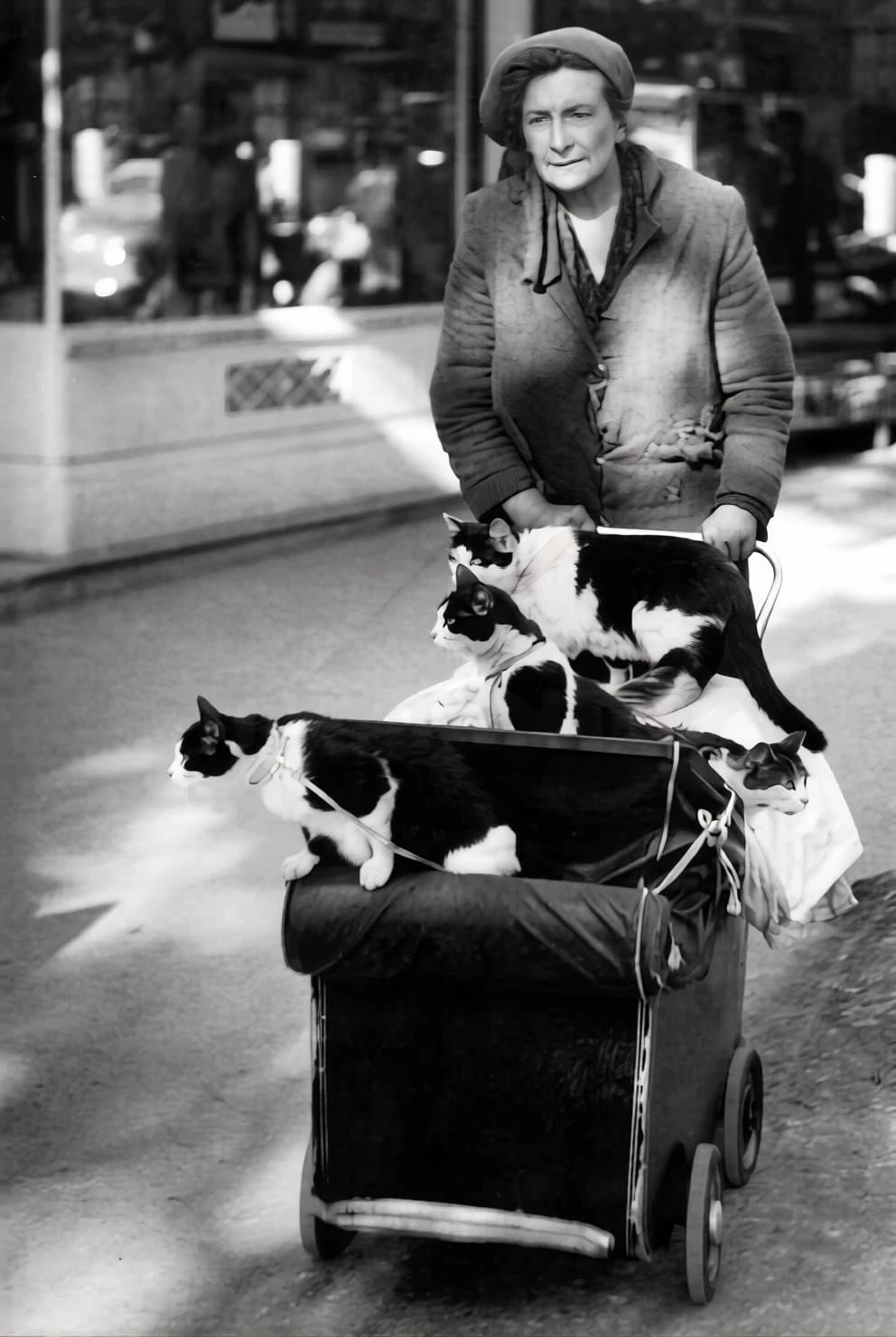
Attributed to Brassaï. Paris, circa 1938
Calabria, southern Italy, circa 1970. An elderly woman rests along a stone-paved street as a cat naps peacefully on her lap. The image was captured by Italian documentary photographer Ferdinando Scianna, whose depictions of life in southern Italy have long since become classics of the craft. 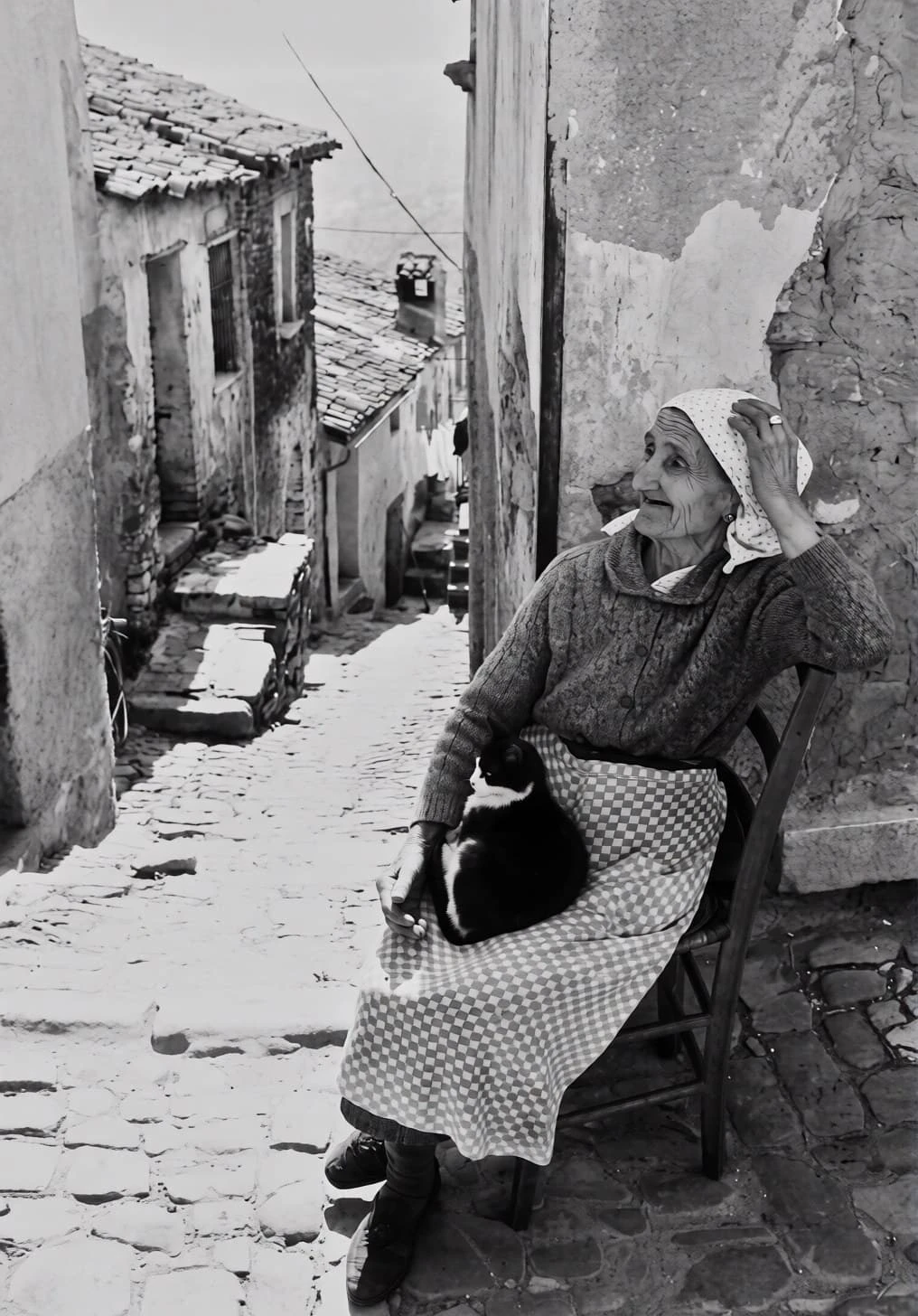
Ferdinando Scianna. Calabria, Italy, circa 1970
Mid-20th century. A woman holds a fluffy cat with effortless familiarity—the way you hold a pet you pick up every single day. The cat takes in the room with absolute serenity. The backstory of the image hasn’t survived, but it hardly matters: the scene is instantly recognizable in any era. 
Mid-20th century. A cat in good hands—a timeless portrait across every generation
Margaret Mitchell was born in Atlanta in 1900. During the 1920s, she worked as a reporter before penning *Gone with the Wind*, her landmark novel about the American Civil War and its aftermath. Published in 1936, the book sold a million copies within its first six months and earned Mitchell a Pulitzer Prize in 1937. This photograph dates back to the 1920s, before literary stardom arrived. 
Margaret Mitchell, author of *Gone with the Wind*, 1920s
Rome in the 1950s. The stray cats living among Rome's ruins were fed and looked after by dedicated local women known as *gattare* ("cat ladies"). The most famous of them was Oscar-winning actress Anna Magnani, who routinely made the rounds to feed alley cats across the city. The woman pictured here isn’t Magnani, but the scene was a familiar sight on the streets of Rome back then. 
Rome, 1950s. Local *gattare* feeding the city's alley cats
London, February 13, 1945. In the closing months of World War II, a German V-weapon strike tore into Judd Street. A British rescue worker carries a cat pulled from the rubble. A pack of cigarettes peeks out from his tunic pocket, and in his arms is a grateful survivor. 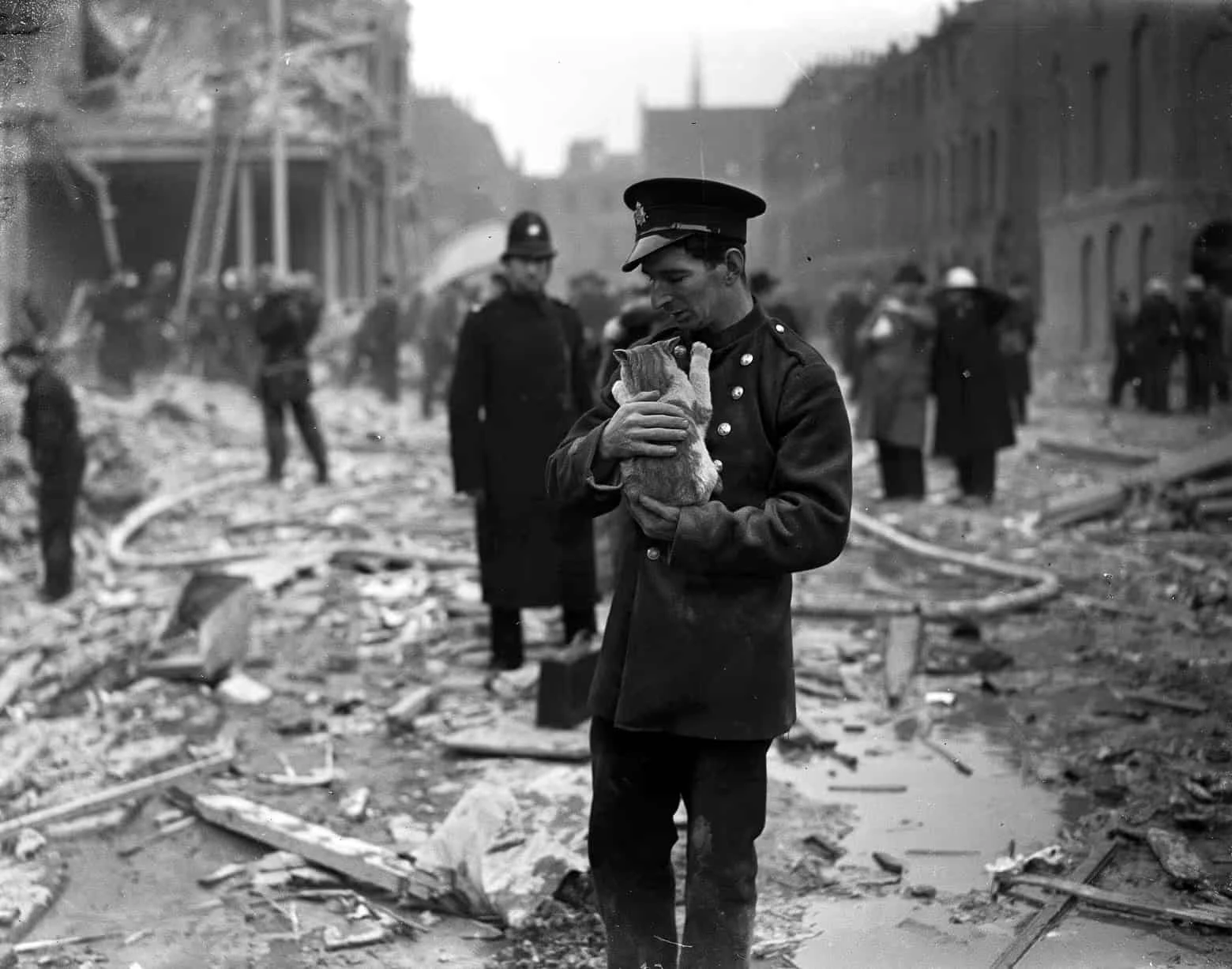
London, Judd Street, February 13, 1945. A cat rescued from the ruins after a V-rocket attack
1897. Photographer E. Lee Ferguson titled this portrait *Chums*. A young woman holds a striped cat to her cheek, both looking straight into the camera lens. The pose is well over a century old, yet it feels intimately familiar to anyone who has ever tried taking a portrait with their cat. 
E. Lee Ferguson. *Chums*, 1897
Paris, March 13, 1930. Mrs. Frederick Fleitmann of New York poses with her five Siamese cats. All five had just captured first prizes at an international cat show held in the French capital. The resulting portrait is formal and solemn—even if the cats are all gazing in completely different directions. 
Paris, March 13, 1930. Five prize-winning Siamese cats from an international competition
Rome, circa 1950. A woman dishes out food for street cats right beneath the towering walls of the Pantheon. The Pantheon was built nearly two thousand years ago, and cats have inhabited its shadows for countless generations. The Italian term *gattara* for women like her arose naturally: no translation necessary. 
By the walls of the Pantheon, Rome, circa 1950. Cats have lived here for nearly as long as the monument has stood
Nepal. Seventy-five-year-old Dipa Thapa feeds cats at the Pashupati shelter. In this quiet black-and-white frame, an elderly woman leans forward in an act of care—a reminder that kindness toward animals transcends age, borders, and eras. 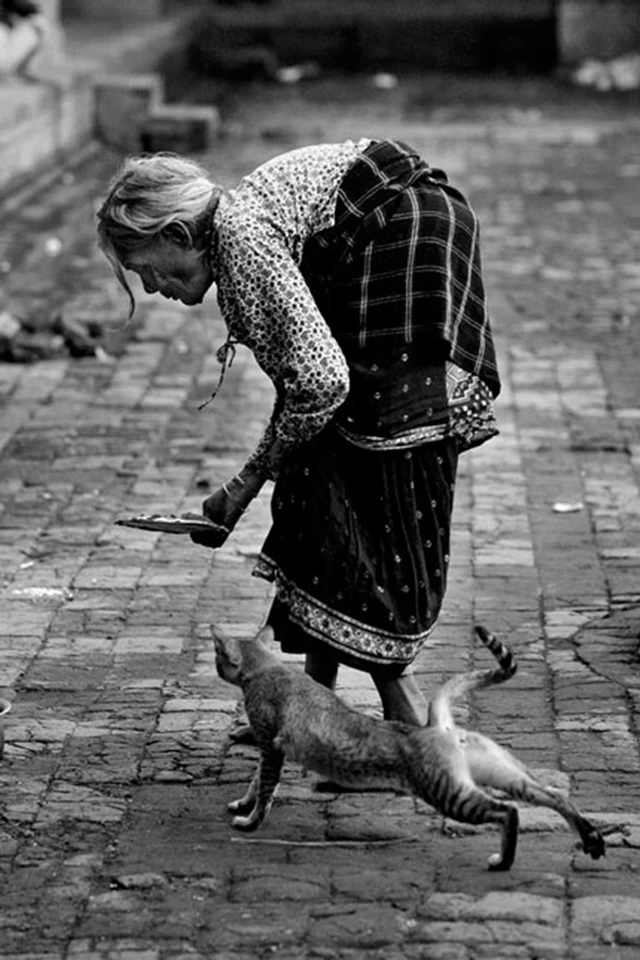
Nepal, Pashupati shelter. Dipa Thapa, 75, feeding her cats
Late 19th to early 20th century. Catherine Gertrude Dobbie, born in 1894, poses in a photo studio with a kitten. Having children photographed alongside a beloved pet was a popular Victorian and Edwardian tradition. Studios frequently kept animals on hand just in case a young client arrived without one. 
Catherine Gertrude Dobbie with a kitten. Studio portrait, late 19th to early 20th century
Tuxedo Park, New York, 1907. Mark Twain once more—this time clad in his iconic white suit, cradling a tiny kitten. Over the years, the author named his beloved pets Apollinaris, Beelzebub, Epitaph, Buffalo Bill, and Zoroaster. This little kitten, unnamed in records, seems to have simply wandered into his waiting hands. 
Mark Twain. Tuxedo Park, New York, 1907
Great Britain, April 11, 1942. Photographer Haywood Magee captured a young woman with a cat on a balcony for *Picture Post*. With the war grinding through its third year, the photograph was titled "A Peaceful Scene"—an apt description of a quiet moment of normalcy. 
Haywood Magee for *Picture Post*. Great Britain, April 11, 1942
Swindon, England, circa 1918. Freda Stirling poses with a black cat nestled on her lap. An everyday studio portrait—nothing extravagant, just a young girl and her cat, over a century ago, in a modest English railway town. 
Freda Stirling with her cat. Swindon, England, circa 1918
Victorian era, 1890s. A young woman poses with two cats: one nestled on her lap, the other perched on an adjacent side table. It is a formal studio portrait, yet the cats act as if the photographer isn't there at all. The impulse to photograph our animal companions was born right alongside photography itself. 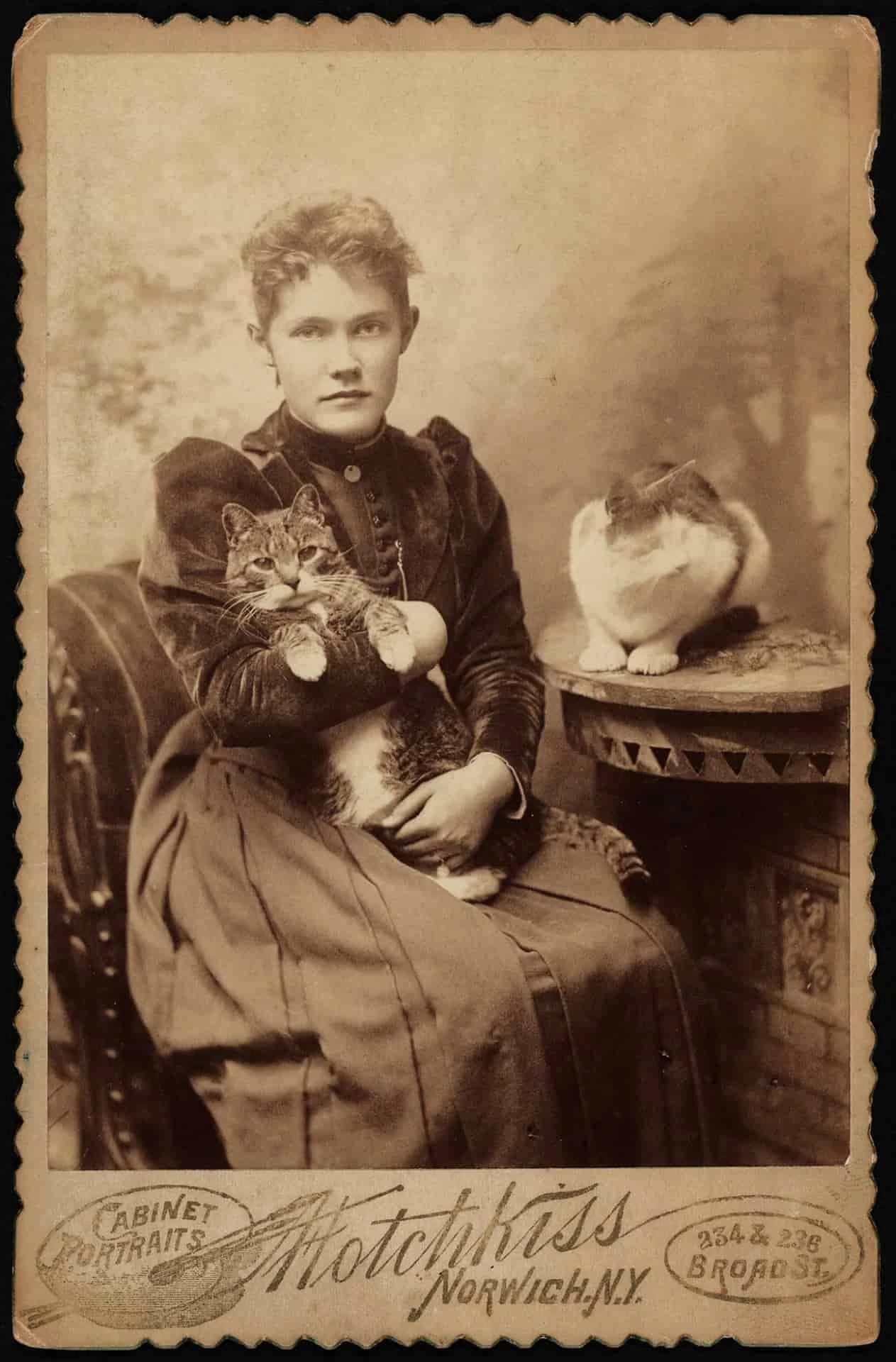
Victorian studio portrait, 1890s. Two cats and their owner
The 1930s. A young woman hugs a striped cat on a balcony. Her identity and the location remain unknown, but the cat looks thoroughly content. And in the end, that’s all that counts. 
The 1930s. Names unknown. Needs no explanation
Circa 1900. A woman sits on a porch surrounded by white cats, holding a small dog in her arms. The record hasn’t preserved her name or where she lived. Yet the photograph tells the whole story: our bond with animals existed long before it could be captured on film—and it will endure just as long. 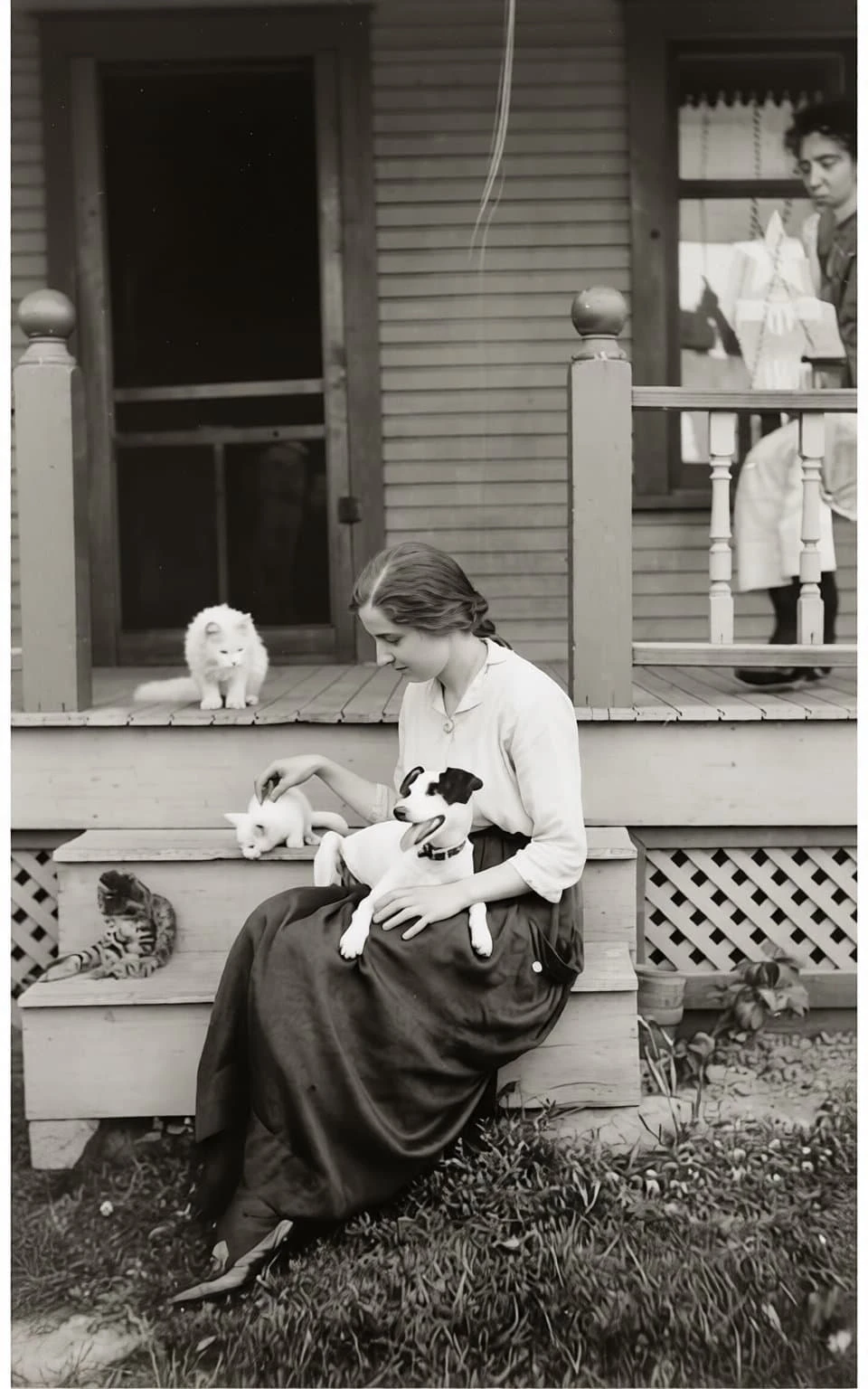
Circa 1900. Cats, a dog, and their human—a timeless bond
Decades and continents separate these photographs. Yet at the heart of each one is the very same thing: a cat beside someone who cherishes it, or a human alongside a cat that chose them. As to who chose whom—that remains an open question. What do you think?