The Smallest Creature on Earth (4 Photos)
Before diving into the main subject of this article, we need to tackle a tricky question: what actually counts as a living organism? 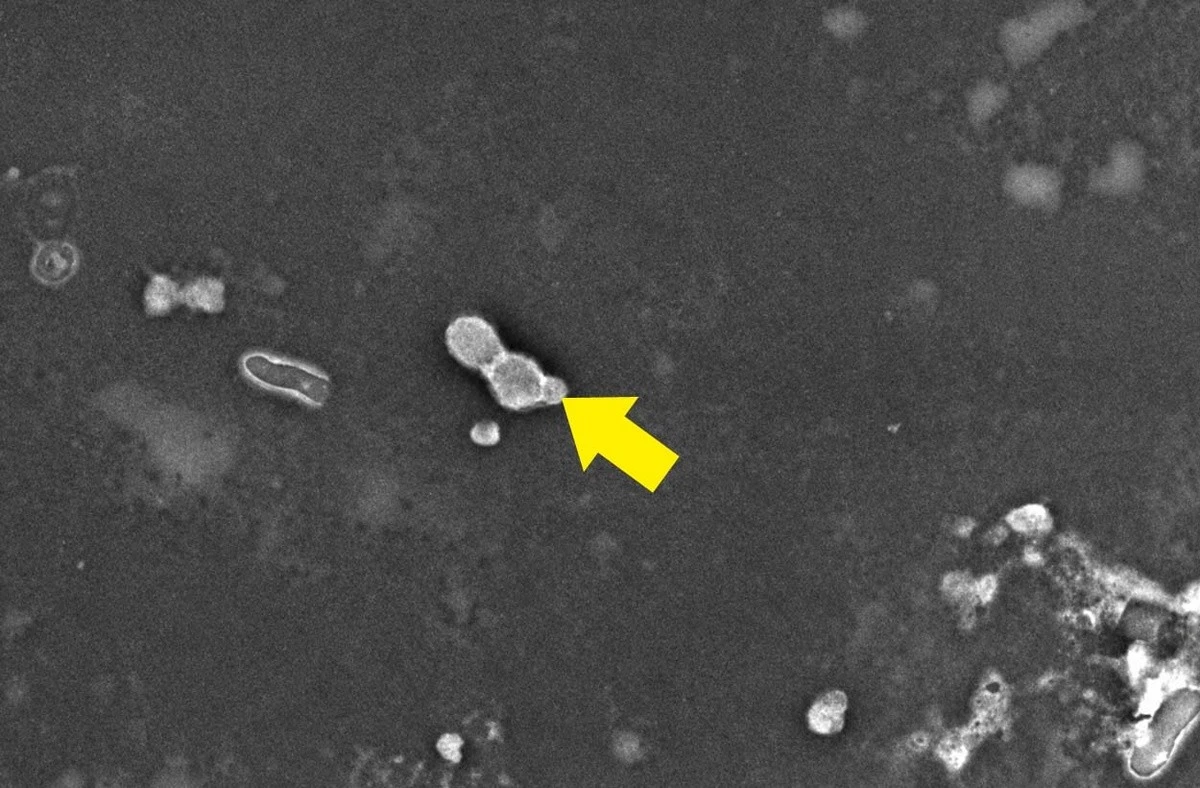
The star of this story
Take viruses, for example. They are incredibly tiny. Yet science doesn't fully consider them living organisms—they lack a cellular structure, have no metabolism of their own, and cannot reproduce independently outside an infected host cell. In essence, a virus is just biological code on a flash drive, requiring host hardware to read it.
So, when talking about the smallest living creature, I mean an organism with a cellular structure that is capable of its own metabolism and reproduction in a suitable environment.
Now that we've cleared that up, let's get started.
The Dethroned Champion
For a long time, the title of the world's smallest living organism belonged to Mycoplasma genitalium—a parasitic bacterium that infects humans and causes certain diseases. It measures just 200 to 300 nanometers across. For scale, an average human hair is roughly 80,000 nanometers thick. 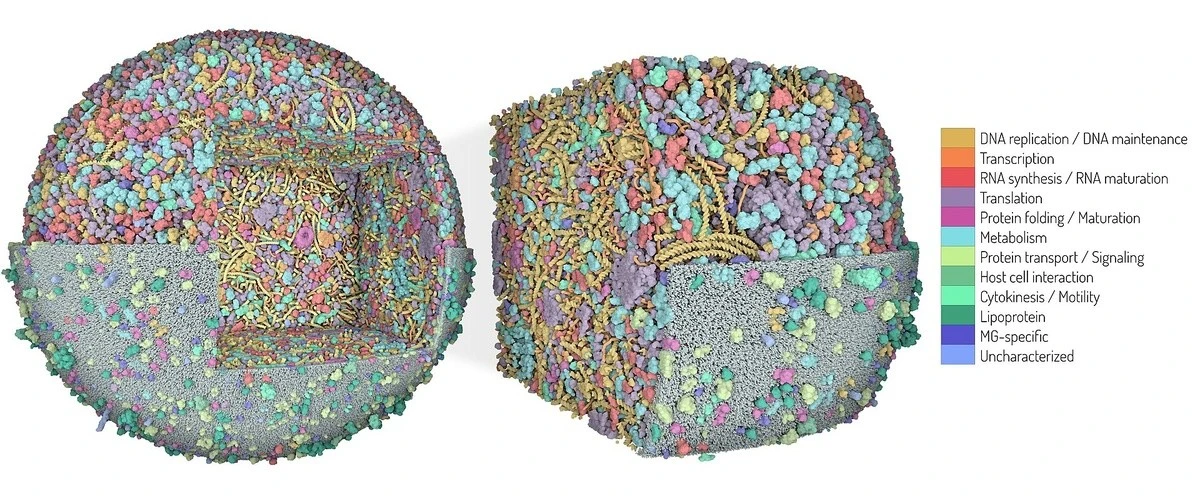
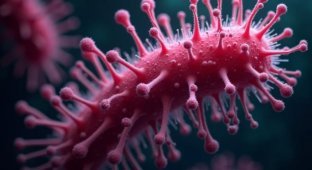
A 3D model of a Mycoplasma genitalium cell. Protein colors correspond to their biological functions
Achieving such extreme miniaturization required radical evolutionary cutbacks. This single-celled organism lacks a cell wall entirely, and its genome contains a mere 525 genes (compared to roughly 20,000 in humans). Biologists consider Mycoplasma genitalium a near-perfect model of a minimal cell: a living machine stripped of all non-essentials and reduced to its bare minimum components.
Then Something Even Smaller Was Found
In 2019, microbiologists described a species of symbiotic nanoarchaea bearing the catchy name Candidatus Nanoclepta minutus. The name "Nanoclepta" translates roughly to "tiny thief"—an apt description of a species whose size ranges from just 100 to 150 nanometers. 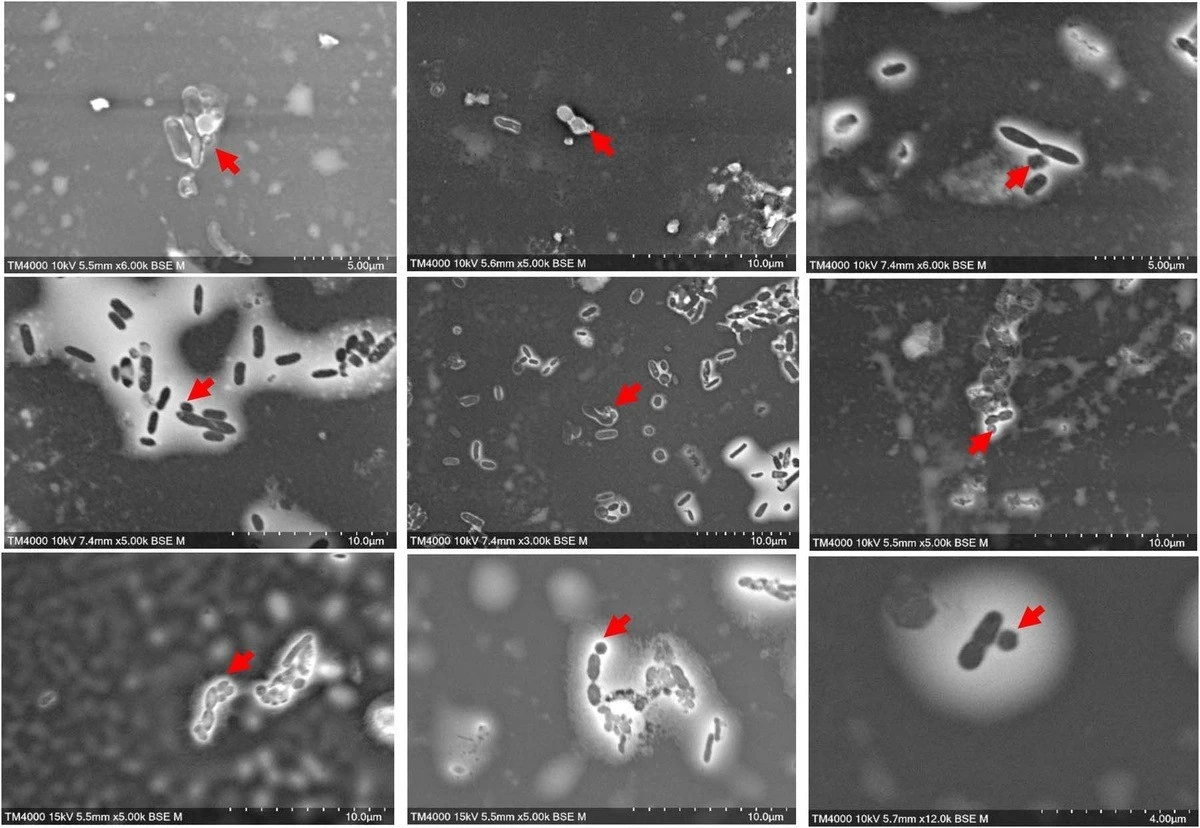
Candidatus Nanoclepta minutus specimens viewed through a TM4000Plus scanning electron microscope
Candidatus Nanoclepta minutus straddles the fine line between the living and the non-living. This tiny organism lacks the genes required to produce its own energy (ATP). To survive and reproduce, it must latch onto a larger host archaeon and steal vital resources.
A sharp reader might ask: "If it lacks energy-producing genes and depends entirely on its host, how is it any different from a virus?"
The distinction is fundamental, and it boils down to self-assembly. A virus is essentially just a blueprint with no machinery of its own. It invades a host cell and hijacks its ribosomes to churn out viral proteins. The virus doesn't replicate itself—the duped host cell does all the work.
A nanoarchaeon, on the other hand, is a fully functioning living organism, albeit a tiny one. It possesses its own cytoplasm, membrane, and—crucially—its own ribosomes. Candidatus Nanoclepta minutus "plugs in" to its host to siphon off energy and molecular building blocks. But using that energy, it builds its own proteins and replicates its own DNA independently, right inside its own cell.
To return to our earlier metaphor: a virus is biological code on a flash drive. A nanoarchaeon is like a smartphone secretly plugged into someone else's computer to charge up and download files—it still runs on its own processor and operating system. 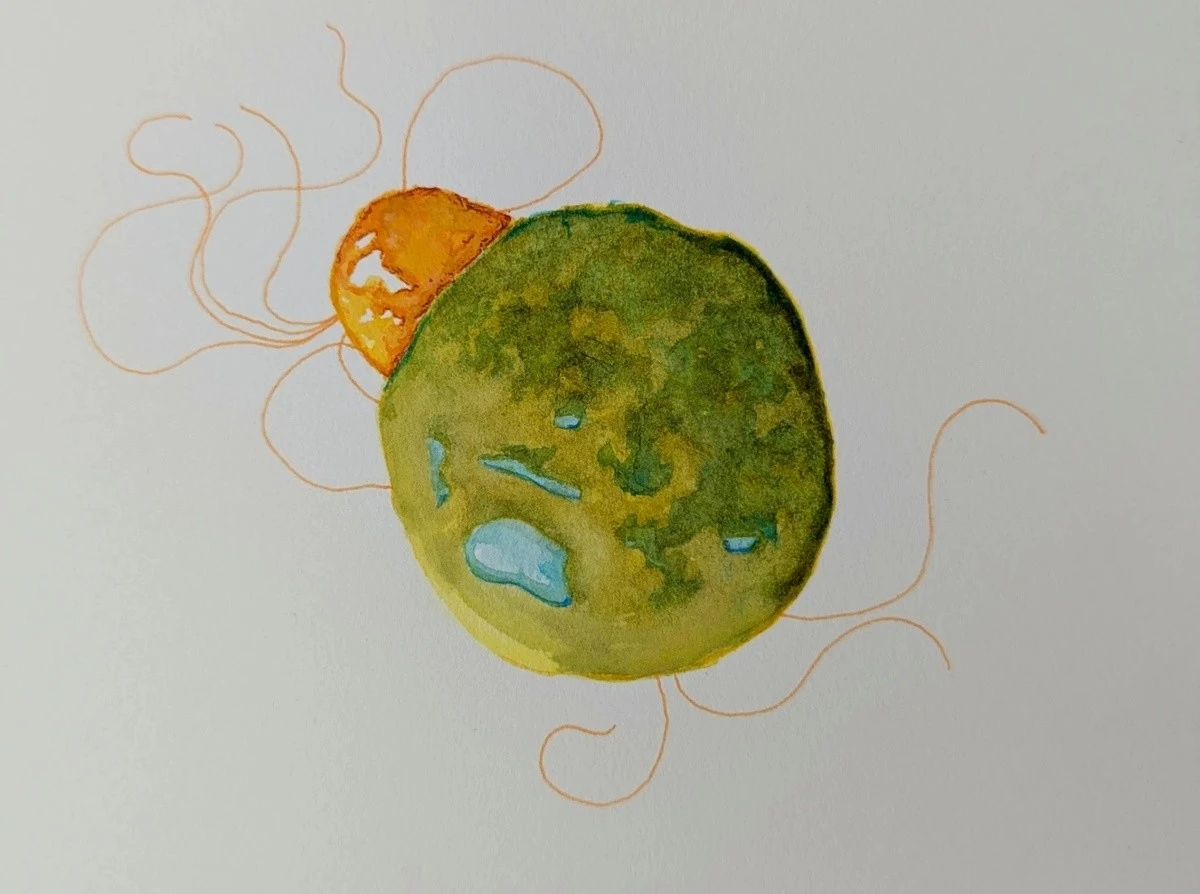
Artist's impression of Candidatus Nanoclepta minutus (orange)
Remarkably, the genetic code of Candidatus Nanoclepta minutus comprises around 580 genes. Evolution managed to pack an amount of genetic information comparable to Mycoplasma genitalium into a shell half the size. Miniaturization at its finest.
The Limits of Life
Scientists have long tried to calculate the theoretical bare minimum: how many genes does a cell need to be considered alive? Experiments by a team of microbiologists and geneticists at the J. Craig Venter Institute in the US provided an answer: at least 473 genes. That is precisely how many were packed into JCVI-syn3.0, a synthetic bacterial cell they created in 2016.
As for physical size, physicists and biologists estimate that a cell cannot be smaller than 50 nanometers. This is an absolute theoretical limit—anything smaller simply wouldn't have enough room to house the molecules required for copying DNA and synthesizing proteins. Life eventually runs up against the hard laws of physics.
All this research isn't just about satisfying curiosity; it's a quest to answer a fundamental question: where does chemistry end and life begin? It may turn out that life isn't some inexplicable miracle, but matter's fundamental drive toward self-organization.