The Moon’s Early Days: How Close Was It to Earth? (3 Photos)
The origin story of the Moon began roughly 4.5 billion years ago, when the young Earth (proto-Earth) collided with a Mars-sized celestial body known as Theia. The impact was so catastrophic that it blasted a huge chunk of Earth's mantle along with fragments of the destroyed Theia into orbit, surrounding the planet with a glowing disk of molten rock and debris. 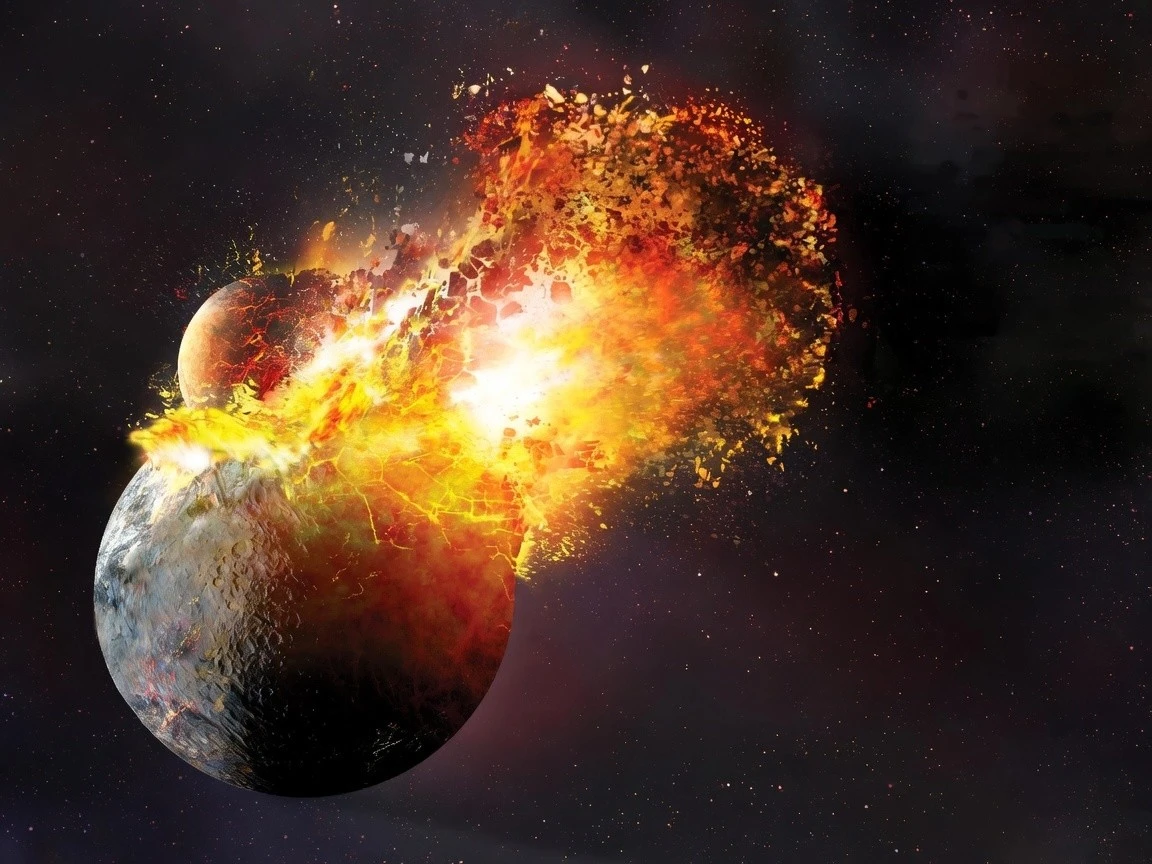
From this disk, the Moon accreted remarkably quickly—within just hours according to some models, or thousands to tens of thousands of years according to others. Either way, on an astronomical timescale, it happened in the blink of an eye.
Immediately after its formation, the Moon orbited at a distance of roughly 20,000 to 25,000 kilometers from Earth. For scale, the average distance today is around 384,400 kilometers—and as you read this, the Moon is actively drifting away from us at a rate of 38 millimeters per year.
Why the Moon Couldn't Be Any Closer
The explanation is simple: there is a fundamental physical boundary known as the Roche limit—the minimum distance a large body can reach before being torn apart by the tidal forces of a more massive neighbor. For the Earth-Moon system, this limit ranges between 9,500 and 18,000 kilometers, depending on the body's density.
In its earliest stage, the forming Moon was a loose, semi-molten mass coalescing from a disk of debris. Lacking the structural strength to stay intact at 9,500 kilometers, it had to form beyond the "fluid" Roche limit—farther than 18,000 kilometers. Only at that distance was its self-gravity strong enough to overcome Earth's relentless tidal forces, which would otherwise have ripped any forming clumps of matter to shreds. 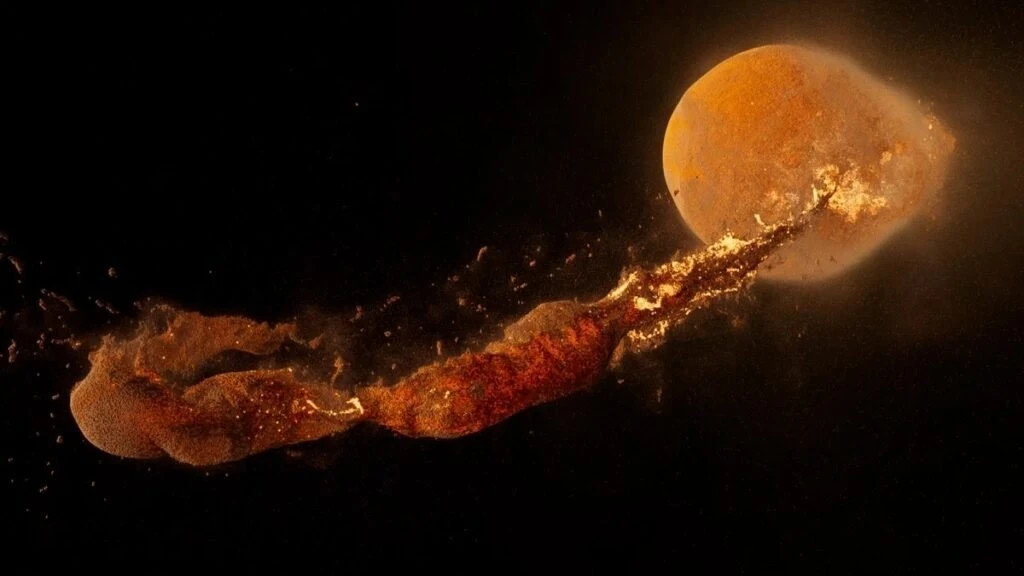
This is where orbital modeling yields an estimate of 20,000 to 25,000 kilometers from our planet. That was the starting point of the Moon's life, kicking off its long journey away from Earth.
Why the Moon Is Moving Away from Earth
As the Moon orbits the common center of mass, its gravity tugs on Earth, creating tidal bulges—swells in ocean waters and deformations in the solid crust. But because Earth spins faster (completing one rotation every 24 hours) than the Moon orbits it (one revolution roughly every 27.3 days), these bulges are pulled slightly ahead of the Moon.
This seemingly subtle asymmetry creates tidal acceleration, nudging the Moon forward in its orbit while gradually slowing Earth's rotation. By gaining energy and speeding up, the Moon moves into a higher orbit, as governed by the laws of orbital mechanics.
Today, this drift occurs at a rate of 38 millimeters per year. We can measure this figure with such incredible accuracy thanks to retroreflectors left on the lunar surface by NASA's Apollo missions. Scientists regularly shoot laser pulses at these reflectors and time the signal's return trip. Knowing the speed of light makes calculating the exact distance to the millimeter a simple matter.
It is worth noting that this retreat has not been constant over the billions of years. It depends heavily on the layout of Earth's continents, as tidal friction is determined by the shape and size of ocean basins. There were eras when the Moon drifted away much more slowly than it does now, as well as periods of rapid movement.
Short Days on the Ancient Earth
The flip side of the Moon's retreat is the slowing down of Earth's rotation, which powers the entire process. Right after the Moon formed, a day on Earth lasted just 5 to 6 hours.
As the Moon moved farther away, "stealing" angular momentum from Earth, our days gradually lengthened to the 24 hours we have today. The process continues to this day, albeit extremely slowly, adding roughly 1.7 milliseconds every century. For context, when dinosaurs dominated the planet, a day lasted between 23 and 23.5 hours.
A Colossus in the Sky
The newly born Moon was 15 to 20 times closer to Earth than it is today, meaning its visible size in the sky was 15 to 20 times larger than the disk we see now. A colossal sphere hung overhead, dominating the sky day and night. 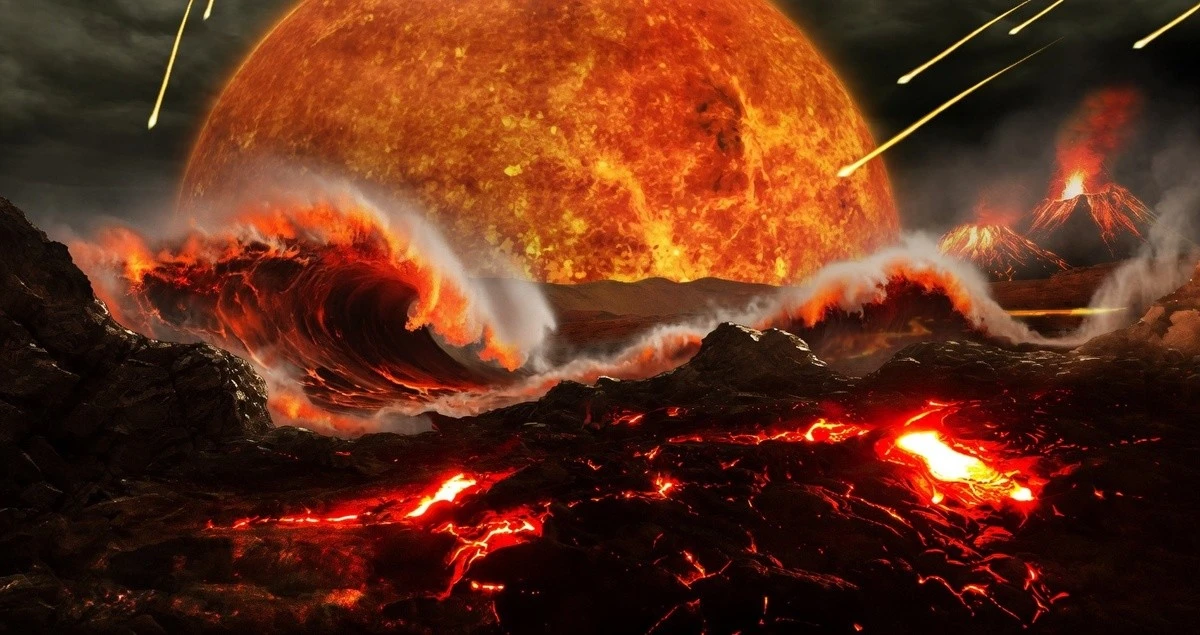
From such a short distance, tidal forces were orders of magnitude more intense. Ocean tides surged as waves hundreds of meters high, while Earth's crust suffered massive distortions, giving rise to temporary mountain ranges and vast fissures.
How Do We Know This?
Naturally, we don't have photos from that ancient epoch, but we do have an equally valuable record: tidal rhythmites. These finely layered sedimentary rocks form in tidal zones and naturally document the rhythm of ancient tides. By analyzing the thickness and structure of these rock layers, geologists can reconstruct how Earth's day length and the Moon's orbit evolved over billions of years.
By combining this geological evidence with modern laser measurements and physical models of tidal interaction, scientists can confidently confirm just how close the Moon was at its birth—and how radically different Earth was in its early history.