Why Everyone Suddenly Gets Sick in the Fall—Even Though Cold Weather Doesn't Cause Colds (7 Photos)
In just a single week, a sharp spike in acute respiratory infections and flu cases was recorded. 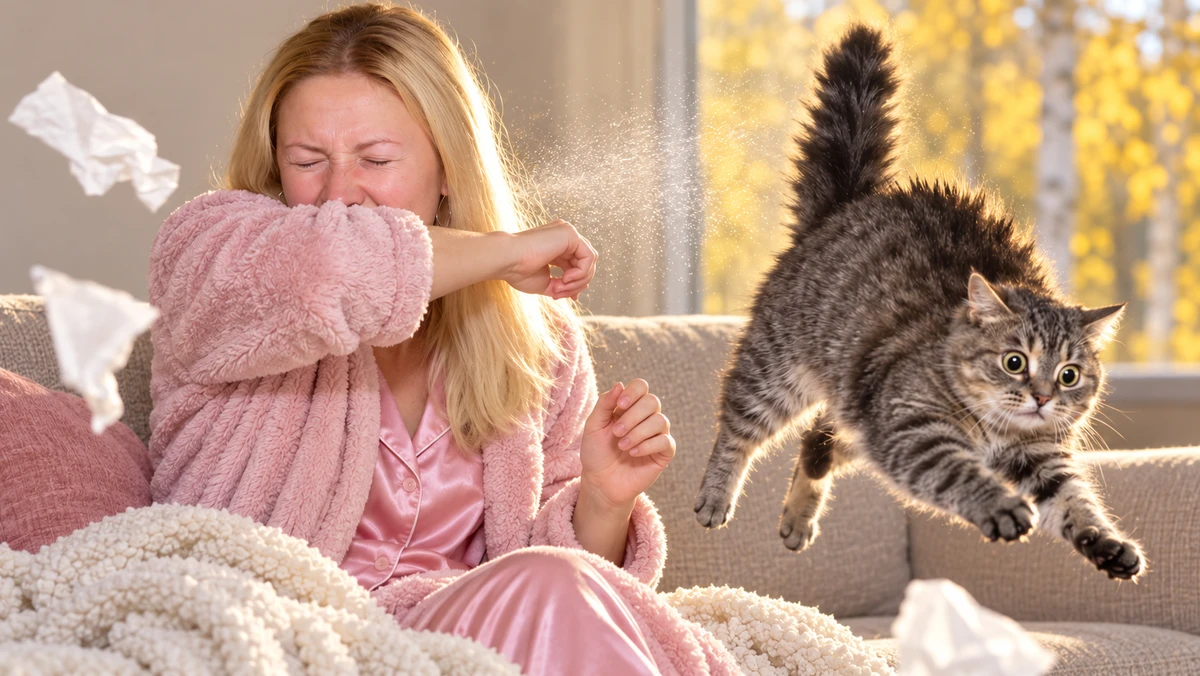
But influenza is hardly to blame here. It accounted for a mere 0.6% of identified respiratory viruses, while the remaining 99.4% were driven by other pathogens. Rhinoviruses—the primary culprits behind the common cold—are particularly rampant right now.
Yet it’s hardly mid-winter outside. So where does this infamous autumn phenomenon of "everyone getting sick" actually come from?
And can catching a chill really make you sick?
Drafts Don't Count
Back in the 1960s, American researchers put this old wives' tale to a rather harsh test: volunteers were infected with rhinoviruses and then exposed to cold conditions—including spending time at 39°F (4°C). The cold exposure itself did not significantly increase the risk of falling ill.
The takeaway is straightforward: you can't catch a cold without a virus. Chilly winds and wet boots alone don't cause respiratory infections. 
However, that doesn't mean cold temperatures play no role whatsoever.
In 2005, Claire Johnson and Ronald Eccles from Cardiff University recruited 180 volunteers. Half submerged their feet in ice-cold water for 20 minutes, while the other half sat with their feet in an empty basin. Over the next four to five days, cold symptoms developed in 13 out of 90 "chilled" participants, compared to just 5 out of 90 in the control group.
However, the participants weren't tested for actual viruses. The researchers merely tracked reported symptoms, so the study couldn't definitively prove that chilling caused an infection.
The reality is more nuanced than a simple "the cold has nothing to do with it." While low temperatures don't create viruses out of thin air, temperature can affect how effectively your nasal passages defend against them.
Why Viruses Love Your Nose
Many rhinoviruses replicate best at around 91–95°F (33–35°C)—which happens to be the exact temperature inside your nasal cavity! 
A team led by Yale immunologist Akiko Iwasaki uncovered one potential mechanism. In mouse airway cells, antiviral defenses triggered far more robustly at 98.6°F (37°C) than at 91.4°F (33°C), with interferons and related genes kicking into high gear.
Humans turn out to have an additional defense mechanism.
Nasal mucosal cells release billions of microscopic sacks called extracellular vesicles into mucus. These vesicles carry surface receptors that act as decoys, tricking viruses into binding with them instead of actual cells.
Researchers measured nasal cavity temperatures after subjects spent 15 minutes in 39°F (4°C) air, finding that temperatures in the front of the nose dropped by about 9–11°F (5–6°C). They then replicated this cooling on human nasal tissue in a lab setting. 
The number of protective vesicles dropped by roughly 42%, and those that remained were less effective at neutralizing viruses.
Of course, you still need a virus to catch a cold. But as it turns out, chilling your nasal lining really can weaken your body's frontline defenses.
Yet the September surge begins long before true cold weather sets in—meaning the main driver isn't outdoor temperature.
School Is Back in Session—And So Are Viruses
For years, Canadian researchers have tracked a phenomenon known as the "September asthma epidemic." Hospitalizations among schoolchildren peak, on average, 17.7 days after the school year starts, with rhinoviruses identified as a key trigger for these flare-ups. 
A similar pattern was observed in Israel among children aged 3 to 14. Upper respiratory infections spiked every September, peaking roughly two weeks after schools reopened before returning to baseline over the following four to seven weeks.
The reason is surprisingly straightforward.
During the summer, children and adults are scattered across vacations, summer camps, and trips. In September, millions of people crowd back into classrooms, lecture halls, offices, and public transit.
For viruses, this marks the ultimate season premiere: 25 to 30 people sharing the same air indoors for hours on end.
For a long time, rhinoviruses were believed to spread primarily via hands, doorknobs, and other surfaces. However, a 2023 systematic review found only weak evidence supporting surface contact as the main route in indoor settings, pointing instead to airborne transmission through respiratory droplets and aerosols.
Washing your hands is still crucial, but wiping down doorknobs alone won't crash the viral party happening in a stuffy classroom.
There's another reason colds keep coming back: there are over 160 known strains of rhinovirus. Immunity to one doesn't make you immune to the rest.
And as fall progresses, another silent accomplice enters the picture.
Indoor Heating Dries Out Our Defenses
When the heating season begins, indoor air grows dramatically drier.
Radiators don't absorb moisture from the air. The mechanics are simple: cold outdoor air naturally holds very little moisture. When drawn indoors and heated, its absolute moisture content stays the same, causing relative humidity to plummet.
This poses a major problem for your respiratory tract. 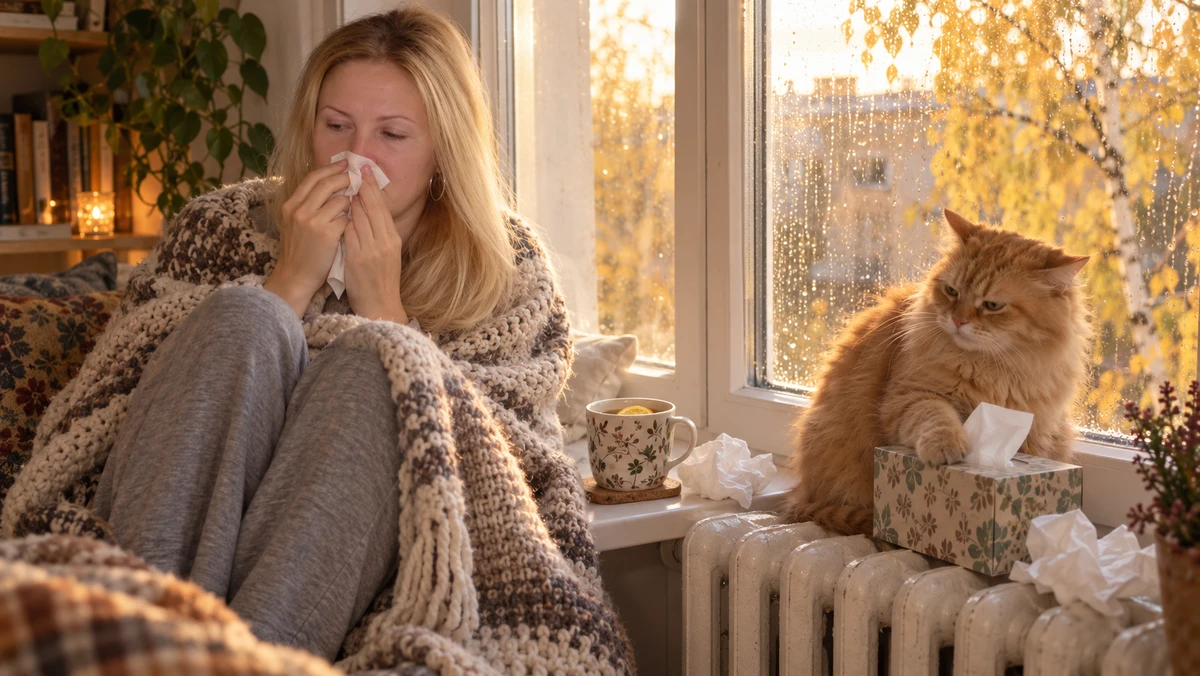
Airways are lined with mucus, while microscopic cilia continuously sweep it—along with trapped dust and microbes—toward the throat. It's a natural conveyor belt for self-cleaning.
In 2019, Akiko Iwasaki's team tested the impact of dry air on mice. At 10–20% humidity, mice suffered far more severe flu outcomes than at 50% humidity: airway clearance slowed down, antiviral defenses weakened, and tissue repair faltered.
Dry air also benefits the virus itself.
In a landmark 2007 study, Mount Sinai researchers infected guinea pigs with influenza while manipulating temperature and humidity. At 68°F (20°C), the virus spread efficiently at low humidity (20–35%), but transmission ceased at 80% humidity. At 41°F (5°C), the virus spread even better than at 68°F (20°C), and infected animals shed the virus for longer.
However, a major caveat is needed: guinea pigs and mice are not humans. While these experiments clearly demonstrate biological mechanisms, they can't pinpoint exactly how much your bedroom radiator increases your personal flu risk.
Viruses Take Turns Throughout Fall
Respiratory infection season isn't a single, continuous outbreak.
In September, rhinoviruses and other non-flu pathogens thrive: schools and offices are packed, and they don't need freezing temperatures to circulate.
Influenza typically arrives later. It benefits further from cold, dry air, with seasonal surges in temperate climates usually hitting during the winter months.
So a runny nose in September doesn't mean the flu has arrived—it's just other players warming up.
What to Do When Everyone Around You Is Sneezing 
The most effective habit during autumn is airing out indoor spaces. In a classroom, office, or apartment with sealed windows, viral particles steadily build up in the air. Good ventilation thins out their concentration.
If you do get sick, stay home. It's simple: your body recovers faster, and you won't pass the bug along to coworkers or classmates.
During the heating season, it pays to monitor humidity levels. Keeping indoor humidity between 30% and 50% is generally recommended. If you use a humidifier, be sure to clean it regularly—a dirty water tank can quickly turn a helpful appliance into a spray for things you definitely don't want in the air.
Washing your hands remains important too. Contact transmission hasn't disappeared—it's just that indoor airborne transmission matters more than previously thought.
So why does everyone get sick in the fall? It's not because autumn winds suddenly turn contagious. We crowd back into schools and offices, spend more time together indoors, encounter dry indoor heating, and experience cold-induced dips in nasal defenses.
A virus brings the cold—but in the autumn, we hand it the perfect environment to thrive.