A Miscellany of Fascinating Vintage Photos (20 Photos)
This collection has it all: from mind-boggling shots to moments that evoke genuine wonder or a warm smile. Step inside and enjoy the scroll!
1. Trick-shot champion Bob Gise, a police officer from York, Pennsylvania, shoots a cigarette out of his wife's mouth during a marksmanship exhibition, 1948. 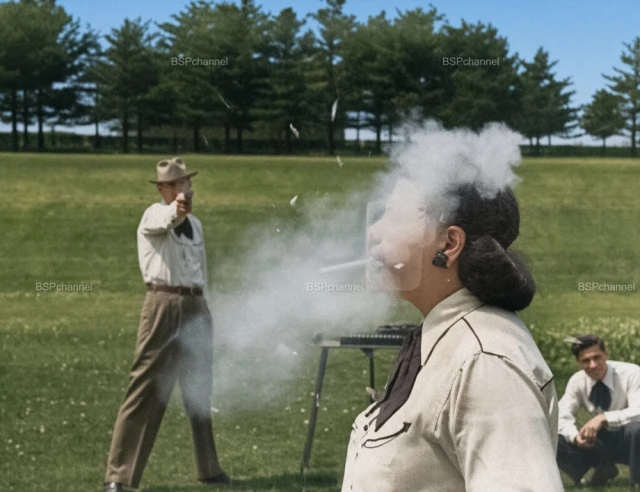
Featured in the archives of the legendary LIFE magazine, this photo captures the spirit of a bygone era of trick-shot exhibitions and a wife's absolute, unwavering faith in her husband's skill. Back then, such extreme displays of marksmanship were immensely popular in the US, often drawing massive crowds to stadiums.
2. Soviet traffic police officers (GAI) detaining traffic violators, 1970. 
3. French inventor Georges Sablier demonstrating his unique backpack helicopter. Saint-Étienne, 1954. 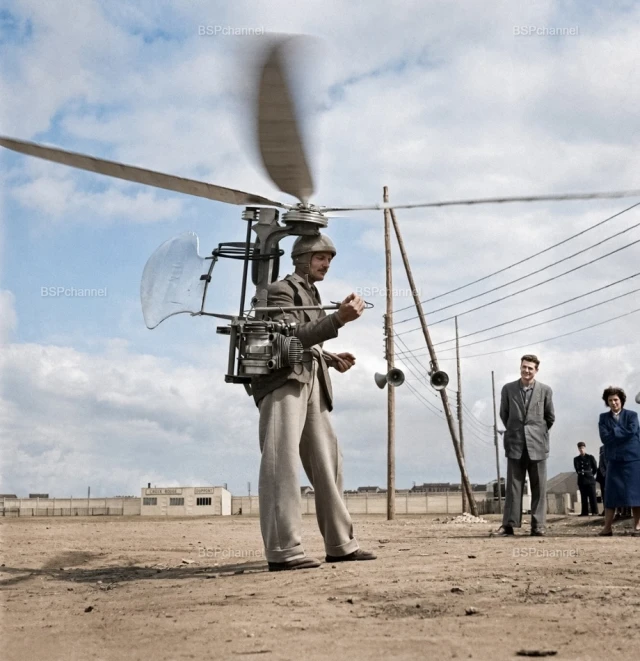
This unusual contraption was presented in the central French city of Saint-Étienne during the International Personal Helicopter Contest. Sablier's invention attracted widespread attention from both the public and the press, earning him a special award from the organizing committee. Weighing roughly 27 kilograms (60 lbs), the rig was strapped to the pilot’s shoulders using a harness system and powered by a tiny 6-horsepower engine. The inventor claimed his "flying windmill" could reach a top speed of 50 km/h (31 mph) and remain airborne for up to 10 hours. However, aviation experts met such impressive flight times with heavy skepticism. To prevent the pilot from spinning out of control alongside the main rotor, a specialized torque-compensating device was integrated. Georges Sablier was a prominent figure in pre- and post-war French aviation. Prior to building this prototype, he had designed successful gliders and light trainer aircraft, and published popular instructional manuals on woodworking and aircraft construction for amateur aviators.
4. A bull fitted with a gas mask. Germany, 1937. 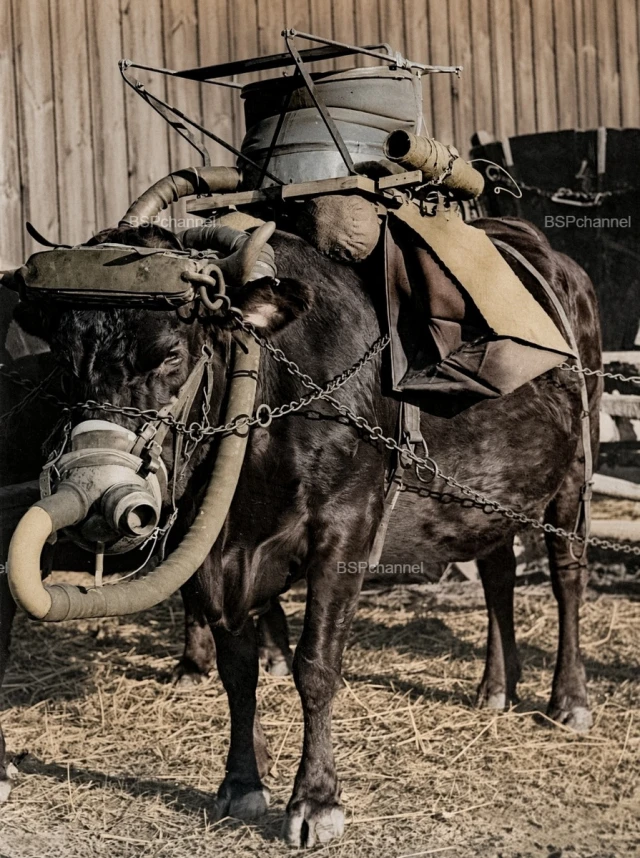
Haunted by the horrific memories of World War I, European nations during the interwar period harbored deep fears that chemical weapons would be used on a massive scale in future conflicts. Since bulls, oxen, and horses were still the primary draft animals in both agriculture and the military before tractors became ubiquitous, engineers developed chemical and radiological defense gear for livestock as well as humans.
5. A deep-sea diving suit, 1925. 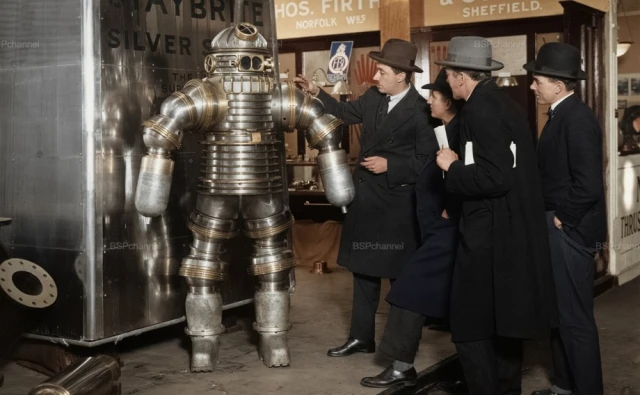
At the Shipping Exhibition at Olympia in London, inventor Joseph Salim Peress unveils his latest creation: an atmospheric diving suit welded from high-strength Staybrite Silver Steel. Weighing 250 kilograms (550 lbs), the suit was designed to withstand pressures at depths of up to 200 meters (650 ft). Notably, Peress had already secured his place in history by creating the world's first fully functional atmospheric diving suit, the Tritonia.
6. Robots built at the Kaliningrad Young Technicians' Station out for a stroll around the city, 1969. 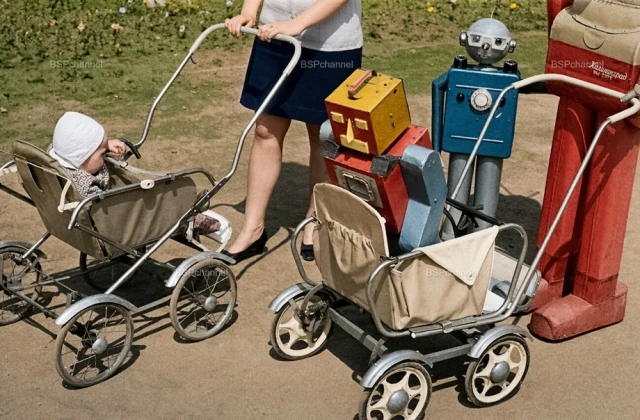
In the late 1960s and early 1970s, the cybernetics and radio construction club at the Kaliningrad Young Technicians' Station—led by talented mentors like Boris Vasilenko and A. A. Malinovsky—made headlines across the Soviet Union. The students weren't just building static models; they were building fully functional automated machines that won medals at the prestigious VDNKh exhibition in Moscow. Among the most famous robots crafted by these youngsters were: Neptune (originally named Jupiter), which won the first All-Union Robot Competition in 1967, earning the station its grand prize—a motorcycle. Neptune could detect radiation levels and issue audiovisual warnings. Electron was another charismatic iron giant that posed on the streets of Kaliningrad. Then there was Andryusha, a whimsical "child robot" featuring a standard rotary telephone dial built right into its chest. The club's achievements reached such heights that in December 1970, one of their creations (sources differ on whether it was a modified Neptune or a purpose-built model) was experimentally deployed as a conductor on a Kaliningrad streetcar. The mechanical conductor greeted passengers, announced stops, politely requested fare payment, accepted 3-kopek coins, and dispensed tickets using its mechanical hand. The experiment was a sensation among residents. Today, one of those legendary Kaliningrad robots (Neptune) is preserved and on display at the Kaliningrad Regional Museum of History and Art.
7. Steeplejacks inspecting the steel structure of the radio tower in Königs Wusterhausen, Germany, 1930. 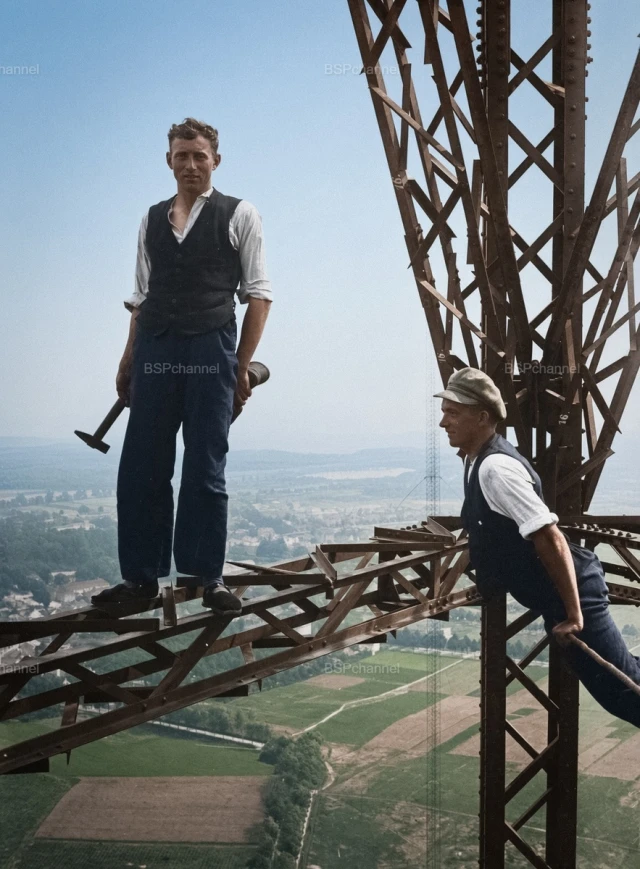
Workers balance on the structural elements of the unique triangular-lattice mast (known as the Königs Wusterhausen Central Tower) at a height of roughly 240 meters (787 feet)—without any safety nets or modern harnesses. Constructed between 1924 and 1925, this famous central radio tower was a key element of one of Germany's first major transmission hubs until it collapsed during the powerful Cyclone Quimburga in November 1972.
8. A Guardsman faints during a parade in London, 1957. 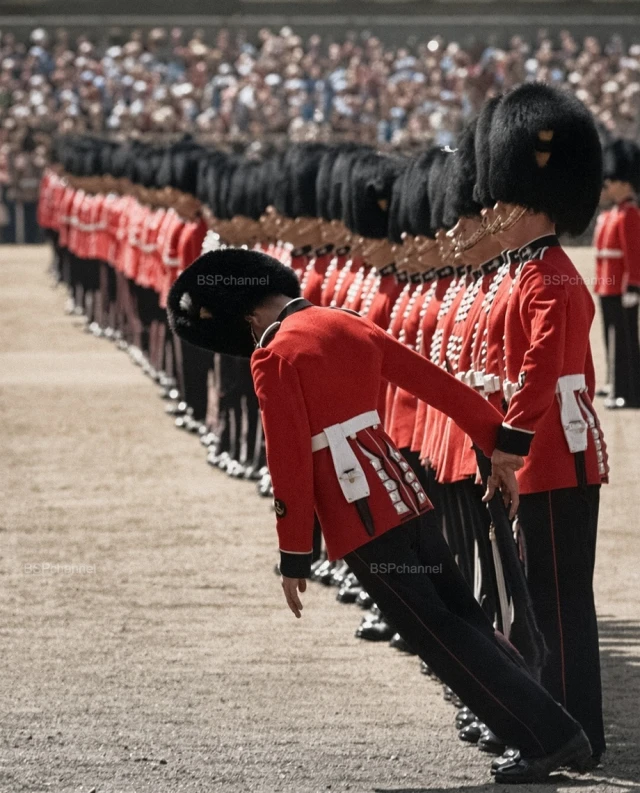
The Trooping the Colour ceremony at Horse Guards Parade in London, celebrating Queen Elizabeth II's official birthday. Protocol dictates that guardsmen must remain frozen at attention during royal ceremonies. Breaking rank without an order is considered a serious disciplinary breach, so soldiers must maintain their gaze straight ahead. Medics on standby immediately rush over with a stretcher to quickly and carefully remove the fallen guard from the parade ground. Fainting during such parades in the UK is a surprisingly regular occurrence. Heavy wool tunics and massive bearskin hats (weighing around 700 grams/ 1.5 lbs), combined with standing motionless for hours in the summer heat, cause extreme thermal stress. Remaining completely still allows blood to pool in the legs, reducing oxygen flow to the brain and causing soldiers to pass out.
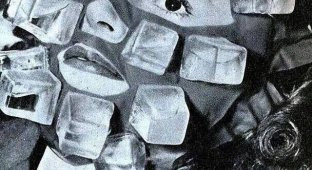
9. A fresh fruit facial treatment at a beauty salon. USA, 1930s. 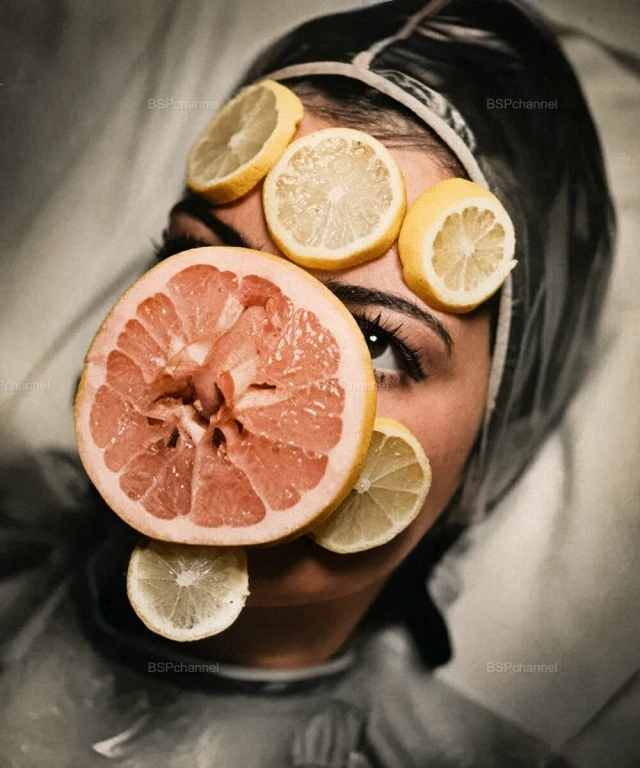
During the early days of the modern beauty industry, when formulated facial creams were still rudimentary, salons experimented heavily with natural ingredients. Slices of fresh fruits and vegetables—most commonly oranges, lemons, tomatoes, and cucumbers—were carefully placed across the client's face. It was believed that these masks nourished the skin with vitamins, lightened freckles (which were out of style in the 1930s), and tightened pores thanks to natural fruit acids.
10. A lion cub hitched to a cart carrying children at the Luna Park Zoo. USA, late 1920s – early 1930s. 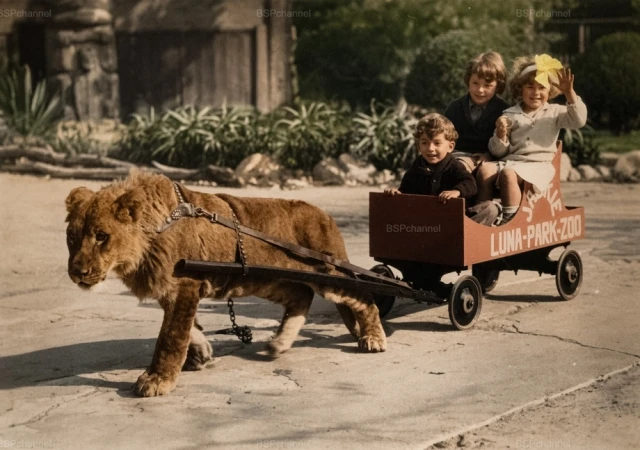
The park where this photo was taken went through several name changes over its history. Originally established in 1915 by film pioneer William Selig as the Selig Zoo, it doubled as a filming location for Hollywood adventure movies and a public menagerie. By the late 1920s and 1930s, it operated as the Luna Park Zoo and later the California Zoological Gardens. During the interwar period, cart rides pulled by exotic animals were a signature attraction at amusement parks. Beyond standard ponies, carts were hitched to large dogs, goats, ostriches, llamas, and, as seen here, even young apex predators.
11. Queenie, the world's only water-skiing elephant, who rose to fame in the late 1950s and 1960s. USA, 1950s. 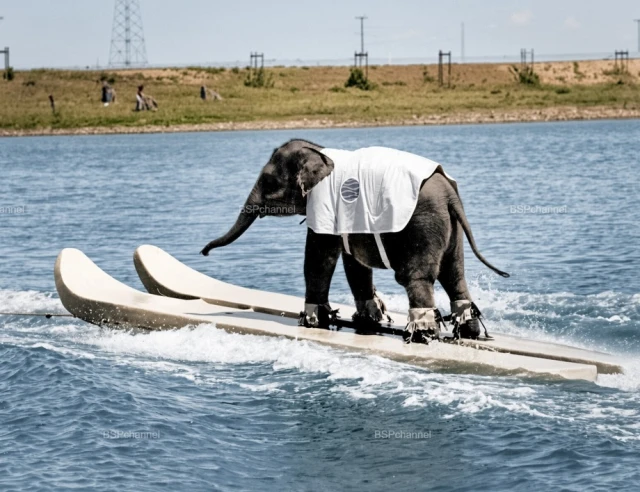
Queenie was born in Thailand in 1952 and brought as a tiny calf to a New York pet shop in 1953, where 9-year-old Liz Dane spotted her and begged her parents for a pet elephant. The family hauled the 110-kilogram (240 lb) baby elephant home to New Hampshire in a standard Mercury sedan after stripping out the back seat. Queenie was taught to water-ski by couple Marge and Jim Rusing at De Leon Springs in Florida. Training went smoothly, as elephants are natural swimmers with a love for water. The "skis" consisted of two massive metal pontoon platforms welded together for stability. Queenie would step onto them from the shore, the motorboat would accelerate, and she would skim across the lake, trumpeting joyfully and spraying water from her trunk. Queenie went on to perform at county fairs, Republican political rallies, and military bases, eventually becoming a television star on hit variety shows. Besides skiing, she could "play" the harmonica and dance to music. While not technically the first elephant to attempt the stunt (a predecessor named Sunshine Sally tried it earlier), Queenie perfected the art and performed on the water for nearly 15 years. In 2003, she retired to the Wild Adventures safari park in Georgia, where she spent her final years peacefully, passing away in 2011 at age 59—making her one of the oldest Asian elephants in North America at the time.
12. A programmer showcasing 62,500 punch cards—cutting-edge data storage from the 1950s. This massive tower of cardboard holds a grand total of 5 megabytes, 1955. 
13. New York, 1963. 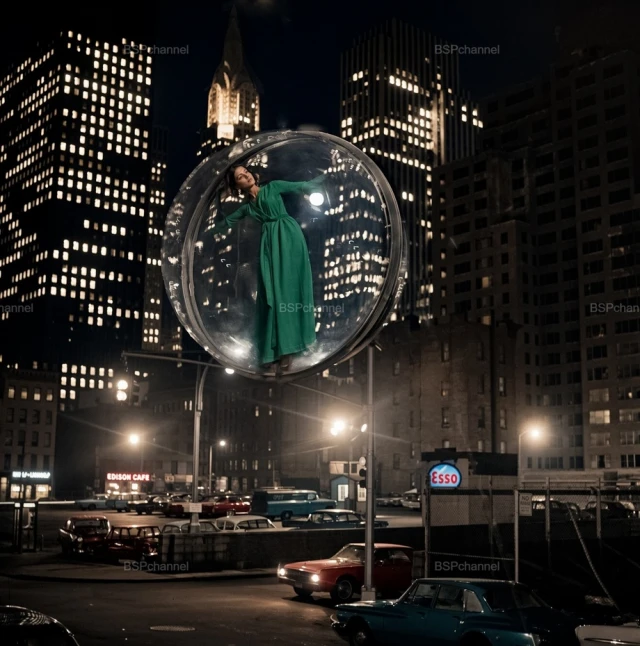
Melvin Sokolsky's iconic "Bubble" series features a series of stunning fashion shots taken not only in New York, but also on the streets of Paris. The outdoor shoots in the French capital were staged against iconic backdrops like the Seine, the Pont Alexandre III, and the Place de la Concorde, bringing a classic European elegance to the futuristic imagery. Sokolsky was inspired to place a model inside a transparent sphere after studying Hieronymus Bosch's famous triptych The Garden of Earthly Delights. The left panel depicts figures inside a glass bubble, sparking the photographer's idea to translate the surreal motif into high fashion. Before enclosing top model Simone d'Aillencourt inside the orb, Sokolsky ran stress tests on the edge of Long Island. He suspended the sphere from a crane and dropped it onto the ground to ensure the Plexiglas wouldn't shatter if it bumped into a building or cobblestone street. Police in both France and the US were left completely bewildered during the shoots. In 1963 Paris, the sight of a giant floating bubble with a woman inside caused traffic gridlocks: drivers abandoned their cars in the middle of the road, and onlookers gaped in disbelief, assuming a sci-fi alien movie was being filmed.
14. An underwater pin-up photo shoot by underwater photography pioneer Bruce Mozert. USA, 1938. 
In 1938, American photographer Bruce Mozert revolutionized visual arts by organizing the first major underwater photoshoot in the crystal-clear waters of Silver Springs, Florida. His images of glamorous women nonchalantly carrying out mundane tasks at the bottom of the river went viral across global media and laid the foundation for post-war Florida tourism advertising. In the late 1930s, specialized underwater photography gear didn't exist. To bring his vision to life, the 21-year-old Mozert demonstrated brilliant engineering ingenuity: he hand-built a custom waterproof camera housing using sheet metal, rubber gaskets, and thick glass. Because clothing, hair, and props constantly floated upward, Mozert hid tiny lead weights inside dress hems, bathing suits, and shoes to keep models seated in chairs or standing at stoves. In one famous scene where a model tastes soup from a pot while standing at a submerged stove, white steam billows dramatically from the cookware. To achieve the effect, Mozert hid a can of condensed milk inside the pot. The milk fat slowly trickled upward through the water in fine wisps, perfectly mimicking steam on black-and-white film.
15. A man driving an ostrich-drawn cart through the city center. Brussels, Belgium, 1933. 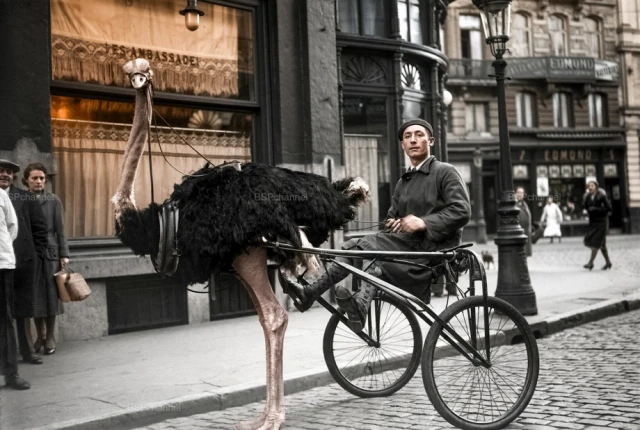
In the early decades of the 20th century, ostrich riding and racing were wildly popular entertainment on both sides of the Atlantic—from specialized ostrich farms in the US to traveling circuses visiting major European capitals. This bird handler taking to the streets of Brussels was a publicity stunt aimed at drumming up media hype and crowd interest for an upcoming show.
16. A high-speed hair drying system. Massapequa, New York, 1970. 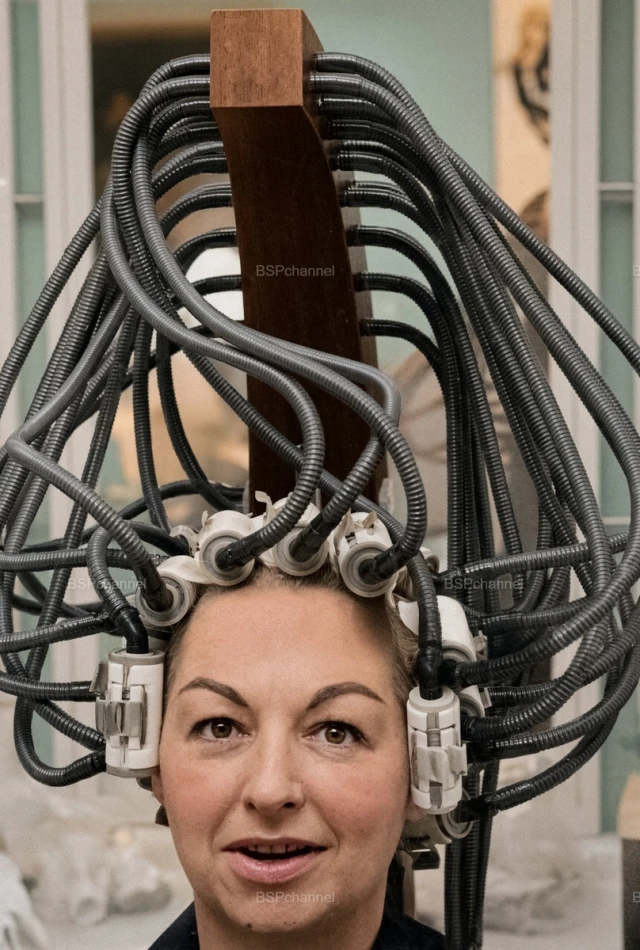
Mrs. John Caputo of Seaford sits beneath a new "5-minute" JetStream hair dryer at the Granada Beauty Salon in Massapequa on January 21, 1970. The dryer piped hot air directly through tubes into curlers, cutting drying time in half.
17. An uncut 80-carat diamond from Tiffany & Co. Photographed by renowned photographer Yale Joel in 1969. 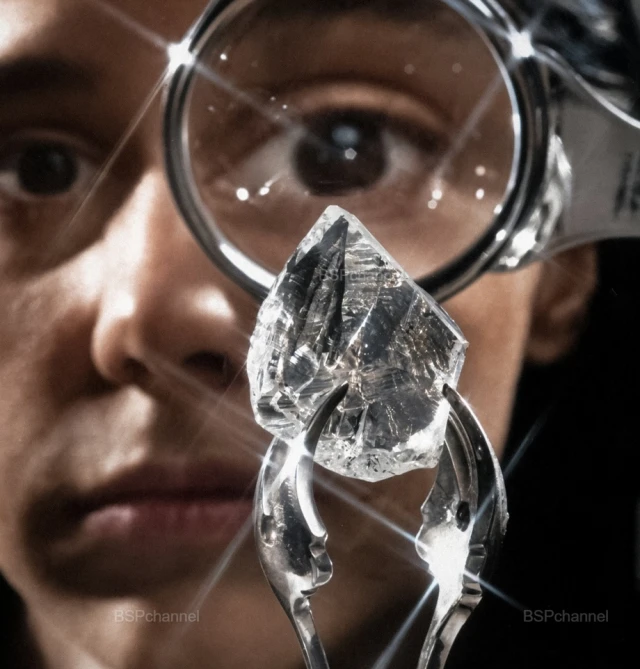
The image was featured in a tongue-in-cheek holiday gift guide magazine spread as an example of an "unconventional" and truly extravagant Christmas present. At the time, the price tag on this massive gemstone was a staggering $450,000.
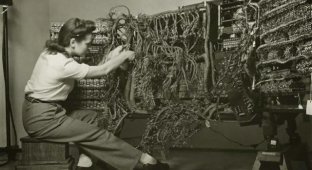
18. Sister Mary Kenneth Keller, the first woman in the US to earn a Ph.D. in computer science, 1965. 
Pictured beside her is the Bi-Tran Six—an educational trainer computer manufactured by Fabri-Tek in 1965 to teach students the basics of programming, digital logic, and computer architecture. The Catholic nun, belonging to the Sisters of Charity of the Blessed Virgin Mary, shattered academic barriers when she successfully defended her doctoral dissertation at the University of Wisconsin–Madison on June 7, 1965. Her thesis focused on algorithms for analytical differentiation. Prior to earning her doctorate, Sister Keller worked at Dartmouth College, which temporarily relaxed its male-only rule to allow her into its computer laboratory. There, she assisted professors John Kemeny and Thomas Kurtz in developing the groundbreaking, beginner-friendly programming language BASIC.
19. Testing the unusual Ford Reconnoitring Car (a modified Ford Model T) fitted with a unique tracked tread system. USA, 1921. 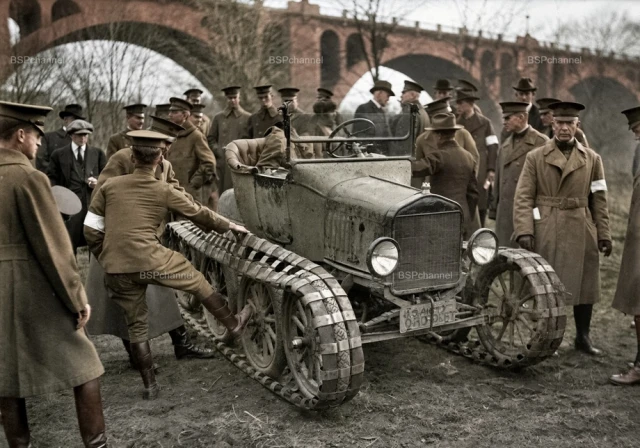
20. Tasters and master blenders at work for the renowned French cognac house Hennessy, 1952. 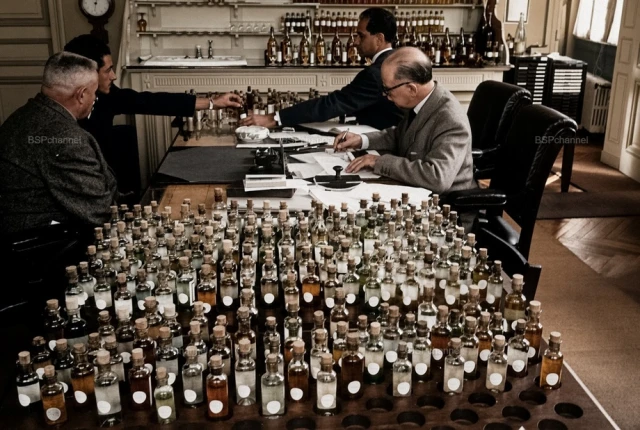
For more than 250 years, the flavor profile of Hennessy cognac has been shaped by the exact same dynasty of master blenders—the Fillioux family. In 1952, the Tasting Committee was led by sixth-generation master blender Maurice Fillioux, who passed down the secrets of blending to his successors. The daily tasting ritual has remained unchanged for centuries: at precisely 11:30 AM, members of the Tasting Committee gather in a dedicated room at the company headquarters. It is believed that at this exact hour, human sensory palate and olfactory receptors are at their sharpest. Contrary to romanticized notions, a blender's job is demanding work. During a single morning session, experts blind-test and evaluate anywhere from 40 to 60 distinct eaux-de-vie. These spirits are judged on color, clarity, and, above all, aroma. Dozens of numbered glass phials line the table, containing samples from various cellars and barrels crafted from Limousin oak. The blenders' task is to decide which spirits warrant further aging, which will make it into legendary blends like Hennessy V.S.O.P or X.O, and which will shape the final character of the batch.