Airships Were as Long as Two Football Fields—Yet They Still Vanished From the Skies (1 photo)
In the 1930s, the airship was the height of engineering sophistication: passengers sipped champagne high above the clouds while the ocean drifted beneath their feet. Today, the only remnants of this airborne luxury are the occasional advertising blimps hovering over sports stadiums. What went wrong? 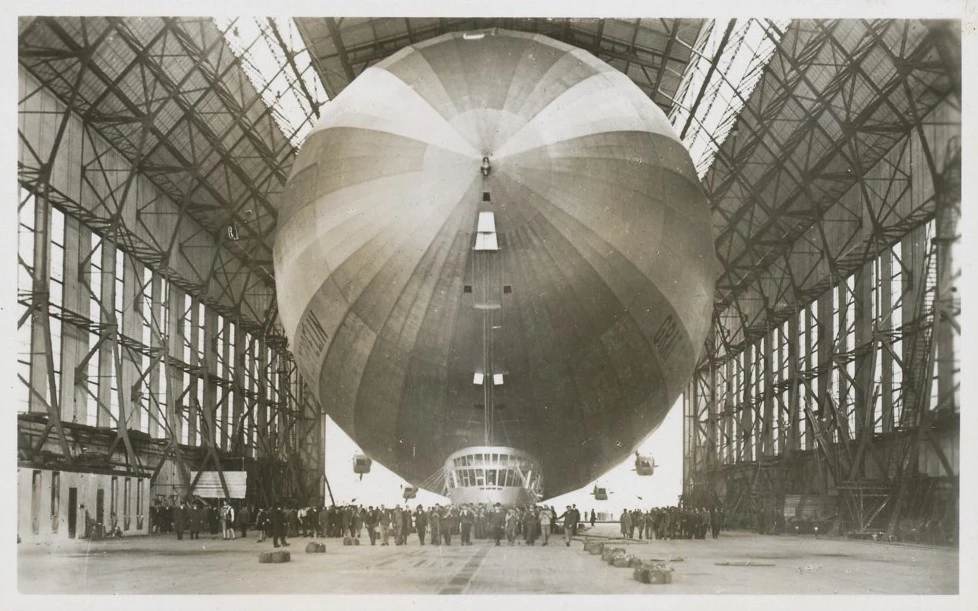
In the 1930s, the airship was the height of engineering sophistication: passengers sipped champagne high above the clouds while the ocean drifted beneath their feet. Today, the only remnants of this airborne luxury are the occasional advertising blimps hovering over sports stadiums. What went wrong?
Airships were undeniably an elegant concept: a lighter-than-air gas lifts a multi-ton structure without burning a single drop of fuel for elevation, allowing it to cruise above the clouds regardless of air currents. But this brilliant idea suffered from an inherent flaw—scale. To carry any significant payload, the envelope had to be gargantuan, and a massive object in the sky is notoriously difficult to maneuver. Landing one was a total nightmare: a ground crew of fifty people would rush to the mooring mast, literally throwing their weight onto handling lines to wrestle the craft against the wind.
That leads directly to the second problem—the weather itself. Whenever strong winds picked up, the multi-ton airship was blown not where the pilot intended, but wherever the weather front dictated. For a commercial mode of transport expected to run on a strict schedule, that was practically a death sentence.
The final nail in the coffin came on a single evening in May 1937, when the hydrogen-filled
Hindenburg
—the largest airship ever built—burst into flames over New Jersey. A single spark was all it took. Ever since, the word "airship" has been inextricably linked to "disaster" in the public imagination. Yet the fault lay not with the physics of lighter-than-air flight itself, but with the specific choice of gas: at the time, the United States held a near-monopoly on the world’s supply of safe helium and simply refused to sell it to Germany.
As a side note, aviation purists still love to point out in comment sections that airships don't technically "fly," but rather "sail"—by textbook definition, lighter-than-air navigation is aeronautics, not aviation proper. It’s a minor distinction, but one people will debate until they're blue in the face.
Still, it's too early to write off the airship completely. Engineers regularly file patents for new rigid designs—some even helium-free—capable of hauling thousand-ton payloads at a fraction of the cost of rail transport. So that lumbering airship may very well make a comeback after all. Only next time, it will be as a heavy cargo hauler rather than a luxury cruise liner.