Why Saturn Is the Most Terrifying Planet in the Solar System: Far From Peaceful (9 Photos)
If you convert Saturn's radio emissions into audible sound, you get an eerie, drawn-out howl straight out of a sci-fi horror film. These were the exact signals captured by the Cassini spacecraft—born near the planet’s auroras, scientists shifted their frequency and compressed the audio so the human ear could hear them. 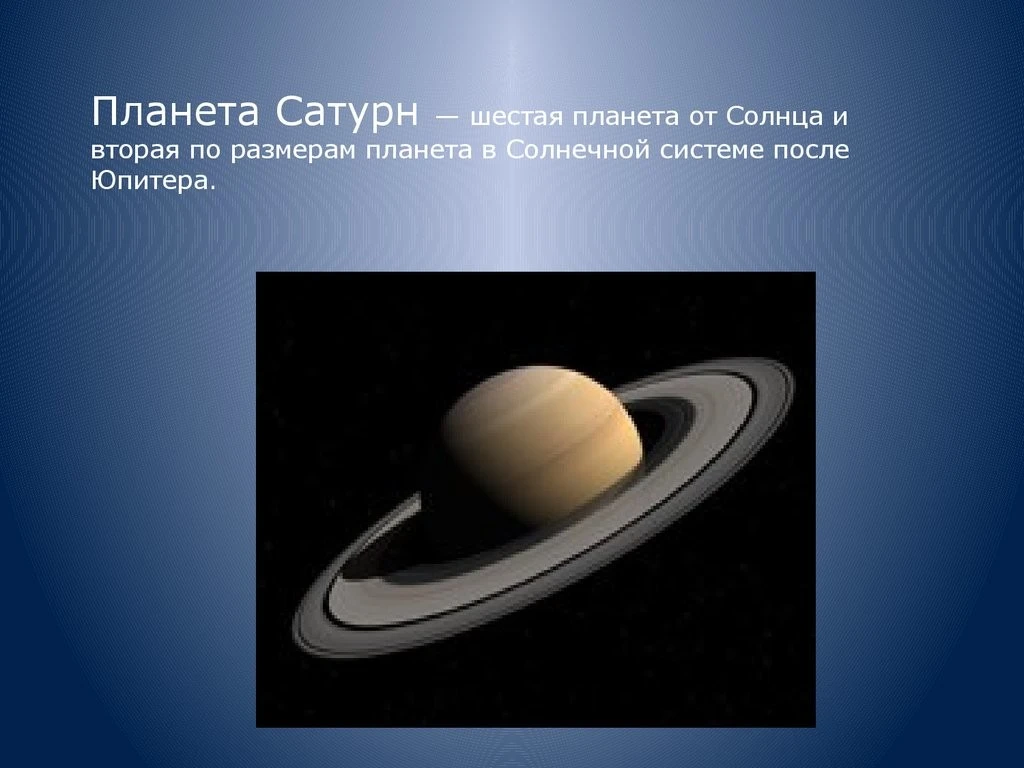
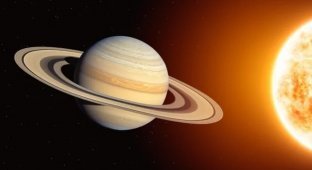
It is a jarring sound to pair with Saturn’s iconic appearance. Through a telescope, the planet looks almost serene: a golden orb wrapped in delicate cloud bands, framed by dazzling rings that seem far too neat to belong to a real planet.
Yet Saturn's tranquility is an illusion captured only in still photos. In reality, it is a colossal churning sphere of hydrogen and helium spinning so rapidly that it has flattened its own poles, spawning Earth-sized megastorms and slowly devouring its own rings.
And in 2026, Saturn delivered yet another curveball to astronomers...
The Planet Where Landing Is Impossible 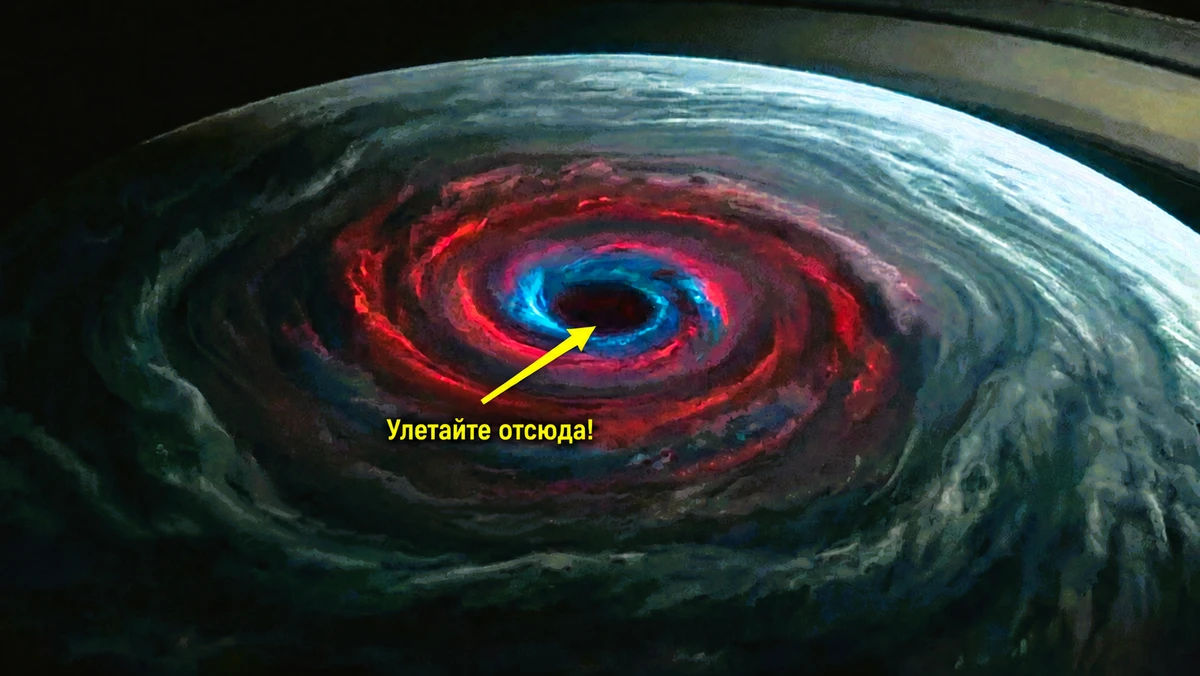
Saturn's diameter is roughly nine times that of Earth, and over 760 Earths could fit inside it. Yet its average density is actually lower than water. If an ocean large enough existed, Saturn would theoretically float in it.
Even so, approaching this "lightweight" giant would be a fatal mistake. Saturn has no solid surface for a spacecraft to touch down on. What we see as clouds are merely the upper layers of its atmosphere; deeper down, the gas grows relentlessly denser and hotter.
A descending probe would first be battered by ferocious winds roaring at up to 1,800 kilometers per hour near the equator. As it plunged deeper, crushing pressure would crush its hull while temperatures soared, surrounded by hydrogen compressing into liquid and, eventually, a super-dense metallic state.
The exact fate of such a probe is hard to pinpoint because the boundaries between Saturn's atmospheric, liquid, and deep interior layers are fluid and blurred. But it would never reach the core—it would be crushed and vaporized long before getting close.
The planet's very shape betrays the extreme dynamics at play inside. Saturn completes a full rotation on its axis in roughly ten and a half hours. This rapid spin causes its equator to bulge outward, making its equatorial radius about 6,000 kilometers wider than its polar radius.
The gas giant literally distorts itself through sheer speed—a colossal ball of gas straining to fly apart, held together only by the relentless grip of its own gravity.
Saturn’s Rings Are a Cosmic Meat Grinder 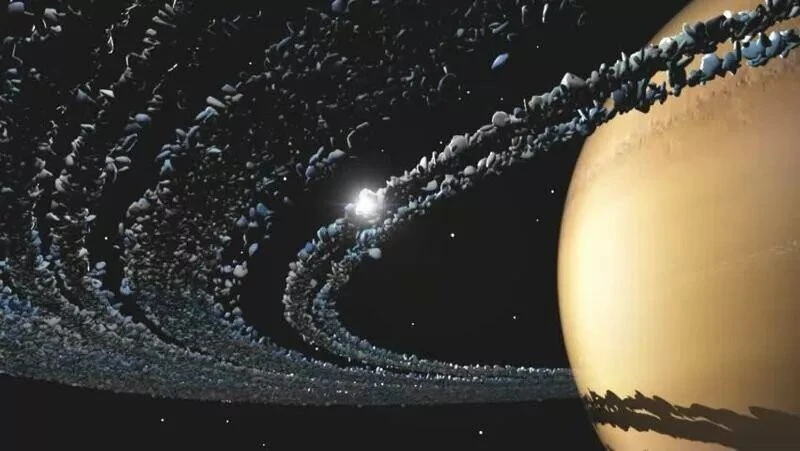
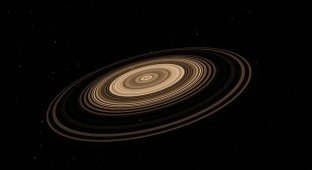
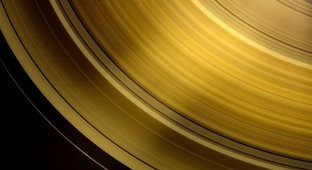
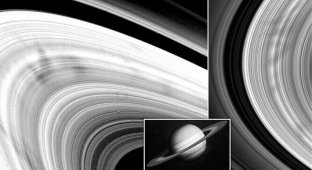
Viewed from Earth, the rings look like smooth, solid ribbons. In reality, they are composed of billions of icy and rocky fragments ranging in size from tiny dust specks to boulders as large as houses—and even mountains.
This vast field of debris hurtles around the planet at tens of thousands of kilometers per hour. The fragments collide, shatter, spray icy debris, and clump back together under their mutual gravity in an endless cycle of chaotic destruction.
While the ring system spans nearly 300,000 kilometers across, its average thickness is a mere ten meters—a razor-thin, colossal disc slicing through open space.
The origin of the rings remains a subject of intense debate, but one compelling theory points to the violent death of an ancient moon. Between 100 and 200 million years ago, a moon roughly the size of Iapetus may have orbited Saturn. Scientists aptly named it Chrysalis.
Gravitational interactions between Saturn, Titan, and other moons slowly destabilized Chrysalis's orbit. Eventually, the moon ventured too close, and Saturn's brutal tidal forces ripped it apart. While much of the debris plunged into the planet, the remaining ice coalesced to form the rings we see today.
If this hypothesis holds true, the rings are the breathtaking wreckage of a cosmic tragedy—the pulverized remains of a moon shredded by the giant's relentless gravity.
A Hexagonal Storm Rages at the North Pole 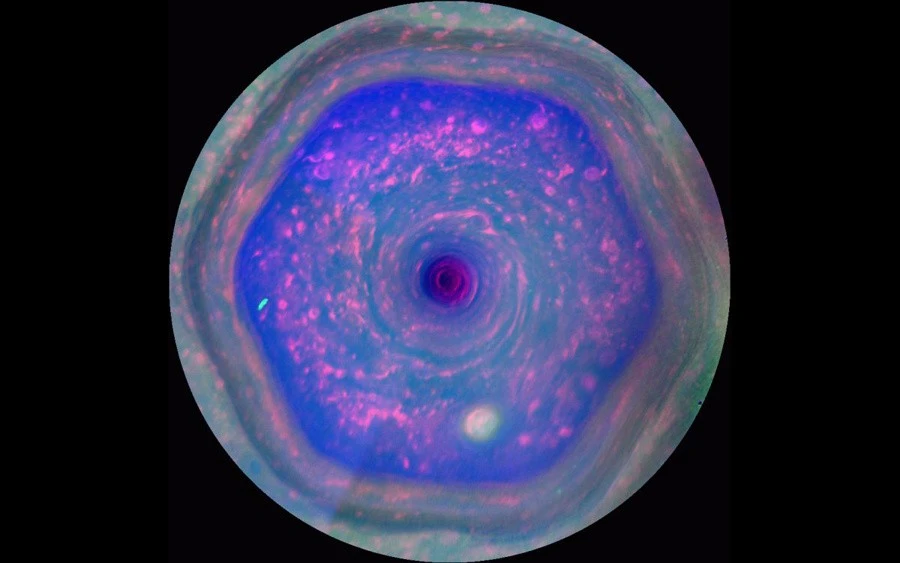
Cyclones on Earth naturally form circular spirals, which is why Saturn's famous hexagon baffled scientists for decades. Encircling the planet’s north pole is a massive jet stream forming a geometric pattern with six almost straight sides and crisp, distinct angles.
Spanning roughly 30,000 kilometers across, the hexagon could easily swallow two Earths side by side, with jet stream winds howling along its perimeter at speeds of up to 320 kilometers per hour.
First discovered by the Voyager spacecraft in the early 1980s, the hexagon was still standing decades later when Cassini arrived. Its geometric shape remained remarkably intact, even as its colors shifted with Saturn's changing seasons.
Researchers believe a powerful jet stream drives the hexagon's shape. As waves ripple through the rapidly spinning atmosphere, they pin the jet stream into a stable, standing polygon—an effect successfully recreated in laboratory experiments with rotating fluids.
At the very center of the hexagon churns a gigantic polar vortex. Its clouds form a swirling structure resembling a deep crimson rose, with an eye spanning roughly 2,000 kilometers across—boasting wind speeds nearly four times higher than a category-five Earth hurricane.
In 2026, Astronomers Discovered Another Geometric Anomaly on Saturn 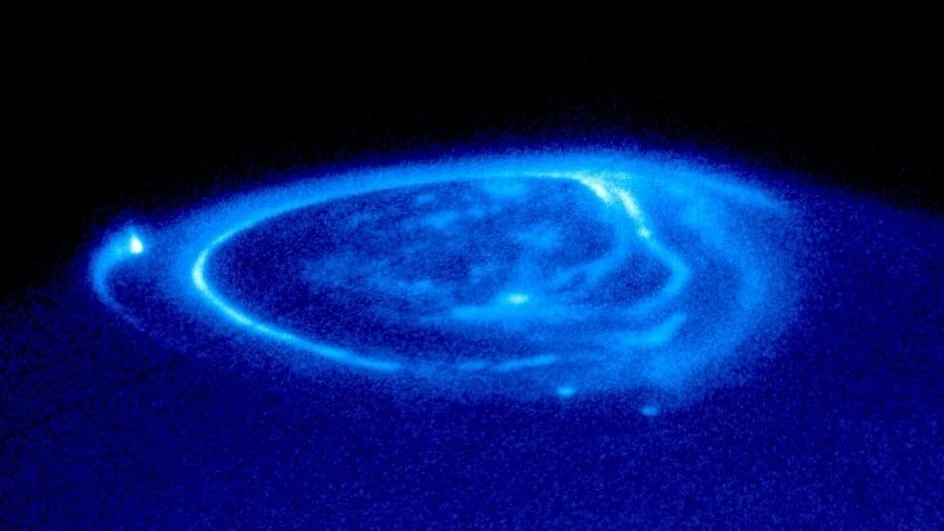
For decades, the north pole's hexagon was thought to be a one-of-a-kind anomaly. However, recent observations from the Hubble Space Telescope revealed a massive, ten-sided wave structure circling Saturn’s south pole.
This newly identified decagon spans approximately 168,000 kilometers in diameter, stretching across Saturn's southern mid-latitudes. Each segment between its ten distinct vertices measures more than 16,000 kilometers long.
Unlike its northern counterpart, the southern decagon appears far more volatile. Its sides shift in brightness, its angles fluctuate, and the entire structure drifts relative to the surrounding atmosphere. Archival imagery suggests it was nonexistent or too faint to detect in 2017, meaning it took shape only recently.
Scientists are still investigating what triggered its formation. The leading theory is that a southern jet stream began meandering into wave patterns, though why it settled into a ten-sided polygon—and whether it will endure—remains an open question.
Saturn now boasts two gigantic geometric structures flanking its poles: a northern hexagon that has endured for decades, and a southern decagon unfolding in real time.
Once Every Thirty Years, Saturn Transforms Beyond Recognition 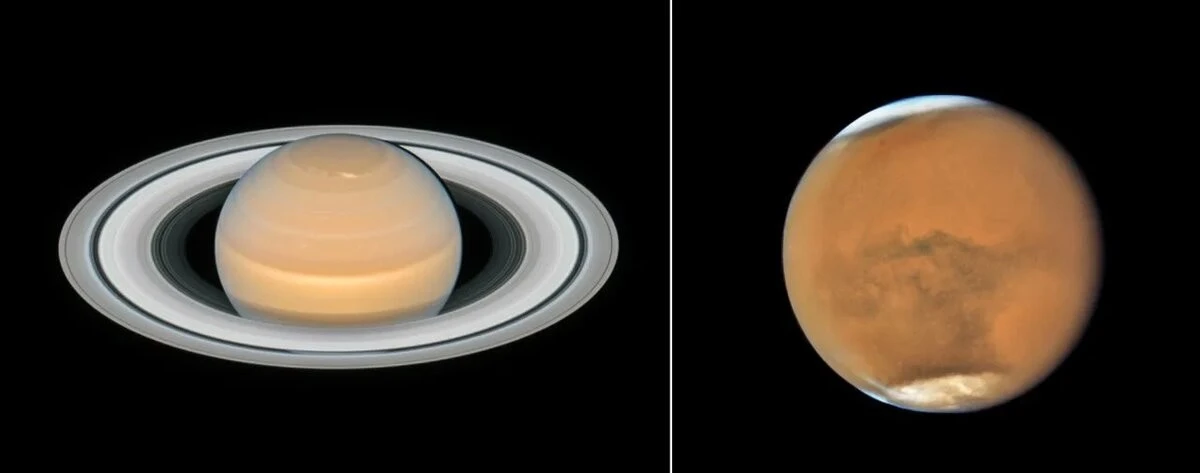
Roughly once every Saturnian year (equivalent to nearly 30 Earth years), a monstrous eruption known as the Great White Spot erupts in the planet's atmosphere. What begins as a small, bright speck quickly expands into a roaring tempest that wraps a long tail of clouds around the entire planet.
During the 2010 event, the storm swelled to roughly 15,000 kilometers across. Its chaotic plume eventually stretched all the way around the planet, transforming Saturn's serene golden bands into a turbulent tangle of white clouds.
These megastorms dredge up material from hundreds of kilometers deep, violently churning ammonia crystals and water ice upward from depths far below the visible cloud deck.
Fierce electrical activity rages within the storm. Cassini detected radio bursts from lightning strikes discharging up to ten times per second. A single storm front can persist for months, leaving lasting scars on the planet's atmospheric dynamics long after the white clouds subside.
Titan Looks Like an Eerie, Frozen Mirror of Earth 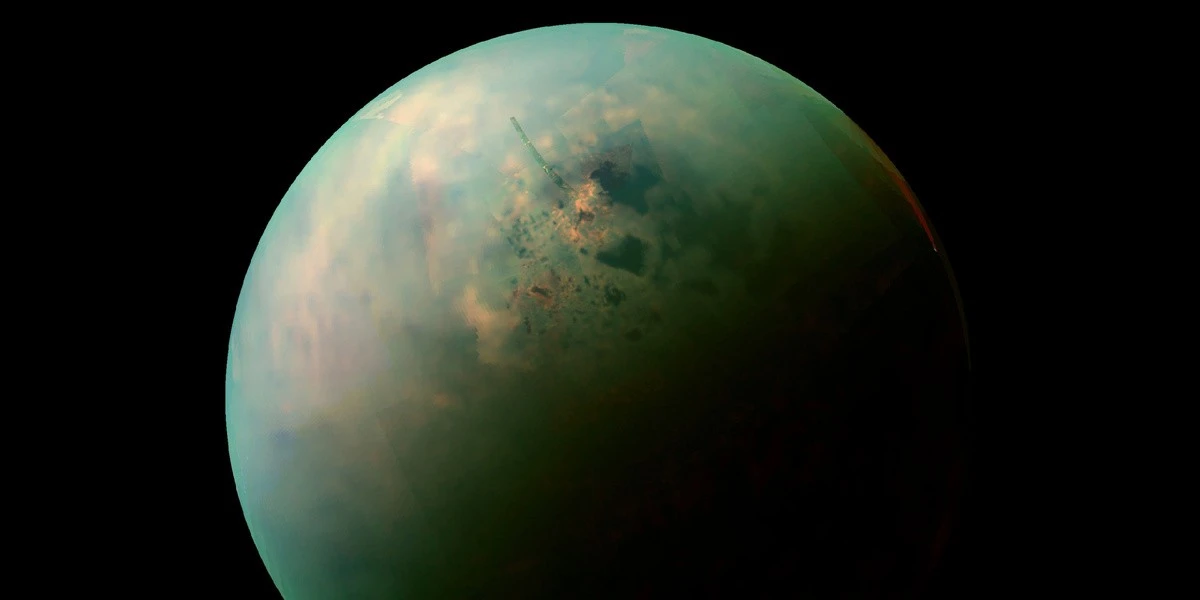
As of August 2026, Saturn has 293 confirmed moons. While most are small icy rocks, its largest moon, Titan, is practically a planet in its own right.
Larger than Mercury, Titan is shrouded in a thick, nitrogen-rich atmosphere with surface pressure 1.5 times that of Earth. Beneath its hazy orange sky lies an unsettlingly familiar landscape of plains, mountains, sand dunes, river channels, lakes, and vast seas.
The alien scenery is uncanny in its resemblance to Earth. Clouds drift through the sky, dropping liquid rain that feeds rivers and fills deep lakes. Yet this entire hydrologic cycle operates at a chilling −179°C (−290°F).
Instead of water, Titan's rivers and seas are filled with liquid methane and ethane—gases on Earth, but liquid torrents hundreds of meters deep in Titan’s deep freeze. At these extreme temperatures, water ice acts like solid granite, forming the moon's bedrock and mountains.
Towering across Titan’s equatorial regions are vast, dark dunes composed of complex organic particles akin to plastic grains, rising hundreds of meters into the smoggy sky.
Titan mirrors Earth's geography using entirely alien ingredients—a haunting caricature of a primordial Earth frozen inside a hydrocarbon deep freezer.
Enceladus Hides a Subsurface Ocean Beneath Its Icy Shell 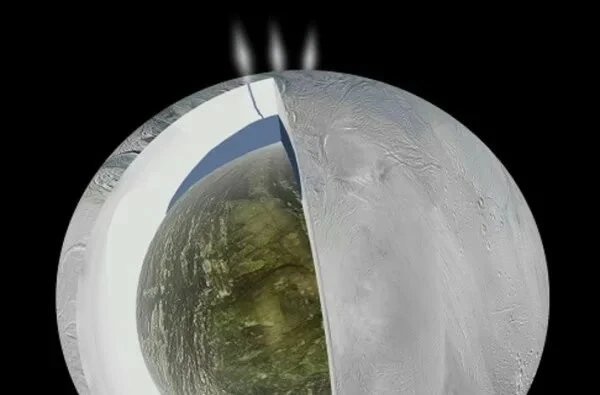
Another of Saturn's moons appears far more modest at first glance. Measuring just 500 kilometers across, Enceladus's brilliant, icy surface long seemed like a desolate frozen wasteland.
That perception changed forever when Cassini spotted deep fractures near the moon’s south pole, dubbed "tiger stripes." Pluming hundreds of kilometers into space from these fissures were massive geysers of water vapor and ice grains.
The geysers revealed a hidden global ocean beneath the ice crust. As Enceladus orbits Saturn, the planet’s immense gravitational tug flexes and squeezes the moon's interior, generating hydrothermal heat that keeps the ocean liquid.
Flying directly through the plumes, Cassini detected salts, molecular hydrogen, phosphorus, and complex organic compounds. A 2025 re-analysis of the mission's data unveiled an even richer organic chemistry originating directly from this subterranean sea.
While evidence of alien life remains elusive, Enceladus possesses all the key ingredients: liquid water, internal thermal energy, and rich organic building blocks. Remarkably, one of our solar system's best candidates for extraterrestrial life orbits a world that constantly threatens to tear it apart with gravitational tides.
Saturn’s Final Victim 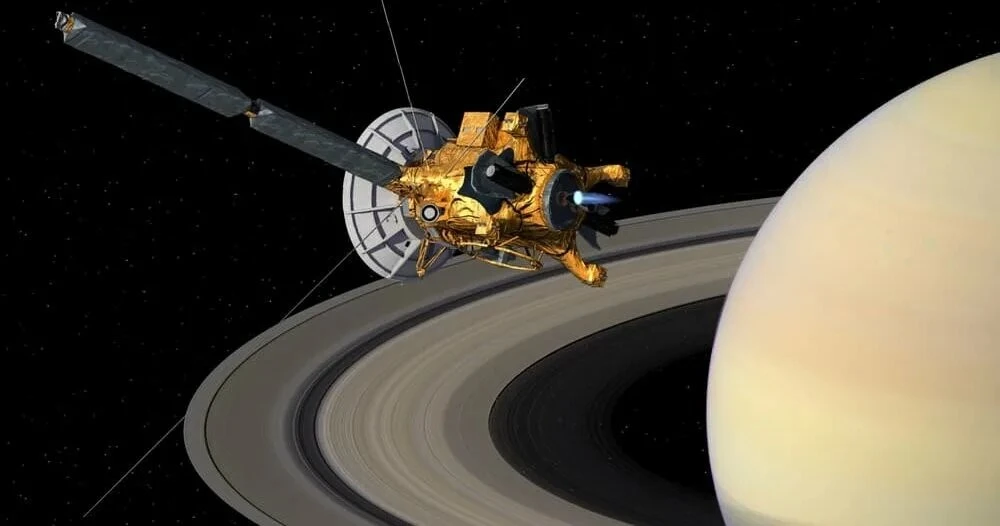
The Cassini spacecraft explored the Saturnian system from 2004 to 2017. It unveiled the intricate structure of the rings, deployed Europe's Huygens probe to Titan's surface, discovered Enceladus's hidden ocean, and returned breathtaking imagery of polar tempests.
By late 2017, its fuel was nearly spent. Fearing an uncontrolled collision that could contaminate pristine moons like Enceladus or Titan with Earth microbes, mission controllers commanded Cassini onto a fatal trajectory straight into Saturn’s atmosphere.
On September 15, 2017, the probe plunged into the upper atmosphere at roughly 124,000 kilometers per hour. Its thrusters fired desperately to keep its antenna pointed toward Earth until atmospheric drag finally overwhelmed the spacecraft.
Its final transmission reached Earth 83 minutes later. By then, Cassini had fractured, melted, and dissolved into the atmosphere of the planet it had studied for thirteen years...
Saturn appears serene only because we view it from over a billion kilometers away. Up close, this golden giant is one of the most alien, chaotic, and dangerous realms humanity has ever glimpsed.