The Story of Timothy Dexter, Who Got Rich Through Sheer Stupidity (7 photos)
Most of us know stories of people who invested in a "surefire" business only to lose everything. But few can recall a time when money was poured into utterly foolish ventures and yielded massive profits. Yet it is entirely possible, as 18th-century American Timothy Dexter proved. He launched some of the most absurd business endeavors imaginable and somehow managed to turn every single one into a windfall. 
Timothy Dexter was born in 1747 to a poor farming family in America. Unsurprisingly, he received no formal education, and his childhood was marked by hardship and struggle. At just eight years old, Timothy had to take a job as a laborer, doing grueling and often dangerous work. By sixteen, he became a tanner's apprentice, and before long, he managed to set up a small business of his own. 
When Dexter was 22, he married Elizabeth Frothingham, a 30-year-old widow. She possessed a modest fortune, which Timothy wasted no time putting to use. He sank all her money into "Continental currency"—paper money printed in huge quantities by the U.S. Congress during the war. Unlike standard banknotes, these had absolutely no backing in gold or silver.
It was 1776, and the government claimed the new dollars held the same value as pre-war paper money and silver coins. But reality quickly set in, and by 1778, 200 Continentals were worth just one real dollar. By 1781, the rate plummeted further to 1,000 to 1. It was precisely at this moment that Dexter spent his wife's entire fortune on several sacks of what was essentially worthless scrap paper.
First Successes
Yet an act that could only be called foolish suddenly made Timothy rich. In 1790, the government decided to buy back Continental dollars with government bonds at a rate of 100 to 1. As a result, Dexter made a tenfold profit! To be clear, he wasn't the only one buying up the "play money." His wealthier neighbors were doing the same, albeit out of patriotism to support their struggling nation. Timothy simply copied them, except—unlike his rich neighbors—he risked every penny his family had. 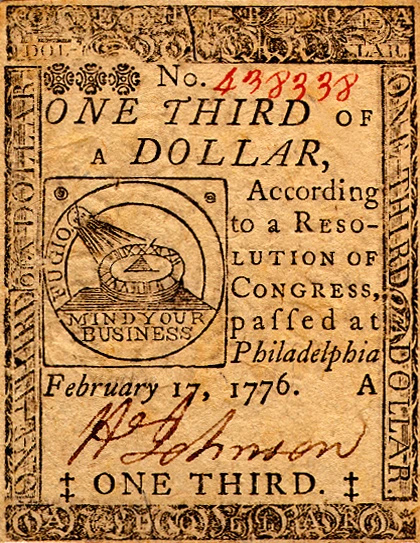
A Continental dollar
His wife may have spent nine years giving him grief, but it paid off in the end. Selling his bonds, Dexter bought several merchant ships and set out to become a trader. The newly minted merchant’s first major venture was shipping bed warmers to the West Indies. What could be dumber than sending bed warmers to the tropical Caribbean? Yet, miraculously, the venture turned out to be wildly profitable.
The warmers—essentially large pans with wooden handles and perforated lids—sold out almost immediately, as local plantation owners found they made perfect ladles for processing sugarcane molasses. Dexter followed this up by shipping... warm mittens to the West Indies. Once again, success awaited him: merchants buying rum on the islands snapped them all up to resell on northern trade routes. 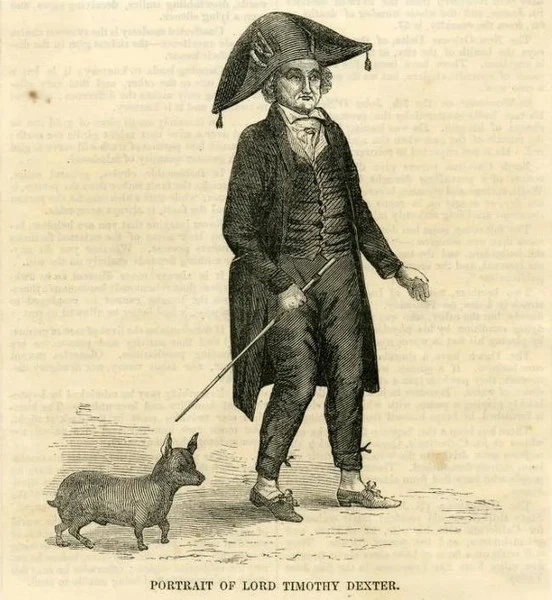
Timothy Dexter with his beloved Hairless Mexican Dog
Dexter became an exceedingly wealthy man, yet he continued making erratic deals. On one occasion, he bought up Boston's entire supply of whalebone. Having no idea what to do with it, he crammed his warehouses to capacity. Rivals rubbed their hands together in glee, convinced Timothy was finally ruined. But then, an unexpected surge in demand for men’s corsets hit Europe, and the whalebone sold out quickly at premium prices. Once again, Dexter pulled off a massive windfall out of nowhere.
The Cat Trade
Dexter’s most reckless gambit was shipping a cargo of coal to the English city of Newcastle. In the late 18th century, Newcastle was the coal-mining capital of Europe. Did he lose money? Not at all. Just as his ships pulled into port, a major miners' strike broke out. Production ground to a halt, and companies facing large delivery contracts bought up Dexter’s coal at exorbitant prices. Some suspect, however, that Dexter was in cahoots with union leaders and that luck had nothing to do with it. 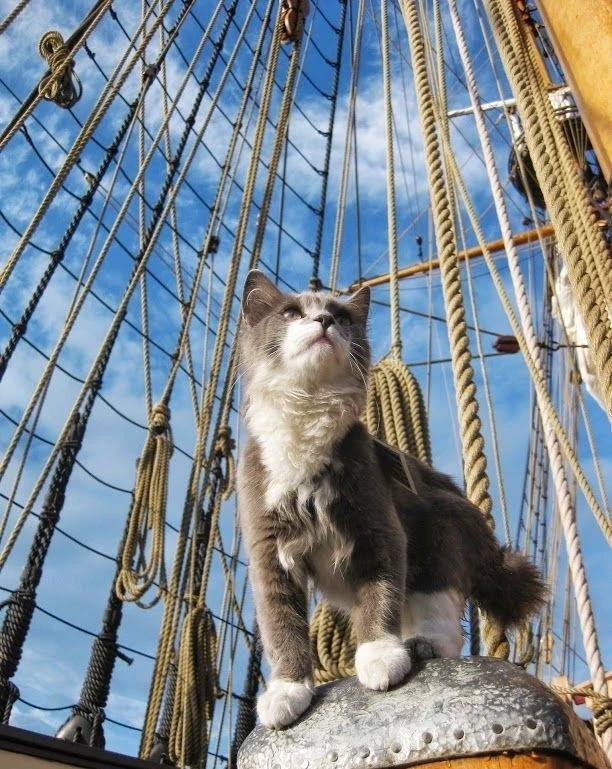
Another of Dexter’s deals went down in history when he rounded up several hundred cats from Newburyport, Massachusetts, and shipped them to the West Indies to sell at a markup. The town was overrun with strays, and local authorities were calling for them to be exterminated. Dexter placed a newspaper ad offering to buy cats for a modest sum. Locals rounded up every feline in town, and the animals were soon dispatched to the islands.
Why were people in the West Indies willing to pay top dollar for cats? As luck would have it, the islands were suffering from a severe rat infestation at the time, making the cats a welcome solution. Dexter netted another fortune, leaving no one surprised. People began whispering that Timothy was no fool after all—and that he might have sold his soul to the devil.
Dexter the Philosopher and Author
Dexter retired at fifty. The lucky entrepreneur was rich enough to live comfortably for the rest of his days. He bought a massive mansion and dubbed it his castle, insisting everyone address him as "Lord Dexter"—rewarding anyone who obliged with generous gifts. Driven by ambition, the eccentric millionaire soon demanded official recognition for his services to the nation. Local officials indulged him by appointing him "Informer of Deer." It was a cushy gig, given that no wild deer had been spotted in the area for over two decades. 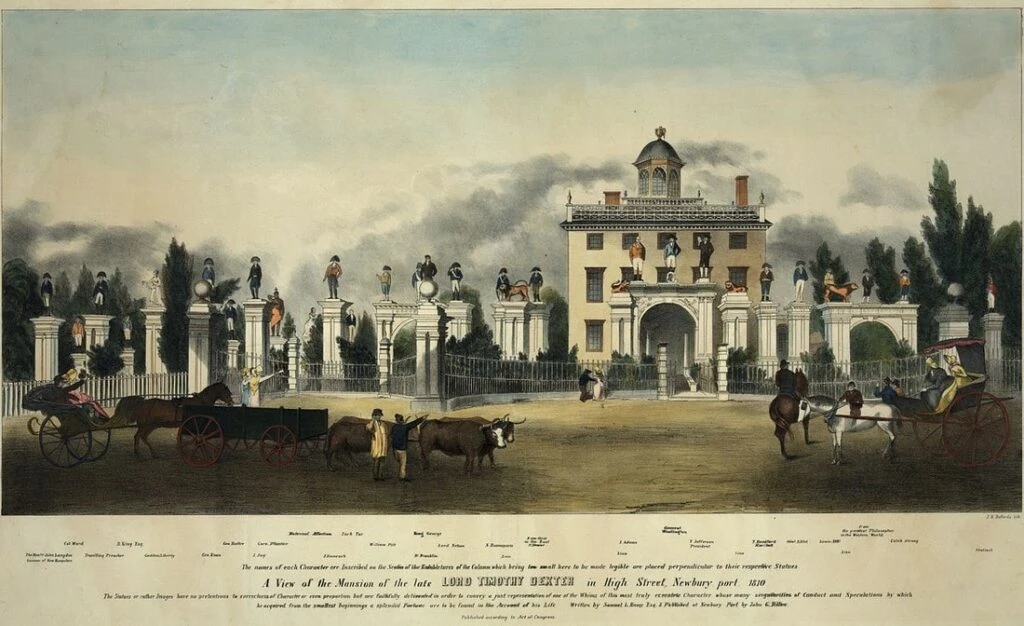
Dexter's estate adorned with statues
In his later years, the eccentric tycoon decided to immortalize himself. He lined his estate’s garden with statues of famous historical figures, placing a statue of himself right among them. On its pedestal, he had pompous words inscribed: "First in the East, First in the West, the Greatest Philosopher in the Western World." Naturally, he became a laughingstock. Yet even this turned to his advantage: curious and bored high-society women traveled from afar to see the eccentric, and the aging ladies' man engaged in several affairs with them. Pushed to her limit by his antics, his wife eventually left him.
Eventually, fully consumed by his own grandiosity, Dexter penned a book titled *A Pickle for the Knowing Ones, or Plain Truths in a Raw Dress*. The work consisted of his personal musings on the clergy, politics, and married life. Having never fully mastered literacy, his writing was riddled with spelling mistakes and entirely devoid of punctuation. 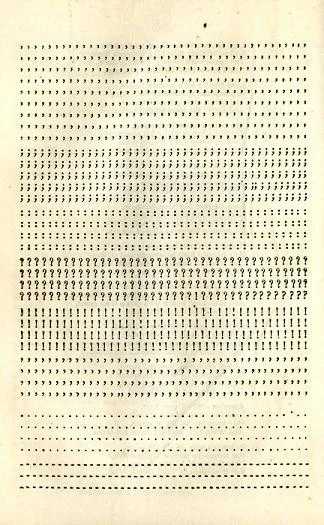
The page of punctuation marks from Dexter's book
When critics mocked him for the oversight, Dexter "fixed" the issue in the second edition. At the back of the book, he added a full page of punctuation marks alongside a note inviting readers to distribute them as they pleased. Surprisingly, the book went through eight editions and became the primary source of information about the author's life and business exploits.
This remarkable man passed away at fifty-nine. He left a will that equitably divided his substantial fortune among friends and family, with generous provisions for charity. Two centuries later, a man named Amarillo Slim would prove that one could make millions on seemingly impossible bets—a feat even Timothy Dexter could only have dreamed of.