127 minutes in hell: what "Venus-13" managed to film before the heat killed it (11 photos)
Engineers guaranteed the station only half an hour of operation. It transmitted data for two hours and seven minutes—under completely unimaginable conditions: a temperature of 462°C and a pressure of 89 atmospheres. 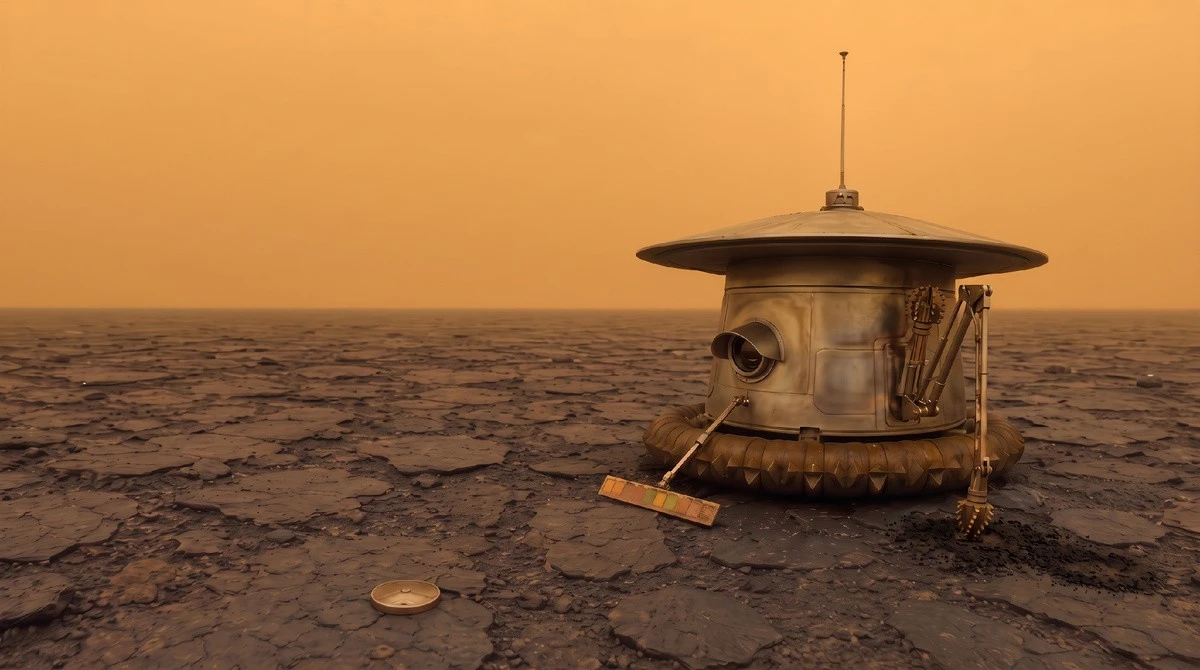
Photo reconstruction of "Venus 13." At the top is the brake shield and antenna for communication via the orbital unit; at the bottom is the crushable shock absorber ring with a toothed crown. On the left side, you can see the camera porthole with its cover blown off. Near the ground, there's a colored target for image calibration and the drill that extracted the rock sample.
The pressure didn't crush it: the sealed titanium casing was designed for precisely these numbers. It was the heat that killed it.
During these 127 minutes, Venera 13 drilled into the soil, determined its composition, scanned color panoramas, and measured the deep atmosphere. Let's figure out how a machine doomed from the first second managed to lose to the planet at almost a quarter of its calculation speed.
A Thermos That Can't Be Opened 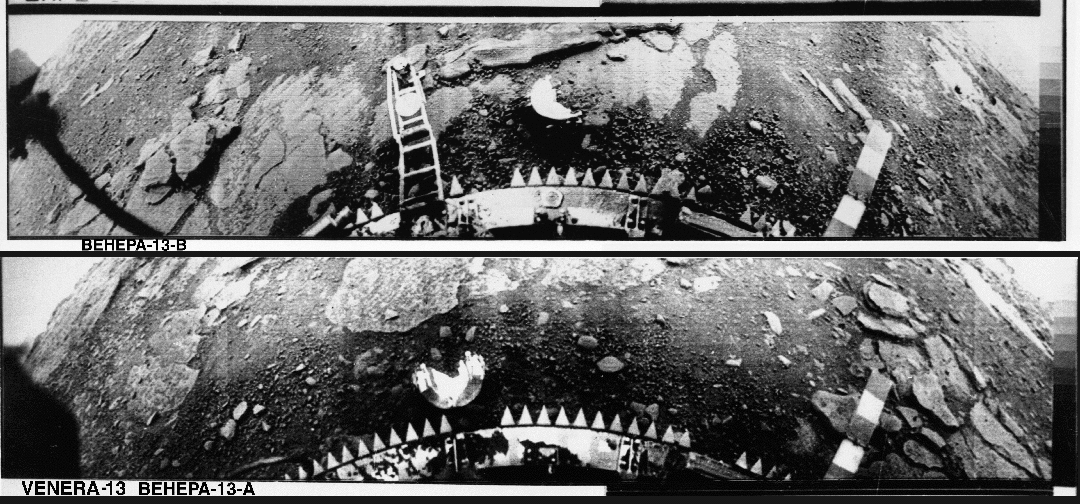
The main problem on Venus isn't the heat itself. The equipment can also tolerate the heat: blast furnaces, turbines, and ovens also operate at extreme temperatures. The problem is that on the surface of Venus, there's nowhere to put the heat. It can't be removed, like on ours.
The refrigerator, air conditioner, and radiator in your computer all work on the same principle: take heat from here and release it to a cooler place. The station on Venusian soil doesn't have such a "colder place" at hand.
So Soviet engineers took a different approach. They concluded that there was only one possible design.
Not a machine that fights, but a thermos that holds up.
The instruments were hidden in a sealed titanium case under thick thermal insulation. Inside, they installed a heat accumulator containing lithium nitrate trihydrate: while the salt melts, a significant portion of the incoming heat is transferred to the phase transition, and the temperature rises much more slowly. A fan circulated air inside to prevent hot spots from burning out the electronics locally. 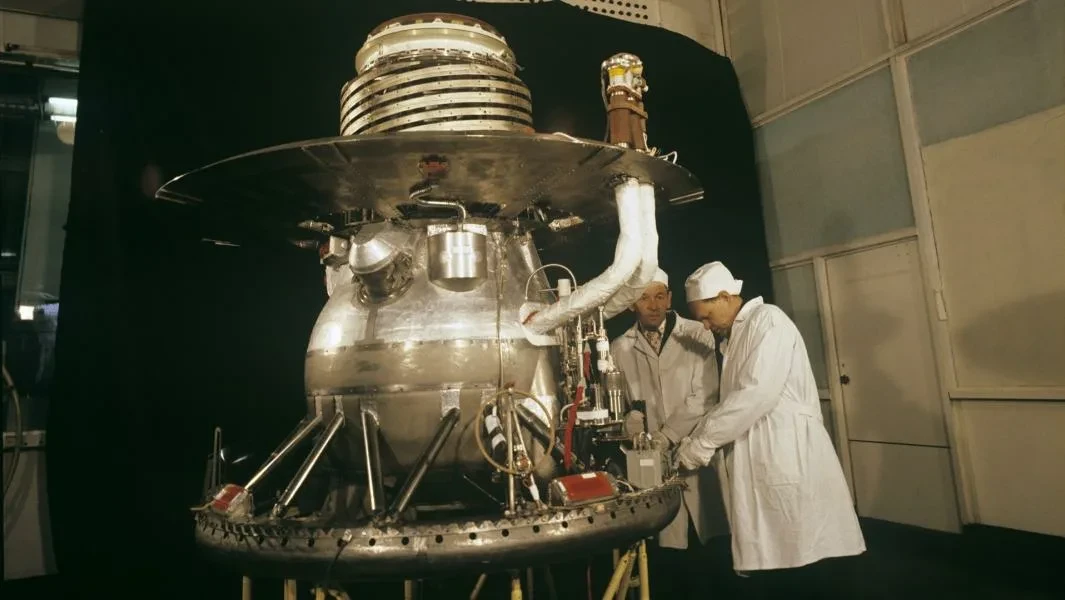
Next, it was a matter of arithmetic: how much heat leaks through the insulation and how much the salt manages to absorb. The guaranteed resource of thirty-two minutes was reached.
The parachute was jettisoned halfway.
On March 1, 1982, the spacecraft made a soft landing on the surface of Venus.
The descent module entered the atmosphere at a speed of 11.2 km/s. The spherical shell with its heat shield dampened the heat to about three hundred meters per second, and at an altitude of about 63 kilometers, the parachute deployed.
And at forty-seven kilometers, the parachute... was jettisoned.
It sounds like an accident. In fact, it was the only correct move. The gas under the clouds is so thick that the spacecraft descends slowly even without a parachute: its speed decreases automatically. Leave the dome, and the station will slide for an extra hour, heating up the entire time. 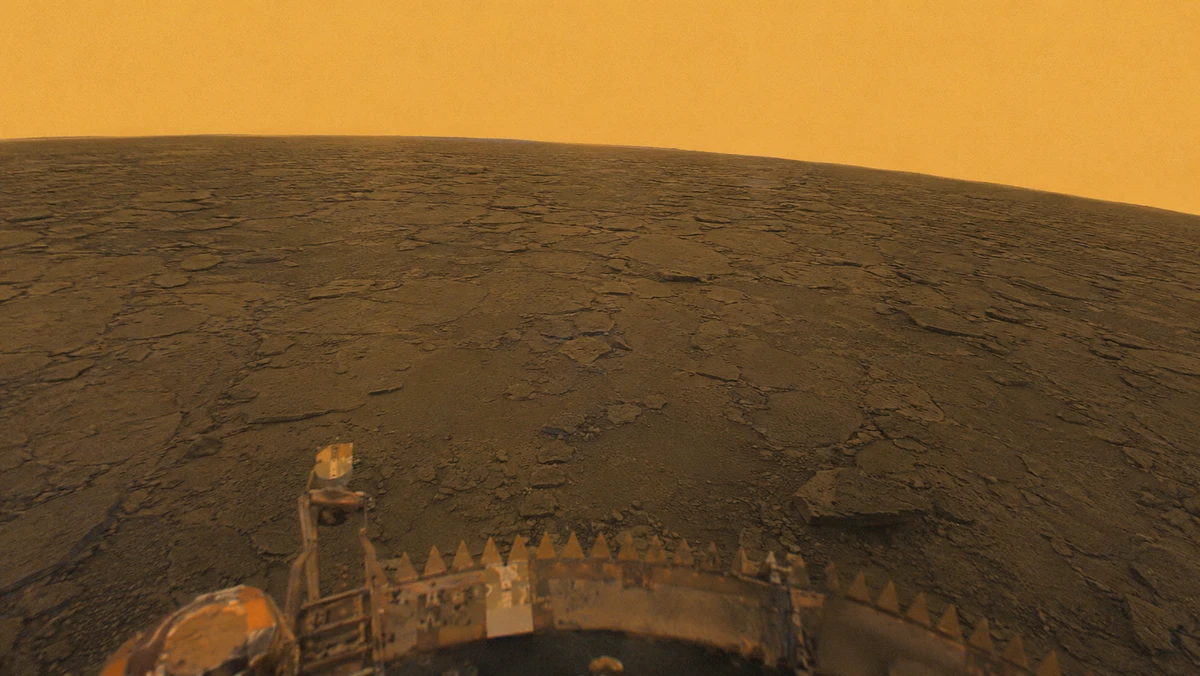
The spacecraft spent the rest of the journey, about an hour, on a rigid brake shield—a metal "pancake" above the body.
The velocity dropped to 7.5 m/s near the surface. The impact was absorbed by a torus-shaped shock absorber with a toothed crown: it dissipates the energy through its own deformation and prevents the spacecraft from tipping over. The station bounced once and came to a stop on the plain east of the Phoebe region.
The clock is ticking.
The most expensive cap in history
Now about the most difficult engineering problem of the Venus program.
The cameras viewed through quartz portholes, covered with protective caps during descent—the optics had to be protected from heat and dirt during atmospheric entry. After landing, the caps were supposed to be fired off with pyrotechnic cartridges.
Venera 9 and Venera 10 in 1975: one of the two chambers each opened.
Venera 11 and Venera 12 in 1978: neither ejected. Both stations landed, operated for 95 and 110 minutes, and faithfully transmitted telemetry—but did not send back a single panorama.
The launch was postponed from 1980 to 1981.
The engineers took an extra year and spent it trying to get the cover to eject.
They ejected. All four.
What Venus is made of
Venera 13 didn't just photograph the surface—it drilled into it and collected a sample. 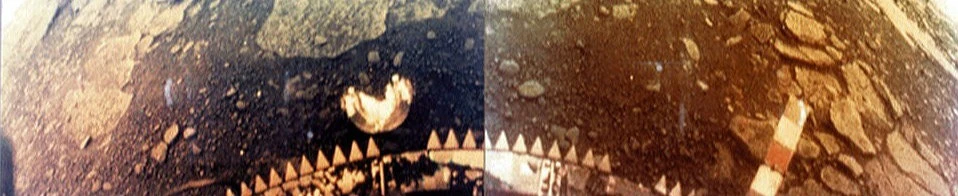
The instrument showed that the soil consisted not of some unknown "Venusian substance," but of compounds familiar to terrestrial geologists. Almost half the mass was silicon dioxide. The rest was mainly oxides of aluminum, magnesium, iron, calcium, and potassium.
The closest terrestrial relative of this rock is dark, heavy basalt, formed during the solidification of lava.
Only the Venera 13 sample contained unusually high amounts of potassium. Therefore, it was classified as an alkaline potassium basalt, similar to rocks found on some volcanic islands and in areas where the Earth's crust stretches and fractures. It is not granite, sandstone, or an exotic space mineral, but a special type of volcanic rock. 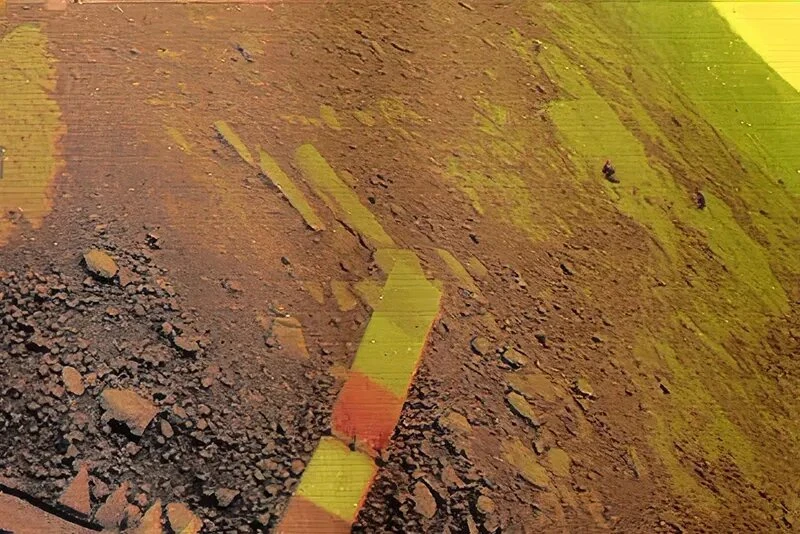
The color strip was needed to calibrate the surface color.
About a thousand kilometers away, Venera 14 found another type of basalt – tholeiitic. On Earth, most of the ocean floor is composed of similar material. The two probes landed on the same planet but discovered rocks with different chemistry. Therefore, the Venusian benches were formed under different conditions, and the planet's surface cannot be considered a single, gigantic layer of identical rock.
These analyses confirmed the main point: the plains of Venus are largely built by volcanoes. They once produced enormous lava flows, which cooled and turned into a basaltic crust almost like that found on Earth.
The panorama was assembled on Earth
The camera didn't click frames. It scanned the light line by line, like a fax machine, and transmitted monochrome scans. Color was collected on Earth – from separate passes through red, green, and blue filters. A total of eight black-and-white images and material for fourteen color ones were received. 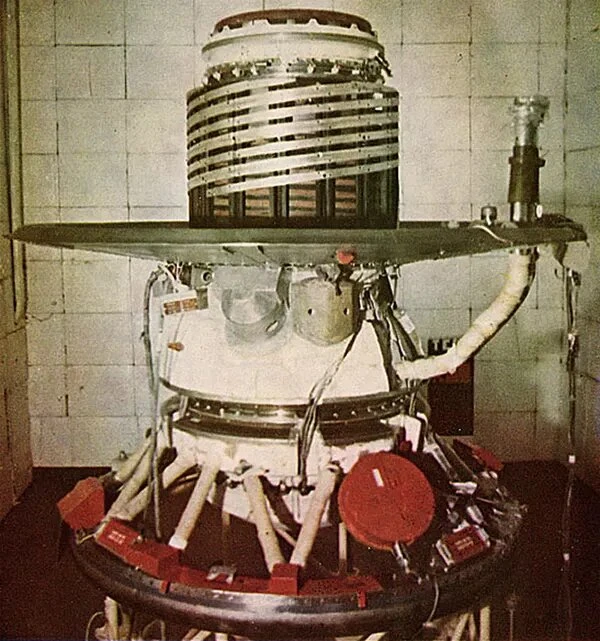
The familiar "Venus photograph" was born twice: first in the station's optics, then in Earth's calculations. The specific hue depends on the chosen color correction – a target with reference color fields was placed next to the spacecraft precisely to provide a starting point.
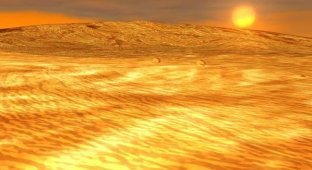
What do the panoramas show? A flat plain, flat stone slabs, with dark, fine dust between them. The illumination is about 3 kilolux – about the same as on an overcast day, only a deep, reddish light: the blue part of the spectrum is absorbed by the hundred-kilometer-thick atmosphere.
Hell turned out to be visually calm, disappointingly. A practically empty quarry – only at temperatures where lead melts.
What sounds are there on Venus?
Venera 13 had a microphone measuring wind noise. The wind was weak – less than a meter per second. But Venus's atmosphere is almost a hundred times denser than Earth's, so even this wind exerted a noticeable force on the spacecraft. 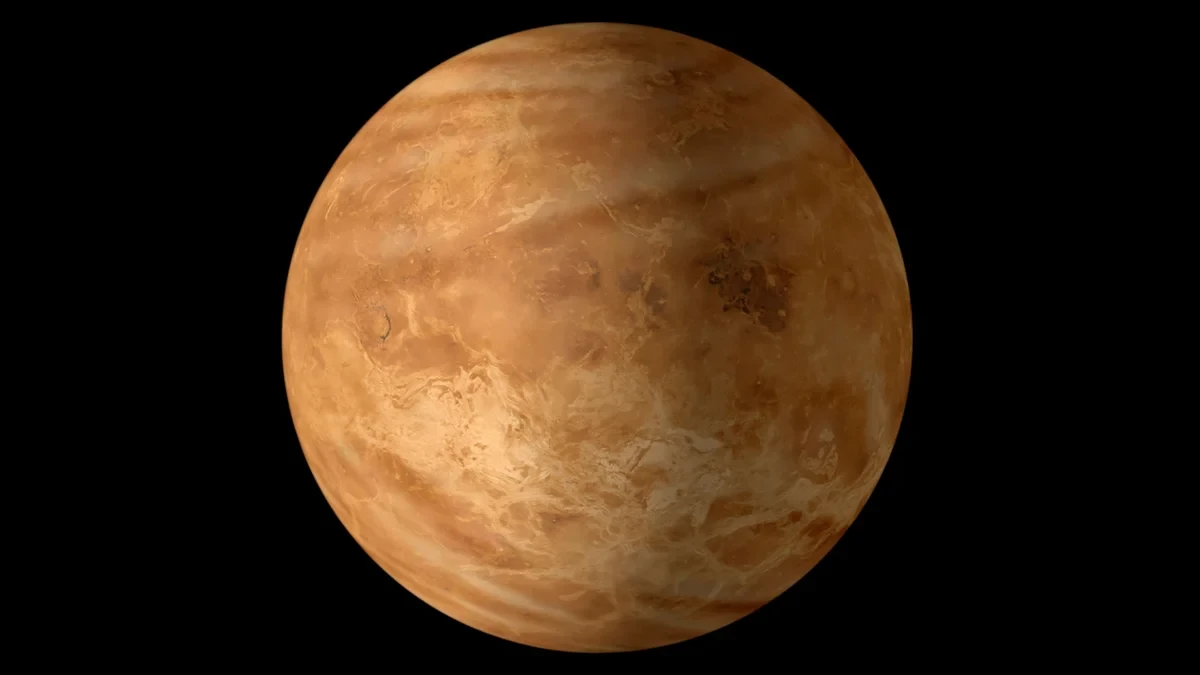
The device also picked up sounds and vibrations from the station itself: the ejection of the covers, the storm, and the loading of soil into the analyzer.
During its descent, the Groza-2 instrument recorded numerous electrical signals. These could have been charges in the atmosphere – something like local lightning. However, the signals could not have been lightning itself, but rather the result of charged particles in the clouds.
The spacecraft also carried ground vibration sensors. Venera-14 recorded two possible tremors, but scientists were unable to reliably distinguish them from the noise of the station and the atmosphere.
What remains for science
The main legacy of Venera 13 is not photographs, but a set of atmospheric measurements. The instruments more accurately determined the abundance of neon and argon, as well as the ratios of their isotopes. These gases are almost unreactive, so they preserve traces of the planet's distant past—what material it was formed from and how it subsequently changed. 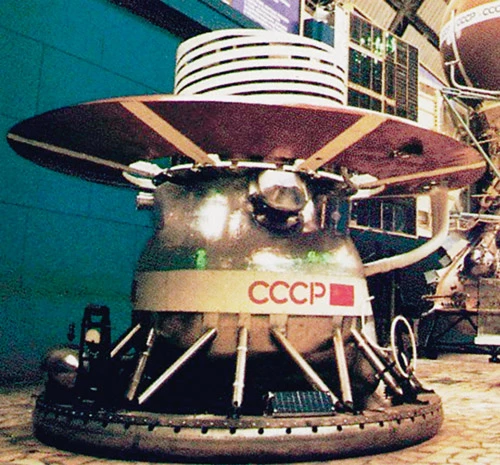
Krypton and xenon could reveal even more, but their measurements on Venus have so far been poor. However, the spacecraft refined the composition of cloud particles, showed how sunlight varies with altitude, and confirmed that there is almost no water vapor near the surface. Venus is almost the size of Earth, but it has virtually no water left.
Why these two similar planets ended up so differently remains a mystery. Perhaps they initially had different water reserves. Perhaps Venus lost it later due to intense heating and a greenhouse effect. One planet became home to life, while the other became a scorching desert under clouds of sulfuric acid.
Scorpio or not?
A decade after the Venera mission, scientist Leonid Ksanfomality reprocessed the old panoramas. In the blurry images, he saw objects resembling mushrooms, flowers, lizards, and even a scorpion. Some forms appeared only in individual frames, as if moving. In 2019, Ksanfomality and his co-authors described up to 18 such objects and suggested that life very different from Earth could exist on Venus.
Interestingly, some objects changed over time and looked slightly different during re-imaging.
Here, for example, are what scientists thought were possible mushrooms on Venus. 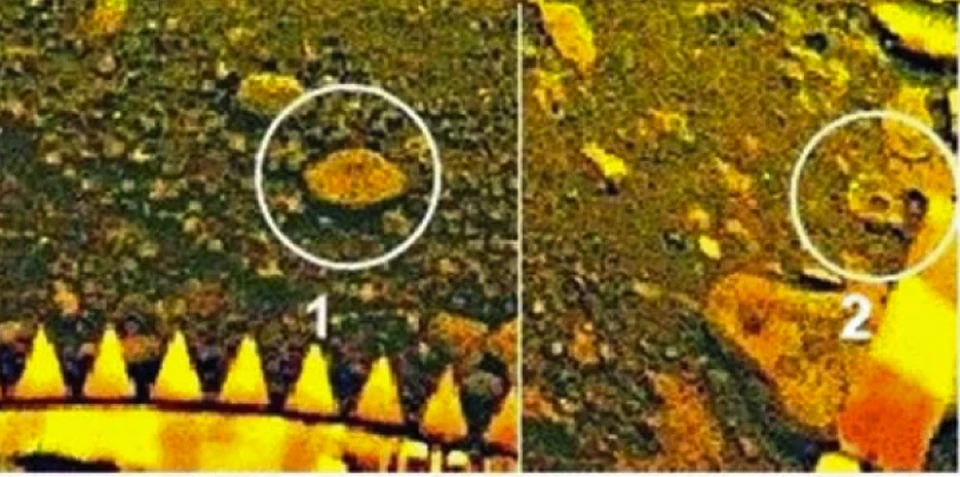
As a molecular biologist, I have found nothing that fundamentally contradicts the possibility of the existence of living organisms in Venusian conditions, says Doctor of Biological Sciences Alexander Spirin, an academician of the Russian Academy of Sciences who headed the Institute of Protein Research at the Russian Academy of Sciences for over 30 years. 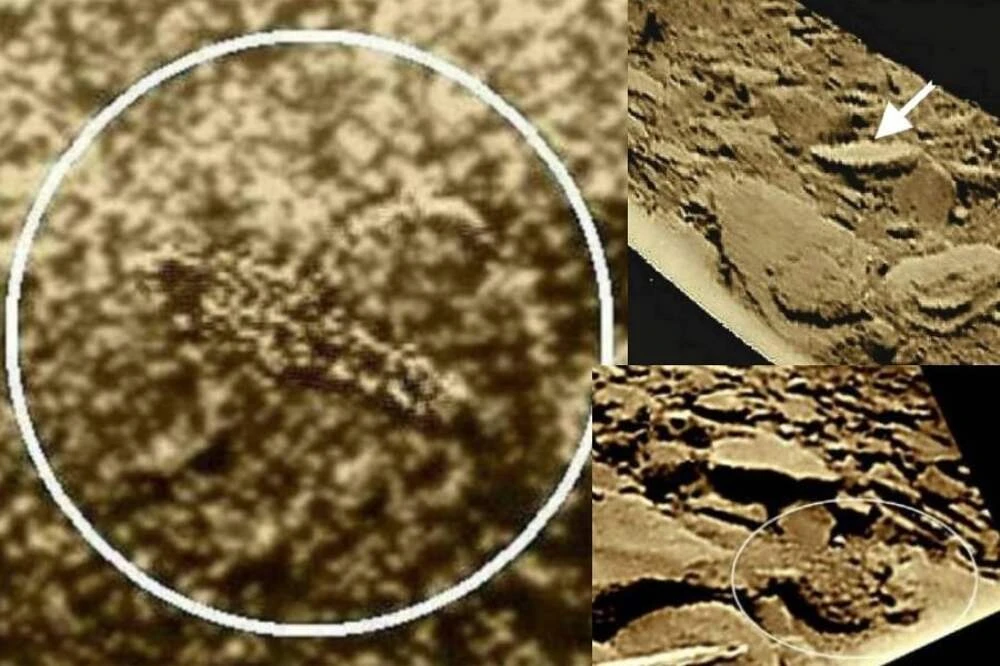
There is also a more serious problem: the surface of Venus is about 460°C, there is almost no water or oxygen, and the pressure is approximately 90 times higher than Earth's. The authors suggested that local organisms might be based on a completely different chemistry, but the spacecraft found no living cell matter, no metabolism, no other independent signs of life.
The question is indeed not yet closed. The conditions there are certainly toxic, but life can also arise in the strangest places. And even live without oxygen.
Only a new station with modern cameras and instruments will be able to test this hypothesis—the old pixels have already told all they could.
After 127 minutes, the signal was lost. The titanium casing held the pressure—heat slowly seeped in, the salt melted, the temperature rose, and one by one, the systems failed.
The spacecraft is probably still lying where it landed.
The last Soviet Vega spacecraft to successfully land on the surface of Venus were in 1985. They no longer had cameras.
Since then, no country has repeated the landing. Mars proved more advantageous: technology there survives for years and sends back beautiful selfies, not two hours of rusty panoramas.
Venus 13 wasn't sent to conquer the planet—it was given just half an hour to ask a few questions. It lasted four times longer and managed to get the answers humanity had been waiting billions of years for.
Sometimes the greatness of a machine is measured not by how long it survives, but by how much it manages to tell before falling silent forever.