Can you reboil water: debunking the biggest kitchen myth (4 photos)
The belief that reboiling water is harmful has been passed down from generation to generation for decades. Many have been familiar with childhood warnings that cooled boiling water supposedly turns into a dangerous "poison." However, chemical research and physical calculations completely refute this stereotype. Let's take a closer look! 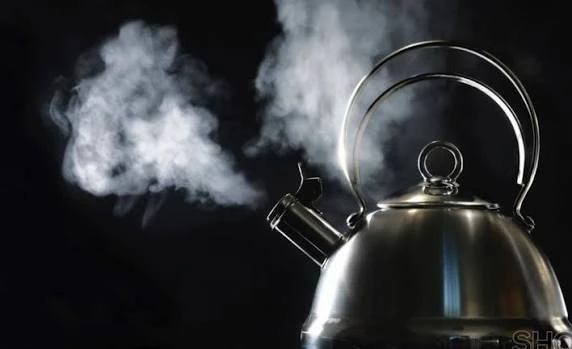
The roots of this myth date back to 1968, when the renowned Soviet culinary expert William Pokhlebkin published the book "Tea: Its Types, Properties, and Uses." In it, the author recommends not reboiling water or adding fresh water to cooled water.
An important detail: Pokhlebkin explained this recommendation solely by the drink's taste—reboiling tea causes it to lose its aroma and may become bitter. The book made no mention of any health risks.
Over time, this practical advice transformed into a dangerous superstition in the popular imagination. It was compounded by speculation about the formation of heavy water, deuterium, carcinogens, and dangerous nitrates. 
Concerns about the accumulation of toxic substances or deuterium (a heavy isotope of hydrogen) have been repeatedly verified by the scientific community.
Calculations by Academician I. Petryanov-Sokolov showed that to increase the deuterium concentration in an ordinary kettle to truly dangerous levels, it would be necessary to evaporate a volume of water hundreds of millions of times the mass of the Earth.
Experiments by Chinese researchers tested the dynamics of changes in the composition of 15 liters of tap water when repeatedly heated. To reach a critical concentration of heavy metals, the water would need to be boiled approximately 140 times, and for nitrates, 36-40 times. However, the water physically evaporates completely by the 18th cycle, before it can become harmful.
Experts in food chemistry and medicine confirm that no toxic compounds form in purified tap water when reheated, and the deuterium content remains microscopic. 
When heated, a well-known chemical reaction occurs: soluble calcium and magnesium bicarbonates are converted into insoluble carbonates:
Ca(HCO3)2 → CaCO3↓ + H2O + CO2↑
Mg(HCO3)2 → MgCO3↓ + H2O + CO2↑
These compounds precipitate, forming the familiar scale. For this reason, when re-boiling, the concentration of hardness salts does not increase, but decreases, since most of them have already settled to the bottom of the kettle during the first heating. 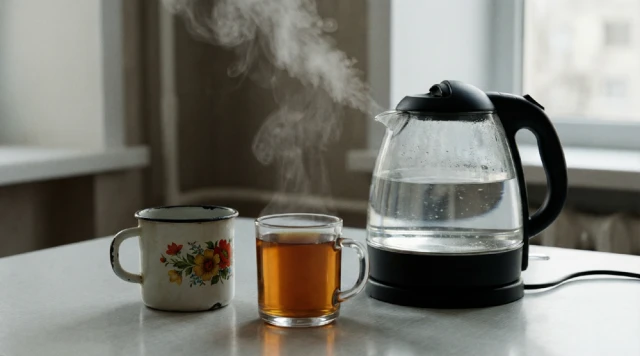
Refreshing the water in a kettle is only worthwhile in certain household situations. If boiling water has been left uncovered for more than 24 hours, it is best to drain it due to the risk of dust and bacteria from the air. The appearance of an off-odor or taste also indicates problems with the quality of the source water. Furthermore, it is best to avoid appliances made of low-quality, cheap plastic, as harmful substances can be released from the body itself when heated.
So what's the bottom line?
If the kettle is made of safe materials and the source water is potable, it is completely safe to reboil it. The main thing is to ensure the cleanliness of the kettle and the quality of the appliance used.