A ship can withstand anything: the story of the merchant submarine *Deutschland* (9 photos)
With the outbreak of World War I, the British Royal Navy initiated a full-scale naval blockade of the German Empire, preventing the enemy from obtaining the critical resources and materials needed to sustain the conflict. Facing the prospect of inevitable defeat, the German government began seeking alternative ways to address these shortages. 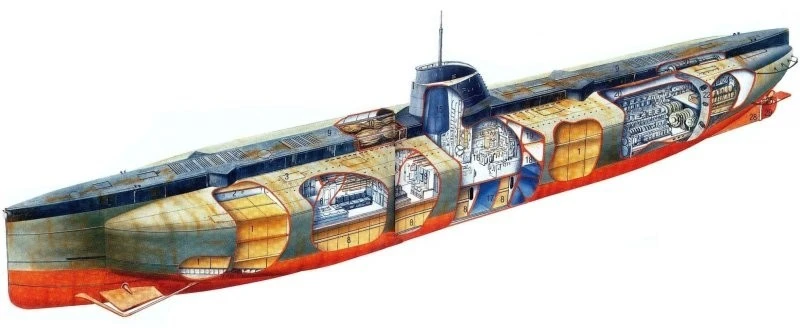
Cutaway view of the submarine *Deutschland* upon entering service in 1916
While semi-legal trade with nearby neutral countries was successfully expanded to some extent, it was insufficient to meet industrial demands.
Breaking the naval blockade was also considered unlikely, given the British fleet's numerical superiority. Consequently, in 1915, a decision was made to create a unique class of submarines designed not to sink enemy vessels, but to bypass the blockade and transport essential resources back to Germany, operating essentially as merchant ships. Thus began the story of the merchant submarine *Deutschland*, which gave its name to this unique class of vessels.
Entering Service
In October 1915, the keels of two merchant submarines, designed by German engineer Rudolf Erbach, were laid at the Flensburger Schiffbau shipyard. This new type of submarine was designated the *Deutschland* class; the first vessel was named *Deutschland*, while the second was named *Bremen*. Erbach envisioned the new vessels as a departure from the established norms of the German submarine construction program. One notable innovation was the inclusion of wide decks to increase cargo capacity. Another significant feature was the absence of any weaponry, which allowed the submarines to be classified as merchant vessels under the international treaties of the time.
However, Erbach designed the vessels to be convertible from merchant ships into combat submarines—a modification that was indeed carried out later. They were equipped with state-of-the-art technology to ensure maximum seaworthiness and operational endurance. Their cargo capacity reached 700 tons—roughly equivalent to the surface displacement of the German Empire’s standard U-31 class submarine. With a cruising range of 12,000 nautical miles at a surface speed of 10 knots, the vessel could make the round trip from Germany to the United States without refueling. The crew consisted of 25 sailors and officers. 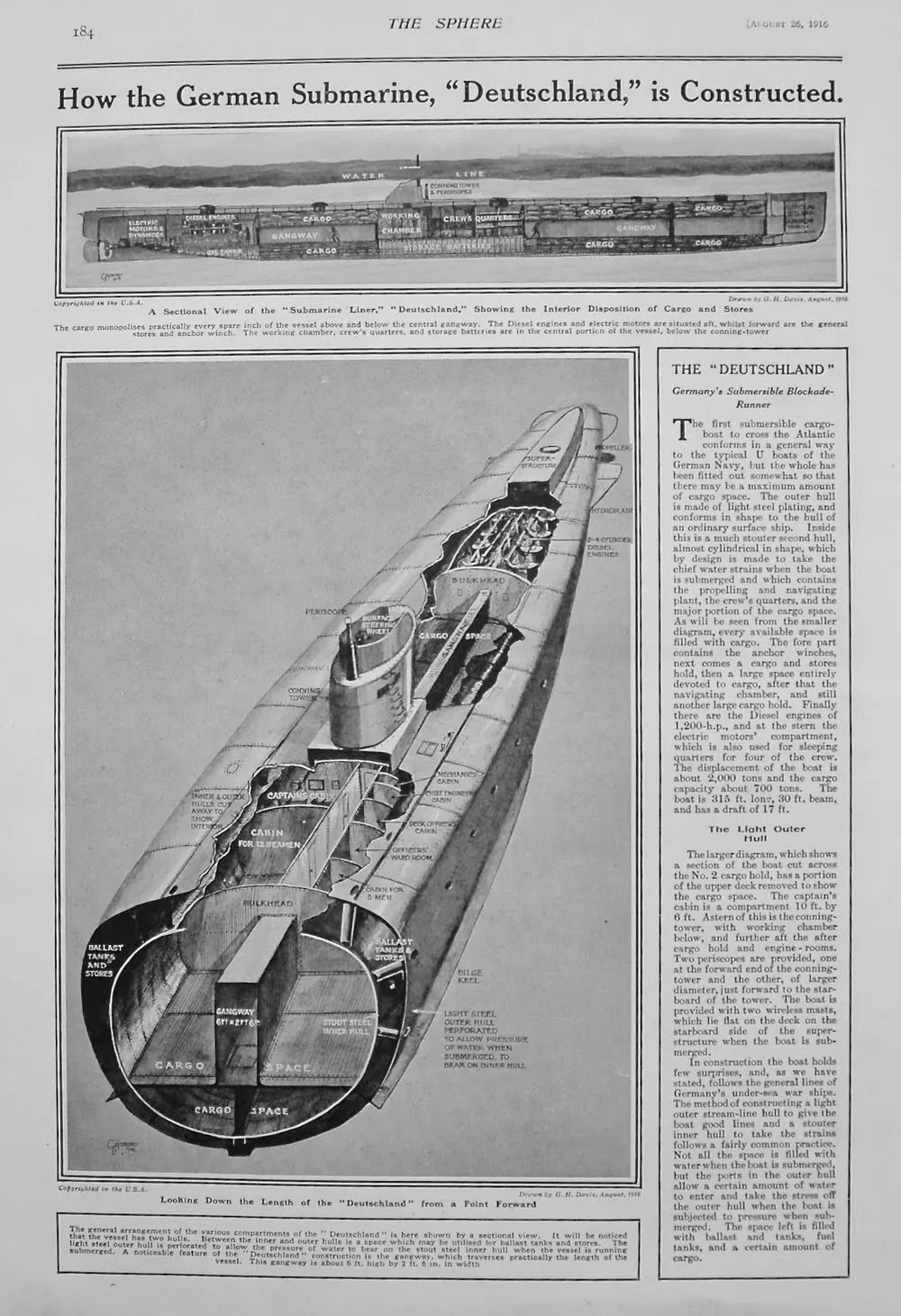
A description of the *Deutschland* merchant submarine's design, featured in the British magazine *The Sphere* in August 1916.
The submarine *Deutschland* was launched on March 28, 1916; by early summer, following the installation of the necessary equipment, the vessel was ready to embark on its maiden voyage.
Voyage to America
Several months before the *Deutschland* entered service, Deutsche Ozean-Rhederei GmbH (German Ocean Shipping Company)—the firm that built and owned the vessel—began recruiting its crew. Sailors and officers with pre-war commercial shipping experience were selected with the utmost care. Naturally, a pivotal role was assigned to the vessel's captain. The company sought a man with years of experience who was prepared to confront the enemy if necessary—not with force of arms, but with words. They soon settled on Paul König, a mariner with over twenty years of service on both merchant and passenger ships, who was fluent in English and well-versed in international maritime law. Yet the most crucial asset König brought to the company was his intimate knowledge of the waters and depths off the U.S. East Coast, where he had spent several years. 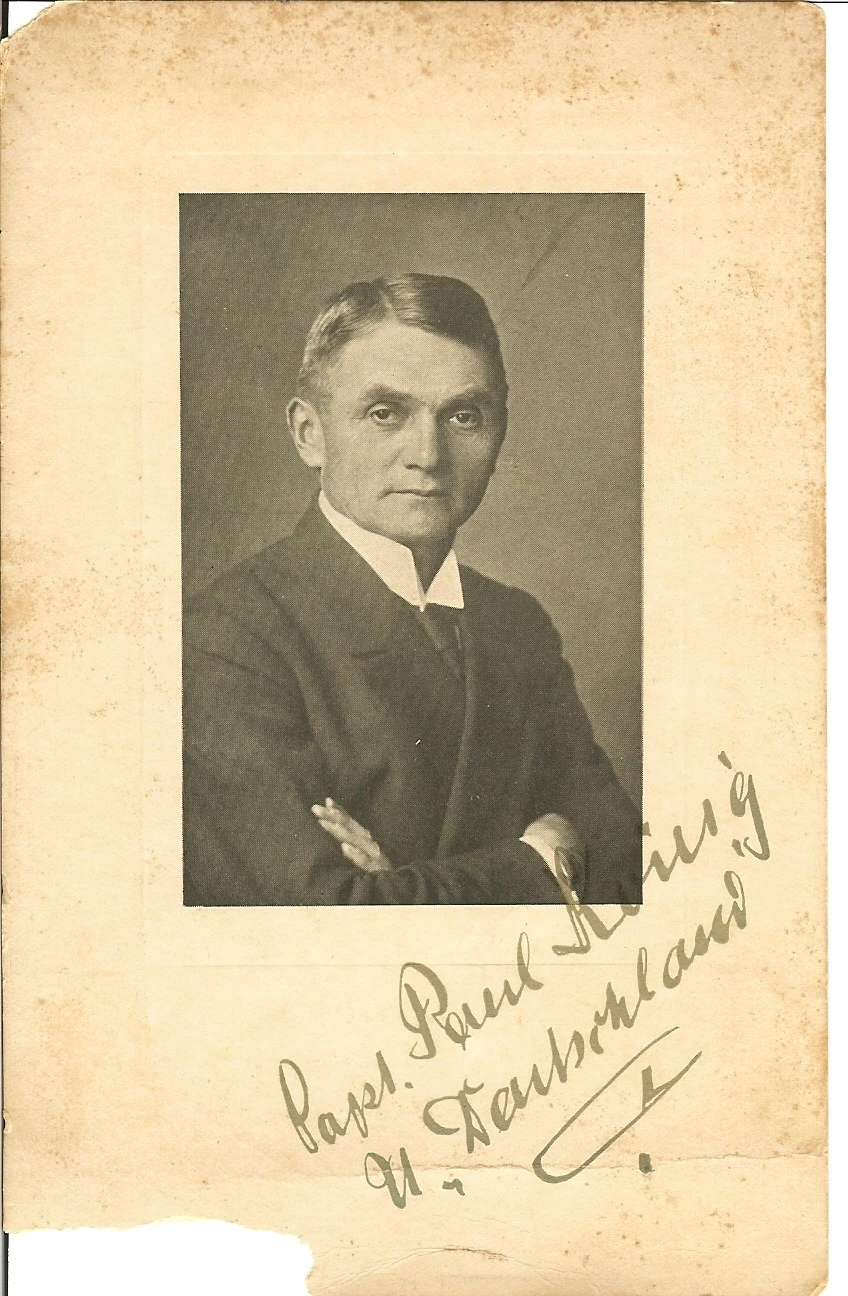
Captain Paul Lebrecht König (1867–1933)
According to the company's leadership, the United States was to be the primary destination for these merchant submarines. This choice was hardly surprising: the U.S. had maintained its neutrality in the raging conflict—even after the sinking of the *Lusitania* in May 1915—and possessed vast reserves of the resources and goods so desperately needed by the German Empire.
On June 14, 1916, the submarine *Deutschland* departed from Bremen, heading toward the East Coast of the United States. Captain König knew that few German ship departures went unnoticed by the British—who maintained extensive intelligence networks within the country—so he decided to alter his route by making a brief stop at the naval port on the island of Heligoland. On June 23, taking every precaution, the *Deutschland* left the port and headed north to round the British Isles. The shortest route to the open Atlantic lay through the Strait of Dover, which separates France and Great Britain; however, since the outbreak of the war, the strait had been heavily guarded, posing a significant risk of detection.
Consequently, König decided to reach the Atlantic via the North Sea. Although patrolled, the North Sea was too vast for the enemy to monitor effectively. The choice of route proved successful; the submarine traveled on the surface for almost the entire journey to the U.S., submerging for only a few hours on a couple of occasions when unidentified ships were spotted. On July 9, the *Deutschland* reached Cape Henry at the entrance to Chesapeake Bay and soon after entered the harbor of Baltimore. 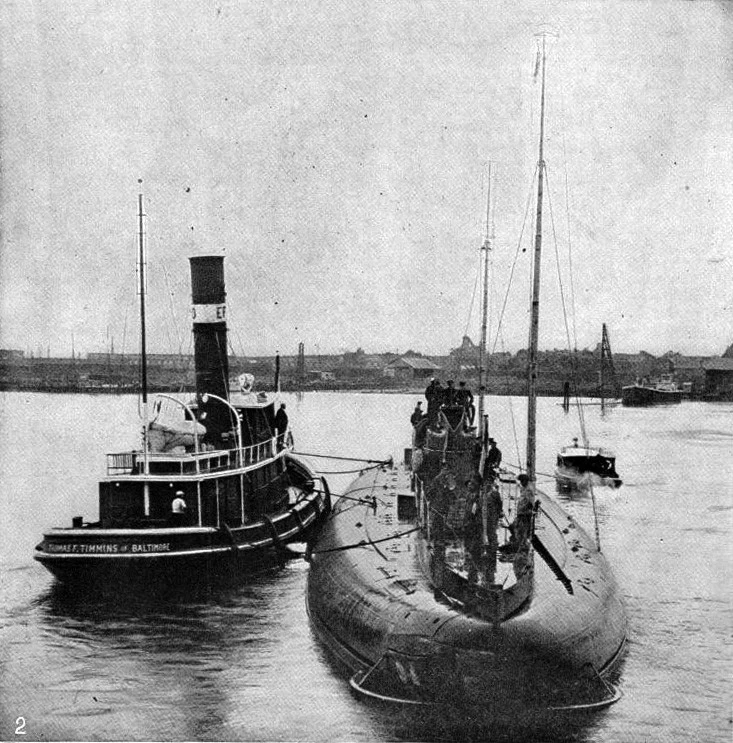
The *Deutschland* being towed to the dock in Baltimore, July 10, 1916
The arrival of such an unusual overseas visitor—a merchant submarine—became a major event. Baltimore residents flocked to the city's harbor to see the new marvel of technology with their own eyes. The boat's crew—and Captain König in particular—became local celebrities, with their photos and interviews appearing on newspaper front pages. Simon Lake, an American submarine pioneer, also took an interest in the *Deutschland* and traveled to Baltimore to see the vessel. Captain König personally conducted a tour of the ship; impressed by its design and innovative features, Lake proposed a contract with the owners to build similar vessels in the United States. 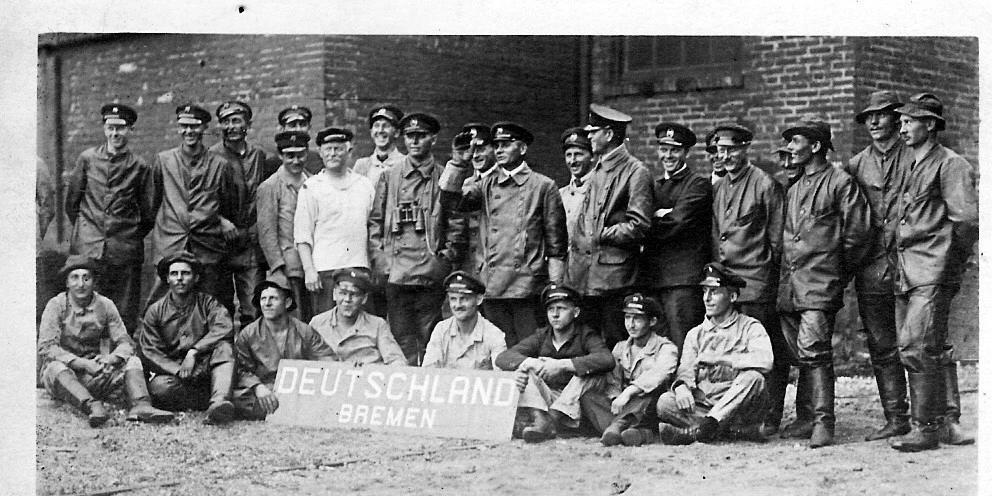
The crew of the *Deutschland* poses for a local Baltimore publication, July 1916.
The *Deutschland* also attracted the attention of French and British officials. Upon learning of its arrival, ambassadors demanded the submarine’s immediate detention and the crew's arrest, arguing that the vessel was a warship. On July 25, at the ambassadors' insistence, a commission from the U.S. Navy Department boarded the *Deutschland* to inspect it for weaponry. However, no weapons were found. Moreover, the crew members were officially listed as employees of the commercial firm Deutsche Ozean-Rhederei GmbH, and none were active-duty military personnel. In reality, however, they were all Imperial German Navy reservists, and some—like Captain König—had served on warships earlier in the war. However, the company’s management had taken steps beforehand to erase an inconvenient entry from the service records of certain crew members. Consequently, the U.S. Navy commission found no violations and cleared Captain König to operate commercially—a move that sparked unprecedented outrage in France and Great Britain. The British intended to dispatch eight cruisers to U.S. territorial waters to sink the *Deutschland* the moment she departed; however, these threats proved futile.
The *Deutschland* remained in Baltimore harbor until August 2, 1916, taking on a cargo of 93 tons of tin, 341 tons of nickel, and 348 tons of raw rubber (much of which was secured to the vessel's exterior). The total value of the cargo exceeded 17.5 million Reichsmarks—four times the cost of the submarine itself. In exchange, the *Deutschland* sold approximately 750 tons of German goods in the U.S.—including chemical dyes, precious stones, pharmaceuticals, and diplomatic mail—generating over 1.5 million Reichsmarks in revenue. Upon leaving U.S. territorial waters, Captain König ordered maximum security measures; the submarine traveled 190 nautical miles submerged, surfacing only at night to take in fresh air. On August 24, having never once been detected by the enemy, the submarine arrived in Bremen. 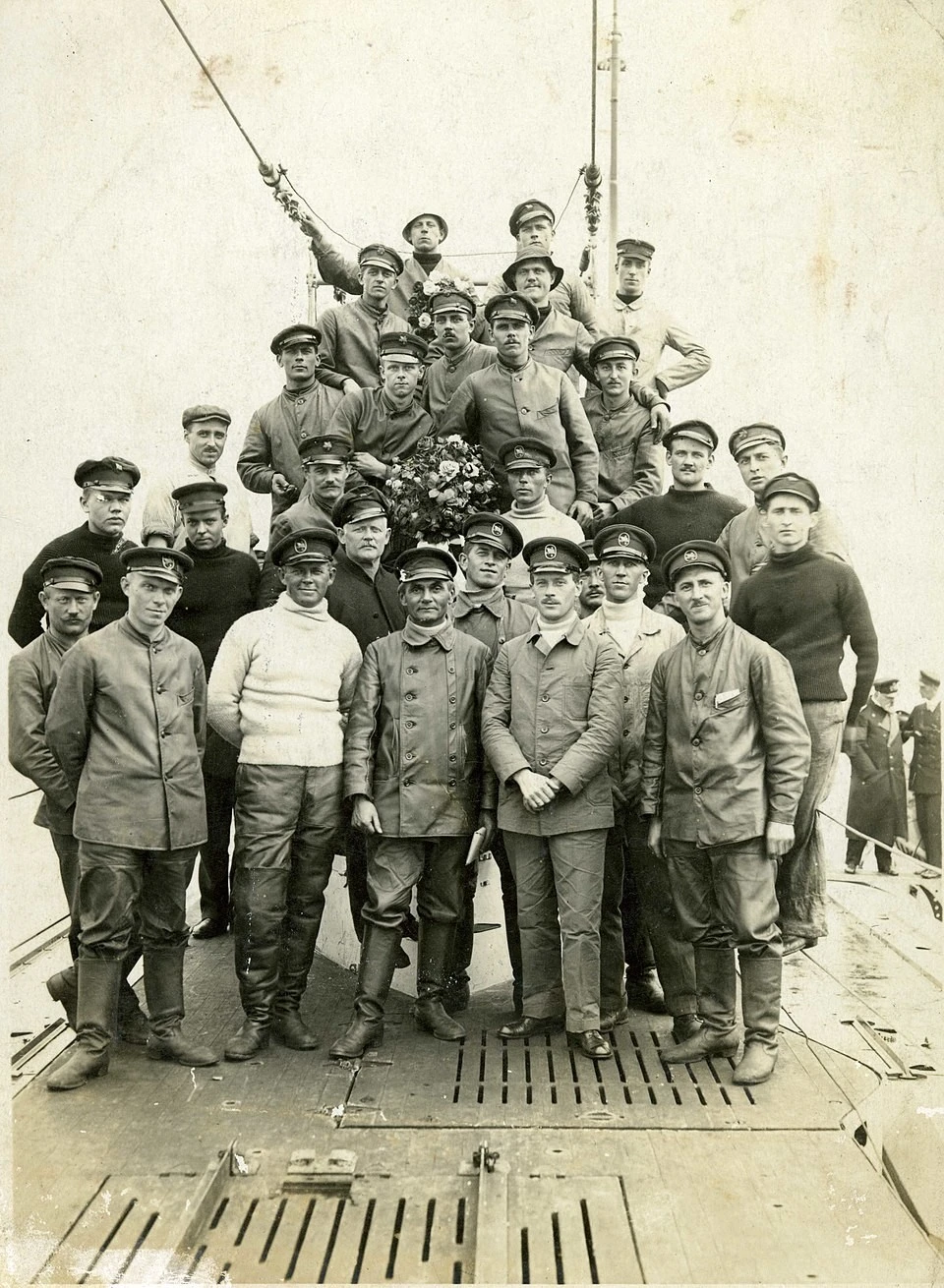
Group portrait of the *Deutschland* crew upon arrival in Bremen, August 1916
A New Voyage
The *Deutschland*'s successful blockade run and return home sparked widespread jubilation across the German Empire. Kaiser Wilhelm II awarded Captain König the Iron Cross, First Class, and the crew received the monarch's commendation. The cargo of valuable resources from the US provided German industry with enough material for three to four months of uninterrupted production of critical supplies for the war effort. This success prompted the German command to dispatch the *Deutschland*'s sister ship, the *Bremen*, to the US as early as September 1916; however, she went missing during the Atlantic crossing.
In November, the *Deutschland* set out for the US again, following the same route but arriving this time in New London, Connecticut. Details of this voyage remain unclear. It is known that the *Deutschland* brought a cargo of precious stones, documents, and pharmaceuticals to America; in exchange, 6.5 tons of silver ingots were loaded onto the vessel, though there is no information regarding other cargo. On November 21, the *Deutschland* departed New London for Bremen, arriving safely in early December. 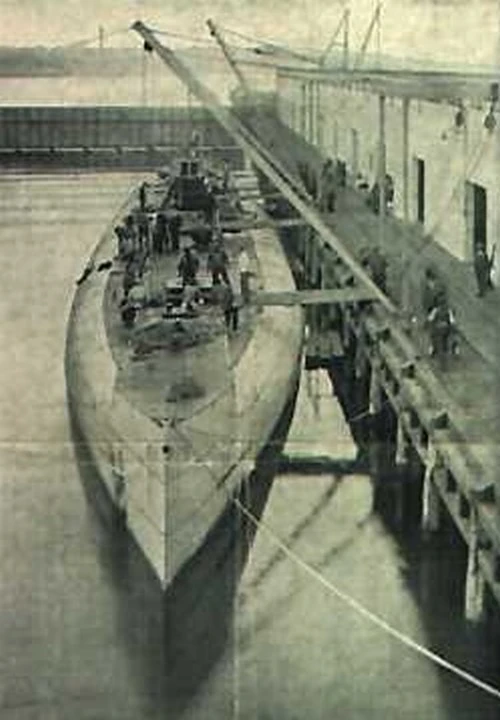
Unloading the *Deutschland* in New London harbor, November 1916
A Time of Change
The successful blockade runs and Captain König's high level of professionalism demonstrated the feasibility of conducting maritime commerce using merchant submarines. The management of Deutsche Ozean-Rhederei GmbH and other German enterprises planned to expand the construction of this class of vessel, intending to establish regular trade routes with the USA and, eventually, supply lines to Germany's African colonies. Five additional *Deutschland*-class submarines were laid down at shipyards. A new voyage for the *Deutschland* under the command of Captain König was scheduled for January 1917; however, relations between the USA and the German Empire soon deteriorated due to Germany's adoption of a policy of unrestricted submarine warfare. The voyage was cancelled. This sequence of events led to the USA entering the war on the side of Germany's adversaries in April 1917, resulting in the cancellation of the merchant submarine construction project. 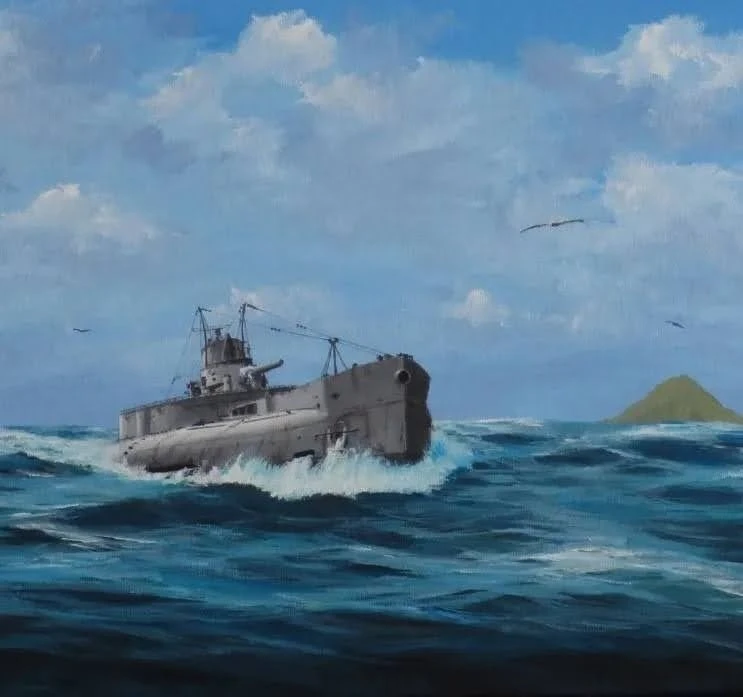
The submarine cruiser *Deutschland*, summer 1917
Because engineer Rudolf Erbach had incorporated the potential for conversion into combat vessels during the design phase of the *Deutschland*-class submarines, they were soon refitted as submarine cruisers equipped with torpedoes and deck guns. This transformation also applied to the *Deutschland*; its merchant crew was replaced by professional naval submariners, marking the beginning of a new chapter in the vessel's history. Boasting excellent range and seaworthiness, the submarine undertook three patrols between the summer of 1917 and November 1918—one lasting over a hundred days—and sank a total of 43 merchant vessels by the end of the war, becoming one of the German Empire's most successful commerce raiders. However, that is a completely different story.