Triumph of Defeat: How the Americans Won a Battle They Lost (4 Photos)
One of the most remarkable naval engagements of World War II in the Pacific took place off the Komandorski Islands. It was not only the northernmost surface action of the war, but also one of the rare gunnery duels fought without the involvement of aircraft or submarines. 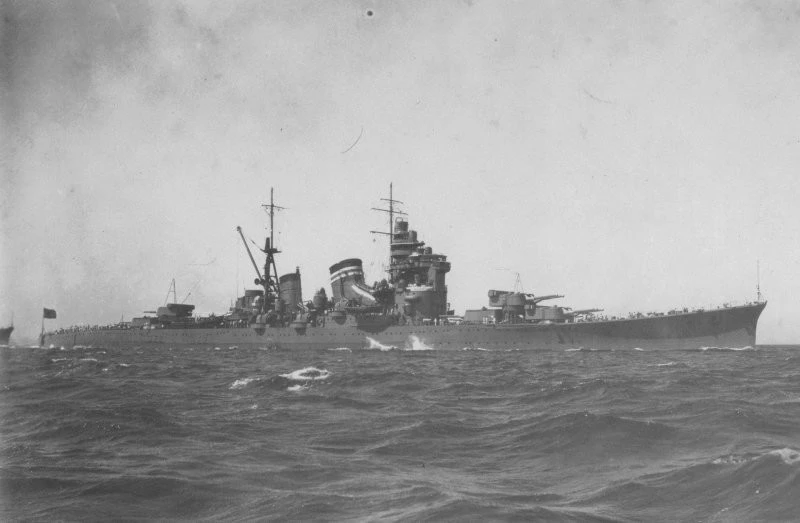
Heavy cruiser Nachi, flagship of Vice Admiral Boshiro Hosogaya’s force during the Battle of the Komandorski Islands. Photo from the 1930s.
In June 1942, as part of preparations for a major offensive in the Central Pacific, Japanese forces landed on the western Aleutian islands of Kiska and Attu. Following their crushing defeat at Midway, the Japanese held these remote outposts as a defensive buffer against potential U.S. strikes toward the Kuril Islands. Although American commanders had no immediate plans for a full-scale assault on these garrisons, they actively targeted supply convoys using submarines and land-based bombers. To survive, Japanese supply ships were forced to run at night or under cover of heavy storms, which severely impaired their efficiency. Seeing no other way to break the impasse, Admiral Thomas Kinkaid decided to deploy surface warships around Attu to enforce a strict blockade.
On the night of February 19–20, 1943, an American patrol unit consisting of the heavy cruiser Indianapolis and the destroyers Coghlan and Gillespie intercepted and sank the Japanese transport Akagane Maru. The message was clear: night runs were no longer safe, and the Aleutian garrisons were now effectively cut off.
In late May, attempting to break the blockade, the Japanese Fifth Fleet assembled a high-speed convoy consisting of two fast transports—Asaka Maru and Sakito Maru. They were escorted by a powerful force under Vice Admiral Boshiro Hosogaya, comprising the heavy cruisers Nachi and Maya, the light cruisers Tama and Abukuma, and the destroyers Wakaba, Hatsushimo, Ikazuchi, and Inazuma. En route, south of the Soviet Komandorski Islands, they were to be joined by the transport Sanko Maru and the destroyer Usugumo. Japan’s primary objective was not merely to breach the blockade, but to deliver vital construction materials needed to finish an all-weather airfield on Attu, which would allow future resupply operations to be conducted by air.
Allied intelligence caught wind of the operation, but drastically underestimated the escorting force, counting only one heavy cruiser, one light cruiser, and four destroyers. Kinkaid dispatched Rear Admiral Charles McMorris with a comparable force—Task Group 16.6 and Destroyer Division 14—including the heavy cruiser Salt Lake City, the light cruiser Richmond, and the destroyers Coghlan, Bailey, Dale, and Monaghan.
Early on the morning of March 27, 1943, American lookouts spotted the Japanese convoy roughly 100 nautical miles south of the Komandorski Islands and 180 nautical miles west of Attu. However, McMorris’s force had already been sighted by the Japanese destroyer Inazuma, which, despite lacking radar, spotted the Americans silhouetted against the brightening southern horizon. Realizing enemy ships were on the horizon, Task Group 16.6 began maneuvering into battle line.
Recognizing he faced warships rather than mere escorts, Vice Admiral Hosogaya ordered the transports to turn east, sending Inazuma with them. The remaining Japanese vessels turned north, then northwest, and at 08:40, Nachi opened fire on the cruiser Richmond. A minute later, Richmond returned fire, followed almost immediately by Salt Lake City. Nachi launched a salvo of torpedoes—all of which missed—before concentrating her fire, alongside the rest of Hosogaya’s fleet, on the American flagship. At 08:50 and 08:52, Nachi was struck by two pairs of 6-inch shells from Richmond. The damaged flagship lost radio communications, suffered a flooded torpedo room, had her bridge wrecked, and lost electrical power to her gun turrets, forcing her to temporarily drop out of the line. 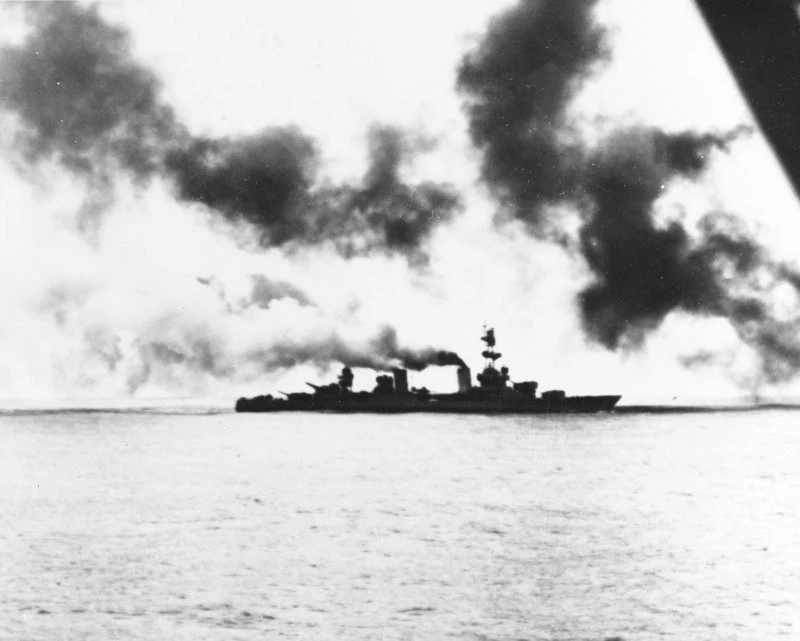
Heavy cruiser Salt Lake City under enemy fire during the Battle of the Komandorski Islands, March 27, 1943.
Before long, however, Japanese numerical superiority began to take its toll. Salt Lake City came under intense fire from the remaining Japanese warships. Heavy cruiser Maya was particularly effective: a spotter plane launched from Nachi provided such accurate target corrections that the Americans believed the enemy was using advanced radar. Between 09:10 and 11:52, Salt Lake City sustained five hits from Maya’s 8-inch guns and several 5.5-inch hits from Abukuma, which pierced her hull, causing severe flooding and triggering a fire in the main boiler room. Counter-flooding extinguished the flames and corrected the list, but the cruiser eventually came to a complete stop in the water.
Richmond and the destroyer Dale closed in on the crippled Salt Lake City to lay a protective smoke screen, while McMorris ordered his remaining destroyers to press forward with a counter-attack. Coghlan, Bailey, and Monaghan managed to close the distance, and from roughly 9 kilometers out, Bailey launched a salvo of torpedoes—none of which found their target. At that precise moment, Bailey was hit by a salvo of heavy shells; an 8-inch round tore through her engine room, knocking out her propulsion. The nearby Coghlan was also hit, but along with Bailey, continued firing, scoring hits on Nachi’s superstructure. Neither Coghlan nor Monaghan was able to launch torpedoes.
The Americans were on the verge of total destruction, but they were saved by Vice Admiral Hosogaya’s extreme caution. Unaware that Salt Lake City was helpless and had completely exhausted all 806 rounds of her armor-piercing main ammunition—and burdened with protecting valuable transports—he decided to break off the attack. The Japanese feared an imminent American air strike. McMorris had indeed radioed for air support from the U.S. Army Air Forces base at Adak, but the squadron of Consolidated B-24 Liberators dispatched to assist got lost in heavy fog and returned without finding the battle. 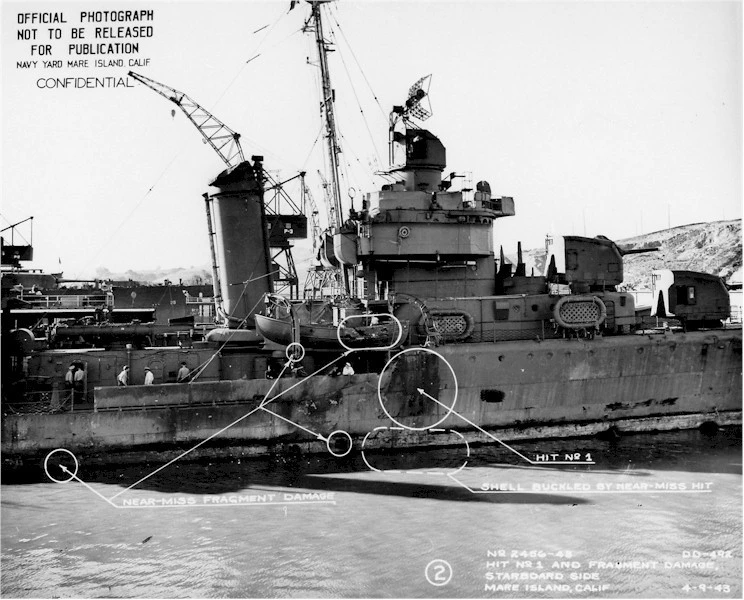
Battle damage to the destroyer USS Bailey following the action off the Komandorski Islands. Photo taken at Dutch Harbor, March 30, 1943.
The Japanese retreated to Paramushir Island, where they assessed their casualties: minor damage to the heavy cruisers Nachi and Maya, with 14 killed and 26 wounded. The American force also managed to limp back to Dutch Harbor under its own power. Salt Lake City, Coghlan, and Bailey were all sidelined for extensive repairs. Despite the intensity of the engagement, U.S. casualties were lighter than the enemy's: 7 killed and 20 wounded.
In tactical terms, the battle was an American victory—the Japanese effectively handed over a battle they had already won, retreating at the decisive moment. No further surface attempts were made to break the naval blockade of the Aleutian Islands. With no supplies to finish the airfield on Attu, Japan was forced to rely entirely on submarines to keep its isolated garrisons alive.