When you see a massive ocean liner cutting through the waves under a vast sky, you might wonder: what enables its ability to travel thousands of miles without stopping? This is possible thanks to the ship's "heart," its lifeblood, which converts fuel into motion. It's called the propulsion plant (PP). 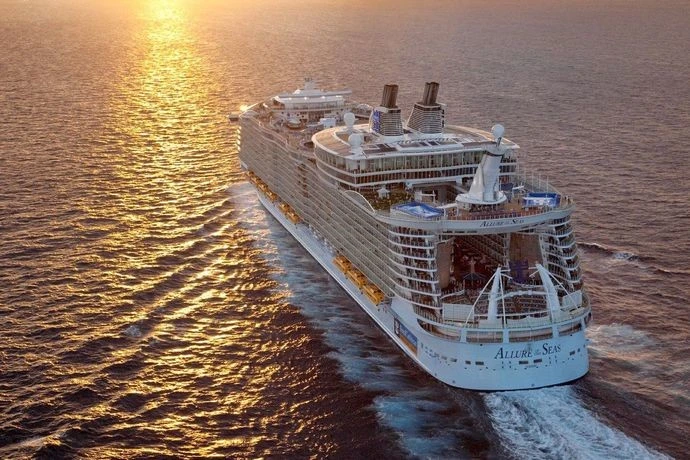
Allure of the Seas
Just as the human heart pumps blood to nourish the organs, the propulsion plant supplies power to all systems of a floating vessel: from propellers to navigation instruments, from air conditioning systems to galleys and cabins. Without it, a ship is just a lifeless hull, frozen in the water.
The importance of the propulsion plant is difficult to overestimate: it determines how quickly a ship reaches its destination, how many days it can spend at sea without refueling, and whether it can quickly change course in a storm. It's not just a set of mechanisms—it's a symphony of energy, where each element plays its part to keep the ship alive and steerable.
How does a propulsion system work? What types are there? Why is a propulsion system the key to the safety and efficiency of sea voyages?
Let's take a closer look.
Design and Operating Principle
A marine propulsion system is a complex of machines, devices, and systems that convert the chemical or nuclear energy of fuel into mechanical energy, and then into electrical energy. Simplistically, it can be divided into three key components:
1. Primary Energy Source
Boiler, diesel engine cylinders, nuclear reactor—this is where the fuel "burns," releasing heat.
2. Energy Converter
Turbine, engine — thermal energy is converted into mechanical energy by rotating the shaft.
3. Distribution systems.
Gearboxes, propellers, generators — transmit energy to consumers.
The operating principle can be compared to a bicycle mechanism. The fuel is the muscle power of the legs, the engine is the chain and sprockets, and the propeller is the "wheel" pushing the ship forward. The only difference is the scale and complexity of these mechanisms. Instead of human muscles, there are tons of burning fuel, instead of a chain, there are huge turbines, and instead of a wheel, there is a massive propeller cutting through the water. 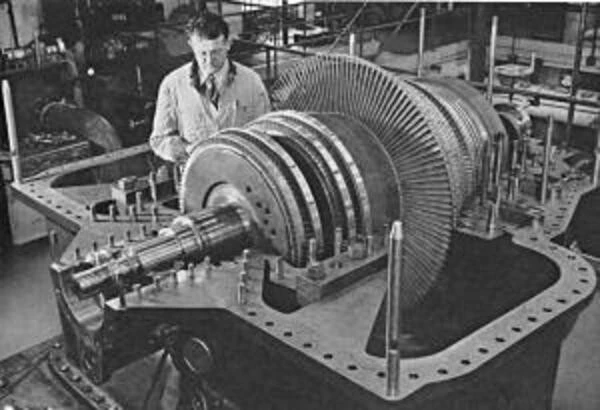
Medium-power marine steam turbine with top cover removed
For example, in a classic diesel propulsion plant, fuel is injected into the cylinders and ignited. The expanding combustion products create high pressure, which pushes the pistons. The pistons rotate the crankshaft, transmitting torque to the gearbox and then to the propeller. At the same time, some of the energy is used by generators that power lighting, communication systems, as well as household appliances and machinery.
Types of Marine Propulsion Plants
Propulsion plants vary by the type of fuel used, their design, and their intended purpose. Main types:
1. Steam engines — historically the first, they ran on coal or fuel oil. Water was heated in a boiler, turning it into steam, which drove the pistons of a steam engine or turned a turbine. Such systems were used on steamships of the 19th and 20th centuries, including the legendary Titanic. They were cumbersome, but they dramatically accelerated maritime transport.
2. Diesel engines — these are the dominant type today. They use fuel oil or diesel fuel, and less commonly, liquefied natural gas. An example is the powerful Weitsila-Sulzer engines installed on container ships. They are compact, fuel-efficient, and capable of operating over a wide range of loads.
3. Gas turbine engines are used on warships and high-speed passenger ships. These engines produce enormous power, allowing speeds of over 30 knots, but they consume a lot of fuel.
4. Nuclear power plants – used on nuclear icebreakers, submarines, and some research vessels. The reactor heats water, creating steam for turbines. These nuclear power plants provide virtually unlimited autonomy – a ship can remain at sea for months without refueling.
5. Hybrid and alternative systems – combine diesel engines with batteries, solar panels, or wind turbines. They are used on eco-friendly vessels seeking to reduce emissions. 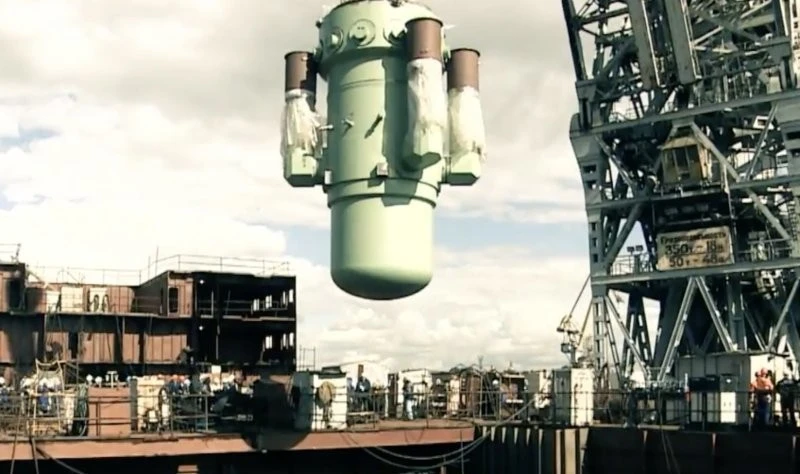
The LK-60Ya-class icebreaker's nuclear reactor
The Evolution of the SPP
Here are a few striking examples illustrating the development of the SPP.
Historical: Steamships of the Industrial Revolution.
In the 19th century, steam engines transformed sea travel. A ship equipped with a steam boiler and piston engine could overcome currents and winds without relying on sails. However, such vessels required frequent stops to load coal, which limited their range. Nevertheless, steamships laid the foundation for regular transoceanic transport, transforming global trade.
Modern: A ship with a diesel engine.
Such engines are also used in modern shipping giants—container ships. For example, Vaitsila-Sulzer engines can have up to 14 cylinders and produce over 100,000 horsepower. They run on heavy fuel oil, but are also adapted to the more environmentally friendly LNG. Such installations allow ships to carry tens of thousands of standard containers, saving fuel and reducing delivery times. 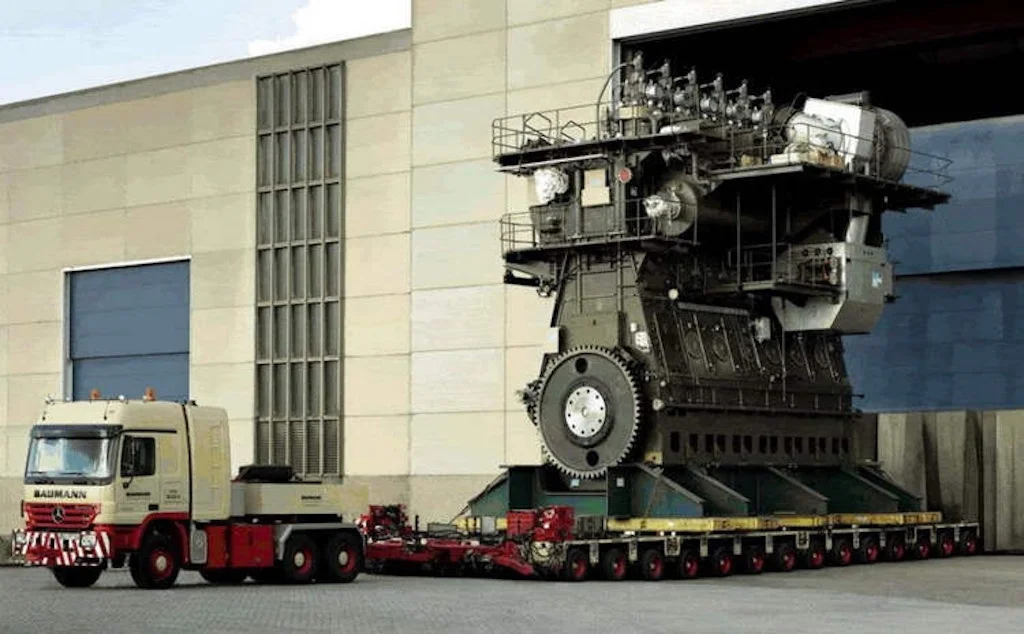
Transporting a Wärtsilä-Sulzer RTA96-C Engine
High-tech: Project 22220 nuclear icebreaker.
Nuclear icebreakers are the pinnacle of engineering. Their propulsion systems include two reactors, providing shaft power of approximately 60 MW. This allows them to break through ice more than 3 meters thick and operate for several years without refueling. An icebreaker becomes more than just a vessel, but a floating city, capable of supporting its crew and performing complex missions in the Arctic.
Experimental: sailing vessels with solar panels.
Some modern designs, such as cargo ships with rigid sails and solar panels, demonstrate a commitment to sustainability. Their propulsion systems partially replace traditional engines, harnessing wind and solar power. While these vessels cannot yet compete with the giants of the container industry, they are setting future trends.
The Impact of a Propulsion System on Ship Performance
A propulsion system directly determines three key parameters:
1. Speed.
The more powerful the system, the faster the ship. However, power is not the only factor: hull streamlining, load, and sea conditions are also important. For example, gas turbine-powered warships sacrifice fuel efficiency for speed, while cruise ships balance comfort and fuel consumption.
2. Maneuverability.
The ability to quickly change direction and speed depends on the type of drive. Modern propulsion plants are equipped with reversing mechanisms that allow the propeller to rotate in both directions. This is critical in ports, where the ship must carefully approach the berth, or during storms, when a sudden change of course is required.
3. Autonomy.
The capacity of the fuel tanks and the efficiency of the propulsion plant determine how long a ship can remain at sea. Nuclear-powered ships excel in this regard – an icebreaker can operate for years, while a diesel tanker requires refueling every 2–3 weeks. Eco-friendly hybrid systems are currently inferior in range, but offer advantages in reducing emissions.
Differences in Subsystems
To understand how a propulsion plant operates as a whole, it must be divided into three subsystems:
1. Main Propulsion Plant – Main Propulsion Plant
This is the "engine department" responsible for propulsion. It includes engines, gearboxes, and propellers. The propulsion system determines how fast and far a ship can travel. For example, on an aircraft carrier, the propulsion system must provide sufficient speed for aircraft to take off, while on a tugboat, it must provide thrust to move other vessels.
2. Auxiliary Power Plant (APP).
This system maintains "life" on board. It powers pumps, air conditioners, water treatment systems, the galley, and crew quarters. The APP ensures that even on the open ocean, sailors have hot water, electricity, and comfortable conditions. Without it, a ship would be a desert island in the middle of the ocean.
3. Electric Power System (EPS).
Generates and distributes electricity. It consists of generators, distribution boards, and cables. The power system powers navigation systems, communications, medical equipment, and, on cruise ships, entertainment systems. Its reliability is critical, as a failure could leave the ship without communication with the outside world. 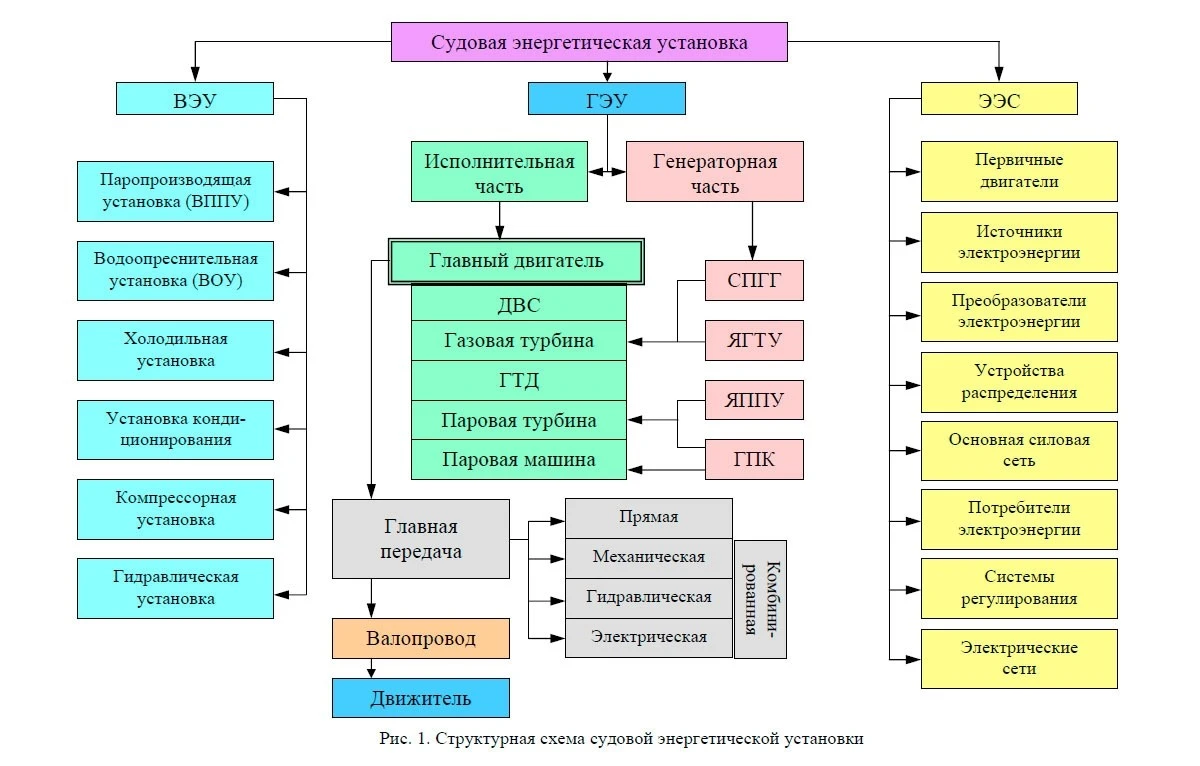
Structural diagram of the power plant
These systems are interconnected. For example, some of the energy from the power plant is used to power the power system generators, and the wind turbine can use the same fuel tanks as the power plant. Together, they create a unified ecosystem, where a failure in one link can paralyze the entire ship.
A ship's propulsion system is more than just a collection of machines; it's the lifeblood of any floating vehicle. Understanding its operation provides insight into the following:
why a container ship can cross the ocean in two weeks;
how a nuclear-powered icebreaker cuts a path through Arctic ice;
Why a cruise ship remains comfortable even in the midst of a storm.
What does the future hold for nuclear power plants? Trends point to the following:
Growing popularity of hybrid systems. Combinations of diesel engines, batteries, and renewable energy sources will help reduce carbon dioxide emissions.
Development of hydrogen technologies. Hydrogen can become an alternative to traditional fuel, providing high power without harmful emissions.
Improvement of nuclear power plants. Next-generation miniature reactors will make nuclear ships even safer and more efficient.
Integration with artificial intelligence systems. Automatic control systems for nuclear power plants will optimize fuel consumption, predict breakdowns, and adapt operation to sea conditions.
Thus, the solar power plant remains not only a technical but also a philosophical mystery: how to transform dead fuel into a living force capable of conquering the oceans. And the further technology advances, the more people admire this marvel of engineering.
Add your comment
You might be interested in:














Margaret Hamilton Dies at 90: The Story of the Moon

25 Incredibly Beautiful and Rare Stones (26 Photos)

16 Fascinating and Surprising Facts About Life in Sweden

Hypnotic and Oddly Satisfying GIFs That Show How Food Is

"What Is This Thing?": 20+ Bizarre Objects That

13 "Healthy" Habits You Should Actually Quit (14
Cassini Spacecraft Reveals Saturn’s Rings (10 Photos)

How Germany Got a Mountain Made of Salt (6 photos)

30 Everyday Details That Will Change How You See the World
