Our planet is full of places that look as if they belong to entirely different worlds. These surreal landscapes will make you second-guess whether you are still on Earth. Ocean depths frozen in stone, twisted forests, blindingly white deserts, and glittering crystal caves—these are all real destinations that any traveler can visit. 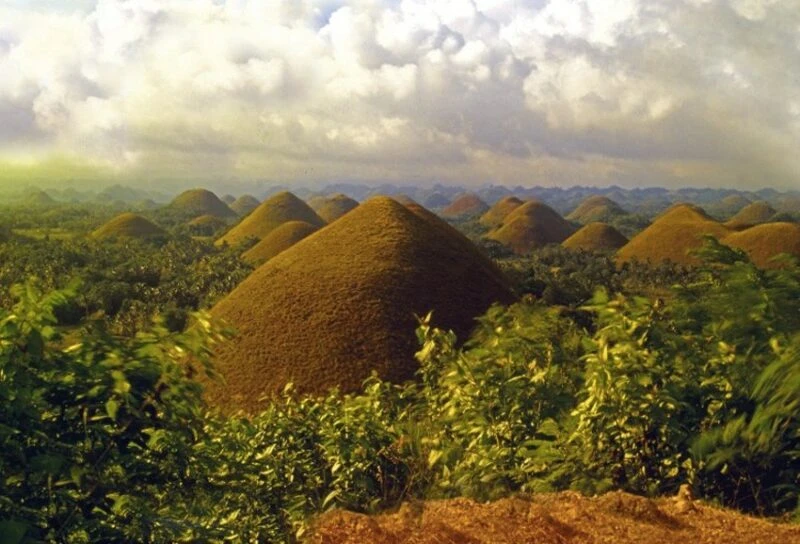
After diving to the bottom of the Mariana Trench, director James Cameron admitted it felt like landing on another planet. But you don't need to descend to record-breaking depths in a submersible to feel like a space pioneer. Simply head to one of these ten incredible locations, where nature has set a scene fit for the boldest science fiction films.
Pancake Rocks, New Zealand
On the west coast of New Zealand's South Island lies one of the planet's most unusual geological formations. Thousands of flat limestone slabs are stacked on top of one another, looking as if a giant had neatly piled up a tower of pancakes. 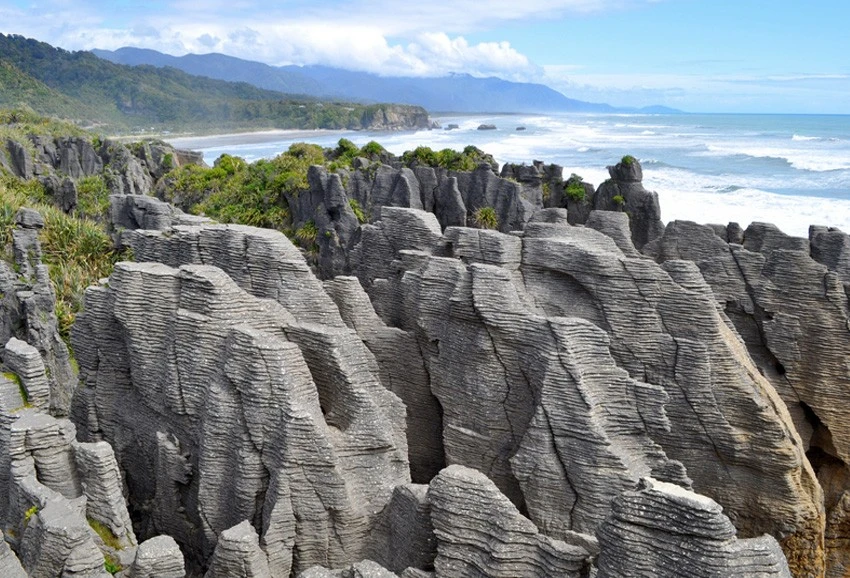
The history of this remarkable site began around 30 million years ago, when the entire area sat at the bottom of an ancient ocean. Over millions of years, alternating layers of limestone and mudstone formed, driven by changing climate conditions and ocean currents.
When tectonic forces pushed the seabed up to the surface, wind and water went to work, patiently carving horizontal grooves between the layers of varying hardness. Today, these natural sculptures reach heights of up to 15 meters. At high tide, crashing waves surge into vertical blowholes, shooting dramatic bursts of ocean spray high into the air.
The Crooked Trees, Canada
In Saskatchewan, Canada, there is a grove that seems to defy the laws of botany and common sense. Here, trembling aspens grow with trunks twisted into bizarre spirals, loops, and bends, as though frozen mid-dance. Locals refer to the area as the "drunken forest" or the "dancing trees." 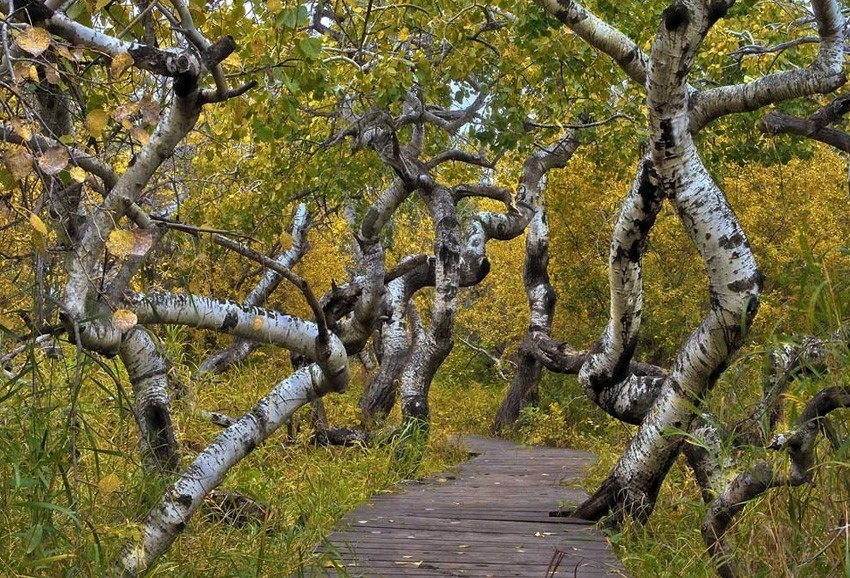
Scientists have yet to reach a consensus on what caused this anomaly. Some suggest a genetic mutation, while others attribute it to unique soil conditions or subterranean water flows. Another theory points to severe winds battering young saplings, or the pressure of heavy ice sheets that once covered the region.
Even more mysteriously, this warping affects only the aspens, while other tree species growing right beside them remain completely straight. The grove has a surreal feel, especially in the morning mist when the gnarled silhouettes resemble an alien forest from another world.
The White Desert, Egypt
Deep in the heart of the Sahara in northeastern Egypt lies a desert that looks as if it has just been blanketed by heavy snowfall. In reality, this dazzlingly white landscape is made of chalk and limestone—the remnants of an ancient ocean that covered the area millions of years ago. 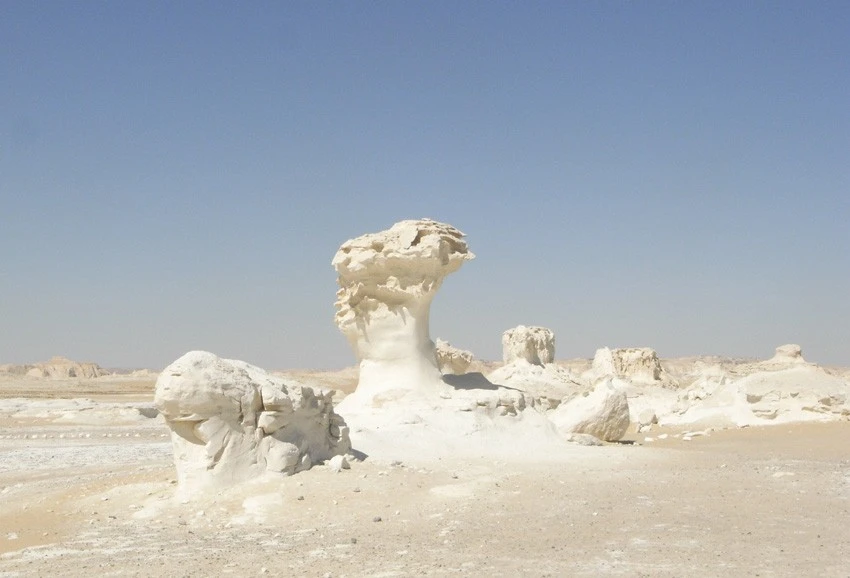
As the sea retreated, it left behind deposits of shells and skeletons from countless marine microorganisms. Over millennia, wind erosion shaped these soft rocks into unbelievable structures—giant mushrooms, sphinxes, cones, pillars, and figures that resemble birds or mythical beasts.
The desert is especially magical at sunset, when the snow-white rock formations glow in shades of pink and gold. At night, under the starry Saharan sky, the landscape takes on a truly cosmic atmosphere. Spanning roughly 300 square kilometers, the White Desert continues to evolve slowly under the force of sandstorms, sculpting new natural masterpieces every year.
Socotra, Yemen
This archipelago in the Indian Ocean is widely considered the most alien-looking place on Earth. Having broken away from the African continent around six million years ago, the islands developed in near-total isolation, giving rise to a unique ecosystem found nowhere else on the planet. 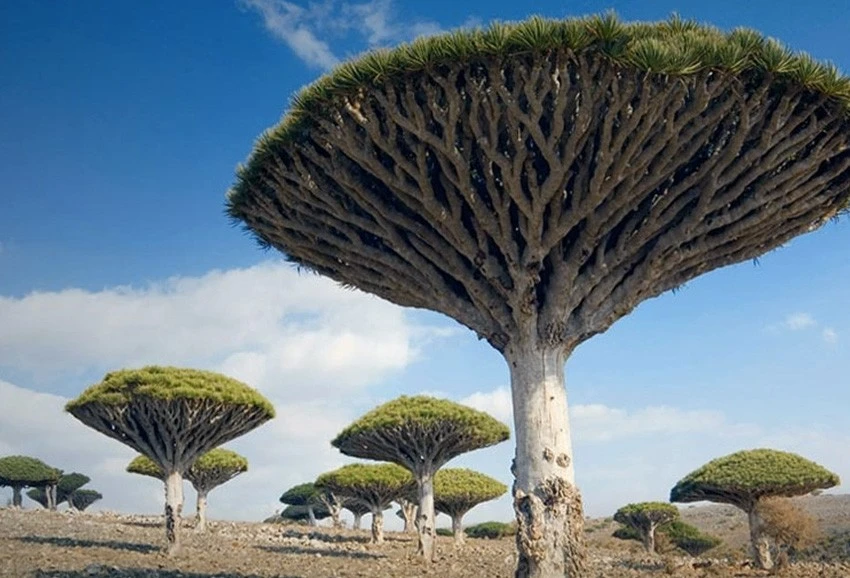
The undisputed symbol of Socotra is the Dragon's Blood Tree—a bizarre plant that looks like an inverted umbrella or a flying saucer atop a thick trunk. Its crimson resin, known locally as "dragon's blood," has been used since ancient times as a dye and traditional medicine.
Yet the Dragon's Blood Tree is just one of 800 plant species on the island, a third of which are endemic. Here you can find bulbous cucumber trees with trunk shapes resembling bottles, giant aloes, and strange succulents of unthinkable shapes. The island's landscape is further embellished by pristine white dunes, turquoise lagoons, limestone caves, and rugged mountain plateaus.
The Atacama Desert, Chile
The Atacama is the driest non-polar place on Earth, so barren that NASA uses it to test Mars rovers and refine techniques for searching for life on the Red Planet. Some weather stations in the desert's central basin have never recorded a single drop of rain, and certain areas have seen no rainfall for over 400 consecutive years. 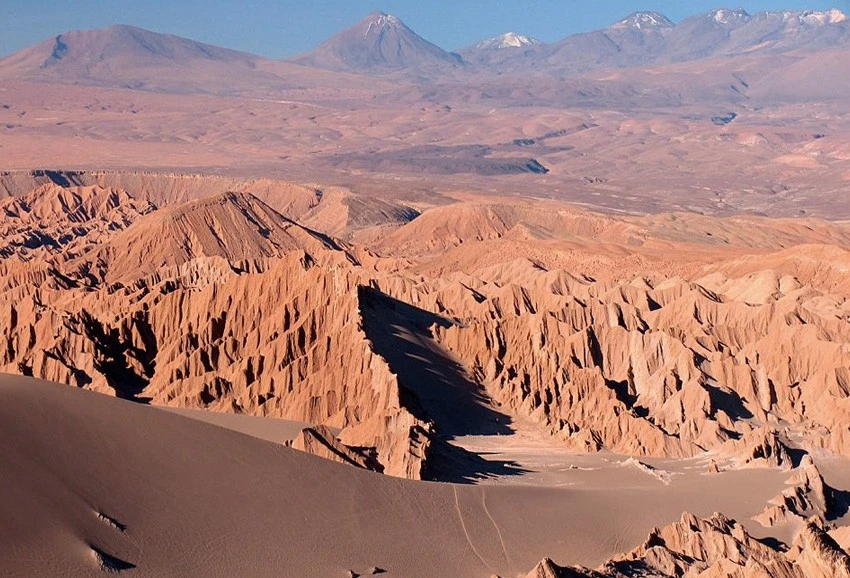
The soil of the Atacama is strikingly similar to Martian terrain—sharing the same reddish hue, mineral composition, and total sterility in its driest stretches. Despite its extreme harshness, the desert is breathtakingly beautiful. It features salt lakes in vivid shades ranging from turquoise to bright pink, massive salt flats that look like snowfields, and valleys filled with otherworldly rock formations carved by wind.
Every few years, when rare rains fall, the desert miraculously bursts into bloom with millions of wildflowers whose seeds can lie dormant for decades. The Atacama is also home to some of the world's premier astronomical observatories, as its crystal-clear air and minimal light pollution make for the best night skies on Earth.
Pamukkale, Turkey
The name of this site translates from Turkish as "cotton castle," and standing before the dazzling white terraces set against lush green hills, it is easy to see why. Over thousands of years, seventeen geothermal springs with water temperatures ranging from 35 to 100 degrees Celsius have shaped this breathtaking natural wonder. 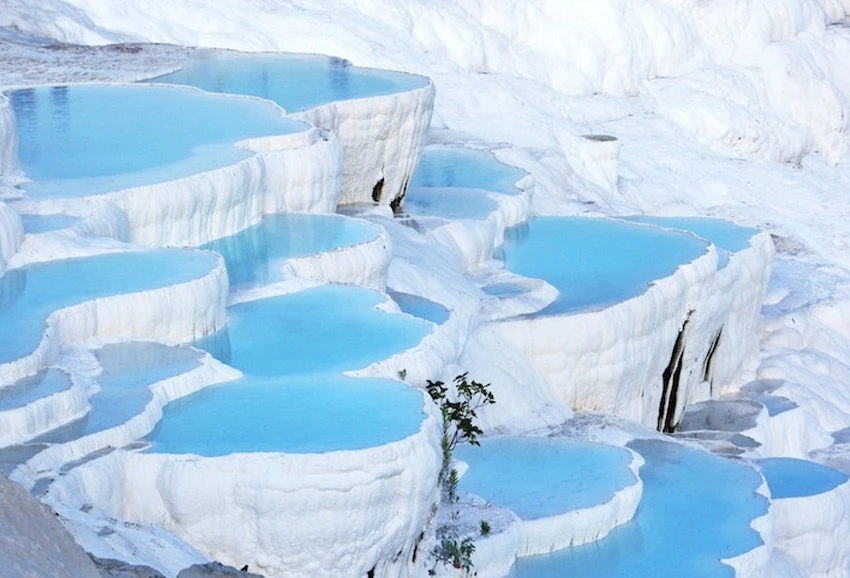
Calcium carbonate-rich waters cascade down the mountainside, creating a series of natural pools that resemble giant basins carved from snow-white stone. As the water cools, the calcium precipitates into travertine—a porous, milky-white sedimentary rock. This process is ongoing, continuously reshaping and building up the terraces day by day.
From above, Pamukkale looks like a frozen waterfall or a cascade of fluffy white clouds tumbling down the mountain. The ancient Romans built the spa city of Hierapolis here, and its ruins still stand right beside the travertine pools. The thermal waters' therapeutic properties have been prized for millennia, attracting emperors and royalty throughout history.
Cave of the Crystals, Mexico
In 2000, miners drilling a new tunnel at the Naica Mine in Chihuahua, Mexico, stumbled upon a sight straight out of a science fiction movie. Behind a rock wall lay a cavern filled with colossal selenite crystals—some measuring up to 12 meters in length and weighing as much as 55 tons. 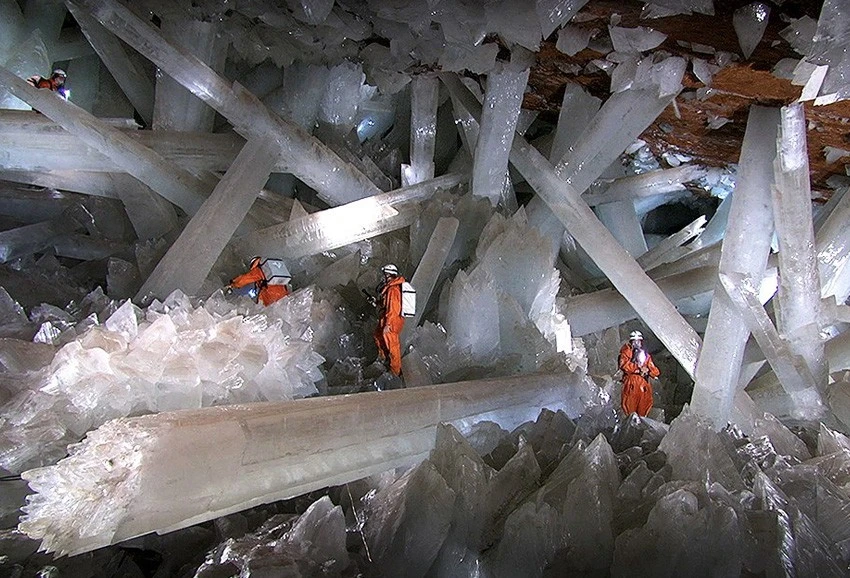
Crisscrossing at varied angles, these translucent beams form a surreal labyrinth of gleaming pillars, beams, and needles. They grew over roughly 500,000 years under extraordinary conditions: the cave was flooded with hot, mineral-rich groundwater while temperatures remained a constant 58°C.
Entering the Cave of the Crystals is lethal without specialized cooling gear. In 58°C heat and 90 to 100 percent humidity, a person can survive inside for no more than 10 minutes, even in a protective suit, before suffering severe heat stroke. Today, the cave has been re-flooded with groundwater to preserve the crystals, as exposure to air causes them to degrade and lose their clarity.
Zhangjiajie, China
When director James Cameron was seeking inspiration for the alien moon Pandora in
Avatar
, he found it in the Zhangjiajie Mountains. Located in northwestern China's Hunan province, this area features a landscape that seems physically impossible. 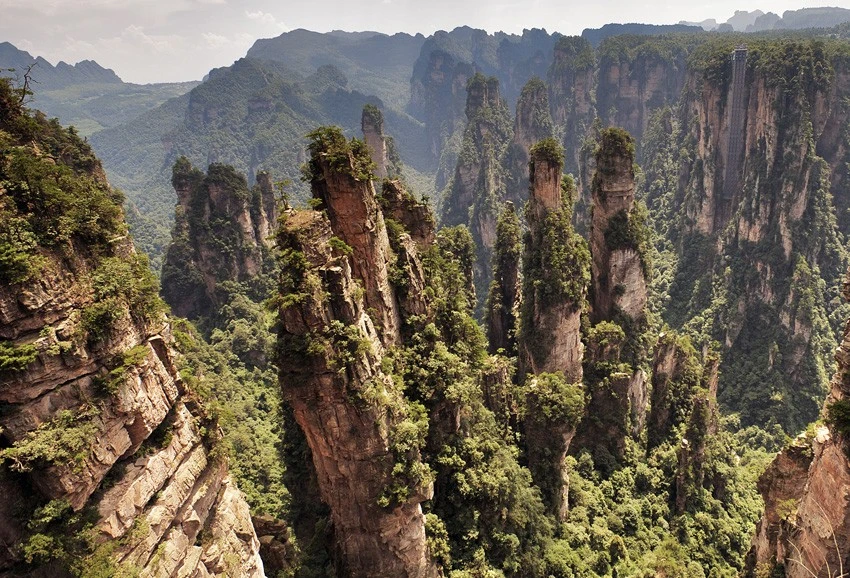
More than three thousand giant quartzite sandstone pillars tower over the forest floor, some rising up to 200 meters high. Covered in lush vegetation and frequently shrouded in mist, these vertical monoliths create the illusion of floating mountains. They evolved over 380 million years: once an ocean floor, then an elevated plateau, the rock was slowly carved away by wind, water, and erosion, leaving behind only the sturdiest spires.
The national park spans some 13,000 square kilometers, encompassing deep ravines, cascading waterfalls, limestone caves, and subtropical forests. Following the release of
Avatar
, one of the park's iconic pillars was officially renamed "Hallelujah Mountain" in honor of the floating peaks of Pandora. To accommodate visitors, officials constructed the world's longest and highest glass-bottomed bridge, offering dizzying views of the stone forest below.
The Chocolate Hills, Philippines
On Bohol Island in the Philippines, nature has crafted one of the world's most geometrically striking and mysterious landscapes. Somewhere between 1,200 and 1,800 near-perfect conical mounds cover an area of over 50 square kilometers. 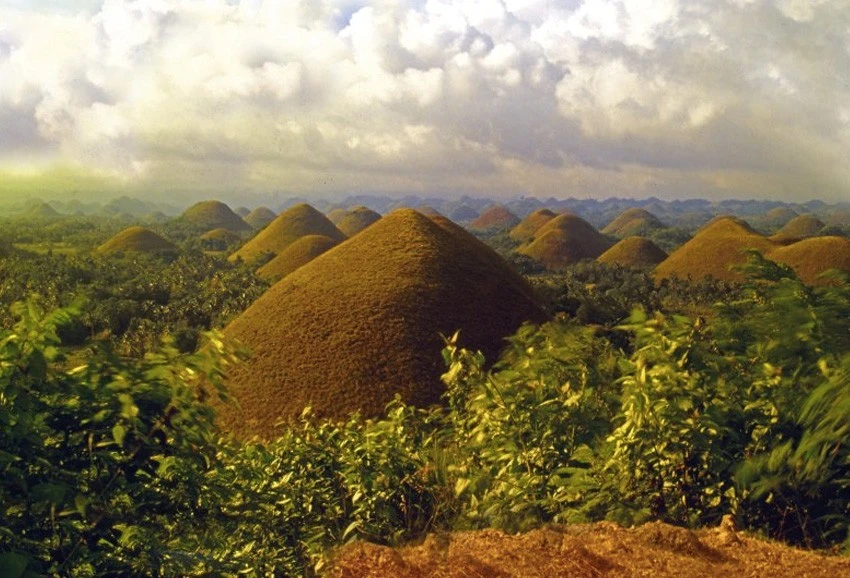
What makes them so extraordinary is their consistent size—ranging from 30 to 50 meters in height—and their surprisingly uniform distribution, as if laid out on a grid. For most of the year, the hills are blanketed in green grass. However, during the dry season from February to May, the vegetation dries out and turns a rich chocolate brown, giving the landmark its name.
Geologists offer several explanations for the formation of the Chocolate Hills, ranging from marine limestone uplifted from ancient seas to severe weathering. Local folklore offers a far more romantic spin: one legend speaks of two battling giants who hurled boulders and sand at each other, while another tells of a giant weeping over the loss of his mortal love, his tears drying into the rounded hills seen today.
Yehliu, Taiwan
Along the northern coast of Taiwan lies a geopark where nature works like a surrealist sculptor. Spanning roughly 1,700 meters of shoreline, the coast has been transformed by wind, waves, and time into an open-air gallery of bizarre rock formations. 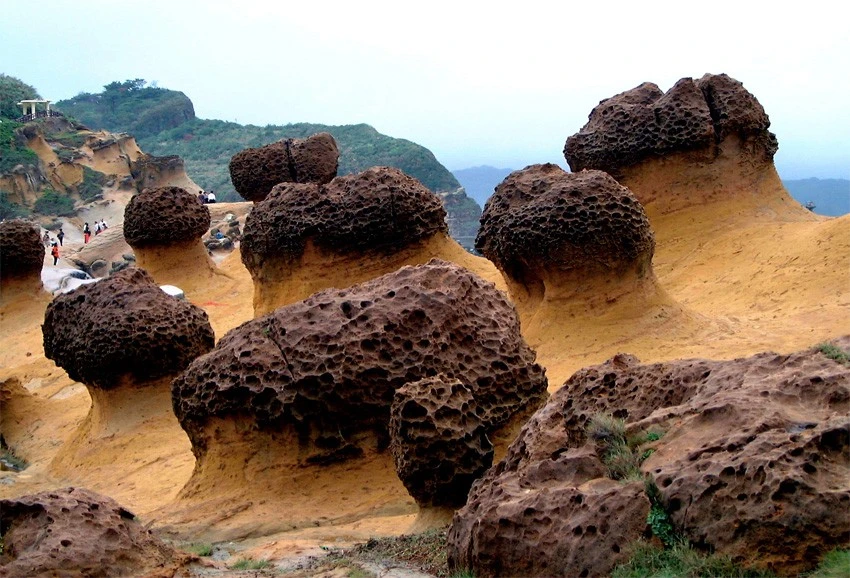
Here, visitors can spot giant stone mushrooms resting on slender stems, rocks resembling blocks of tofu or ginger roots, petrified candles complete with melted wax drippings, and even a spire shaped like a royal profile. The park's most famous landmark, the "Queen's Head," bears such a striking resemblance to a monarch's profile with an elegant neck and elaborate hair that it looks artificially sculpted.
These otherworldly shapes are formed by the uneven density of sandstone layers—softer rock erodes quickly, leaving harder sections behind as caps and ledges. The process is continuous; with every passing year, the formations change as some erode away and others take on new shapes. In fact, the "Queen's Head" neck grows thinner by the year, leading geologists to warn that it could snap off in the coming decades.
Add your comment
You might be interested in:













Margaret Hamilton Dies at 90: The Story of the Moon

"What Is This Thing?": 20+ Bizarre Objects That
25 Incredibly Beautiful and Rare Stones (26 Photos)

13 "Healthy" Habits You Should Actually Quit (14

16 Fascinating and Surprising Facts About Life in Sweden

Cassini Spacecraft Reveals Saturn’s Rings (10 Photos)

Hypnotic and Oddly Satisfying GIFs That Show How Food Is

Behind-the-Scenes Feuds: Hollywood's Most Famous On-Set

Soldiers in Lace, a Bowling Geisha, and 20 More Rare Photos
