The HK G11 was a prototype assault rifle developed from 1968 to 1991. It never entered serial production.
The weapon used a unique cartridge feeding cycle. 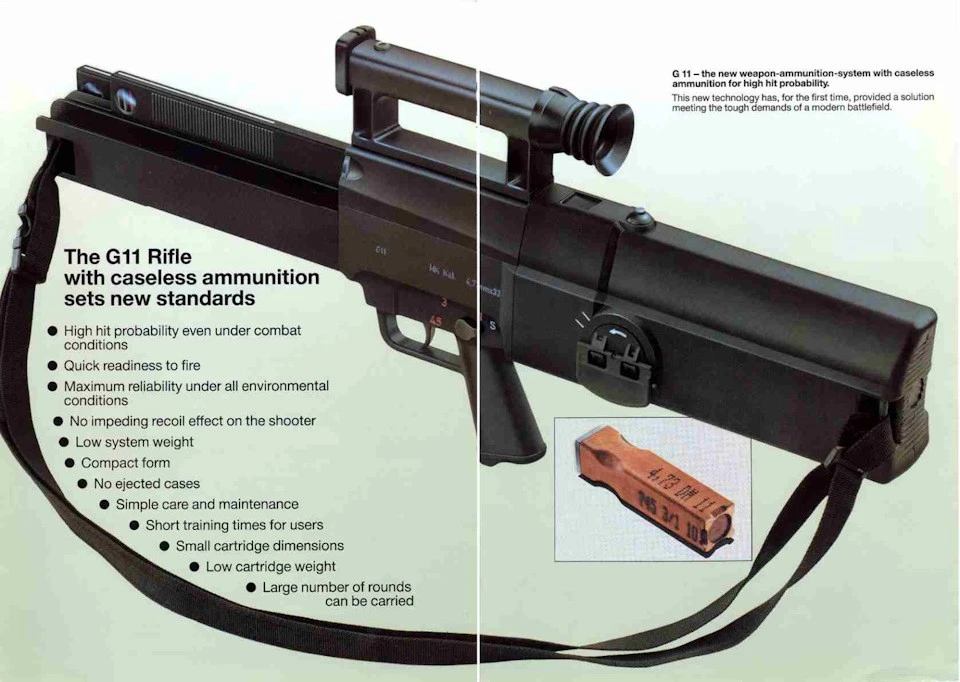
In 1966-1967, NATO countries began research into caseless ammunition for small arms. Such ammunition would eliminate the spent cartridge extraction and ejection mechanism, which is responsible for the majority of malfunctions and firing delays. A fully enclosed receiver would protect against dust and dirt. A caseless cartridge also promised a significant reduction in cost, increased carry capacity, and a smaller weapon.
Based on the research, it was determined that the Bundeswehr needed a lightweight, small-caliber rifle with high accuracy. To ensure reliable engagement of the enemy, it was necessary to ensure multiple bullets hit the target. Therefore, the decision was made to develop a rifle chambered for a 4.3mm caseless cartridge (later switched to 4.7mm) capable of firing single shots, long bursts, and three-round bursts. Heckler & Koch was commissioned to develop this rifle, with the participation of Dynamit Nobel, responsible for developing the new caseless cartridge. IWK/Mauser and several other German firms also participated in the competition for the new rifle. 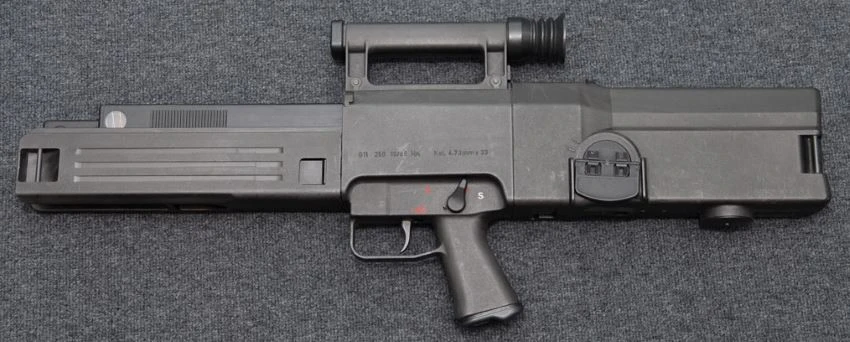
HK G11 caseless rifle, pre-production version (1989) The rifle features the ability to mount two spare magazines on either side of the main magazine, above the barrel.
In 1988, the first HK G11 prototypes were submitted to the Bundeswehr for testing. Based on the testing results, a number of changes were made to the HK G11 design, including: the sight was made removable, allowing it to be replaced with other types of sights; magazine capacity was reduced from 50 to 45 rounds, but the rifle now features the ability to mount two spare magazines on either side of the barrel; and a mount for a bayonet or bipod was added under the barrel. A new variant of the rifle, designated the G11K2, was provided to the German military for testing in late 1989. Based on the test results, the decision was made to introduce the G11 into service with the Bundeswehr in 1990. However, deliveries were limited to just a few dozen units, after which the program was terminated by German authorities. The main reasons for the program's closure were, firstly, a lack of funding due to the unification of the two Germanies, secondly, a significant number of unresolved technical issues, and, thirdly, NATO requirements for ammunition standardization, which ultimately led to the adoption of the G 36 rifle chambered for the 5.56x45mm NATO cartridge by the Bundeswehr. 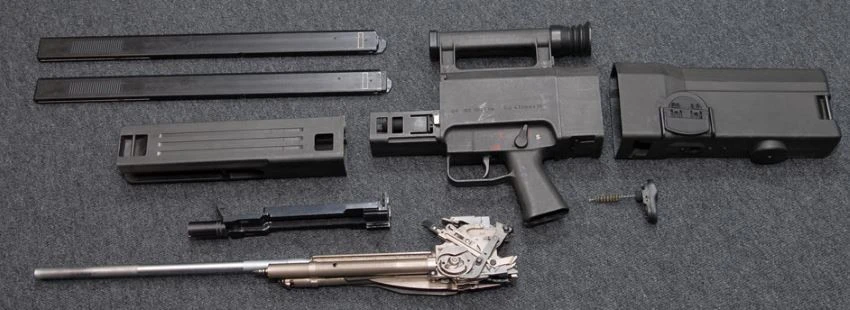
HK G11 rifle chambered for caseless cartridges, pre-production version (1989). Partially disassembled.
09:35
The new weapon was developed for an original cartridge, in which the bullet was pressed into the front of a prismatic powder charge coated with a combustible varnish. Cases of spontaneous combustion were observed in the first prototypes. By the mid-1980s, a telescopic cartridge was developed that successfully eliminated this problem, preventing autoignition during intense firing—a drawback common in early prototypes. The DM 11 cartridge had a caliber of 4.73 mm, a length of 32 mm, a prism side of 8 mm, and a bullet weight of 3.25 g. The bullet was completely recessed in a varnish-coated octagon-based propellant charge. A plastic tip was located at the head of the charge, ensuring complete combustion of the propellant powder and effective bullet propellant. The primer was located behind the bullet, and its base served as an anvil. The 3.25 g bullet was accelerated in the barrel to a velocity of 930–960 m/s. Thanks to the barrel's 155 mm twist rate, the bullet was highly stable: at a range of 300 meters, its overshoot was only 0.17 meters.
HK G11 Design
The HK G11 rifle features a bullpup design and maximizes the advantages of a caseless cartridge. All the main mechanisms are housed within a streamlined, minimally sized plastic body, with controls that are virtually flush with the body. During testing, the rifle's design, layout, and appearance changed only slightly: the first prototype had a metal body with reinforcing ribs and a plastic forend, buttstock, and handguard; later, a one-piece plastic body was added. The trigger guard was enlarged.
The automatic system operates on the principle of venting propellant gases through a hole in the muzzle. Gas pressure forces the moving system, which includes the barrel with the locking mechanism, the firing pin, and the magazine feed mechanism, to the rear. Due to the "floating" position of the moving parts within the frame and the "linear recoil" principle, the weapon's movement during firing is minimal. The recoil spring is located under the barrel.
The weapon is fed from a single-row, 50-round magazine, mounted horizontally above the barrel. A unique feeding and locking system employs a rotating chamber: the cartridges are loaded vertically in the magazine, with the bullet tip down. The chamber is a through, diametrical bore in a steel cylinder that rotates vertically. Behind the cylinder is a bolt with a firing pin, fixed relative to the barrel. In the initial position, the chamber is aligned with the barrel bore. During recoil after firing, the cylinder rotates 90°, returning the chamber to a vertical position. The next cartridge is fed into the chamber from the magazine using a special lever, and the lower vertical channel vents any propellant gases or misfired cartridges. The cylinder then returns to its firing position, the chamber aligns with the barrel axis, and the firing pin strikes the primer, resulting in a shot. A folding rotary handle, located on the left behind the pistol grip, is provided for manual reloading. The magazine release button is located on the top of the buttstock. The trigger mechanism allows for single and continuous fire, as well as three-round bursts. The ambidextrous safety selector is located above the pistol grip and has four positions: "S" for safety, "1" for single fire, "3" for three-round burst, and "50" for continuous fire. 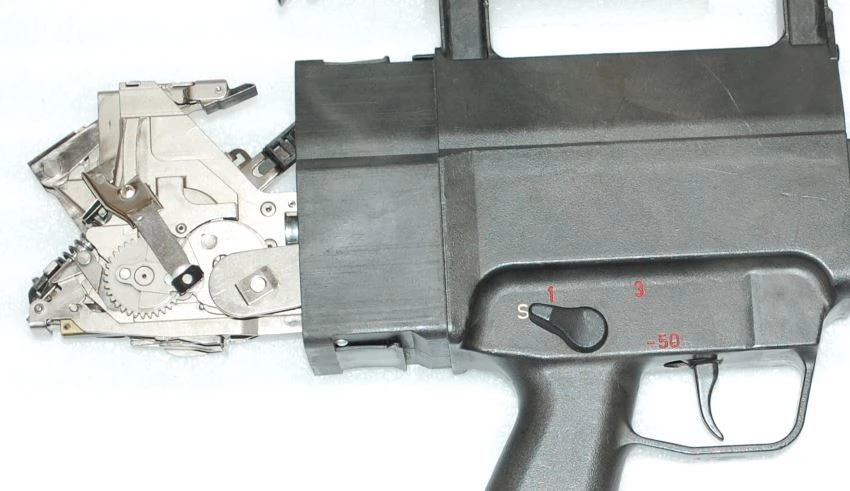
HK G11 design. View of the partially exposed mechanism. Due to its complexity, this rifle has earned the informal nickname "the rapid-fire cuckoo clock."
The barrel, trigger mechanism (excluding the safety/selector and trigger), rotating breech with mechanism, and magazine are mounted on a single base that can move back and forth within the rifle's body. When firing single or continuous bursts, this entire system completes a full recoil-coil cycle after each shot, significantly reducing felt recoil (a principle similar to that of artillery systems). When firing in fixed three-round bursts, the cartridge feed and the shot occur almost instantaneously, resulting in a rate of fire reaching 2,000 rounds per minute. The entire moving system only reaches its rearmost position after the third shot, and recoil begins to affect the weapon and shooter only after the burst is completed. This ensures extremely high accuracy (a similar technical solution is used in the AN-94 Abakan assault rifle). Early G11 prototypes were equipped with a fixed optical sight with 1X magnification. Magazines initially held 50 rounds and were loaded from special clips. Later versions featured single-stack, plastic magazines that held 45 rounds. Three magazines were supplied, each loaded from plastic clips holding 15 rounds. The magazine length was approximately 50 cm. Initially, the G11 cartridge consisted of a compressed powder block with a sprayed-on primer and a glued-in bullet, coated with a flammable lacquer to protect it from damage and moisture. The final version of the cartridge, designated DM11 4.7×33mm, featured a telescoped design: the bullet was completely recessed within the powder charge block. Development of the DM11 was completed by the mid-1980s, and the problem of cartridge autoignition in the chamber during intense firing, a common problem with earlier cartridges, was largely resolved. The DM11 cartridge accelerated a 3.25g bullet to a muzzle velocity of 930–960 m/s. 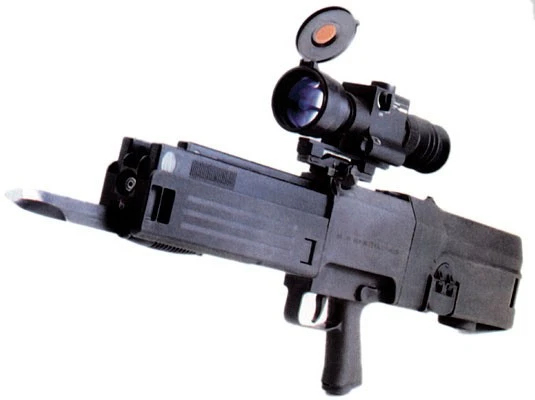
The G11's primary feature is a 1x magnification optical sight mounted in the carrying handle above the weapon's center of gravity. The reticle is designed as a ring: it is believed that this type of sight, without magnification, provides the shooter with a wide field of view of the battlefield, while the ring reticle ensures quick and intuitive aiming. A scope with variable magnification—1x and 3.5x—could also be installed. The sight's eyepiece and high buttstock ensure proper head positioning during careful aiming. Magazines are loaded directly from a 25- or 15-round clip. The G11 weighs 7.35 kg with 550 rounds of ammunition, equivalent to a G3 rifle with 100 rounds or an M16A2 with 240 rounds.
To disassemble the rifle, the magazine is first removed, then the fore-end and buttstock are separated, after which the entire rifle assembly is removed from the receiver.
Following testing conducted in 1989, a number of changes were made to the G11 design. The sight became removable, allowing the use of various types of optical and collimator sights. Magazine capacity was reduced from 50 to 45 rounds, but the ability to attach two spare magazines on either side of the barrel was added. A visual indicator for the presence of cartridges was installed on the magazine housing. Additionally, bayonet and bipod mounts were added under the barrel.
An updated version of the rifle, designated the G11K2, was presented to the German military for final testing in late 1989.
During this same period, the G11 became one of four leading contenders in the American Advanced Combat Rifle (ACR) program, which aimed to test innovative weapons concepts—caseless ammunition, flechette-shaped sabot bullets, and other solutions—to analyze and develop requirements for a potential successor to the M16A2 rifle. During testing, the HK G11 proved itself to be a reliable and easy-to-use weapon, characterized by high accuracy in all firing modes. 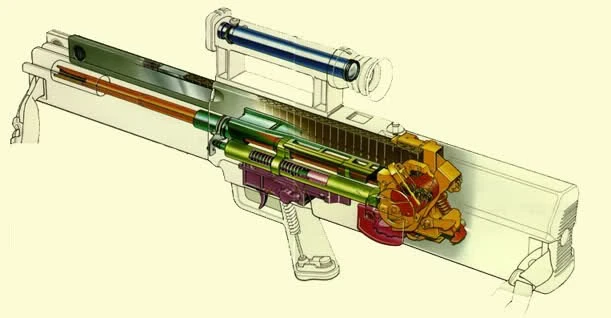
In 1990, following the testing results, Heckler & Koch announced that it was ready for serial production of the G11 in 1992. Main tactical and technical characteristics: Caliber 4.73×33 mm Length 750 mm. Barrel length 540 mm. Weight (without cartridges) 3.6 kg. Magazine 45 rounds. Muzzle velocity 930–960 m/s. Effective range 400 m. Rate of fire 600–2000 rounds/min | Although it was decided to put the G11 into service with the Bundeswehr, deliveries were limited to a small batch of only 1,000 units. The FRG army had two modifications of this weapon: - Heckler & Koch G11K2 rifle - a modernized version with a shortened body, a bayonet mount and a 45-round magazine. The sight was made in the form of a removable handle, which allowed the installation of standard sighting devices adopted by NATO. The Heckler & Koch LMG11 light machine gun was developed based on the G11 rifle.
The Heckler & Koch G11 is one of the most daring and innovative designs in the history of small arms. With its caseless cartridge, unique design, and advanced technical solutions, this rifle was ahead of its time and had a significant impact on the development of weapons technology. Although the G11 did not achieve widespread use and remained experimental, its developments and experience were incorporated into subsequent projects, and the rifle itself became a symbol of engineering excellence and the pursuit of perfection in military affairs.
Add your comment
You might be interested in:













Margaret Hamilton Dies at 90: The Story of the Moon

25 Incredibly Beautiful and Rare Stones (26 Photos)

16 Fascinating and Surprising Facts About Life in Sweden

30 Everyday Details That Will Change How You See the World

Hypnotic and Oddly Satisfying GIFs That Show How Food Is

Who Is the Woman Standing Next to Trump — and What's Going

"What Is This Thing?": 20+ Bizarre Objects That

13 "Healthy" Habits You Should Actually Quit (14

Queen of Thailand completes first solo flight in Gripen
