Huygens' Dive into Titan's Atmosphere: The Story of a Unique Photo (2 photos)
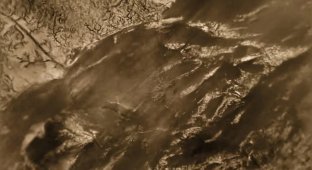
This image of the surface of Titan, Saturn's largest moon, was taken on January 14, 2005, from an altitude of approximately 70 kilometers, by the European Space Agency's (ESA) Huygens lander. 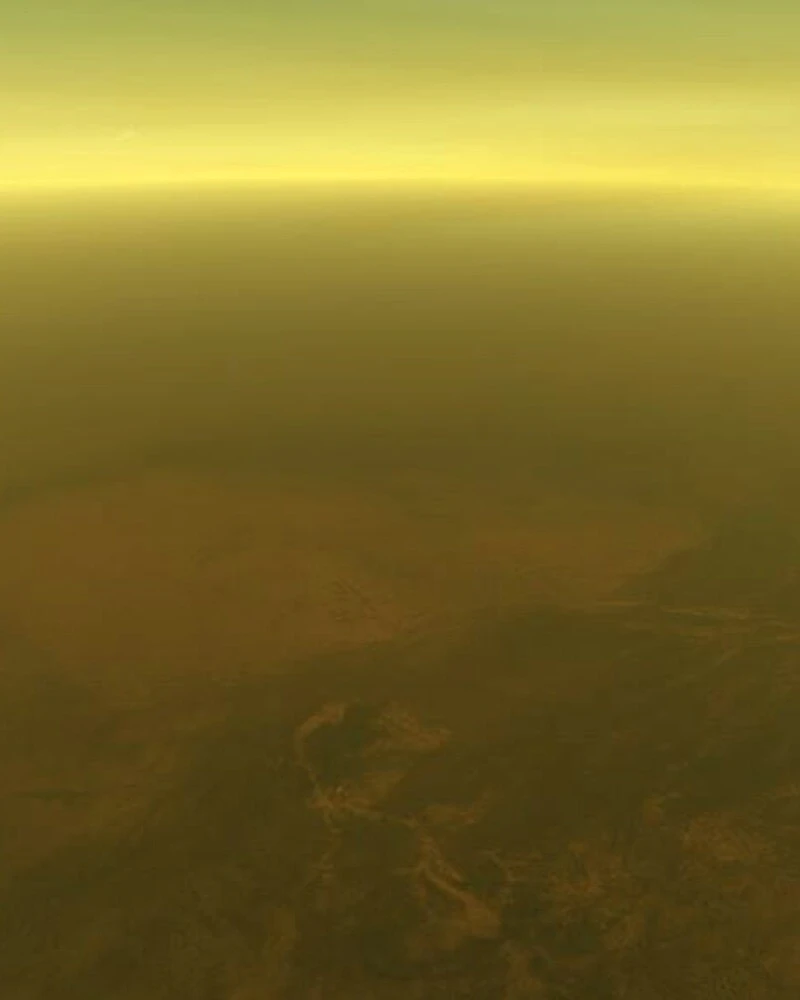
At that moment, humanity attempted to land on the surface of a celestial body in the outer solar system for the first time in history.
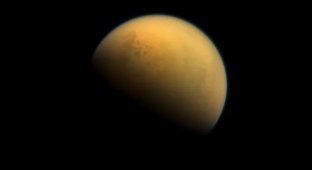
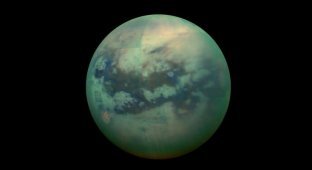
Huygens was delivered to the Saturnian system aboard NASA's Cassini probe, traveling over a billion kilometers before plunging into Titan's mysterious atmosphere—so dense and rich in organic compounds that it completely obscured the moon's surface from Earth-based telescopes. The parachute descent through this thick orange haze took 2 hours, 27 minutes, and 50 seconds before the spacecraft reached the surface in a region later dubbed "Xanadu"—after the paradise described in Samuel Taylor Coleridge's poem "Kubla Khan."
Titan's atmosphere has presented scientists with many mysteries. In the upper layers (about 500 kilometers above the surface), Huygens recorded unexpectedly high temperatures—from -10 to -20 degrees Celsius. This is astonishingly warm for a world located ten times farther from the Sun than Earth. One hypothesis suggests that this relative "comfort" is due to Saturn's gravitational influence, which causes tidal heating. However, the details of this mechanism remain unexplained.
As the spacecraft descended, the temperature began to plummet. At an altitude of 44 kilometers, Huygens' thermometers showed -203 degrees Celsius. However, by the time of landing, the environment had "warmed up" to -180 degrees Celsius. This temperature range remains one of Titan's greatest mysteries.
But it wasn't just the temperature anomalies that surprised scientists. While planning the mission, experts expected some wind activity, but the reality exceeded all predictions. At an altitude of 120 kilometers, Huygens encountered a powerful air current moving at 430 kilometers per hour. This caused the spacecraft to be thrown several kilometers east of its originally planned landing site.
After its successful landing, Huygens operated for 90 minutes, transmitting the first-ever close-up images of Titan's surface, detailed data on the composition of the atmosphere, and discovered evidence of erosion. Analysis of the collected data revealed that the surface in the Xanadu region is composed of water ice and hydrocarbon compounds, resembling wet sand or clay in consistency. 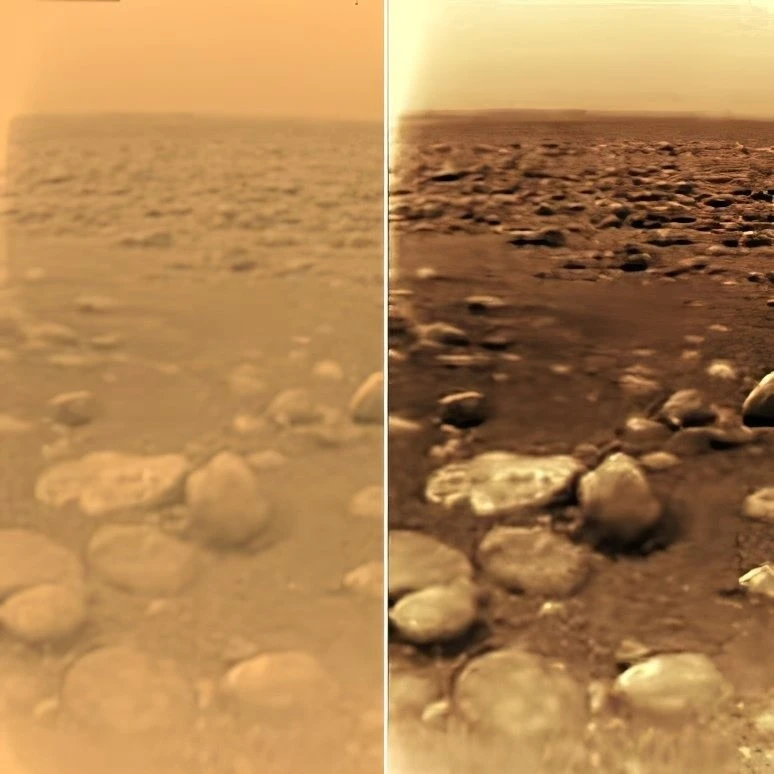
Titan's surface, as captured by Huygens. The second image had slightly increased contrast.
These discoveries, coupled with data from the Cassini orbiter, have created a comprehensive picture of Titan—a world remarkably similar to ancient Earth, but with fundamentally different chemistry. Furthermore, the collected data is being actively used in planning NASA's Dragonfly mission, which will send an eight-rotor drone to Titan in 2028.