A Photograph That Proved the Existence of Lakes and seas on Titan (2 photos)
What you see here isn't the Moon, blocking our sun during a total eclipse. This faint golden glint is a reflection of sunlight from the surface of a lake near the north pole of Titan, Saturn's largest moon, with an average diameter of 5,149.5 kilometers. 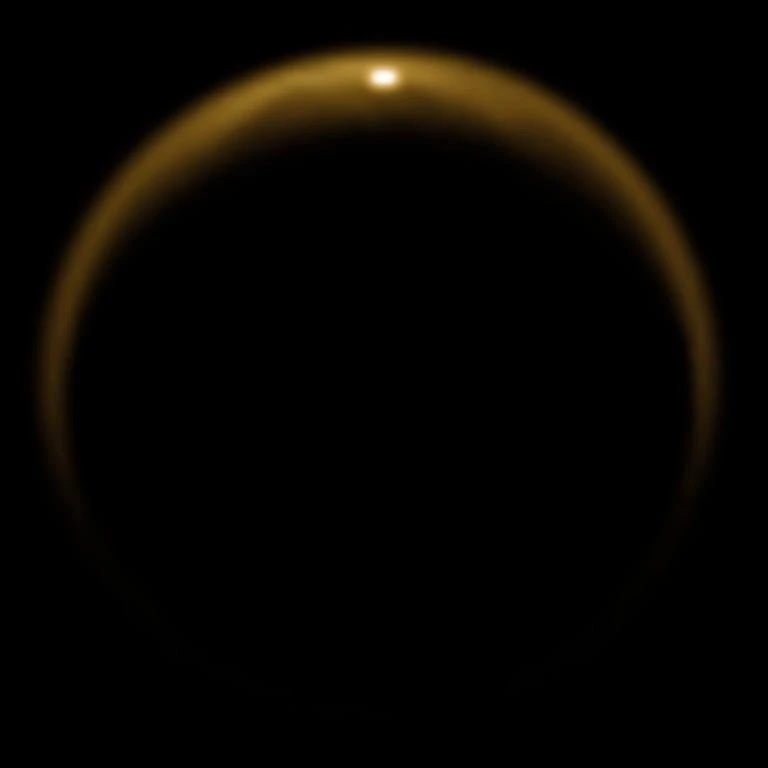
This image was taken by NASA's Cassini spacecraft in 2009 and was one of the first direct visual confirmations of stable reservoirs of liquid on Titan's surface.
But it's not water.
Titan is the only place in the solar system besides Earth with rivers, lakes, and seas. However, these rivers are not made of water, but of liquid hydrocarbons—primarily methane and ethane. The average surface temperature of the moon is about -180°C, and under these conditions, water turns into ice, which is almost as strong as rock, while methane and ethane behave like familiar liquids.
Important Glare
Before the launch of the Cassini mission, scientists only speculated that liquid seas might exist on Titan. However, the extremely dense atmosphere, approximately 50% denser than Earth's, completely obscures the surface in visible light, preventing us from seeing what's happening "below."
The first serious grounds for such assumptions emerged during the mission: Cassini's radar surveys, conducted from 2004 to 2008, revealed dark, very smooth areas on Titan's surface, resembling bodies of water. But this data was insufficient.
Then in 2009, while flying close to Titan, Cassini captured a mesmerizing glint of sunlight. This effect indicated the presence of a very smooth surface capable of reflecting light. Combined with the radar data, this image became definitive confirmation of the existence of lakes and seas on Titan.
An Alien, Yet Familiar World
Titan is in many ways similar to Earth. It has a thick atmosphere and clouds, rain, rivers and canals, lakes and seas. 
Today, it is known that the image depicts Kraken Mare, an approximately 400,000 square kilometer region—one of the seas located near the moon's north pole.
Titan actually has a fully functioning methane cycle—analogous to Earth's water cycle. The liquid evaporates, forms clouds, falls as precipitation, and then accumulates again in the lowlands. And all this happens at a distance of about 1.4 billion kilometers from us.
Yet Titan remains a completely alien world. Instead of water, there are liquid hydrocarbons; instead of the familiar nitrogen-oxygen atmosphere, there is a nitrogen-methane atmosphere; and instead of the familiar terrestrial chemistry, there are exotic organics.
Despite this, Titan is considered a prime candidate for the search for unusual forms of extraterrestrial life. If life exists there, it will likely be based on a different chemistry and will be unlike anything found on Earth.
Furthermore, Titan offers scientists a unique opportunity to understand what early Earth might have looked like before the advent of oxygen and the modern biosphere.
And scientists will certainly take advantage of this opportunity: NASA's Dragonfly mission to Titan is scheduled to launch in July 2028, with the spacecraft expected to arrive in late 2034. Dragonfly is an eight-rotor drone that will fly from place to place, film, collect data, and analyze the surface and surrounding environment during landings. It will be our guide to this distant and extraordinary world.