Titan: a world of dunes, hydrocarbon seas, and a subglacial ocean (5 photos)
Among Saturn's 274 known moons, Titan occupies a special place. This ringed gas giant's largest moon, larger than the planet Mercury, is the only moon in the Solar System with a dense atmosphere and a stable liquid cycle. 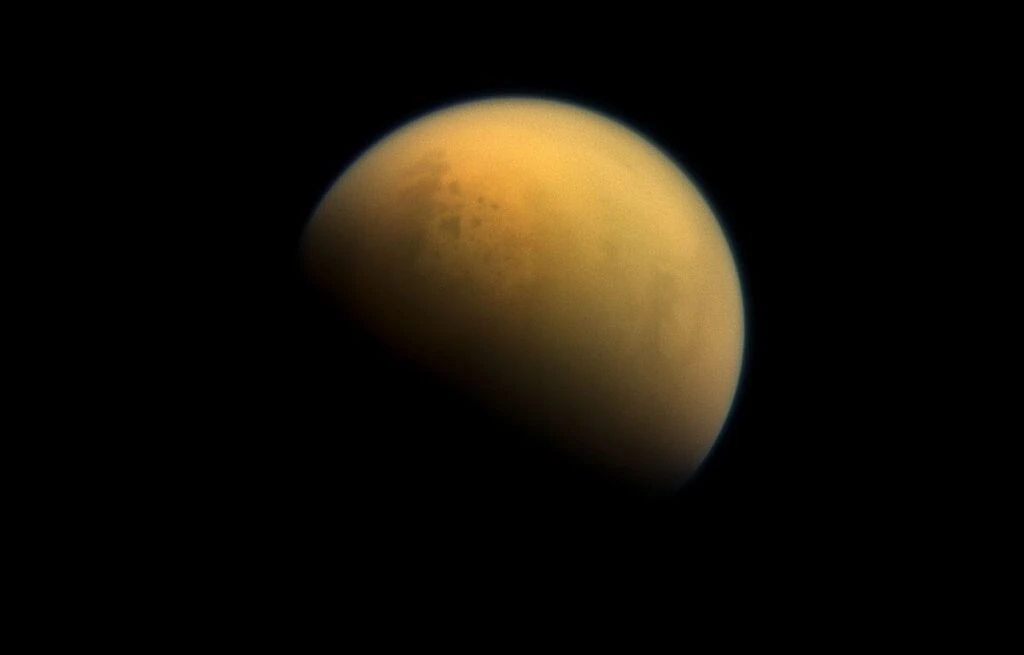
Titan's north is up and rotated 36 degrees to the left. Image from NASA's Cassini spacecraft
Titan's average diameter is 5,152 kilometers, 272 kilometers larger than Mercury's diameter (4,880 kilometers). Titan has very low gravity—approximately 14% of Earth's. Therefore, a 70-kilogram person on Titan would weigh only 9.8 kilograms.
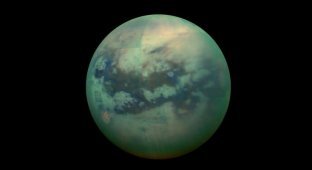
Titan was discovered on March 25, 1655, by the Dutch physicist, mathematician, and astronomer Christiaan Huygens, but for more than three centuries, we knew virtually nothing about this amazing world due to its extremely thick atmosphere, which reliably obscured the surface from curious scientists. Only with the development of radar remote sensing and infrared spectroscopy has humanity finally managed to peer beneath the orange-brown haze of this mysterious world.
Earth-like Atmosphere
Titan's atmosphere is unique among the satellites of the Solar System. Its surface density is 1.45 times that of Earth, and its pressure is 147 kPa—equivalent to a depth of five meters underwater on Earth. The atmosphere is 98.4% nitrogen, 1.4% methane, and trace amounts of other gases. Interestingly, nitrogen also dominates Earth's atmosphere, making up 78% of its volume. 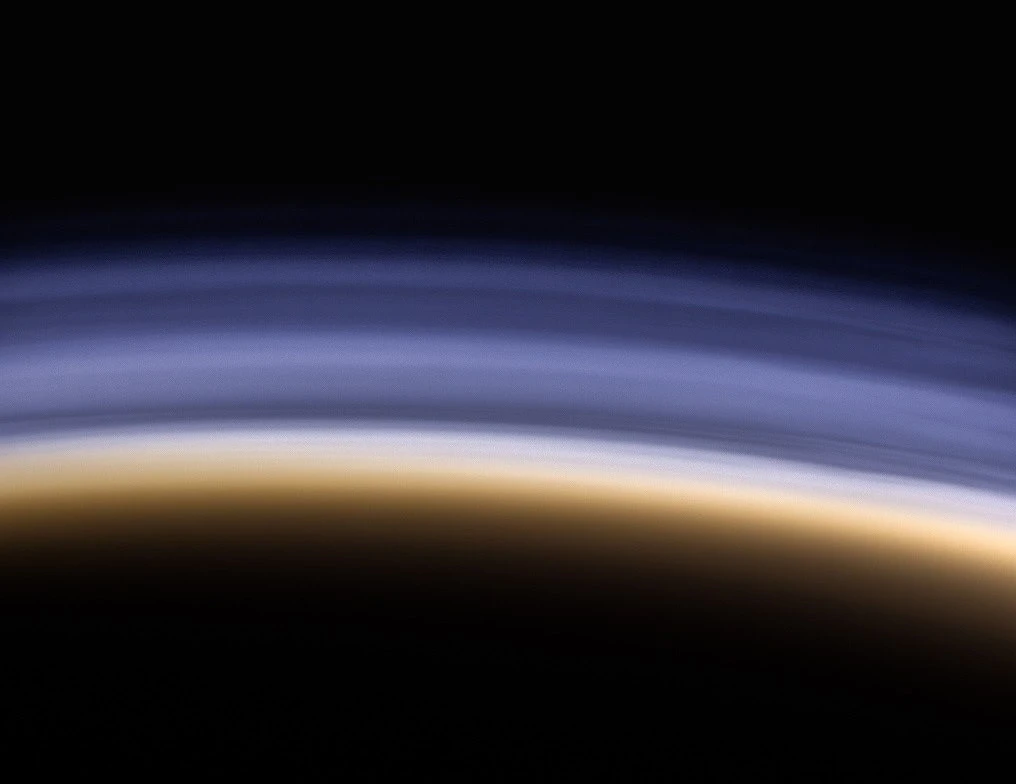
Titan's atmosphere as seen by the Cassini orbiter
The orange-brown color of the haze is due to complex organic molecules called tholins, synthesized by solar radiation and cosmic rays. In large quantities, tholins create an extremely dense smog that prevents direct observation of the surface in visible light.
Methane Cycle
Titan has a fully functioning hydrological cycle, similar to Earth's water cycle, but based on methane and ethane. Hydrocarbon rain falls from methane clouds, forming rivers, lakes, and seas of liquid hydrocarbons, which then partially evaporate back into the atmosphere, completing the cycle. The largest sea, Kraken Mare, has an area of approximately 400,000 square kilometers. For comparison, the Caspian Sea on Earth is 371,000 square kilometers. 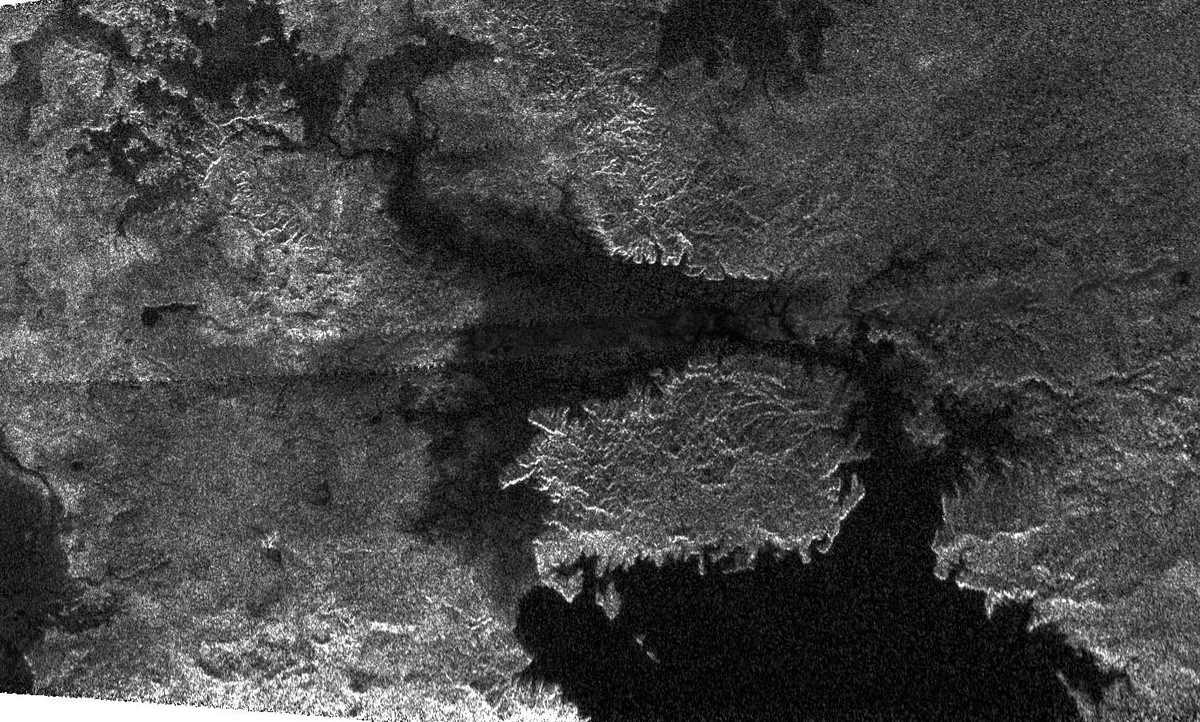
Radar image of northern Kraken Mare, acquired by Cassini on February 22, 2007
Surface temperatures drop to -180 degrees Celsius—ideal conditions for liquid methane. Seasons on Titan last 7.5 Earth years, due to Saturn's 29-year orbital period around the Sun.
Shangri-La Dunes
Titan's surface offers a striking diversity of landscapes. The dark equatorial region of Shangri-La is covered in dunes sculpted from organic particles. These dunes, formed over millions of years, reach heights of up to 100 meters and stretch for hundreds of kilometers. 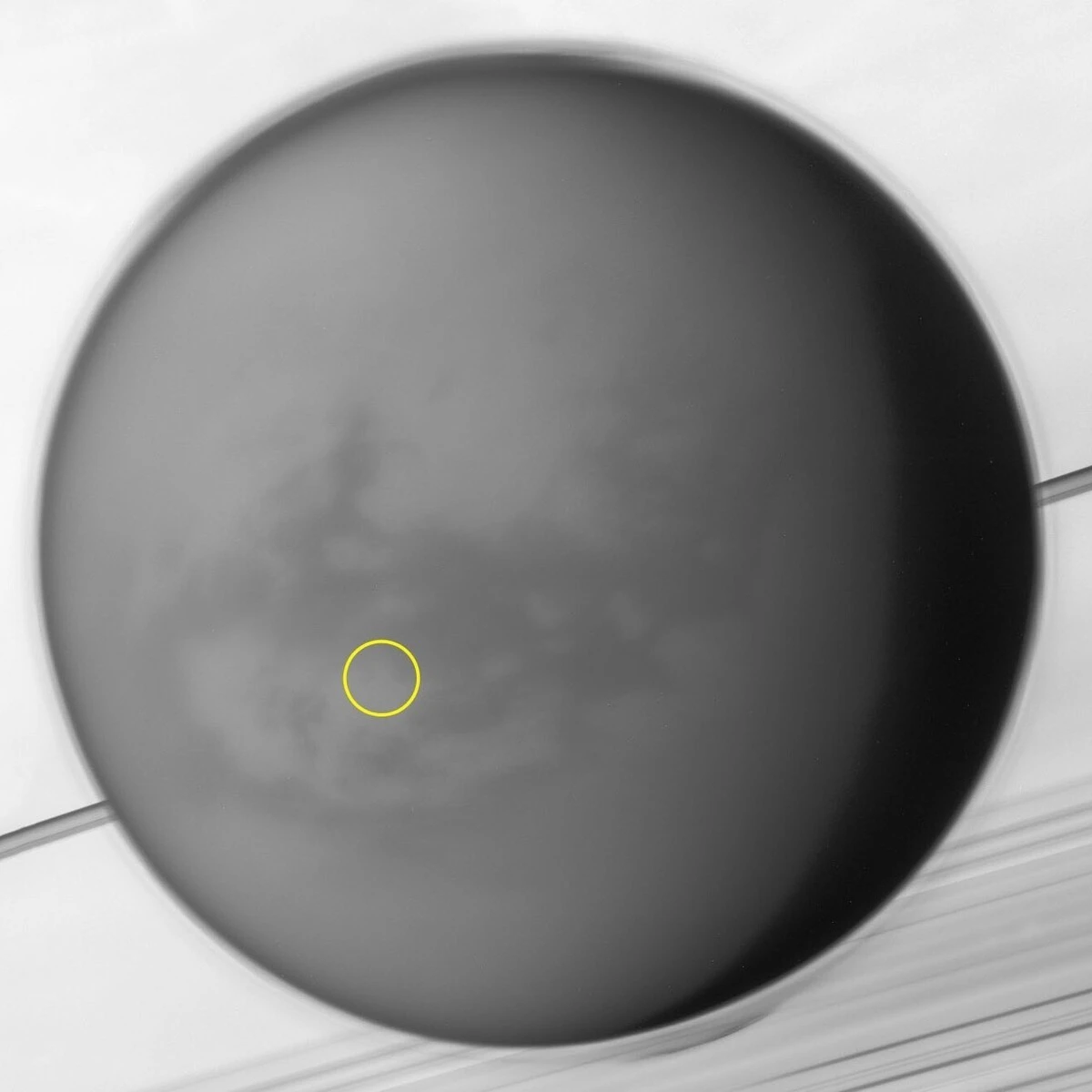
The Huygens landing site is marked in yellow.
It was in this region on January 14, 2005, that the European Space Agency's Huygens lander landed—the first spacecraft ever to successfully "land" in the outer solar system.
Subsurface Ocean
Beneath Titan's icy crust, at a depth of 55-80 kilometers, lies a global ocean of liquid water. Its depth can reach an impressive 300 kilometers; it contains more water than all of Earth's lakes, seas, and oceans combined. 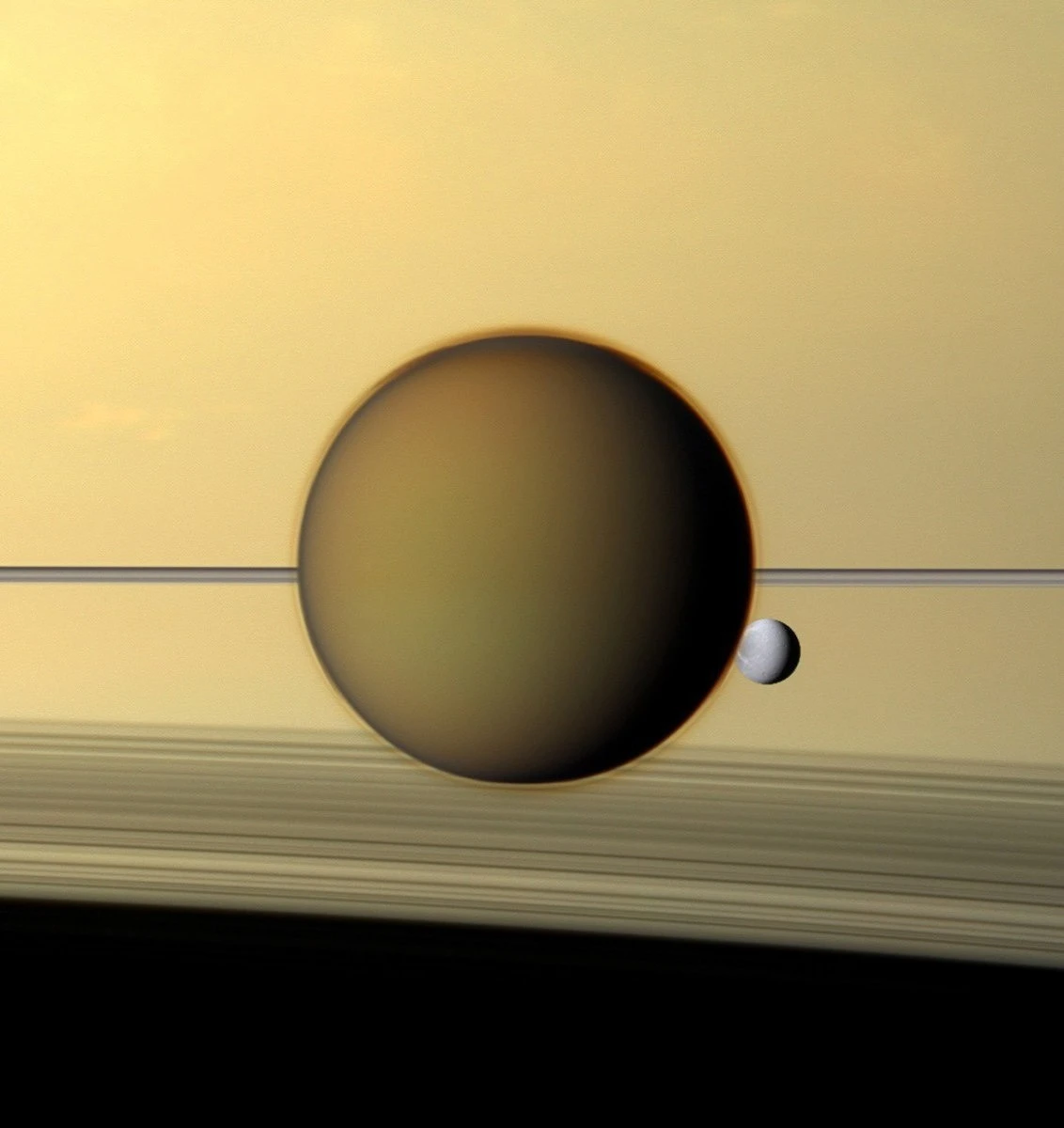
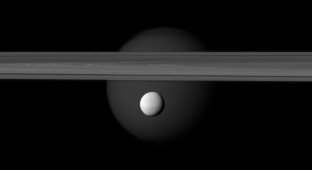
Saturn's moons Titan and Dione with the gas giant in the background. Image from the Cassini probe
Despite the fact that Titan's subsurface ocean is isolated from the surface by a thick icy crust, it is still of particular interest to astrobiologists, who consider the Saturnian moon a potentially habitable world.
In 2028, NASA's Dragonfly mission will launch to Titan, delivering an eight-rotor drone to its surface to explore this mysterious world from a bird's-eye view. Arrival is scheduled for 2034. Dragonfly's primary mission is to search for signs of prebiotic chemistry and explore the conditions for possible life.