Jellyfish are among the most mysterious and ancient inhabitants of the world's oceans, with a history spanning over 650 million years. These translucent creatures evoke mixed emotions in us: from admiration for their unearthly beauty to fear of their painful stings. But what do we know about the inner workings of these creatures? Let's take a virtual journey into the world of enigmatic jellyfish. 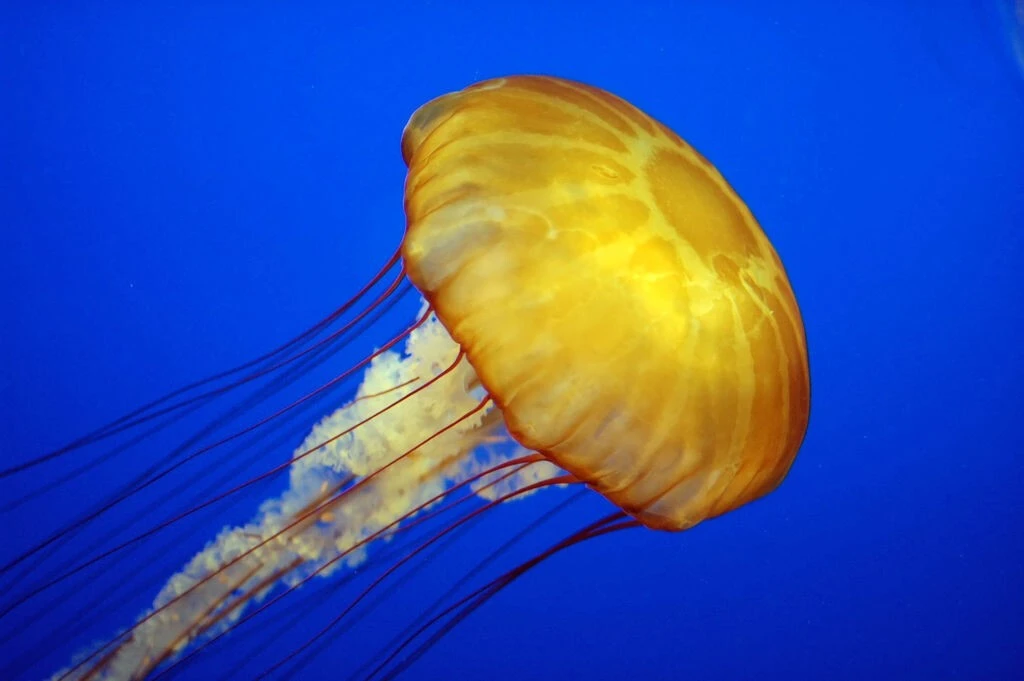
The Pacific sea nettle (Chrysaora fuscescens) is a pelagic jellyfish common in the Pacific Ocean. The diameter of an adult's dome can reach 50 centimeters.
Life without a brain: how is it possible?
Jellyfish do not have a brain in the traditional sense. They lack a central nervous system typical of vertebrates. Instead, their bodies are permeated by a diffuse network of nerve cells, concentrated primarily along the edge of the dome in the so-called nerve ring.
The nerve ring of a jellyfish consists of highly sensitive sensory neurons that respond to various environmental stimuli, such as light, touch, and changes in the chemical composition of seawater. Despite the lack of a "central processor" in the form of a brain, this system allows jellyfish to effectively navigate, find food, avoid danger, and reproduce.
It is noteworthy that some species of jellyfish, such as box jellyfish (Cubozoa), have a more complex nervous system, with nerve cells concentrated in specific areas. They have modified tentacles called rhopalia, which contain sensory organs, including primitive "eyes" capable of distinguishing light and darkness, and in some species, even forming simple images.
Amazing Abilities of "Brainless" Creatures
Despite their lack of a brain, jellyfish exhibit astonishing behavioral responses. For example, the Caribbean box jellyfish Tripedalia cystophora actively hunts, using its 24 eyes to navigate mangroves. It is capable of not only navigating a fairly complex environment but also remembering the landscape and feeling at ease in places it has previously visited, something previously thought impossible for creatures without a central nervous system. 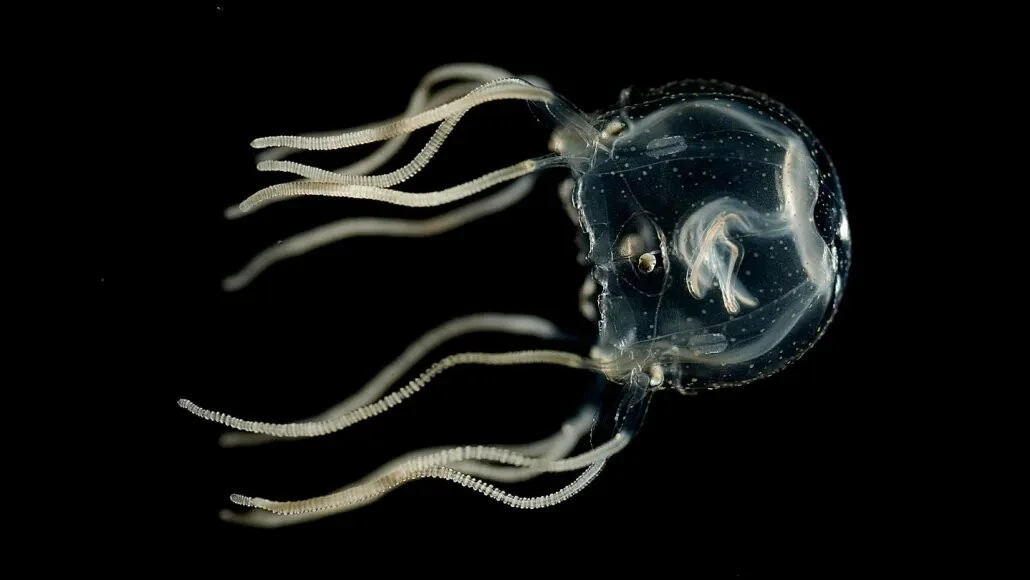
The Caribbean box jellyfish Tripedalia cystophora. Its dome diameter is only about five millimeters.
Furthermore, studies show that jellyfish can learn. In numerous experiments, the Caribbean box jellyfish Cassiopea xamachana demonstrated signs of associative learning, changing its behavior in response to repeated stimuli. This fact refutes the idea that the brain is necessary for learning.
The navigational abilities of jellyfish are particularly noteworthy. Many species migrate vertically through the water column, rising closer to the surface at night and diving deeper during the day. Some ocean jellyfish, such as the eared jellyfish (Aurelia aurita), can navigate currents and even deliberately prefer weaker currents. All of this clearly requires processing sensory information. And jellyfish manage it without a brain!
Jellyfish are also among the most efficient (and productive) swimmers in the ocean, in terms of energy expenditure. Their pulsating movements create eddies that not only propel them forward but also attract plankton—their main food source—directly to their tentacles.
Immortal and Reproducing
The species Turritopsis dohrnii, better known as the "immortal jellyfish," is capable of reverting to an immature stage of its life cycle after reaching sexual maturity, theoretically achieving biological immortality (unless, for example, it is eaten by a predator). 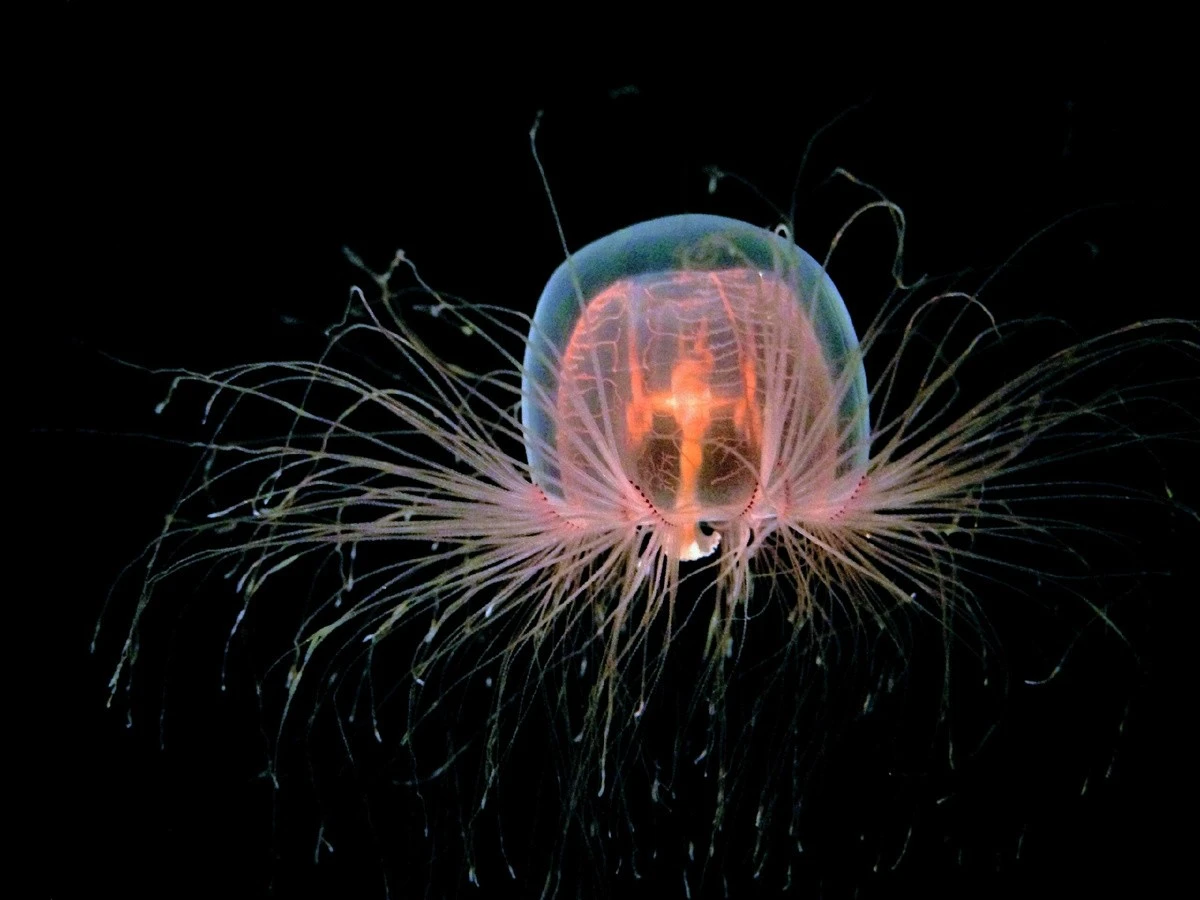
The immortal jellyfish is a tiny inhabitant of the world's oceans. The diameter of an adult's dome does not exceed five millimeters.
When this jellyfish encounters unfavorable conditions or suffers severe physical damage, it can transform its cells into an earlier stage of development and... simply begin the life cycle anew.
Jellyfish reproduction is no less astonishing. Most species have a remarkable life cycle, alternating between sexual and asexual reproduction. Adult free-swimming jellyfish reproduce sexually. Some species, such as Copula sivickisi, even exhibit a semblance of a "mating ritual," where the male and female join tentacles before transferring spermatophores. Fertilized eggs develop into larvae, which settle to the bottom and develop into immobile polyps. These polyps, in turn, reproduce asexually, budding off new free-swimming jellyfish, completing the life cycle.
Food for Thought
Long-term research on jellyfish has shattered the long-held notion that a brain is necessary for complex behavior. These ancient inhabitants of the world's oceans, hundreds of millions of years old, are living proof that a decentralized nervous system can be remarkably efficient for comfortable survival in the dangerous ocean depths. 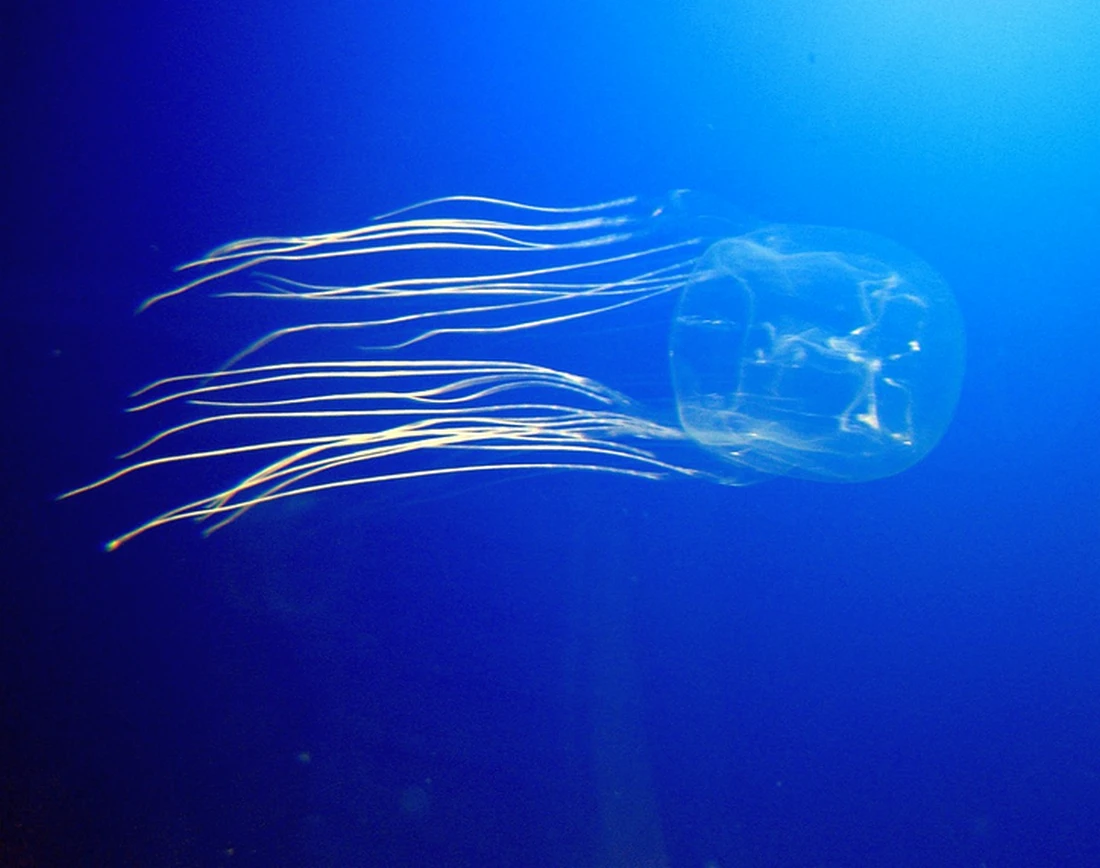
Chironex fleckeri is a species of marine cnidarian from the class Box Jellyfish. It prefers to live off the coast of Northern Australia. Its tentacles can reach three meters in length.
Perhaps it is the simplicity of their structure that is the key to their incredible resilience—jellyfish have survived five mass extinctions and will likely survive future cataclysms on our planet. In a world where climate change and ocean pollution threaten many marine species, jellyfish populations are, by contrast, expanding, adapting to changing conditions with remarkable efficiency.
Add your comment
You might be interested in:















Margaret Hamilton Dies at 90: The Story of the Moon

25 Incredibly Beautiful and Rare Stones (26 Photos)

16 Fascinating and Surprising Facts About Life in Sweden

"What Is This Thing?": 20+ Bizarre Objects That

13 "Healthy" Habits You Should Actually Quit (14

Cassini Spacecraft Reveals Saturn’s Rings (10 Photos)

How Germany Got a Mountain Made of Salt (6 photos)

30 Everyday Details That Will Change How You See the World

Hypnotic and Oddly Satisfying GIFs That Show How Food Is
