Phantom Jellyfish: A 10-Meter Ghost of the World's Oceans (4 photos) (photo)
Imagine you're part of an oceanographic expedition embarking on a deep-sea dive somewhere in the Pacific Ocean. Your task is to keep an eye on the monitors, which are receiving images from sensitive external cameras.
One hundred meters... a kilometer... three kilometers... six kilometers... and suddenly it appears on the monitor: a huge, dark red thing with long ribbons, rapidly disappearing into the darkness. 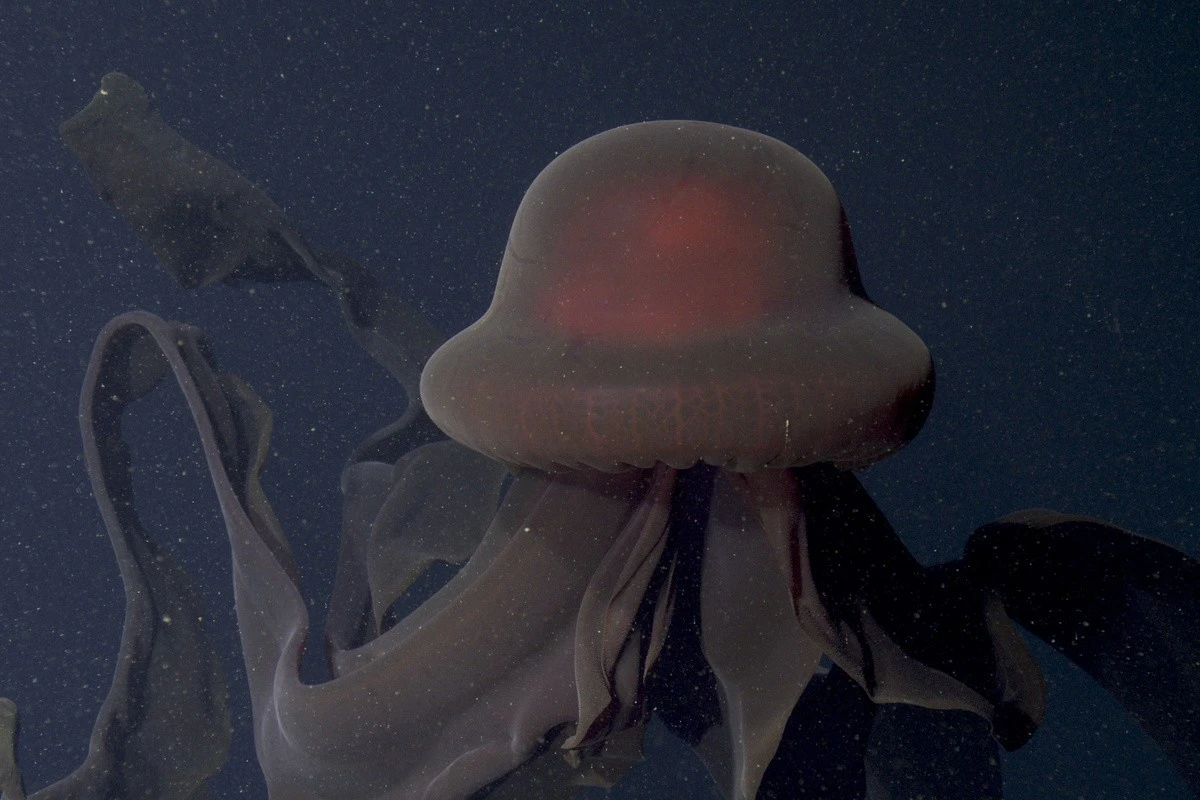
This isn't the beginning of a horror story, but something you could actually encounter. And this enormous "ribboned monster" is the giant phantom jellyfish (Latin: Stygiomedusa gigantea).
This amazing creature, first discovered in 1899, is widespread throughout the world's oceans (probably with the exception of the Arctic Ocean). However, in more than a century, it has only been observed about 120 times. This is due to the phantom jellyfish's preference for living at impressive depths—up to 6,700 meters. It's worth noting that this giant has also been seen in relatively shallow waters (200–300 meters deep), but this is the exception rather than the rule. 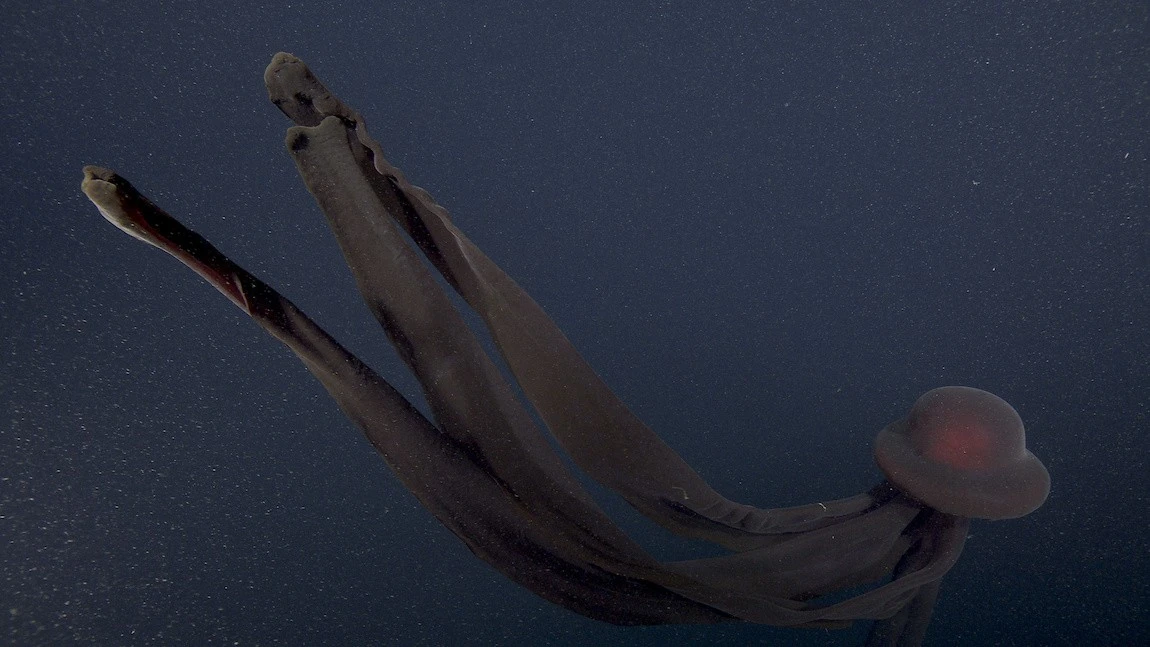
Encounters with a phantom jellyfish are so rare that, in thousands of unmanned dives organized by the private, non-profit oceanographic research center MBARI in California, the creature has only been captured nine times.
The giant phantom jellyfish is one of the largest invertebrate predators of the deep. Its dome can reach a meter in diameter, and its four ribbon-like oral tentacles extend for more than ten meters. And here's an important detail: these aren't "tentacles" in the traditional sense—their surface isn't covered with thousands of stinging cells, which in many jellyfish fire microscopic capsules containing venom to immobilize and hold prey. Instead, the giant approaches its potential victim, wraps it in "ribbons," and pulls it toward its mouth. The phantom jellyfish feeds on plankton and small fish. 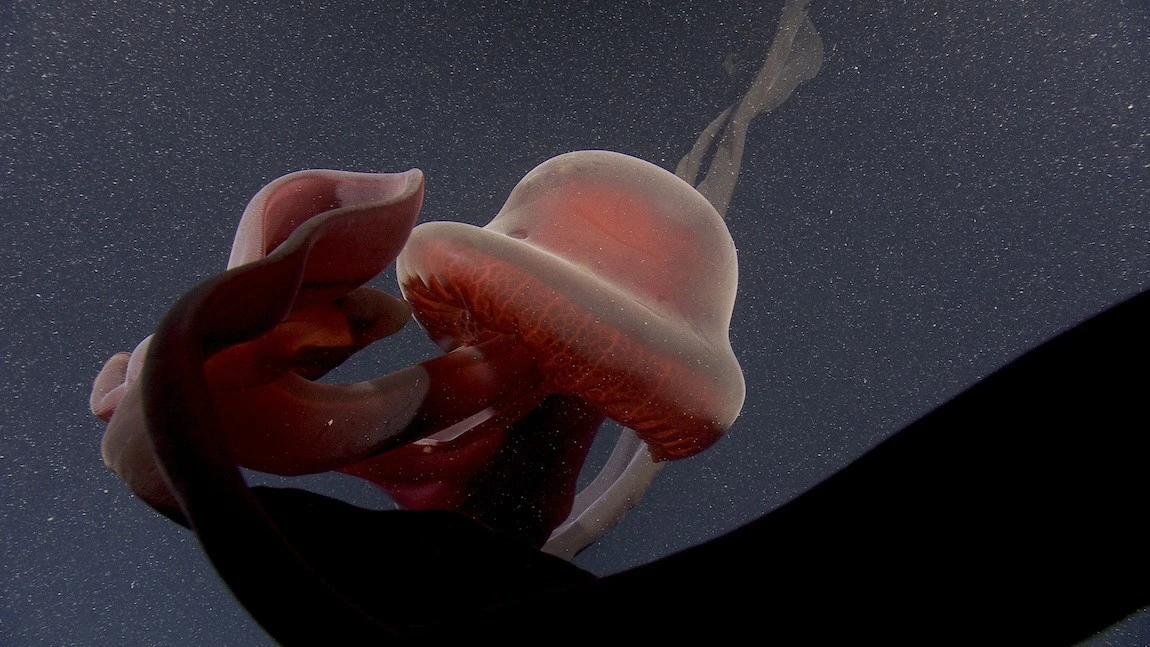
Their distinctive coloration is easily explained: water absorbs red wavelengths most quickly, so the red spectrum quickly fades with depth. As a result, the phantom jellyfish effectively blends into the darkness, appearing almost black.
Interestingly, these jellyfish sometimes have unexpected "companions" in the form of fish of the pelagic eelpout species (Thalassobathia pelagica). In open waters, where there is nowhere to hide, these fish use the dome and long "ribbons" for cover and possibly even feed on the remains of their giant companion's meal. 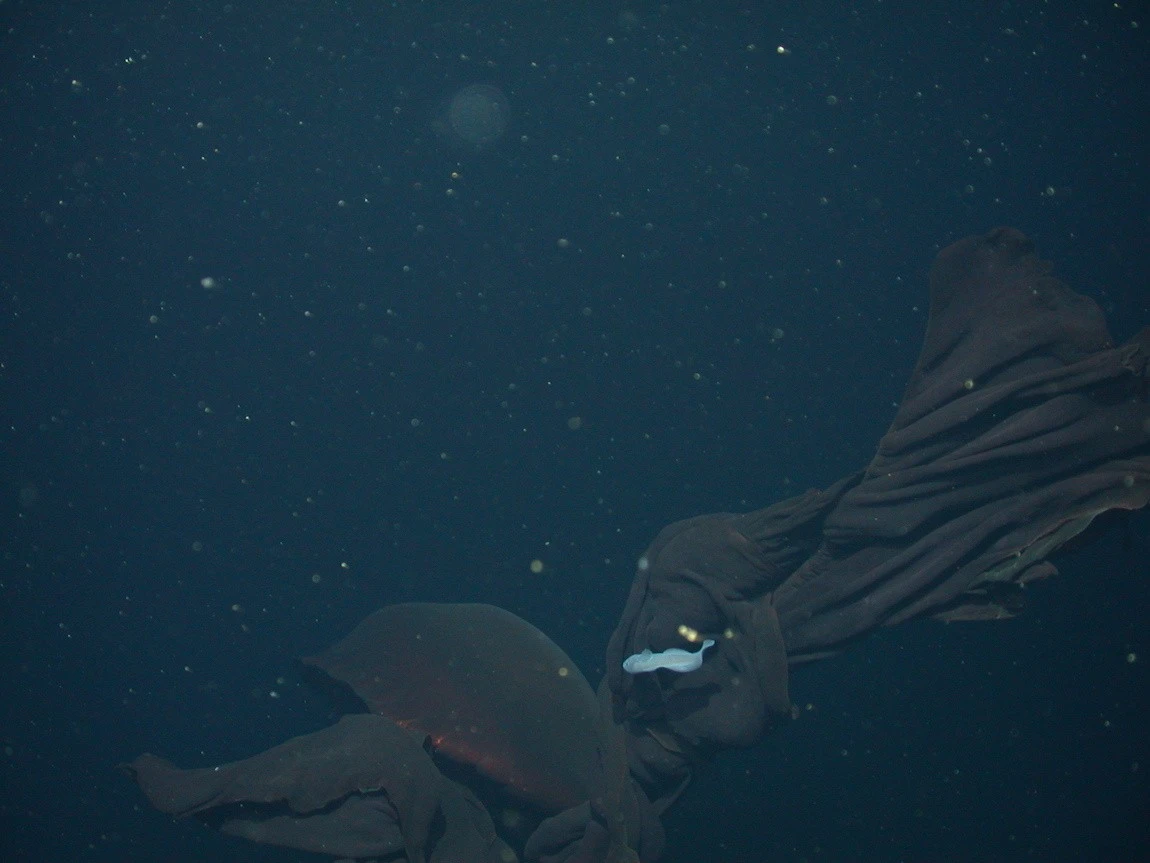
This relationship is also beneficial for the jellyfish: the fish can consume parasites. A classic symbiosis in harsh conditions.
The phantom jellyfish is a creature with a fragmented history: its size and range are known, but the details of its life—from reproduction to behavior—are still unclear. This animal reminds us that Earth's oceans are inhabited by countless "ghosts"—organisms we have yet to discover. More than 228,000 marine species have been described to date, but this is only a tiny fraction of the true diversity. Just think about it: humanity has explored only about 3% of the ocean surface on our home planet. We know the surface of Pluto better than what lies beneath our own depths.
Therefore, as we strive to discover extraterrestrial life, we should remember that right now, creatures we cannot even imagine inhabit our planet.