This is the highly unusual galaxy NGC 4753, located approximately 60 million light-years from Earth in the direction of the constellation Virgo. 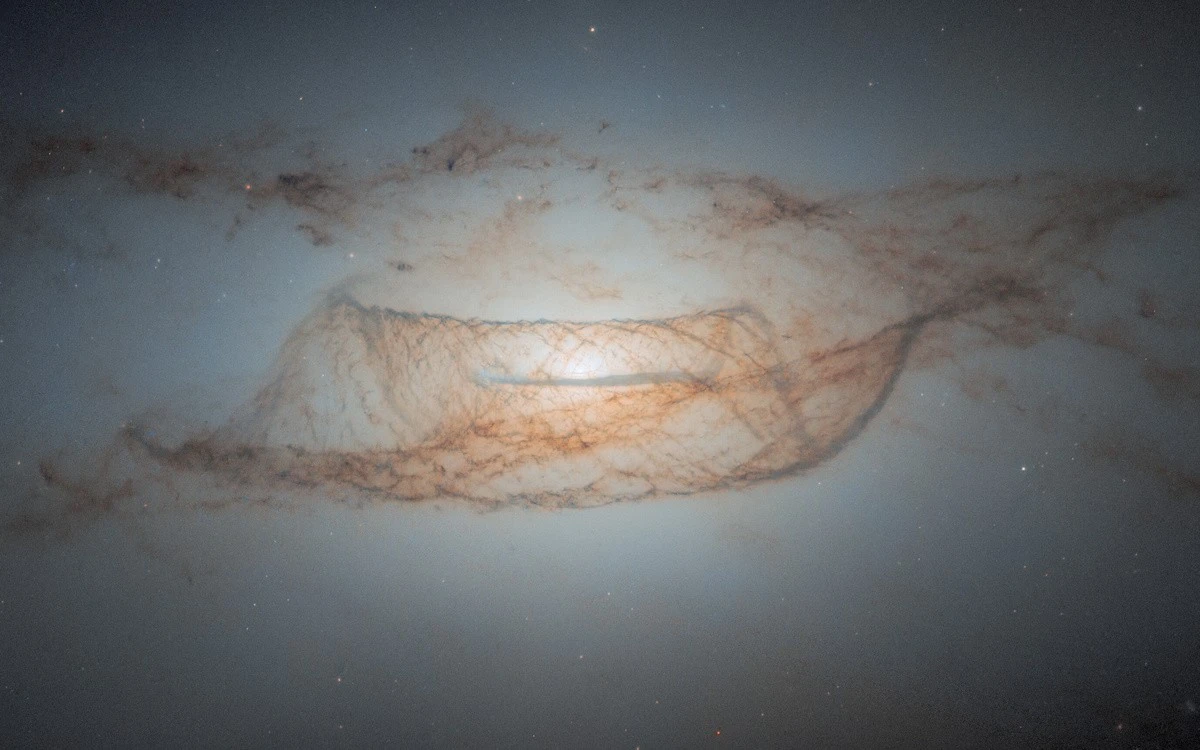
Lenticular galaxy NGC 4753, captured by the Hubble Space Telescope
NGC 4753 is a lenticular galaxy—an intermediate type between spiral and elliptical galaxies. Such objects, in addition to a galactic disk, have a pronounced bulge (a spheroidal compaction of stars in the center), but lack the distinct arms characteristic of spiral systems. This is why lenticular galaxies typically appear smoother and quieter, but NGC 4753 certainly stands out even among them.
The main feature of NGC 4753 is a complex and intricate system of dust lanes that surround the central region and seem to intertwine, forming a multilayered pattern that gives the galaxy its unusual appearance.
These dust lanes are not simply decoration for NGC 4753, but "silent informants" capable of revealing details about the past of the galaxy and its surroundings. Modeling suggests that NGC 4753's current appearance may be related to a merger with a nearby dwarf galaxy that occurred about 1.3 billion years ago. 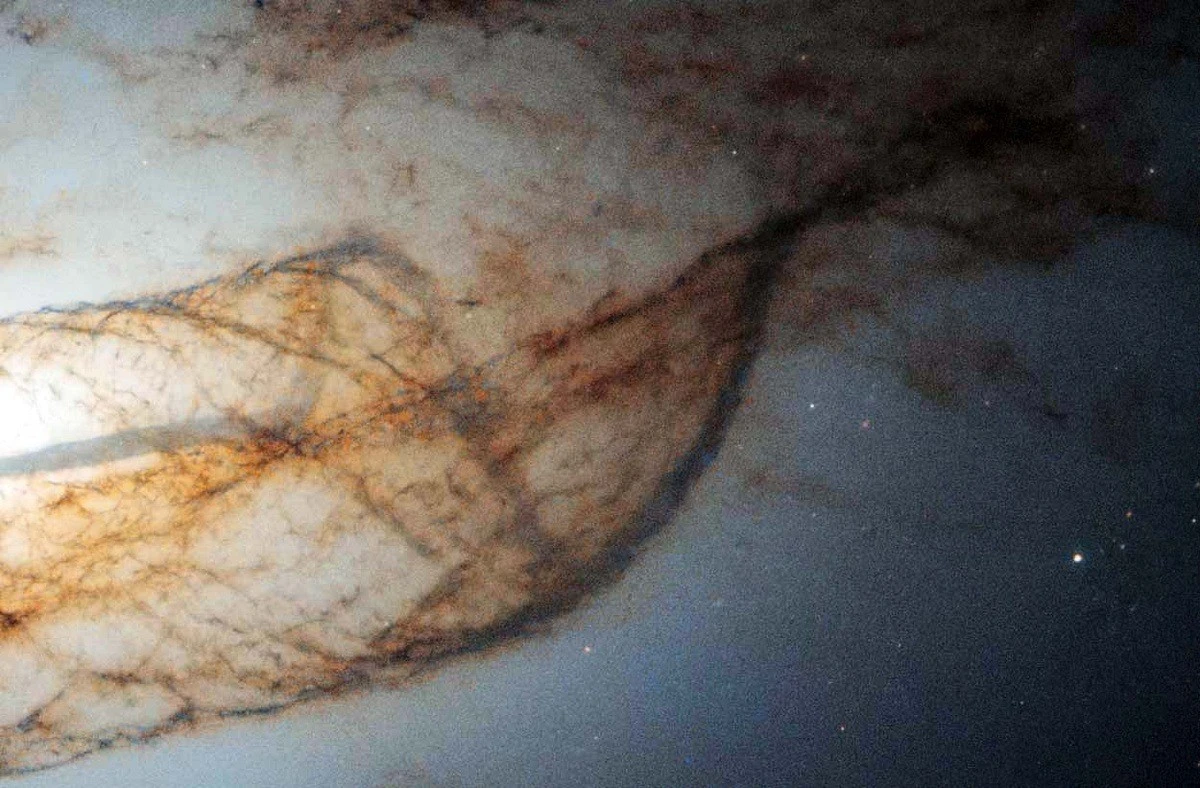
The image has been processed to more clearly highlight the dust streaks. The matter in these formations moves at speeds of hundreds of kilometers per second, but against the backdrop of the galaxy's colossal size, these structures appear motionless. 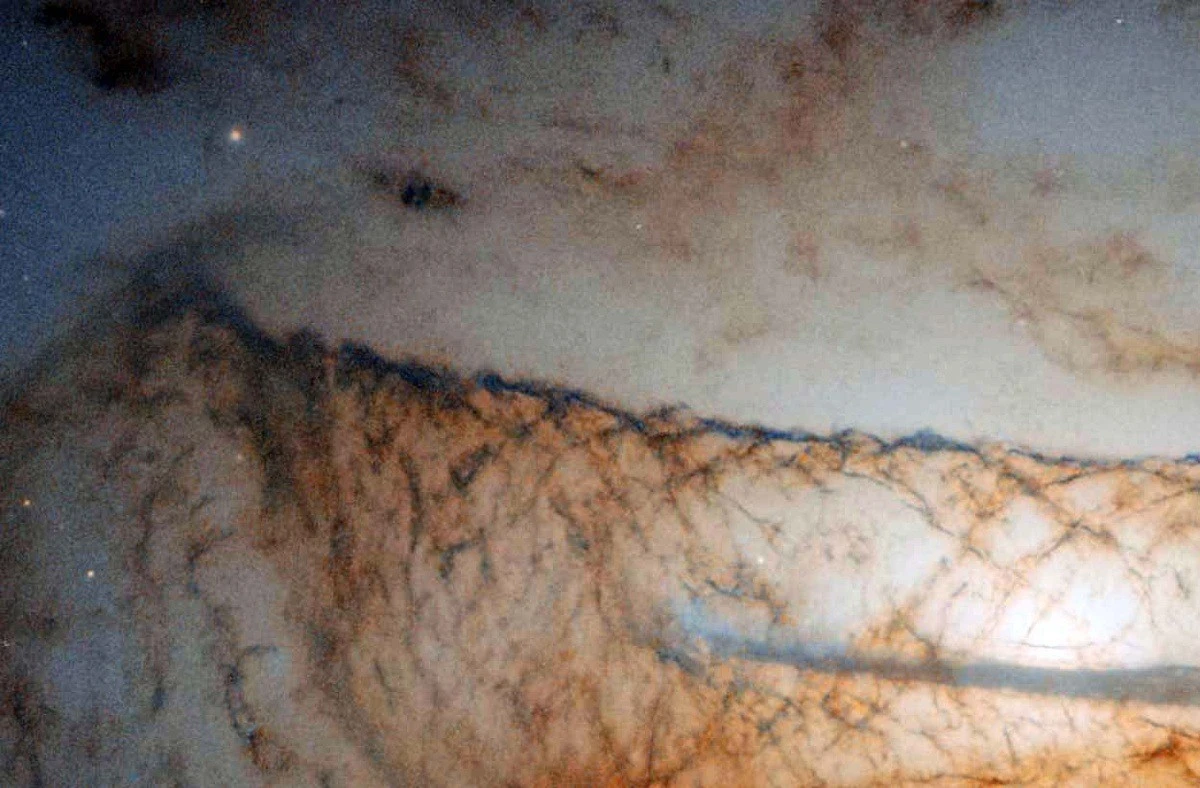
Image processed to more clearly highlight dust lanes.
Events of this kind leave their mark: they disrupt the galaxy's previous structure, redistribute gas and dust, activate star formation, and sometimes leave behind complex and atypical formations.
Studying such objects is especially valuable to astronomers, as it helps them understand galactic "cannibalism," the life history of dominant systems, and the evolution of their surroundings. All this expands our knowledge of the structure of the Universe, helping to fill in the gaps in its history from the Big Bang to the present day.
NGC 4753 reminds us that the structure of any object in the Universe is almost never random: behind every bend in a dust lane, behind every distortion of the structure, there could be an ancient merger, a gravitational perturbation, or an entire chain of catastrophic events stretching over billions of years.
Read also:
The Big Bang vs. "Tired Light": A Battle of Cosmological Models.
Why does everything in the Universe rotate?
The early Universe turned out to be different than we thought.
Add your comment
You might be interested in:











How to start a 102-liter engine

Protective film Removing it with a power screwdriver

When a child plays hide-and-seek at a professional level

Man sets up bedroom camera and discovers the reason for his

Super dads who swoop in to save the day

Precision carpentry

Looks like it's time to buy WinRAR

How to hang wallpaper neatly

How metal buckets are made in Pakistan
