Dangerous Romance Life on Ships of the Age of Sail (5 photos)
Anyone who has ever come into contact with the sea knows that there is nothing more captivating than a sailing ship. They were the beginning of seafaring, and even in the 21st century, the belief persists that you're not a sailor if you haven't sailed. But what is a sailing ship really like, once you strip it of its romantic aura? 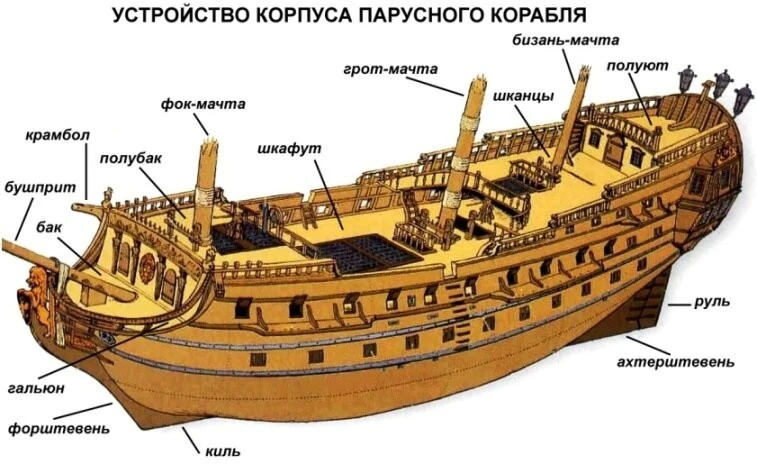
Layout of a typical sailing ship
Construction Materials
Until the second half of the 19th century, sailing ships in Europe were built exclusively of wood. To achieve durability and reliability, builders had to be meticulous: softwoods rotted too quickly in water, so oak, pine, and spruce were primarily used. The wood was thoroughly dried, specially treated, and only then used. But even with strict adherence to technology, rot was inevitable. In the early 18th century, the British and Dutch boasted the longest-lived ships—thirty or even forty years of service was a significant achievement. The situation was much worse in France, Spain, and Turkey. By the beginning of the next century, France had succeeded in establishing the construction of more durable ships, but Great Britain still retained the lead in construction quality until the end of the age of sail.
Starting in the 18th century, the British began lining the underwater portion of the hull with thin copper sheets to prevent rapid growth of algae and barnacles, which not only destroyed the wood but also increased drag in the water, reducing speed. However, even in the modern era, it is impossible to completely eliminate marine fouling.
The Structure of a Sailing Ship
Sails, as we know, have been used for water travel for over five thousand years, and since then, their use has become increasingly complex and modified. The larger the ship, the more complex its sailing rig.
If you look at typical European sailing ships, those that made the Great Geographical Discoveries of the 15th-17th centuries and fought the wars of the 18th century, you will discover clear similarities in their design. These were fairly large vessels with a rounded hull, a protruding bowsprit ("bow"), and two or three, rarely four, masts carrying square sails. They were complemented by a variety of auxiliary sails—gaffs, jibs, and staysails.
The hull consisted of several parts. The forward edge of the foredeck was called the forecastle—it housed the bowsprit, with its ornate trim. Its enclosure, the latrine, served for sanitary purposes. Next came the forecastle—an elevated platform that protected the ship from waves and wind. The first mast (the foremast) was mounted on it, and thick timbers were attached to the sides for hauling up the anchors. 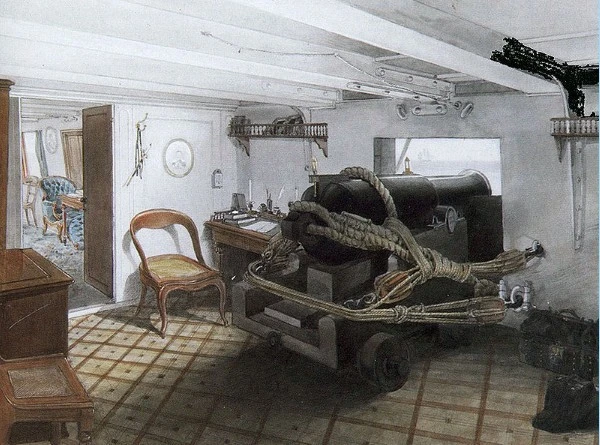
A cannon on the inner deck. This image well demonstrates the peculiarity of the cramped shipboard environment—the cannon stands surrounded by ordinary furniture.
The middle and longest part of the deck was called the waist; The mainmast, lifeboats, and, if the ship was a warship, most of the guns were mounted on it. Next came the quarterdeck—a small, raised section that served as the captain's bridge. The mizzenmast, wheel, and binnacle were mounted here. Beyond the quarterdeck rose the poop deck, intended for observation. And beyond that was the quarterdeck—the aft section of the ship's deck.
The ship's interior was also divided according to strict rules. Closest to the bottom was the hold, containing stores, provisions, water, and ballast. Next to it was the powder magazine, mandatory on warships but often found on merchant ships as well. Above the hold was the crew's quarters, and next to it (on warships) were the marines' quarters. This proximity was no accident—sailors often rebelled, and soldiers had to quickly restore "order" among them.
There was no public space like a mess hall for junior officers—they spent all their time on deck. Meals were often taken there as well—not all ships had designated dining areas. Sometimes, on warships, dining tables were placed right between the gun ports.
Ship Life
What was life like on a sailing ship? It's important to remember that, before the transition to steel hulls, wooden ships rarely exceeded a hundred meters in length. However, several hundred people could be on board—sailing ships were characterized by extreme cramped quarters. The holds were packed to capacity, with boats, masts, and guns occupying their space, leaving the remaining space for the crew.
For example, the ships of Columbus's and Vasco da Gama's squadrons averaged 20-60 crew members and were no more than 30 meters long! By the 19th century, sailing ships had become larger, but so did their crews—maintaining the large number of sails and guns required crews of up to 700-800. They all had to squeeze between the guns and rigging, often in semi-darkness. Natural light penetrated the lower decks either through ventilation hatches in the upper deck or through gun ports. Artificial lighting was strictly limited, which is unsurprising—fire and wood don't mix well. Ventilation also left much to be desired.
In addition to the cramped and stuffy conditions, people had to put up with neighbors—crew members, passengers, and livestock. Private cabins were a rarity, and, besides the captain, they were occupied by senior officers on warships and the most important passengers—aristocrats, wealthy merchants, and officials. 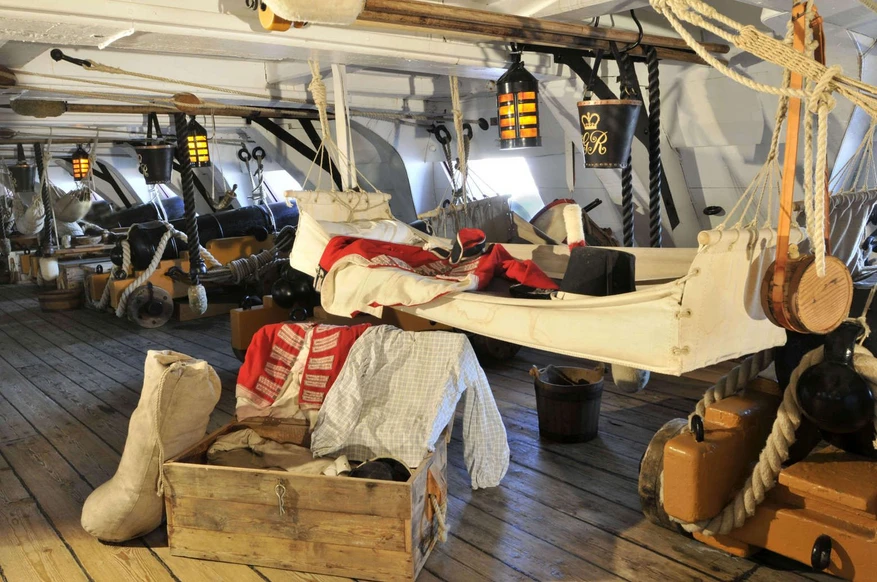
Bunk and personal belongings of a crew member living directly on the gun deck. Ship of the line HMS Victory (built in 1765)
Long-distance voyages were also characterized by other domestic problems. First, water—in barrels, it quickly spoiled, turning into a murky, foul-smelling green sludge. If the crew couldn't go ashore to replenish their supplies, they were left either relying on rain or dew, or drinking what was available—and even then, the norm in most cases was one liter per person per day. Using water for hygiene was completely out of the question.
Secondly, food. Before the invention of the can (early 19th century), food also spoiled, although not as quickly as water. Crackers, corned beef, beans, dried vegetables, and fruits could provide the crew with the necessary energy, as long as they didn't become a food source for pests—rats, worms, and beetles—that spoiled food en masse. Fresh meat was only possible if live chickens, goats, or sheep could be brought on board, and if they didn't die prematurely during the voyage.
Thirdly, the lack of food and water, unsanitary conditions, stuffiness, and seasickness created favorable conditions for the development of a wide range of illnesses—from mental illness in passengers unaccustomed to the sea to scurvy and fever. A doctor, if present, had only a minimal supply of medicines. Sickbays began to appear en masse only on warships in the 18th and 19th centuries; in other cases, one often had to rely on providence and one's own resources. 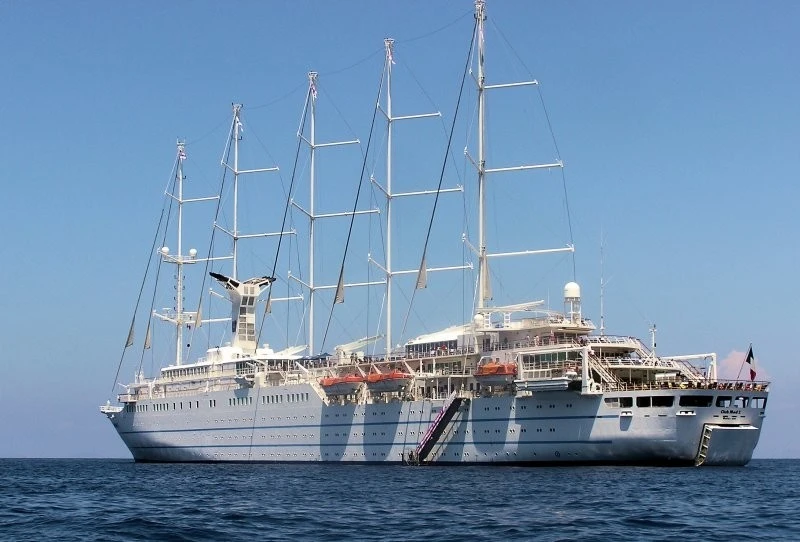
The cruise sailing ship Club Med 2, along with her sister ship, is the largest sailing vessel ever built. Built in France in 1992, it flies the flag of the French territory of Wallis and Futuna.
Modern Sailing Ships
On sailing ships of the 20th and 21st centuries, many of these problems no longer apply. Electricity allows for lighting and ventilation of interior spaces, and refrigerators preserve provisions. Medicines can save lives, and more spacious accommodations contribute to the comfort and health of the crew. And yet, even today, a sailing ship remains a difficult craft to master. Long voyages still carry the same risks as in the age of sail. The only difference is that modern people are better prepared to face most of the unexpected.