Didn't return from a combat mission: the mystery of the first combat submarine's demise was solved after 150 years (5 photos)
On February 17, 1864, during the American Civil War, the Confederate submarine H.L. Hunley carried out its first and last combat mission, sinking the USS Housatonic, a screw sloop of the United States Navy, but never returned to base. It was only found and raised in 1995, but the cause of the submarine's sinking was determined only on August 23, 2017. 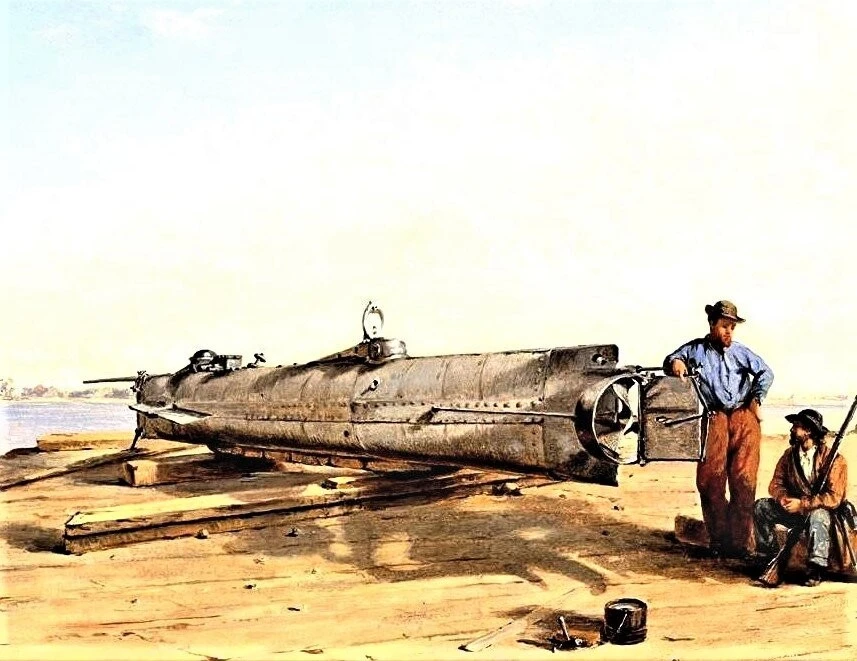
Confederate submarine H.L. Hunley on shore. In the foreground is a propeller and rudder; in the background is a mine-attaching pole. Watercolor, 1902.
Design, armament, and problems.
The H.L. Hunley was the third submarine model built by American entrepreneurs Horace Lawson Hunley, Baxter Watson, and enthusiastic designer James McClintock. It was named after one of its creators (the first two designs, the Pioneer and the American Diver, were unsuccessful). The submarine had a cigar-shaped hull approximately 12 meters long and 1.2 meters wide. The ship had two ballast tanks for diving and surfacing. They were filled through valves and emptied by hand pumps. Metal weights were installed in the middle of the hull, acting as ballast to give the submarine stability. The weights were secured with bolts that could be loosened to release ballast for an emergency ascent. The submarine's crew consisted of eight men, seven of whom manually turned the crankshaft that drove the propeller.
The H.L. Hunley was armed with a pole mine, a copper cylinder filled with 41 kilograms of black powder. The detonator was a contact mine and, judging by the copper wires found in the submarine, an electric one. The mine was mounted on a 6.7-meter-long wooden pole in the bow of the ship and was designed to detonate at a depth of up to 1.8 meters: the submarine was supposed to approach the enemy ship and ram the mine into its side. Experts estimate that it could reach speeds of up to four knots (7.4 kilometers per hour) and dive to depths of two to three meters.
In August 1863, the submarine was expropriated and handed over to the Confederate Navy, but testing revealed serious design flaws: during a training cruise on August 12, 1863, the submarine sank along with five crew members. It was raised, repaired, and returned to the fleet, but on October 15, 1863, the ship sank again, this time taking the entire crew with it, including one of its inventors, Horace Hunley. However, this time it was raised and returned to service. 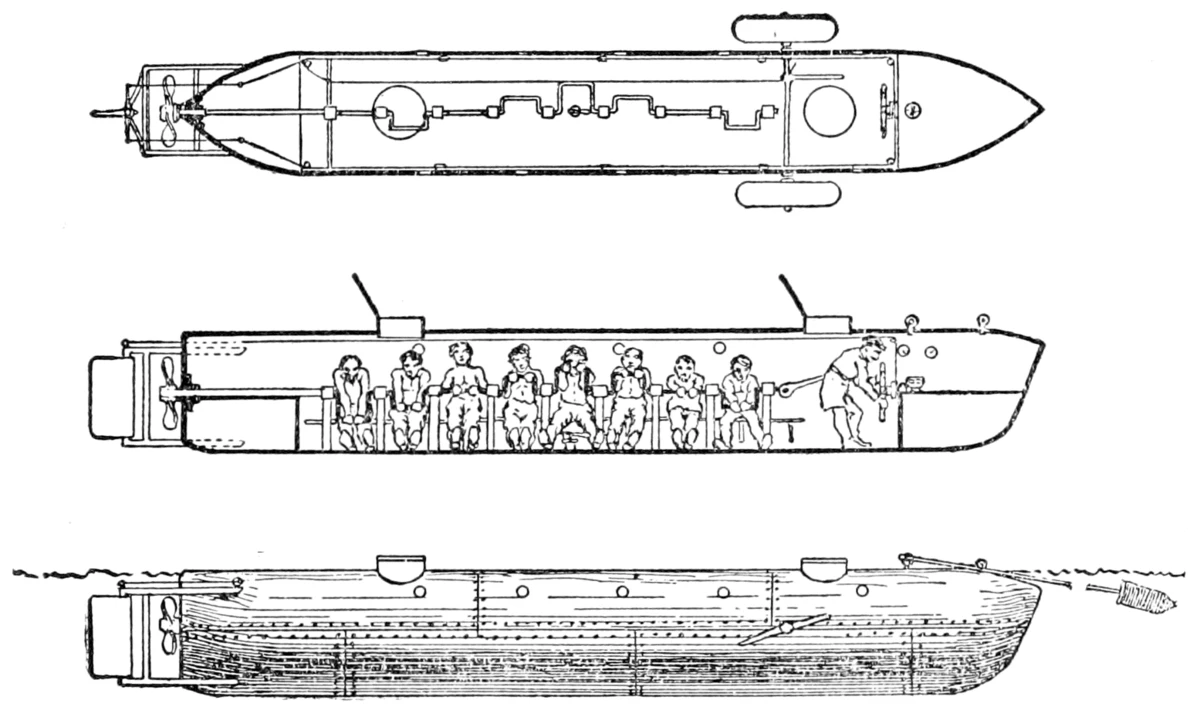
The design of the H.L. Hunley: top, side, and general views. Drawing from 1902
First and Last Combat Mission.
On February 17, 1864, the submarine set out on its first (and last) combat mission. It attacked the 12-gun screw sloop Housatonic, anchored off Charleston, South Carolina. The H.L. Hunley managed to approach the sloop undetected and ram it with a mine. After the explosion, the Housatonic sank within five minutes, killing five of its 160 crew members. This was the first use of a submarine in combat, the first submarine attack on a surface ship, and the first successful submarine attack on a surface ship. However, the H.L. Hunley did not return from the mission, becoming the first submarine to be lost while on a combat mission. 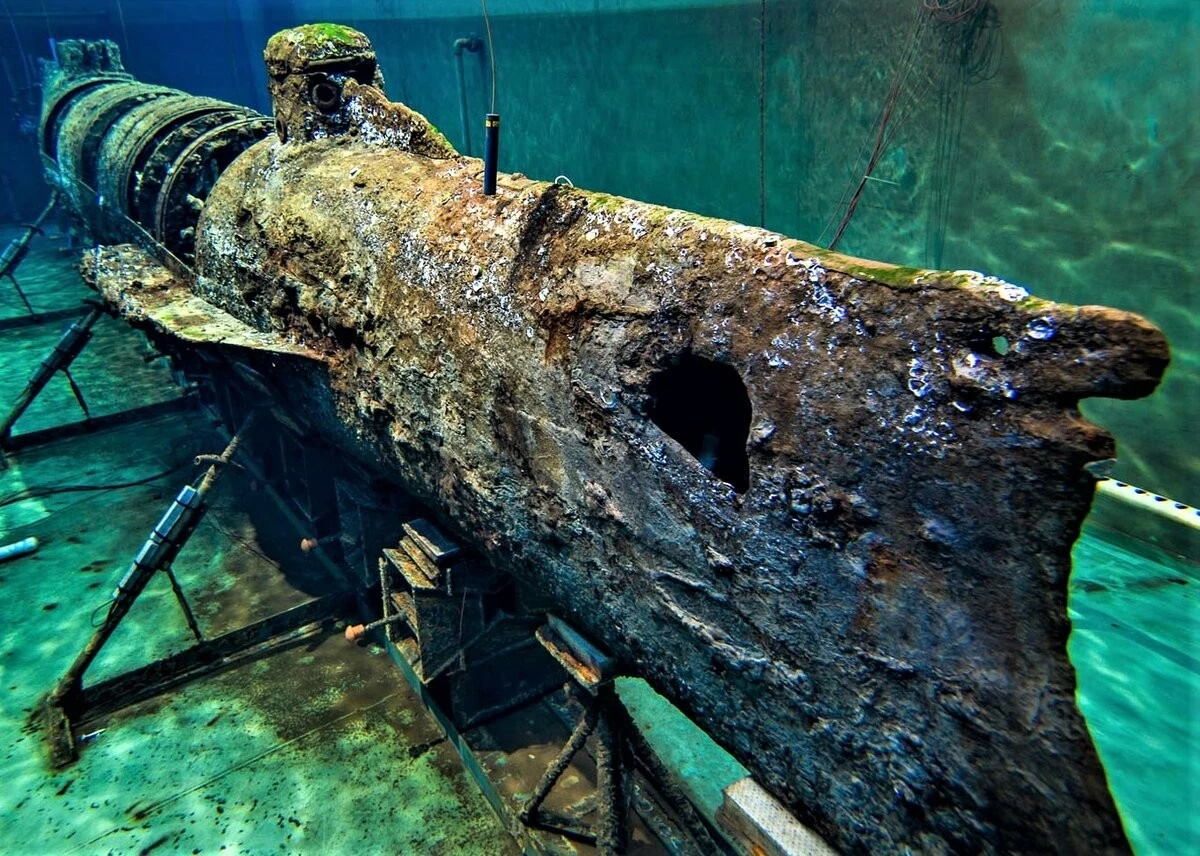
The raised submarine in a special dock in 1996.
Discovery, recovery, and restoration.
The submarine was found only in 1995, 300 meters from the Housatonic, at a depth of 8.1 meters. It was covered in a thick layer of silt, which protected its iron hull from destruction. In 2000, the ship was raised to the surface. The hull had no significant damage, except for a small hole in the conning tower and a small breach in the bow, which could have been sustained after the ship sank. The remains of the crew were in their proper positions: the captain was seated in the bow, and seven sailors were at the propeller crankshaft, which they were supposed to rotate to propel the submarine. The remains also showed no bone damage. Thus, the examination of the submarine refuted the theory that it sank due to critical damage sustained during the explosion of the Housatonic. The theory that the submarine sank due to malfunctioning ballast tanks or crew error was also unsubstantiated. It was assumed that the submarine had sunk to the bottom, and the crew, unable to raise it, had simply suffocated: an initial inspection showed that no water had penetrated the compartment. However, it was later discovered that the tank valves were closed and operational, and the pumps used to pump out the water had not been used—they were in the stowed position. 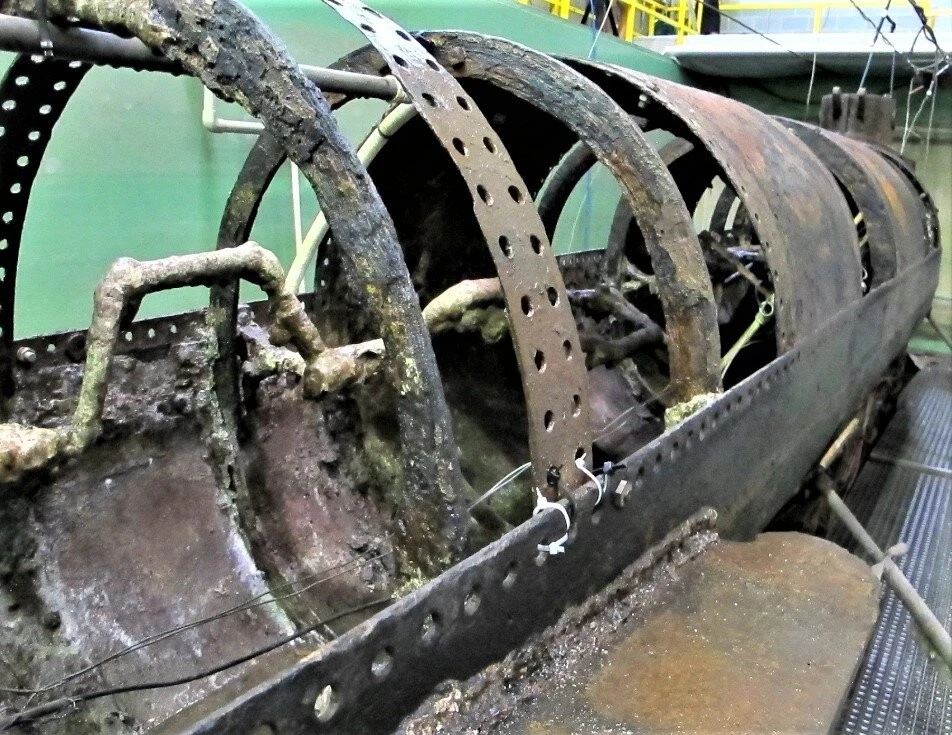
The submarine's hull during restoration. The crankshaft, which the crew would have turned, is visible.
The mystery of the sinking, solved after 150 years.
On August 23, 2017, scientists from Duke University published a study that revealed the cause of the submarine's demise. They hypothesized that the crew's deaths were caused by the shock wave generated by the mine's detonation. After calculating the average shock wave pressure from the detonation of a mine containing 41 kilograms of black powder and modeling the explosion, the scientists concluded that the submarine's hull could have been subjected to a pressure surge of 12.2 megapascals (120.4 atmospheres) in the water, while the internal pressure surge could have reached 195 kilopascals. This surge is insufficient to cause serious damage to almost any organ in the human body except the lungs: there is an 85% probability that the submarine crew suffered pulmonary contusion—damage to the respiratory system caused by the shock. According to the scientists, death from contusion occurred very quickly. This explains why the sailors' remains were found in their proper positions and positions, suggesting they did not suffer the torment of oxygen deprivation that would have been inevitable had the submarine sunk with living crew members on board. 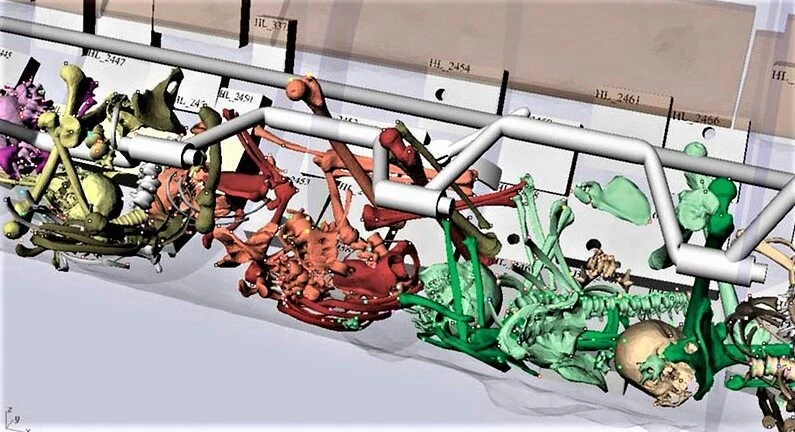
3D model of the position of the submarine crew's remains after its recovery.