Not Just Ammonium Nitrate The Largest Non-Nuclear Explosions (3 photos + 1 video)
Humanity stubbornly turned every useful or indifferent discovery into a means of destroying its own kind. Even things that should have been beneficial, like explosives, led to disasters in peacetime. 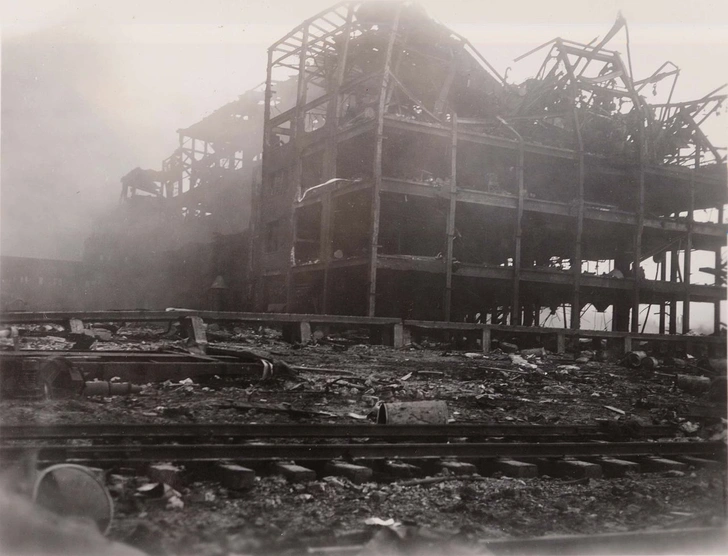
This five-story factory building was located in close proximity to the pier where the explosion occurred. Freight cars stood on the railroad tracks, and as you can see, not even a wreck remained. Source: Townsend, Charles Tellus/ University of Houston Libraries/ Wikimedia Commons
A little about ammonium nitrate and its relatives
Ammonium is a cation with the chemical formula NH4, a compound of nitrogen and hydrogen, the salts of which are used in the chemical industry, particularly in the production of fertilizers and explosives. A significant portion of these salts are themselves explosive, which has led to numerous disasters over the past hundred years. Thus, ammonium nitrate, also known as ammonium nitrate, which is well remembered by residents of Beirut, caused an explosion with a yield of 0.73–0.86 kilotons of TNT equivalent (that is, the amount of energy that would be released by the explosion of this amount of TNT; hereinafter kt), killing more than 580 people and destroying a significant portion of the port of Texas City, Texas, in 1947. This man-made disaster is considered one of the largest in US history. It also began with a fire on a ship carrying ammonium nitrate in its hold: first, the ship exploded, followed by storage facilities for liquid chemicals and petroleum products in the port.
The same ammonium nitrate combined with ammonium sulfate, stored as fertilizer in a warehouse at the BASF chemical plant in Oppau, Germany, exploded on September 21, 1921, leveling not only the plant but also 800 of the 1,000 buildings in Oppau itself and nearby villages, killing more than 560 people. The sound of the explosion was heard as far away as 300 km in Munich, and the tragedy was apparently caused by workers using explosives to break up the caked chemicals and miscalculating the strength of the charge (no, so what? They had been doing this for years before, and everything was fine). The warehouse left a 20-meter-deep crater, and the event itself was featured in A.N. Tolstoy's novel "The Hyperboloid of Engineer Garin" (1927). The explosion's yield is estimated at 1-2 kilotons.
Finally, ammonium perchlorate, used as an oxidizer in solid rocket fuels and as a component of explosives, exploded at a PEPCON plant on May 4, 1988, in Henderson, Nevada, 16 km from Las Vegas. The cause was a fire of unknown origin. It soon spread to chemical storage facilities and triggered several explosions (0.8-1.0 kilotons), razing the plant to the ground, blowing out windows within a 15 km radius, killing two plant workers (out of seventy-five—the rest managed to escape), and injuring more than 370 people.
However, in addition to ammonium compounds, the global chemical industry produces many explosive substances, and sometimes disasters of enormous proportions occur.
Halifax, 1917 — Chemicals
The largest explosion before the invention of atomic weapons is considered to be the one that occurred on the morning of December 6, 1917, in the port of Halifax, Canada, on the Atlantic coast. Although World War I was raging at the time and Canada, as part of the British Empire, was participating in it, the incident had no connection to the fighting.
It all started this way: early one morning, the Norwegian ship Imo departed the port of Halifax, which had become the main staging point for ships traveling from Europe, exhausted by three years of fighting, to the United States and Canada to pick up supplies and return. En route, empty, from the Netherlands to New York to collect material aid for war-torn Belgium, it stopped in Halifax to refuel. To reach the Atlantic, ships leaving the port had to navigate a narrow strait (no more than 500 meters at its narrowest point) with the telling name of The Narrows. Halifax proper stands on one bank, and its suburb, Dartmouth, stands on the other; together, the two towns were home to 60,000–65,000 residents at the time. The French vessel Mont-Blanc, loaded to the brim with explosives and flammable substances (picric acid, TNT, pyroxylin, and benzene—over 2,500 tons in total)—was en route from the ocean to meet Imo. It had called in Halifax to join a convoy and, after crossing the Atlantic, teeming with German submarines, reach Bordeaux, France. Refueling Imo took longer than planned, so its captain, who had planned to leave Halifax the day before, rushed and entered the Narrows, both at excessive speed and on the wrong side of the channel to avoid a collision with other vessels. Although Imo and Mont-Blanc spotted each other more than a kilometer away and shut down their engines, they were unable to avoid the collision. It was not violent, but sufficient to cause a leak of liquid benzene in Mont-Blanc's hold. Sparks created by the collision of the ships' hulls ignited the benzene, starting a fire on board. The captain of the Mont-Blanc, recognizing the danger of an explosion and the impossibility of extinguishing the fire, ordered the crew to evacuate, leaving the burning vessel drifting toward Halifax. Residents of the city and sailors nearby gathered at windows and on decks to watch the unfolding events. At 9:04 AM, an explosion rocked the Mont-Blanc, the power of which is now estimated at 2.9 kilotons. It was heard over 200 kilometers from the site of the disaster, the bay floor was exposed for a few moments, and an 18-meter tsunami was generated. The blast wave, traveling at over 1,000 meters per second, carried fragments of the ship and destroyed buildings over an area of 160 hectares. The explosion threw the melted 90mm cannon from the bow of the Mont-Blanc over 5 kilometers. The smoke column rose 3.6 kilometers.
The explosion destroyed several businesses and a train station, killing at least 1,950 people, 1,600 of whom died instantly. At least 9,000 were injured. What the explosion didn't destroy was lost to fires. The situation was further exacerbated by a severe snowstorm that set in that evening, isolating the city from the rest of the country and making it impossible to search for victims in the rubble. However, the death toll could have been even higher: at approximately the time of the explosion, a passenger train carrying 300 passengers was scheduled to arrive at the station, located approximately 250 meters from the epicenter. The train was delayed by a telegram from station dispatcher Patrick Vincent Coleman. However, after sending his message, he was unable to escape and died. 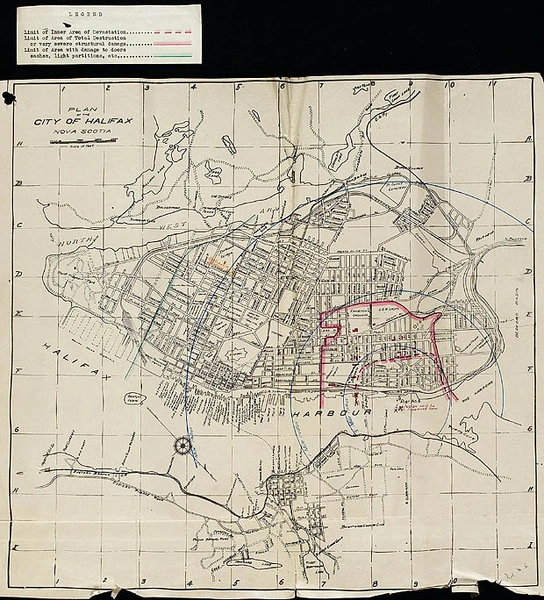
Plan of Halifax (top) and Dartmouth showing the blast radius. Source: BiblioArchives/ LibraryArchives from Canada/ Wikimedia Commons
Port Chicago, 1944 — Ammunition
Another world war, another port in North America, and another massive explosion at the pier, completely unrelated to enemy sabotage or bombing, although it was ammunition that exploded, and in huge quantities. But no one knows exactly how the disaster occurred, because the explosion left literally no evidence or witnesses at the epicenter, so powerful was it. What's known, however, is what happened before. In the port town of Port Chicago, two ships—the Quinault Victory and the E.A. Bryan—were moored at the pier for loading, both fueled for the long voyage. By 10:00 PM on July 17, 1944, working around the clock for four days, military dockworkers had loaded more than 4,000 tons of ammunition, including artillery shells, aircraft, and naval depth charges, into the holds of the E.A. Bryan. The ship was only 40% full. The loading of the Quinault Victory had just begun. Cargo was being transferred to the ships from rail cars parked on three tracks on the pier between the Quinault Victory and the E.A. Bryan. The cars still contained more than 400 tons of ammunition.
At 10:18 PM, a "metallic sound and the cracking of wood, like a crane arm breaking," was heard, followed by an explosion and a fire. Five seconds later, both ships, the pier, and the railcars vanished in a fireball three miles (about 4.8 km) in diameter, according to the pilot of a nearby military aircraft. Seismographs at the University of California, Berkeley, recorded two shock waves, the second of which, the stronger, was equivalent to a magnitude 3.4 earthquake. All 320 people working on the pier and the ships were killed, and another 390 people in the port area were injured by flying metal fragments and unexploded ordnance ejected by the explosion. It's noteworthy that the dockworkers at Port Chicago were predominantly African-American servicemen—202 killed and 233 wounded accounted for 15% of all US African-American casualties in World War II. The yield of the explosions is estimated at 1.6–2.2 kilotons.
And this is December 1944. 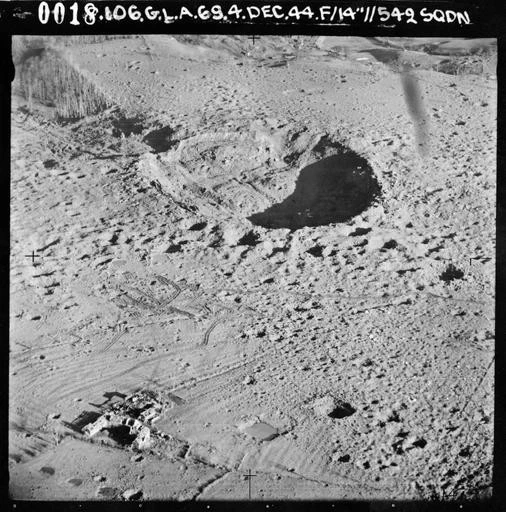
Interestingly, less than five months later, on November 27, 1944, a similarly powerful explosion destroyed an underground ammunition storage facility at Fold Air Force Base in England. The exact cause of the explosion could not be determined in this case either, as nothing remained at the site of the explosion except a crater 90 meters deep and 230 meters in diameter (pictured). However, it is suspected that the cause may have been a violation of ammunition handling regulations by Italian prisoners of war working in the depot. At least 70 people died in the explosion. The crater, named Hanbury after the nearby village, remains to this day. Source: Royal Air Force/ Wikimedia Commons
Baikonur, 1969 — Rocket Fuel
The hot world wars were over, but the cold war was in full swing: on July 3, 1969, the test and dress rehearsal of all pre-launch procedures for the sixth launch of the Saturn V super-heavy launch vehicle concluded in Florida. Eleven days later, its liftoff would mark the beginning of the Apollo 11 mission—the first human flight to another planet. On the other side of the globe, at the Baikonur Cosmodrome, a test launch of the Saturn V's Soviet competitor is underway—the N-1 super-heavy launch vehicle, designed to deliver people and cargo to the Moon, as well as a heavy space station and spacecraft for missions to Mars and Venus. After the space (in every sense) successes of the late 1950s and early 1960s, the USSR is seriously lagging behind in the lunar race: having built the Saturn V, in 1967–1968 NASA had already conducted test flights, a lunar flyby, and lunar module tests in low-Earth and lunar orbits. This is only the second launch for the N-1—the first, in late February 1969, ended in an explosion and the fall of rocket parts fifty kilometers from the launch site. This time, the 105-meter-long rocket is carrying an unmanned spacecraft, a mock-up of the lunar module, and 2,300 tons of liquid fuel. The R-1 rocket, while inferior to the Saturn V in terms of payload capacity, would remain number two for a long time—until the end of the 1980s: 90 tons for the N-1 versus 141 tons for the Saturn V. At 11:18 PM Moscow time, the rocket lifted off the launch pad and began to rise into the air. But this didn't last long: less than fifteen seconds later, parts began to fall off the first stage, all engines except one shut down, and at an altitude of 200 meters, the rocket began to tilt. Twenty-three seconds after liftoff, it fell back onto the launch pad, producing the most powerful explosion in the history of rocketry and one of the most powerful non-nuclear explosions in history—its yield is estimated at 0.3–1.0 kilotons. It completely destroyed the launch pad (its restoration took a year and a half), severely damaged the underground facilities of the launch complex, and was visible and felt at least 35 kilometers from the cosmodrome. Debris from the launch vehicle was scattered over a 1-kilometer radius.
And the memory of the Lebanese tragedy is still fresh: on August 4, 2020, a powerful explosion rocked Beirut. It left a 40-meter-deep crater, destroyed a significant portion of the port, and severely damaged the surrounding areas of the city. The cause was a fire in a warehouse containing 2,750 tons of ammonium nitrate. The explosion's yield was estimated at 2.1 kilotons (compared to approximately 20 kilotons in Hiroshima).
The Beirut explosion confidently ranks among the top ten most powerful non-nuclear explosions to occur outside a combat zone in the past two centuries. The editors of "Around the World" decided to recall several more memorable incidents of this kind and find out what, besides ammonium nitrate, can explode with such force.