Unfortunately, we've never reached the Earth's core (and likely never will), but we know a lot about its structure thanks to the remarkable science of seismology, as well as data from gravimetry, geomagnetism, geochemistry, and laboratory experiments under extreme pressures. 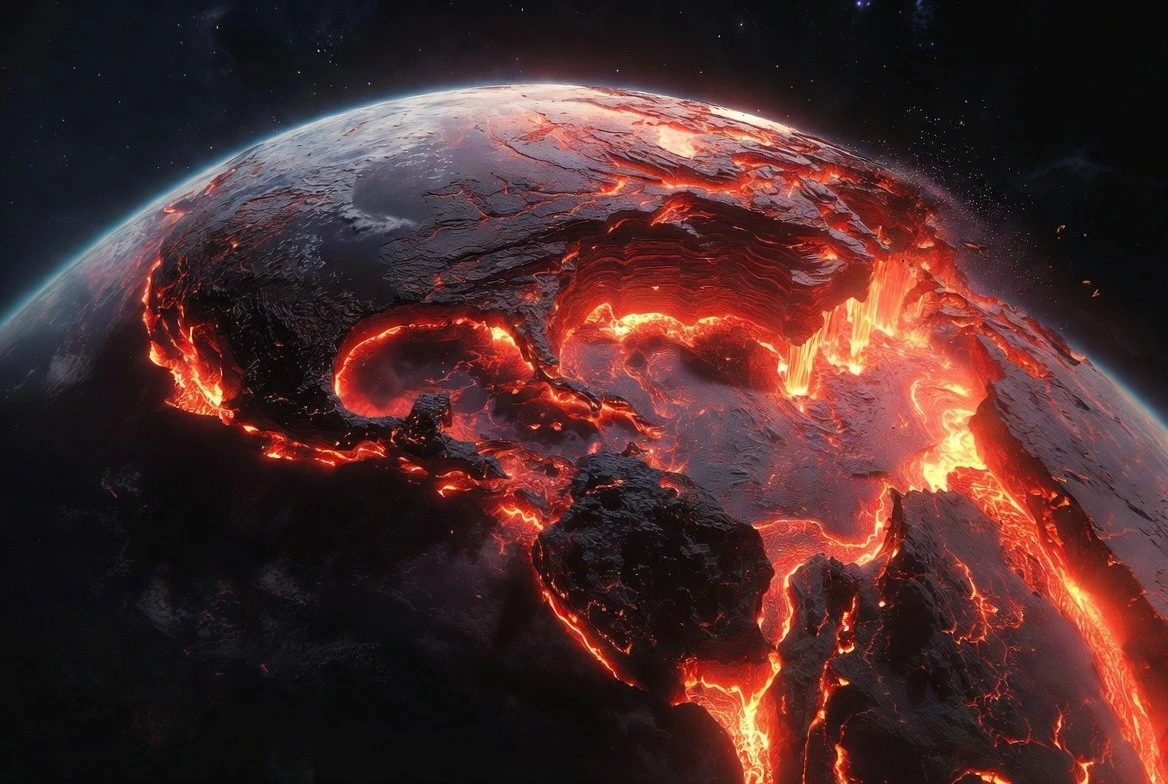
Furthermore, we gained some important knowledge about the internal structure of our planet thanks to subsurface nuclear tests during the Cold War, which provided scientists with "triggered" seismic signals.
Today, we can confidently say that the Earth's outer core is molten and its inner core is solid. Furthermore, based on our knowledge of the abundance of chemical elements in the universe and what happens to them under certain conditions, we know that the core is composed predominantly of iron, which is under enormous pressure.
Available data indicate that the Earth's core temperature is approximately 6,000 degrees Celsius (from here on, temperatures are in degrees Celsius), making it even hotter than the Sun's surface (approximately 5,500 degrees Celsius). The core is separated from the Earth's surface by approximately 3,000 kilometers—if our Sun were that close, it would instantly incinerate the planet.
Why, then, has the Earth's hotter core not melted either the planet or its inhabitants over the past 4.6 billion years?
The core is isolated from the surface by a vast thickness of the mantle, consisting primarily of solid, hot rocks that "flow" (mantle convection) at a rate of several centimeters per year.
Despite the core's enormous temperature, heat from the depths rises to the surface extremely inefficiently, as the rocks are poor conductors of heat, and transfer via slow mantle convection takes an enormous amount of time. Therefore, in this case, it's not just the core temperature that matters, but also how much thermal energy can be transferred outward and at what speed. 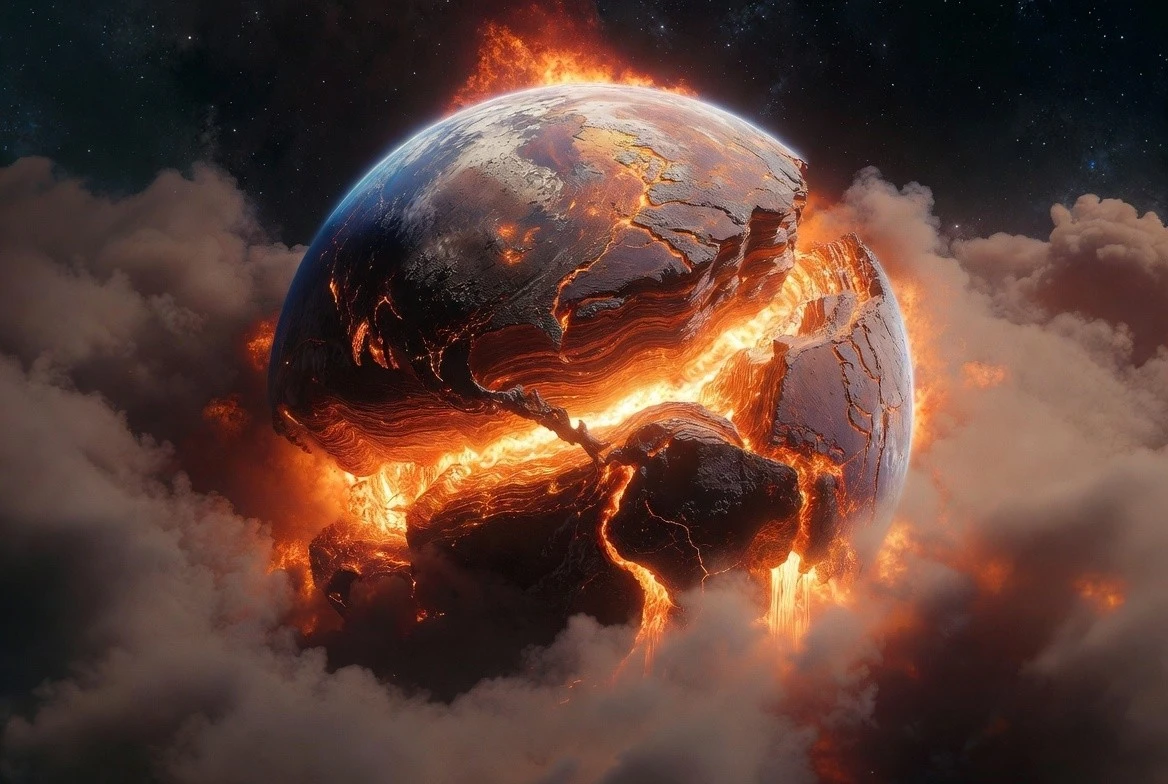
As a result, too little thermal energy reaches the surface to warm the entire planet to melting temperatures: the Earth simply slowly loses heat (it escapes into space) rather than "boiling" from within. At the same time, the mantle does not "melt from below" so that the melt gradually rises. Deep within, pressure increases the melting point of rocks, so even at high temperatures, the lower mantle remains mostly solid. Where melt does appear, it usually does not accumulate: as it rises, it enters cooler regions and partially crystallizes. As a result, there is no "growth" of melt oceans from the bottom up within the Earth—only isolated zones of partial melting occur.
A spark from a sparkler can reach a temperature of 1,500 degrees Celsius, but if it accidentally hits you, you likely won't even feel it. However, immersion in a bath of boiling water (a mere 100 degrees Celsius) would be fatal for most inhabitants of Earth, because water has a large mass and heat capacity—it can transfer a lot of energy.
The same principle applies to Earth: the "stove" is hidden very deep, and heat leaks out gradually—through convection in the mantle and thermal conductivity of the rocks. Therefore, the planet doesn't melt, but rather slowly cools.
Add your comment
You might be interested in:















How to start a 102-liter engine

Protective film Removing it with a power screwdriver

How metal buckets are made in Pakistan

When a child plays hide-and-seek at a professional level

Man sets up bedroom camera and discovers the reason for his

Super dads who swoop in to save the day

Precision carpentry

Looks like it's time to buy WinRAR

How to hang wallpaper neatly
