Two destinies in the storms of war. The History of the Submarines Hrabri and Nebojša (5 photos)
Yugoslavia only began actively expanding its navy in the 1920s. In addition to a series of destroyers, the kingdom could also afford to build submarines—a highly effective weapon, especially against the large surface ships of a potential adversary, Italy. The first submarines built were the Hrabri-class. 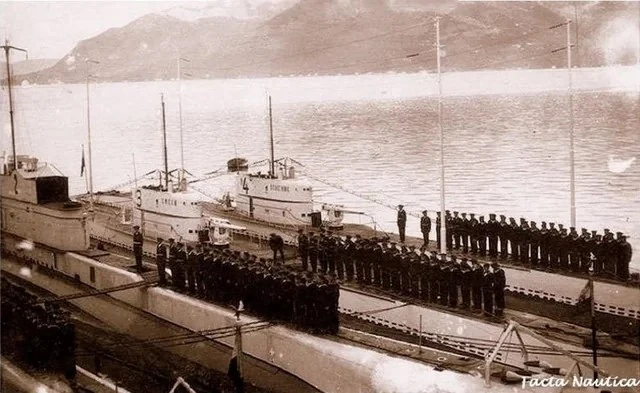
Submarines Hrabri and Nebojša
By the mid-1920s, the Kingdom of Serbs, Croats, and Slovenes (Yugoslavia) had virtually no navy—despite the fact that a significant portion of the country bordered the Adriatic Sea. Finally, at the request of the Yugoslav armed forces, the British L-class submarine HMS L53 visited the Adriatic Sea in mid-1926. The purpose was to familiarize the Yugoslavs with this type of submarine and demonstrate its capabilities. Everything went smoothly, and that same year, a very modest naval development program was adopted, which included, among other things, the construction of two types of submarines, each with two units.
The first type, designated Hrabri, was to be built by the British based on the specifications adopted by the Royal Navy. The order was placed with the Vickers-Armstrong Naval Yard in Newcastle upon Tyne. The designers based their design on the L-class submarines built during World War I, with some improvements. Moreover, to reduce the cost of the ships, the shipyard didn't build the Yugoslav submarines from scratch—the company owned HMS L-67 and HMS L-68, partially assembled for the Royal Navy. They were built in late 1918, and after the order was cancelled due to the end of the war in July 1919, they were launched and placed in storage.
The submarines had a straight stem and a narrow, pointed stern. The hull was divided into seven watertight compartments. The hull was 72.1 meters long, 7.3 meters wide, and had a surface draft of 4 meters. Their displacement was 991 tons when surfaced and 1,183 tons when submerged. Their maximum diving depth was 60 meters. Several design innovations in the Hrabri distinguished it from its British prototype. First, at the suggestion of Yugoslav sailors, gyrocompasses taken from ships of the former Austro-Hungarian Navy were installed. Second, a central pumping station was installed, allowing all ballast tanks to be purged simultaneously from a single station. Third, one of the three periscopes was modified to monitor the sky to warn of possible air attack.
There were two propulsion systems on board. The first, with a capacity of 2,400 hp, was comprised of two Vickers V12 diesel engines and was designed for surface propulsion. The engines consisted of six parts connected by propellers. This design proved unreliable: with frequent use or in adverse weather, the propellers cracked and required replacement. As a result, the submarine had to carry a significant supply of parts, and the crew, in far from ideal conditions, had to constantly carry out repairs. Historians estimate that during a single 15-day cruise, the submarine expended a total of 420 kg of propellers. Its surface speed was 15.7 knots.
The second propulsion system, with a capacity of 1,600 hp, was designed for surface propulsion. The submarine's powerplant consisted of two electric motors for submerged propulsion, providing the submarine with a maximum speed of 10 knots. An additional electric motor, producing only 20 hp, was also installed for silent underwater propulsion. The speed during this propulsion did not exceed 1.7 knots. 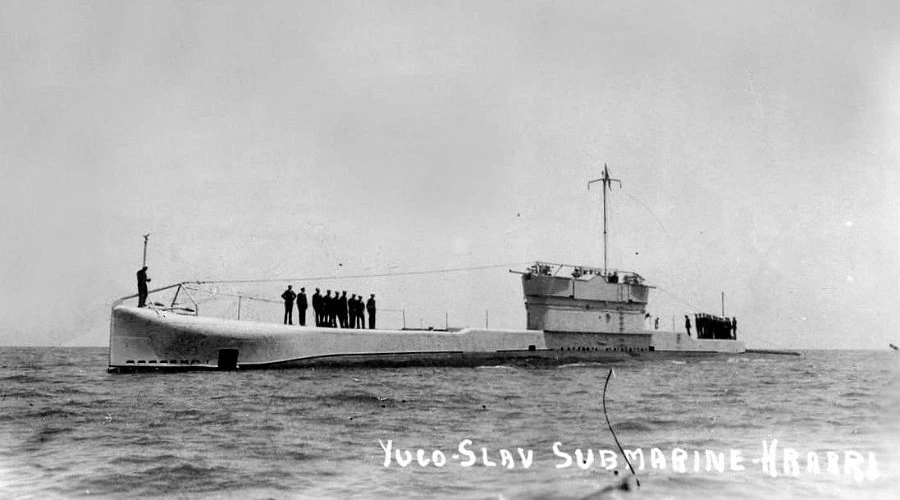
Submarine Hrabri
The submarine's armament consisted of six 533 mm torpedo tubes mounted in the bow and two 102 mm Mark IV L/40 guns, one each in the fore and aft portion of the superstructure. Thanks to the raised platforms and sides, the guns could be used before the submarine reached full buoyancy, and the crew could also be safely washed overboard in bad weather. Until the commissioning of the destroyer Dubrovnik in 1932, the guns of the Hrabri-class submarines had the largest caliber in the Yugoslav Navy.
The boats were later modernized several times. Immediately upon arrival in the Adriatic Sea, each was equipped with one 40mm Vickers QF L/39 anti-aircraft gun and two anti-aircraft machine guns. The Exide batteries on both boats were then replaced with Tudor SHI-37 batteries. Between 1933 and 1934, the superstructures of both boats underwent significant reconstruction: the conning towers were reduced in size, the corners were rounded, and bulwarks were installed to cover the forward portions of the conning towers. At the same time, the bases of the 102mm gun mounts were moved downwards. The 40mm guns were also removed and replaced with 13.2mm Hotchkiss M1929 anti-aircraft machine guns. These changes resulted in the silhouette of the Yugoslav submarines becoming similar to that of the British R-class submarines.
The submarines were launched in 1927—Hrabri on April 15, and Nebojša on June 16. Both submarines experienced a number of problems during testing. Nebojša nearly sank, but the crew managed to prevent it from hitting the bottom. Hrabri collided with a British tugboat and sustained minor damage, and then, during a test dive, listed sharply to starboard and nearly capsized. On March 11, the submarines departed the UK for Yugoslavia, but one of them suffered an engine failure en route. It was repaired in Gibraltar, and on April 5, Hrabri and Nebojša entered the Bay of Kotor, where they were commissioned into the fleet.
During her very first exercises in August, Hrabri's rudders jammed, and the submarine nearly ran aground near the port of Šibenik. In May and June 1929, the submarines made a voyage to Malta and Tunisia without incident, but in June 1930, Nebojša collided with a cargo ship. The collision resulted in the destruction of the conning tower and the loss of one 102mm gun. It was replaced with a wooden replica, which remained on the submarine until 1934. 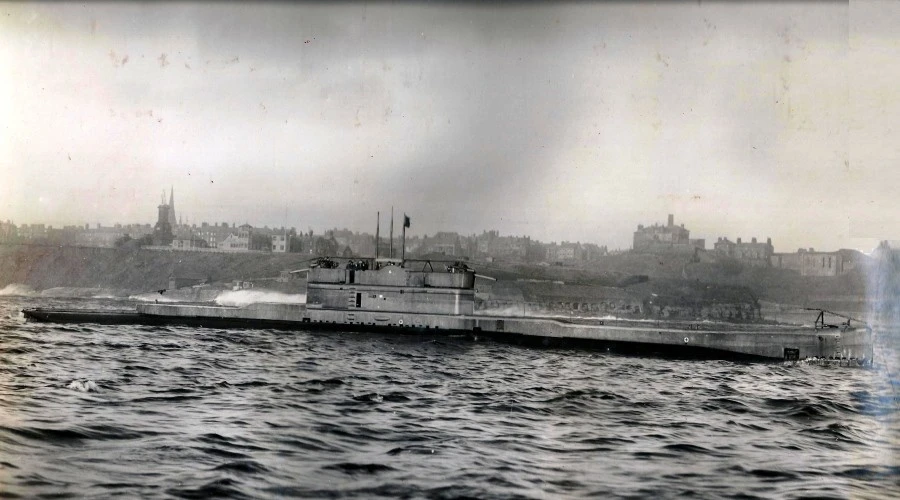
Submarine Hrabri in 1928
In 1933-1934, Hrabri and Nebojša underwent repairs and modernization. They subsequently participated in occasional exercises, and in 1937, they sailed in the Mediterranean. The following year, the naval command deemed the Hrabri-class submarines obsolete and placed an order with Germany for two Type IIB submarines as replacements. However, with the outbreak of World War II, the opportunity to receive them disappeared, so the "old ladies" remained in service.
In April 1941, all four Yugoslav submarines were in the Bay of Kotor, on patrol in pairs: Hrabri with Smeli, and Nebojša with Osvetnik. On April 6, when Germany, Italy, and Bulgaria attacked Yugoslavia, the submarines remained on patrol. Italian aircraft bombed Nebojša, causing no significant damage. Hrabri and Osvetnik were supposed to support the attack on Zara, but the order was cancelled, and the boats remained in the bay. Their crews, rather than follow the example of one of the auxiliary ships that had broken through to Greece, surrendered to the Italians, who arrived shortly afterward. The new owners renamed Hrabri No. 3 and towed her to Pola. After inspection, the submarine was deemed unfit for use and was broken up for scrap later that year.
Nebojša and Smeli nevertheless put to sea with the aim of disrupting communications between Bari and Albanian ports, but failed to find anyone and returned to the Bay of Kotor on April 10 or 11. By that time, the fleet had ceased to exist as an organized force, and the Italians were expected to arrive soon. On April 14, Nebojša's commander, Anton Javoršek, informed the crew of the planned surrender the following day. Knowing there were those on board who wanted to join the British, he tried to persuade them not to do so. After the commander disembarked, First Mate Đorđe Đorđević approached his friend, staff member Đorđe Mitrović, asking him to take command of the submarine to break through to the Allies. Mitrović agreed.
Of the six officers and 46 sailors on Nebojša, three officers and 28 sailors decided to make the breakout. The rest were allowed to disembark, and 11 men from the submarine reserve, also unwilling to surrender, were taken on board in their place. That evening, Nebojša approached the town of Kumbor in the Bay of Kotor and took on four more sailors, nine army officers, and six civilians.
On the night of April 17, Nebojša left the bay and remained submerged until 8:20 PM. She then surfaced, recharged her batteries, and, submerged again, passed through the Strait of Otranto on the night of April 18. On April 19, the gyrocompass failed, so the submarine stopped on the island of Kefalonia for repairs. After repairs and replenishing supplies, the Yugoslavs reached Crete on April 22. There, they managed to link up with two more Yugoslav ships that refused to surrender—the torpedo boats Durmitor and Kajmakčalan. Escorted by a civilian steamship and a Greek submarine, the Yugoslav force met a British warship on April 26 and departed for Alexandria.
At 12:20 PM on April 27, Nebojša's diesel engines failed, but she still managed to arrive in Alexandria at 2:00 PM using only electric power. There, the submarine joined the fleet of the Yugoslav government-in-exile and came under the operational command of the British Mediterranean Fleet. From May to June 1941, Nebojša underwent major repairs, but nearly sank during her first trials. Nevertheless, the submarine was used as a target during anti-submarine warfare training, and then conducted reconnaissance missions until November. 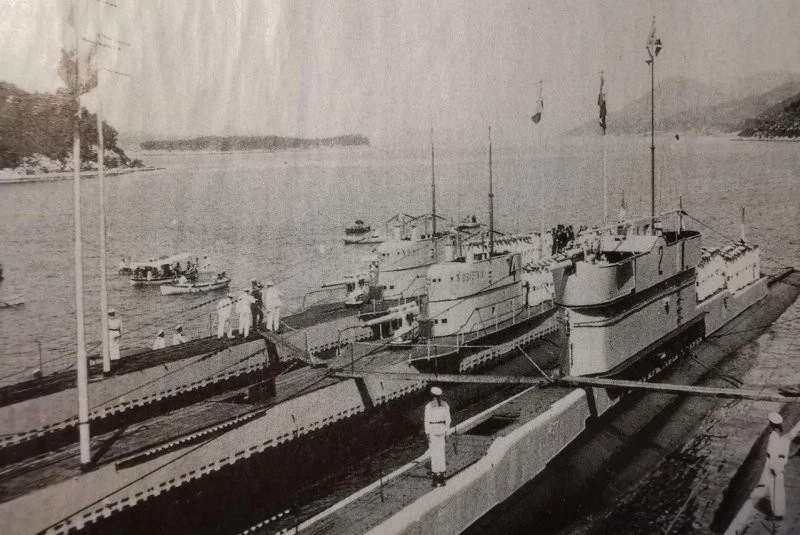
Submarine Nebojša (closer to camera) in Egypt, 1941
Due to continued breakdowns, command forbade Nebojša from diving, and after another overhaul, she was used as a charging station for other submarines. The Yugoslavs demanded a combat-ready ship, but after an attempted mutiny by the generals, Great Britain broke off negotiations and sent the submariners to Cairo for settlement. The few remaining Yugoslavs were assigned to submarines with predominantly British crews—the same was true of Nebojša. In 1942, Nebojša sailed to Port Said for repairs, from where she moved to Beirut in January 1943.
In April, the submarine returned to Alexandria, where in May she was again manned by a Yugoslav crew and commissioned. But it was short-lived—during her first sea trial, both air compressors failed, and the port electric motor burned out. Repairs were carried out from June to November, and Nebojša recommissioned in January 1944. Then, in October, the electric motors had to be repaired again, this time in Port Said. In December, Nebojša was ordered to Malta, the headquarters of the navy in exile. En route, the hydraulic system failed, but repairs in Tobruk were of little help, and tugboats towed the submarine to Malta on January 12, 1945.
In August 1945, Nebojša was handed over to the new Yugoslav government. She was renamed Tara and used as a training vessel and floating depot. At the Navy Day celebrations in Split in 1952, Tara was presented as a combat submarine, although by that time all of her deck guns and part of her conning tower had been removed. Finally, in 1954, the submarine was decommissioned and dismantled.
Thus, Yugoslavia's first submarines were not particularly successful. From the very first sea trials after construction, important mechanisms failed, rendering them obsolete by the start of World War II. However, the heroism of the Nebojša crew still etched the ship into history in a positive light: they refused to surrender to the enemy at any cost and fought their way to the Allies.