Australia's Spider-Legged Crater (2 Photos)
In Western Australia, a crater viewed from orbit bears a striking resemblance to a giant spider. Pale sandstone "legs" radiate from its center across reddish terrain—the heavily eroded remnant of an ancient meteorite impact. 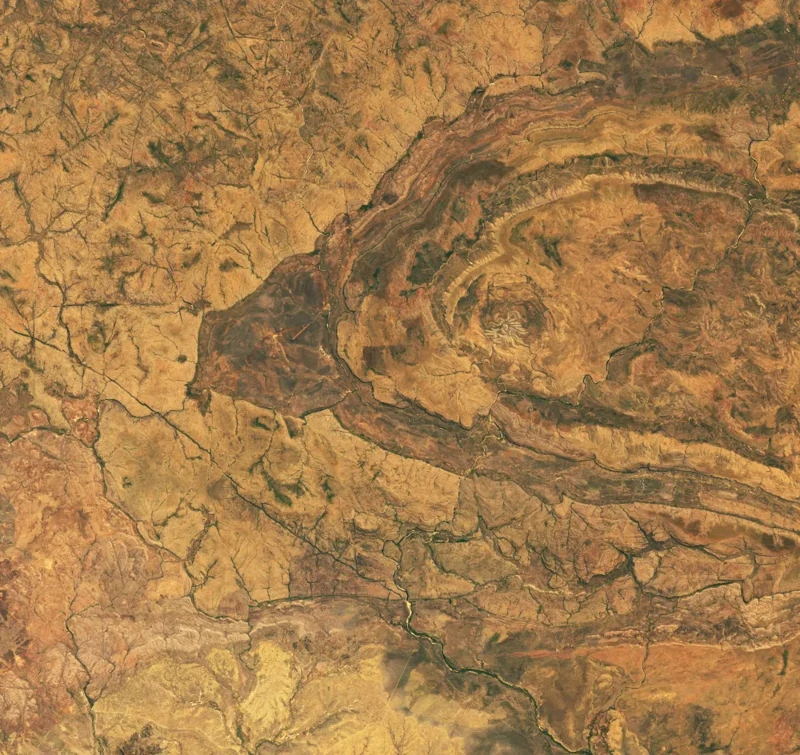
Spider Crater and the surrounding area. Landsat 9, September 20, 2026. NASA Earth Observatory/ Michala Garrison; USGS data.
Spider Crater lies in the Kimberley region of Western Australia. The entire impact structure spans roughly 13 by 11 kilometers, while its spider-like central core measures about four kilometers across. Landsat 9 captured the scene on September 20, 2026.
Little remains of the classic circular basin or its raised rim. Over hundreds of millions of years, differential erosion wore down the rock layers at varying rates. Hardier sandstone ridges weathered the test of time, forming the distinct pattern clearly visible on satellite imagery today.
Geologists attribute this web-like pattern to the crater's central uplift. During a massive impact, rock compresses and displaces before rebound forces push the crater floor back up, often creating a central peak in large impact structures. At Spider Crater, all that remains of this feature are a few resilient ridges. 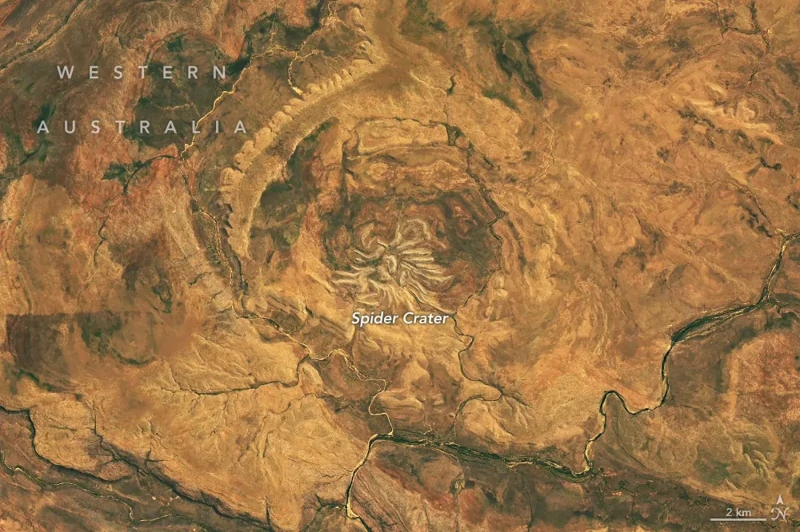
Detail of the same image featuring a label for Spider Crater and a 2 km scale bar. NASA Earth Observatory/ Michala Garrison; USGS.
Confirming the crater's impact origin took time; early theories even favored volcanic activity. A major clue came with the discovery of shatter cones within the central dome—distinctive fan-shaped fracture patterns created only when intense shockwaves tear through rock.
Researchers later examined shock-metamorphosed quartz and zircon from local sandstones. These minerals retain microscopic deformation features that allow geologists to reconstruct the extreme conditions of the collision. The view from space and the microscopic samples tell the exact same story.
The precise timing of the collision remains unknown, though the age of the surrounding bedrock places it between 900 and 600 million years ago. What remains today is a deeply eroded impact structure—a testament to an ancient cosmic collision reshaped by eons of geological forces.