Buying Brides, Selling Widows: The Marriage Market of Lombard Italy (13 photos)
In 568 AD, the Germanic tribe of the Lombards invaded Italy. Known as the "longbeards," they ruled the Italian peninsula for over two centuries. These conquerors worshipped a different god and lived by their own laws, while the native Romans remained distinct, adhering to their own legal code and faith. Yet, within the very first generation, the victors began marrying local women. In 643, King Rothari issued the Lombards' first written code of marriage laws. Here is the story of what a bride cost, why a simple offense could carry a 900-solidus fine, and why calling a woman a witch was strictly against the law. 
A World Falls Apart: The Lombards Arrive in Italy
By the 6th century, Italy lay in ruins. The grand majesty of Ancient Rome had faded, leaving the peninsula open to successive waves of invaders. In 568, the Germanic Lombards swept into the region under King Alboin. Their name, meaning "longbeards," was given to them by the Romans in reference to their appearance. This was no peaceful migration; the invaders seized lands and established isolated military garrisons, keeping the native population at arm's length—or rather, at sword's length. 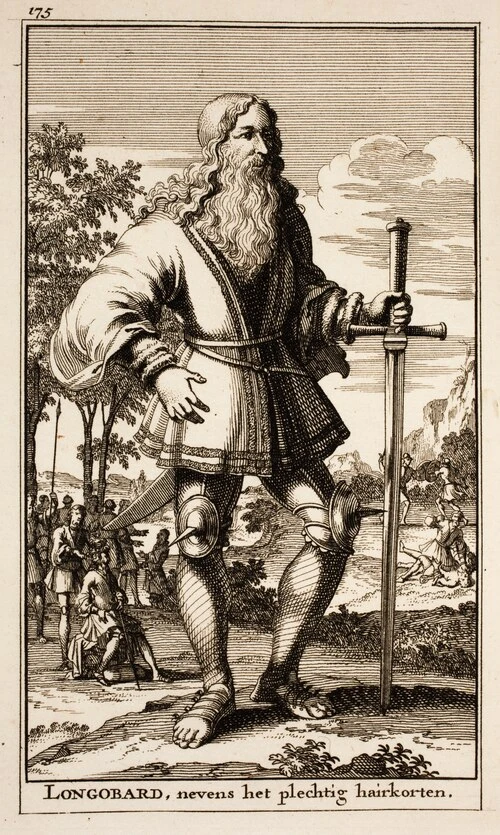
A Lombard warrior. 18th-century engraving
The Romans continued to live under codified Roman law, while the newcomers abided by their unwritten tribal customs. Religious divides ran deep as well: the Lombards adhered to Arianism, a Christian branch that rejected the doctrine of Christ's equality with God the Father. To Italy's Catholic majority, this was a dangerous heresy. Even King Rothari himself remained an Arian in 643. The conversion of the Lombard nobility to Catholicism began later, under the influence of Queen Theodelinda's court, and was not complete until the late 7th century. 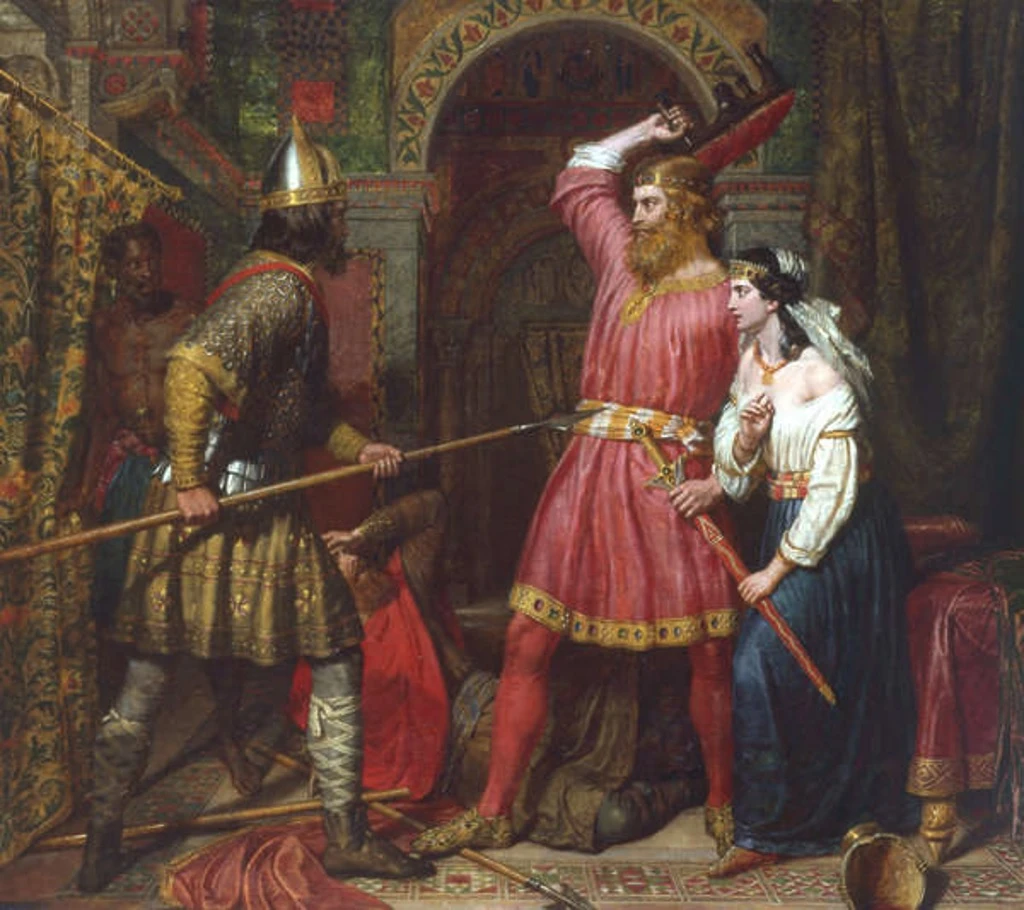
The Murder of Alboin, King of the Lombards. Painting by Charles Landseer, 1854
Alboin's reign was short-lived. According to legend, he was assassinated in 572 by conspirators instigated by his wife, Rosamund, whom he had forced to drink from a cup crafted from her slain father's skull. The king's death did little to stall the conquest, however, as the Lombards continued expanding their domain for decades. The country was split into two parallel worlds—conquerors and conquered—living side by side under entirely different sets of rules.
DNA Insights: Two Peoples Merged Faster Than Legends Suggest
Official separation could not last forever, a fact modern science has proven directly from skeletal remains. In 2018, a research team from the University of Florence, the Max Planck Institute, and Stony Brook University sequenced the DNA of 63 individuals buried in two 6th-century cemeteries—Szólád in Hungary and Collegno in Piedmont, Italy. The findings challenged the long-held belief that the invaders lived in strict isolation, revealing that genetic as well as cultural intermixing began in the very first generations following the migration. 
The Collegno necropolis in Piedmont: DNA analysis revealed genetic mixing between Lombards and Romans within the earliest generations after the conquest
In 2024, the same research team expanded their study to 52 additional genomes, tracing the history of the Collegno cemetery over several generations. Initially, the community consisted of a tight-knit network of high-status families of northern origin. Over time, however, locals were gradually integrated—a shift evidenced by changes in diet, burial rites, and genetic markers. The graves proved more accurate than any medieval chronicle: where chroniclers depicted an unbridgeable divide between conquerors and conquered, teeth and bones told a story of steady integration.
Law Forged by the Clashing of Spears
In 643, King Rothari decided to put an end to the uncertainties of oral tradition. Inspired by Roman tradition, he set out to codify Lombard law, producing the
Edictum Rothari
(Edict of Rothari)—the first written Lombard legal code, comprising 388 articles transcribed by the royal scribe Ansoald. 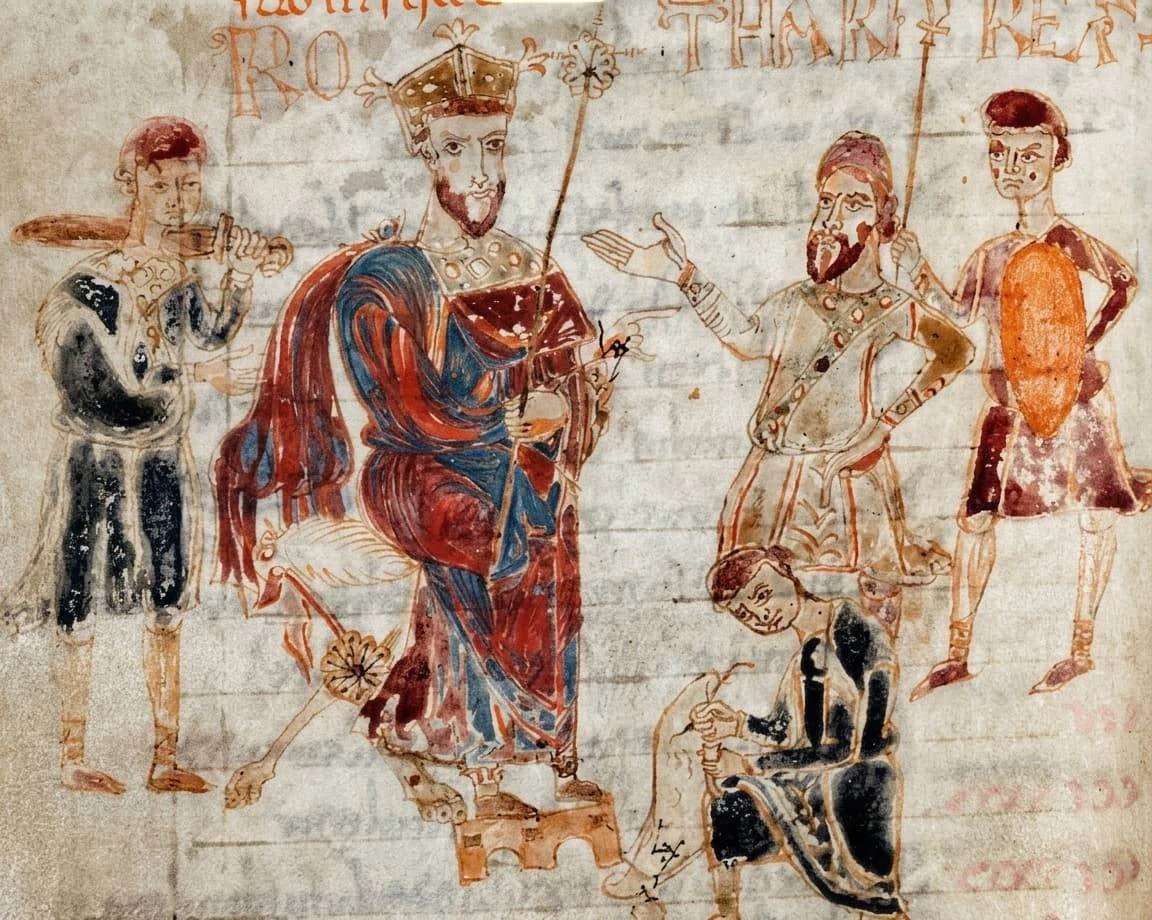
Rothari, King of the Lombards. Miniature from an 11th-century manuscript
The manner of its ratification was deliberately archaic. On November 22, 643, the
gairethinx
—an assembly of free warrior men—gathered in Pavia. They ratified the new laws by clashing their spears against iron shields. Notably, the code paid almost no attention to public administration, foreign affairs, or commerce. Instead, it focused heavily on property rights and financial restitution for personal injury, operating largely on the principles of Germanic wergild. 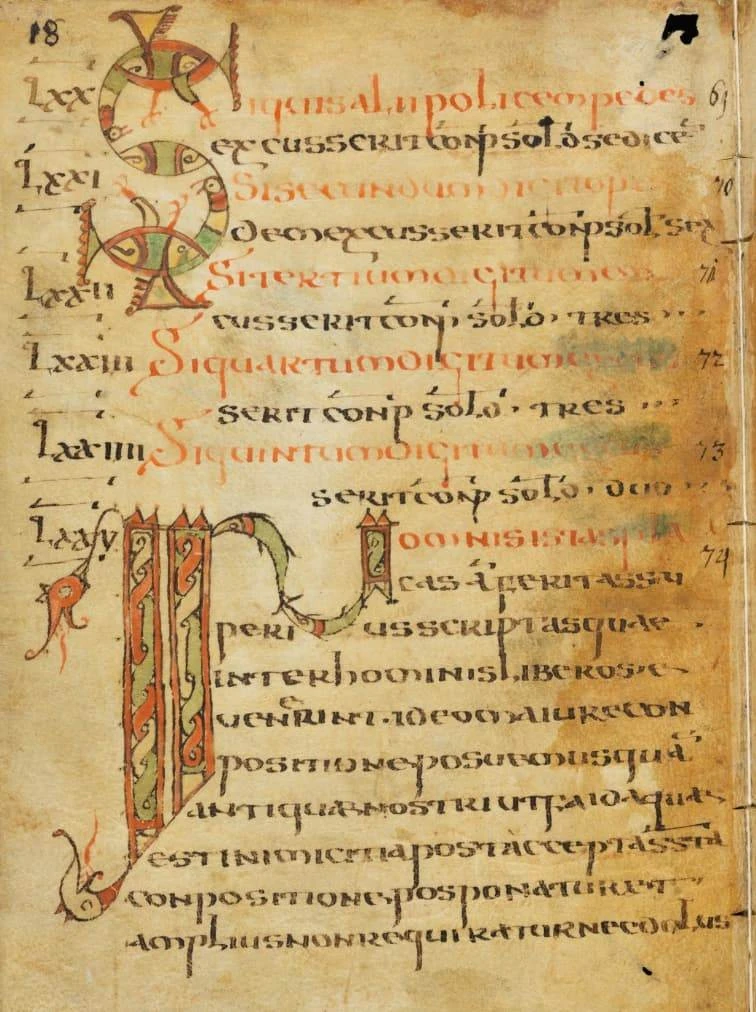
A page from the
Edictum Rothari
. Manuscript dating from the 7th–8th century
It is precisely through these meticulously calculated fines that a vivid picture of the era emerges. The edict regulated marriage, sexual conduct, violence, and family hierarchies. It assigned precise values to a broken rib, a knocked-out tooth, or an insult to a free woman, effectively establishing a price tag on human honor and life.
Mundium: The Price of a Bride
The status of a Lombard woman was complex and contradictory. From birth until death, a free woman remained under the legal guardianship of a male relative—a system known as
mundium
. Without the consent of her guardian (
munduald
), a woman could not sell property, free a slave, or marry. Under Lombard law, marriage was essentially a financial transaction: a prospective husband did not simply take a bride, but purchased her
mundium
from her family for a negotiated sum known as the
meta
. 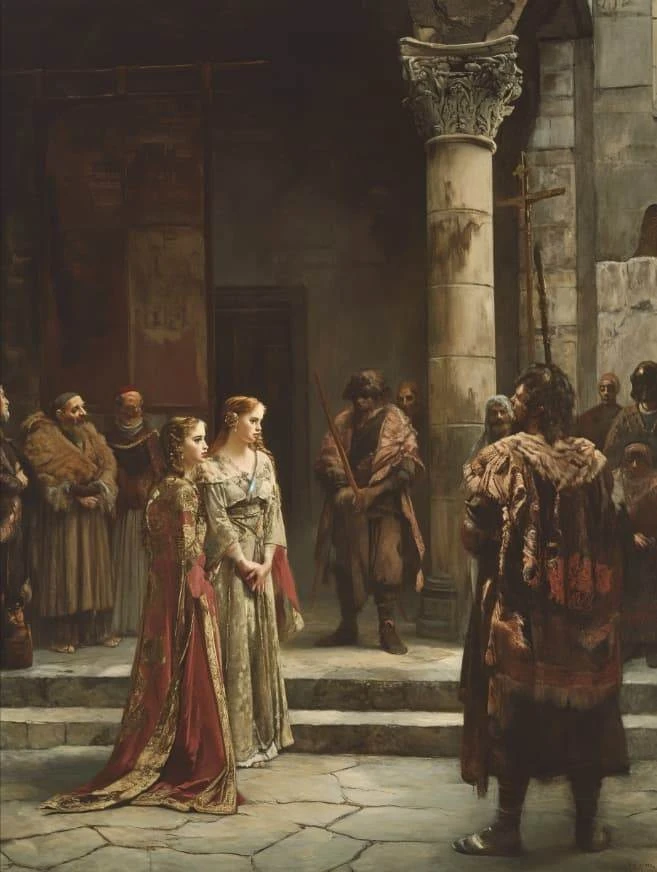
The Lombards. Painting by Edmund Leighton, late 19th century
If a woman was widowed, her
mundium
reverted to her father or brother, who held the right to remarry her—effectively selling her guardianship to a new suitor. Germanic law strictly enforced social boundaries: if a free Lombard woman married a semi-free
aldius
or an enslaved man, it was treated as a severe crime against her kin. Her relatives were legally permitted to execute her or sell her beyond the kingdom's borders to cleanse the family honor. 
The Shadow. Painting by Edmund Leighton, 1909
Yet
mundium
was not merely an instrument of oppression. A guardian bore full financial and legal responsibility for the woman under his care, and no outsider could command her without his approval. Legal historians still debate whether
mundium
was protection disguised as control, or control disguised as protection. In truth, the Edict of Rothari provides ample evidence for both views.
900 Solidi for Accosting Another Man's Wife
The edict established fines that were unprecedented for their time to protect the freedom and safety of women. Germanic law aimed to nip blood feuds—a centuries-old tradition—in the bud, converting almost every act of violence into monetary compensation. Article 26 of the edict, known as
wegworin
, stipulated that anyone who barred the path of a free woman or girl was required to pay a staggering fine of 900 gold solidi, split equally between the king and the victim's family. 
For the exact same offense against a free man, the edict prescribed a fine of just 20 solidi—45 times less
The contrast is striking. A woman's life was valued even more highly: the treacherous murder of a free maiden or married woman incurred a fine of 1,200 solidi. A dedicated clause explicitly forbade a husband from executing his wife without a formal judicial conviction. This legal shield was born not of sentimentality, but of cold pragmatism: a free woman embodied the honor and material interests of an entire lineage.
The Morning Gift: A Bride's Financial Safety Net
A central element of Lombard marriage was the
morgingab
, or "morning gift." On the morning following the wedding night, the husband transferred a portion of his property—sometimes up to a quarter of his entire estate—to his new bride. This gift became her personal, inalienable property. If the couple had sons, they eventually inherited their mother's
morgingab
; if they remained childless, the property reverted to her birth family upon her death. 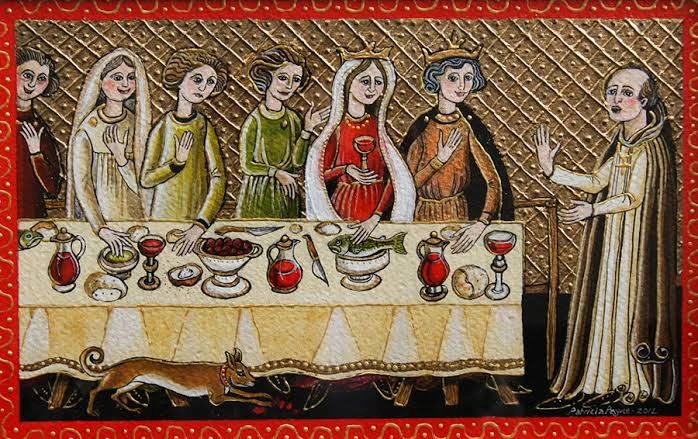
A medieval wedding banquet. Painting by Patricia Payne, 2012
Here, Lombard custom stood in stark contrast to Roman tradition, where the bride provided a dowry to her new household. Tellingly, terms such as
morgingab
,
metfio
, and
faderfio
were incorporated into the Latin text of the edict without translation, as King Rothari's scribes could find no Roman legal equivalents. This linguistic anomaly illustrates just how deeply Germanic customs reshaped a legal code written in the language of the vanquished Romans. 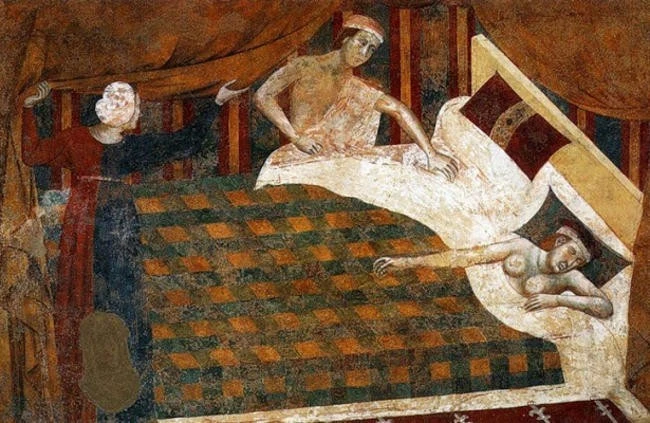
Scenes of Courtly Love: A married couple retiring to bed. Painting by Memmo di Filippuccio, c. 1320
The
morgingab
functioned as an insurance policy of sorts, securing a woman's financial independence in the event of her husband's early death or marital breakdown, regardless of her relatives' wishes. In a society where women could not manage their lives without a guardian, sole ownership of a substantial estate represented a rare measure of autonomy.
Striga: The Witch Who Legally Couldn't Exist
A fascinating dimension of this cultural encounter was the legal stance against superstition. The Edict of Rothari explicitly prohibited accusing a woman of witchcraft or labeling her a
striga
—a Latin term for a blood-sucking witch. The law's reasoning was strikingly rational for the 7th century, explicitly stating that no Christian mind should believe it possible for a woman to devour a living person from within. 
The execution of witches. Medieval miniature
False accusations of witchcraft carried heavy financial penalties. If the accused was an enslaved woman or an
aldia
, the accuser was required to pay her master 60 solidi on top of her full market value. Free women were similarly protected in proportion to their status. Historians suggest that such accusations were often leveraged as weapons to remove unwanted female relatives or to contest their claims to a
morgingab
or inheritance. Thus, royal law—driven by order rather than mercy—shielded women from mob justice centuries before the witch trials swept late medieval Europe. 
Stitching the Standard. Painting by Edmund Leighton, 1911
Through fines for harassment, the purchase of
mundium
, and disputes over witchcraft, we catch a glimpse of a new Italy taking shape. The collision of Roman jurisprudence and Germanic custom produced a unique synthesis. Ultimately, family law and the marital bed proved to be among the most powerful drivers integrating these two civilizations—long before kings and bishops reached an official accord.
What do you think? Was the Germanic system of total male guardianship—
mundium
—harsher on women than Roman law? Or did steep fines for insults and a guaranteed morning gift make life safer for a Lombard woman than for her Roman contemporaries?