What Happens When Air Gets Into a Vein (4 Photos)
Many of us have heard that getting an air bubble in your vein can be fatal. But is that actually true? Just how dangerous is an air bubble in your bloodstream, and when should you actually worry? Here is what really happens to your body if air enters a vein, how much air it actually takes to cause harm, and what your chances of survival are. 
Is an Air Bubble in an IV Drip Really Dangerous?
Almost all of us have had an IV drip at some point. Yet this routine procedure fills many people with dread because of a persistent myth: if the IV bag runs out and the line isn't clamped in time, air will pump into your veins and kill you. Is it really that terrifying? 
You can often spot tiny bubbles inside IV tubing, but they pose no threat whatsoever—they simply stick to the walls of the tube and stay put. Panic usually sets in when the IV bag empties completely and patients watch air moving toward the needle.
There's no need to panic. Like everything else, an IV drip relies on basic physics. The blood pressure inside a peripheral vein is high enough to block air from advancing down the tube. Nothing bad will happen, and your health and life are never at risk.
Dangerous air embolisms happen under entirely different circumstances, such as severe trauma or complications during central vein catheterization. Large veins can have negative pressure, which creates a risk of pulling air directly into the circulatory system. Even then, it takes a substantial amount of air to trigger a life-threatening emergency. 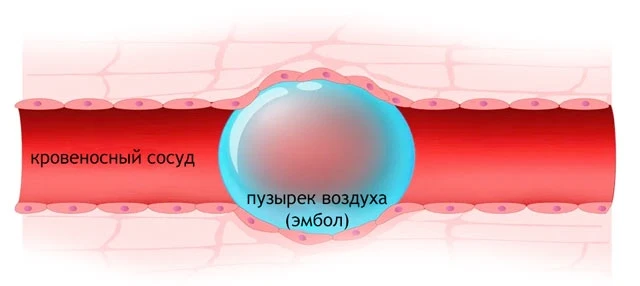
To trigger a life-threatening heart attack or stroke, roughly 200 to 300 milliliters of air—equivalent to twenty 10-mL syringes—would have to be intentionally injected into a vein. This could only happen if someone deliberately forced air in during a procedure, a scenario with virtually no record in medical history.
What Situations Are Actually Dangerous?
Blood vessels can become blocked by air in the case of deep, extensive wounds that pull air directly into the bloodstream. While this can disrupt blood circulation, prompt medical treatment can successfully prevent severe complications.
An air embolism can also occur without any physical injury. Deep-sea divers face this risk if they ascend to the surface too quickly, causing a rapid drop in ambient pressure. Gases dissolved in the bloodstream form bubbles that block blood vessels, leading to decompression sickness and potentially severe tissue ischemia. 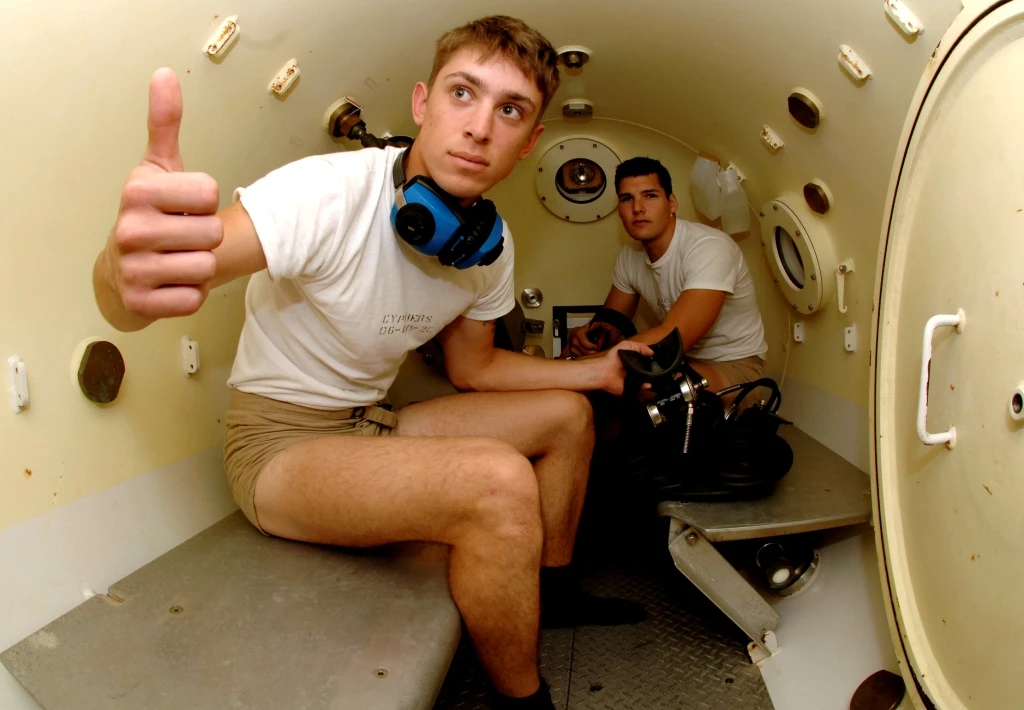
Scuba divers inside a decompression chamber
Following proper diving protocols prevents this entirely. A gradual ascent allows dissolved gases to leave the body safely. Divers coming up from extreme depths can also use specialized decompression chambers—hyperbaric capsules where air pressure is kept elevated and then slowly decreased.
As you can see, the fear of a "fatal air bubble" in an IV is mostly a myth. True danger arises only under rare, extreme circumstances. Have you ever worried about this during a medical procedure? How much do health myths influence your peace of mind?