The Story of the "Milwaukee Cannibal" Jeffrey Dahmer (12 photos)
The desire to leave a mark on history is natural for human beings. Some achieve fame in the arts, others in science or sports. Many do not aim so high, choosing instead to live a dignified life for the sake of their children, remaining the most cherished and respected figures in their lives. Unfortunately, there are also those who choose a horrific path of violence and death, gaining notoriety as murderers and sadists. This is precisely how Jeffrey Dahmer—known as the "Milwaukee Cannibal"—went down in history. 
Jeffrey Lionel Dahmer was born on May 21, 1960, in Milwaukee, Wisconsin, USA. Serial killers are often assumed to come from dysfunctional families, but Dahmer defies this stereotype. His father was a prominent research chemist with a doctorate, while his mother was a theater actress. Jeffrey was the eldest child in the family; he had a younger brother, David, born in 1966. 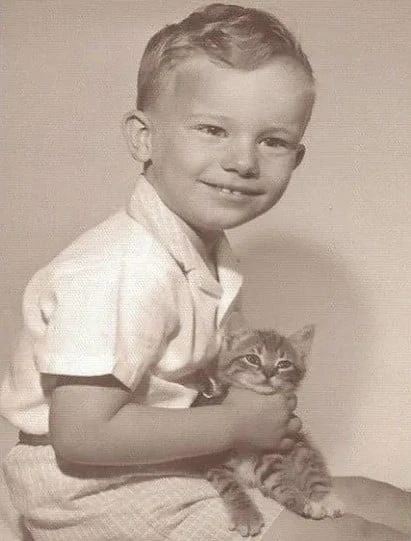
Jeffrey Dahmer as a child
During Jeffrey's childhood, the family moved frequently due to his parents' changing jobs. His father's career was flourishing, and he received invitations to teach at prestigious universities. Things were not going as well for the boy's mother, however; she constantly felt undervalued because she was cast in minor roles. At one point, following a nervous breakdown, she was admitted to a psychiatric hospital. There, she became addicted to tranquilizers and continued taking them even during her pregnancy.
The strange obsessions of a quiet straight-A student
Despite his mother's issues, Jeffrey was born a perfectly healthy child. At school, he was known as a quiet, friendly boy. He was a good student; by some accounts, his IQ was 145. However, this was merely the outward appearance of the young Dahmer. There was another, darker side to him—one that gradually began to surface. 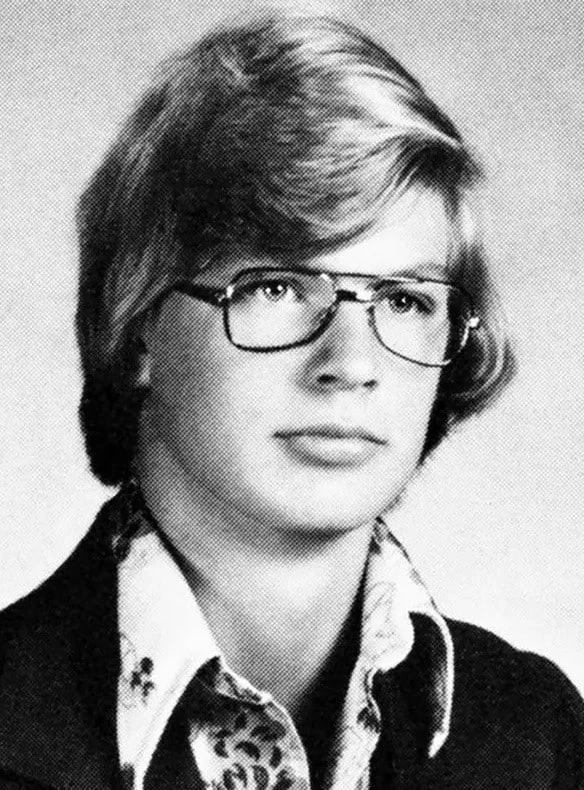
Jeffrey Dahmer in his youth
From preschool age, the boy was drawn to dead animals. He would collect the carcasses of mice, rabbits, cats, and dogs, dismember them, and preserve the body parts in jars of formaldehyde—which he obtained from his father's laboratory. Jeffrey even established a small cemetery in the backyard, which he tended to meticulously.
His parents, preoccupied with their work, paid no attention to their son's disturbing hobbies. Meanwhile, Jeffrey’s condition was deteriorating. By the age of 14, the quiet straight-A student was a thing of the past. Dahmer had developed an alcohol addiction, drinking both with peers and in solitude. Witnesses recalled that alcohol affected him differently than it did others; after drinking, Jeffrey did not become cheerful or uninhibited. He would fall into a stupor and could sit motionless for hours, staring fixedly at a single point.
Around this same age, the teenager realized he was gay after having his first sexual experience with a peer. At sixteen, Jeffrey fell in love with a man who lived on his street and was a runner. The young man fantasized about having the object of his desire completely at his mercy and helpless. Once, Dahmer even lay in wait for him in the park with a baseball bat while the man was out for a run. The athlete was lucky—he had chosen a different route that day. It was the first warning sign. 
After graduating from high school, Dahmer enrolled at Ohio State University. However, his craving for alcohol prevented him from succeeding as a student, and he was expelled. Jeffrey joined the army, but was discharged for the same reason: heavy drinking. Without a degree or formal training, he scraped by on odd jobs. He worked as a nursing assistant, a cleaner, and a manual laborer at a confectionery factory.
First Arrests
For a time, his parents supported him both financially and emotionally. But then they divorced, and each moved on to their own personal lives. Dahmer was left to face his problems alone. Jeffrey’s mental state deteriorated. He was plagued by unbridled homosexual fantasies in which themes of submission and violence played a major role. 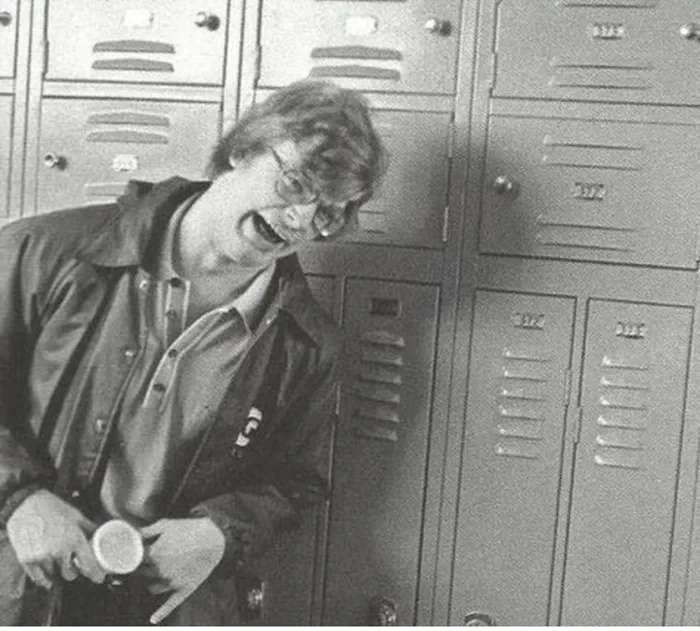
Dahmer lived with his grandmother; he would meet men in the basement of her house. He would drug casual acquaintances and photograph them naked. The old woman had no idea what was happening right beneath her feet. However, she sensed that something was wrong with her grandson and soon demanded that he leave her home. Jeffrey rented an apartment, where he continued to act out his twisted fantasies.
One day, he brought a 13-year-old boy home, gave him alcohol laced with a sedative, and began photographing him in explicit poses. Fortunately, it did not end in murder that time—the victim regained consciousness in time and escaped. The police learned of Dahmer's actions, and he was soon arrested. However, the police did not take the crime seriously; the deviant photographer received only a five-year suspended sentence. He was arrested again for masturbating in front of two teenagers; that time, Dahmer merely received a fine.
Victims of the "Milwaukee Cannibal"
In total, Jeffrey Dahmer claimed 17 victims. He killed 16 of them in his home state of Wisconsin and one in Ohio. He committed his first murder in 1978, almost immediately after graduating from high school. The maniac took his final life 13 years later, in 1991. The bloody tally began with 18-year-old hitchhiker Steven Hicks; Dahmer gave him a ride and invited him over for beer and marijuana. 
A still from the 2022 series *Monster: The Jeffrey Dahmer Story*
Some sources claim the young men had sex, while others deny it. After spending several hours at Dahmer's home, Hicks wanted to leave. Jeffrey refused to let him out and struck him on the head with a dumbbell. The killer strangled his unconscious guest and then dismembered the body. Dahmer wrapped the head in plastic and placed it in the refrigerator.
The young man drove the body parts—packed into bags—to a forest in his trunk and scattered them over a wide area. On the way, a police officer stopped the killer and even looked into the trunk. However, the officer did not check the trash bags and let the maniac go. The victim, Steven Hicks, was a drifter, and his disappearance went unnoticed. This fact gave Dahmer a sense of impunity.
Jeffrey committed his second murder nine years later, on September 15, 1987. His victim was 25-year-old Steven Tuomi. Dahmer met him at a bar, after which the two men went to a room at the Ambassador Hotel. Dahmer claimed he did not remember the details of the murder. He told investigators that he simply woke up one morning to find his lover's corpse in bed beside him. 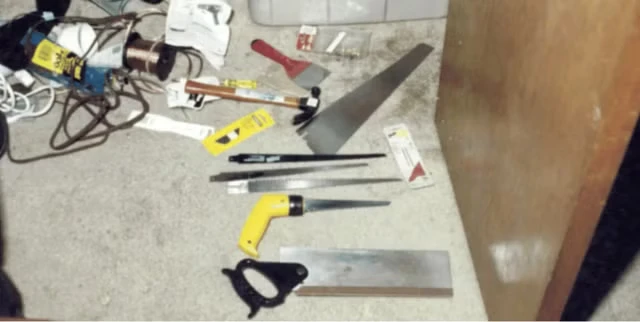
The tools Dahmer used to dismember bodies
The maniac stuffed Tuomi's body into a suitcase and drove it to his grandmother's house. There, he raped the corpse and performed a series of bizarre acts with it. The victim's body remained in the basement for a week; Dahmer then dismembered it and disposed of the parts at several different dump sites. Not a single fragment of Steven Tuomi's body was ever recovered.
Dahmer's deranged schemes
Dahmer always used the same tactic. He would meet his victims at gay bars and invite them to his home. Once there, he would drug the unfortunate men with a mixture of alcohol and narcotics before killing them. Typically, the killer strangled his victims or struck them on the head with heavy objects. But that was only the beginning. 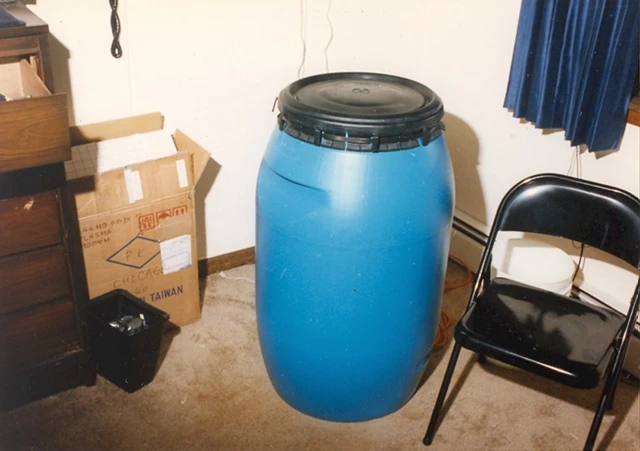
The killer dissolved body parts in this barrel.
After the murder, the necrophile would rape the corpses, dismember them, and perform grotesque acts with the remains. He would sever hands, feet, or genitals, dissolving them in acids and alkalis or preserving them in jars of formaldehyde. In several instances, after rendering a guest unconscious, Dahmer would drill a hole in their skull and pour acid inside, hoping to turn the victim into a zombie.
At times, Jeffrey Dahmer consumed body parts and even flayed the skin from victims' faces to create a mask. He photographed these acts with a Polaroid camera, amassing a gruesome archive over the years of his killing spree. Dahmer came close to being exposed on several occasions but managed to escape detection. Once, his father discovered a tub containing dissolved human remains in the basement of his grandmother's house; Jeffrey managed to convince him that he was conducting experiments on animals. 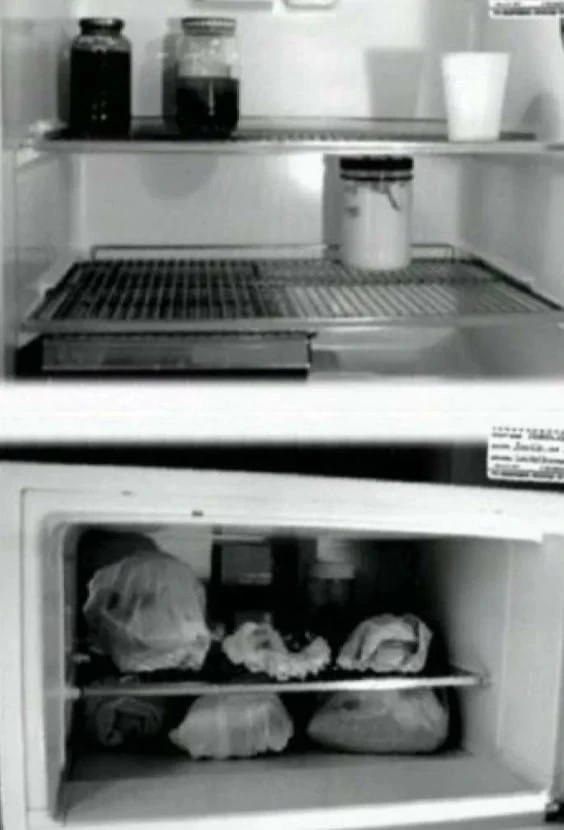
Human organs found in the killer's refrigerator.
The killer frequently came to the attention of the police but managed to avoid prosecution or received only minor penalties for petty offenses. At one point, while under investigation for sexual harassment, Jeffrey killed another victim. Fearing to keep yet another trophy at home, Dahmer took the severed head of a man to the confectionery factory where he was working at the time.
Arrest, Trial, and Death
Over time, the serial killer's activity only intensified. Shortly before his arrest, Dahmer was killing one person a week. It all came to an end on July 22, 1991. On that day, Dahmer invited Tracy Edwards to his home. After plying his guest with a cocktail of alcohol and a sedative, the killer began to handcuff him. However, Edwards suddenly regained consciousness, pushed the killer away, and ran out into the street. 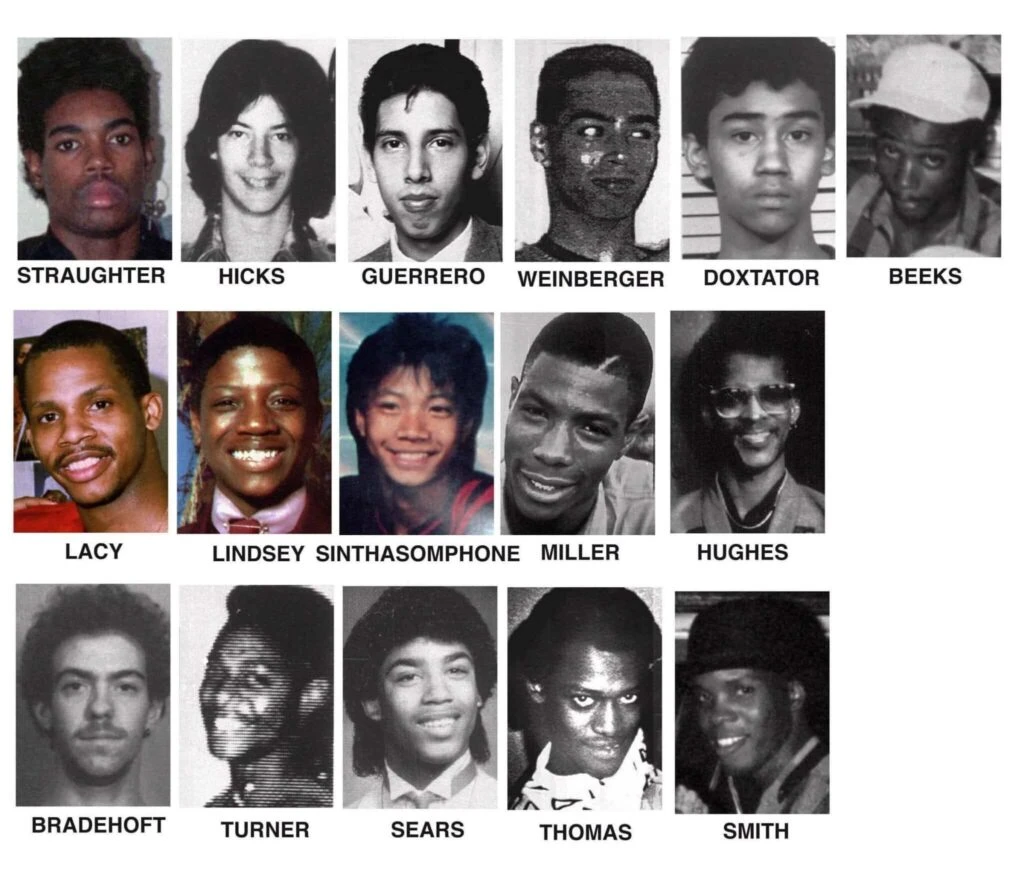
Photographs of Jeffrey Dahmer's victims
A naked man running down the street with a handcuff dangling from one wrist caught the attention of the police. Two officers entered Jeffrey’s apartment, where they discovered a cache of gruesome trophies. Human entrails and three heads were stored in the refrigerator. In the bathroom, they found a large pot containing severed hands and penises, as well as several skulls and jars of organs preserved in formaldehyde.
In his bedroom closet, Dahmer kept a complete human skeleton and a collection of dried penises. A 260-liter vat stood in the storage room, containing the dissolving torsos of his most recent victims in acid. Photographs of the maniac's victims and his mutilation of their bodies were displayed throughout the apartment. Interestingly, the horrific stench filling the premises did not bother Dahmer, nor did his intoxicated guests seem to notice it. The stench of decomposing flesh did not bother another monster, either—Alexander Spesivtsev. 
Jeffrey Dahmer’s trial began on January 22, 1992. The defense argued that the defendant was mentally ill and required treatment. However, on February 15, 1992, the court found the serial killer guilty on all counts. Since the death penalty is prohibited in Wisconsin, Dahmer was sentenced to 15 consecutive life terms, totaling 957 years in a maximum-security prison.
Death in Prison
While incarcerated, Jeffrey Dahmer behaved well and feigned sincere remorse. He had even undergone treatment for persistent suicidal thoughts. On November 28, 1994, Dahmer and another inmate, Jesse Anderson, were found beaten in the shower area where they had been cleaning. They had been attacked with a metal bar and a mop handle by Christopher Scarver, a Black repeat offender. 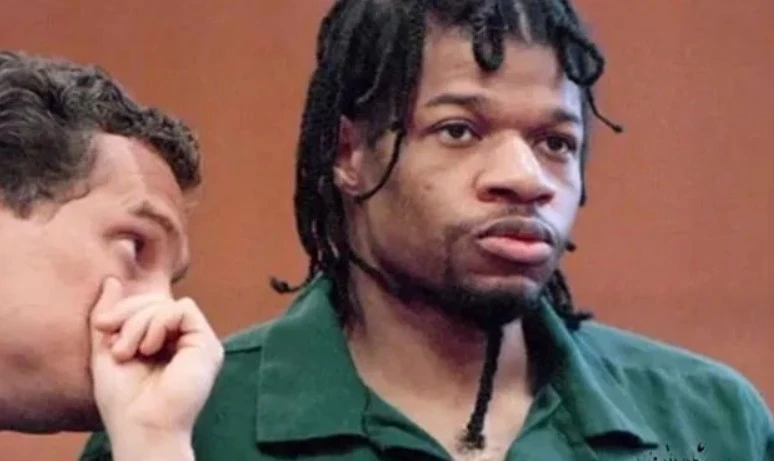
Christopher Scarver
Dahmer died on the way to the hospital; his skull had been crushed. Anderson survived for another day but also died in the intensive care unit without regaining consciousness. When a guard asked why an inmate already serving time for murder had decided to commit two more killings, Scarver replied that the Lord had told him to do it.
Jeffrey Dahmer’s body remained in the prison morgue’s cold storage for nearly a year. The killer’s father refused to grant permission for his organs to be used for scientific purposes and insisted on cremation. The body was cremated, and the ashes were divided into two portions: one went to the killer’s mother, and the other to his father and stepmother.