Humans and Pet Dinosaurs: What Would Our Planet Look Like Today if Dinosaurs Had Never Gone Extinct? (21 photos)
Have you ever wondered how history might have unfolded if dinosaurs had never vanished from the face of the Earth? Would they have died off later anyway? Would humanity even exist? The scenario of humans coexisting with ancient reptiles has fascinated sci-fi writers for generations—from Arthur Conan Doyle’s *The Lost World* and Ray Bradbury’s *A Sound of Thunder* to Michael Crichton’s *Jurassic Park*. 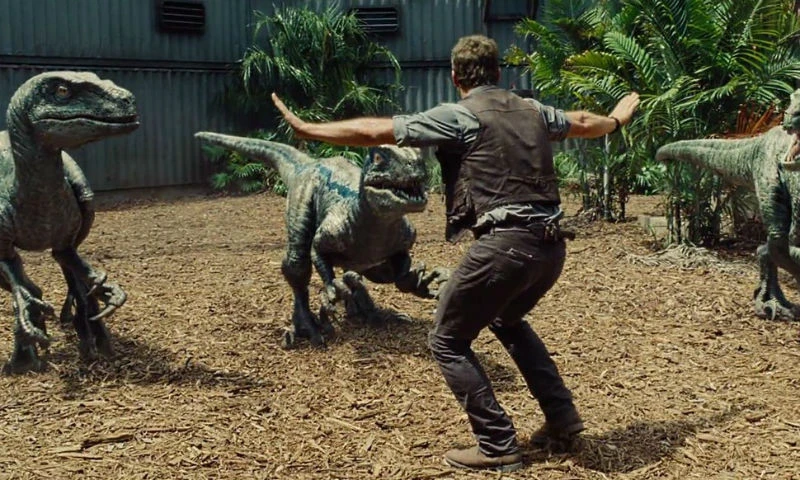
What if humans and dinosaurs had to share the planet as equals? It was actually a distinct possibility. Igor Kray, a regular contributor to *Mir Fantastiki* magazine who has been writing popular science and history articles since 2004, explains.
The Cataclysm
The extinction of the dinosaurs is usually blamed on an asteroid impact that left a massive "wound" on the Earth 65 million years ago: the Chicxulub crater on the Yucatán Peninsula. Yet even after uncovering such convincing evidence of a cosmic disaster, scientists don't consider the case closed. The cataclysmic impact itself, which literally shook the planet to its core, doesn't explain everything. 
To survive in this new world, reptiles had to adapt their tactics against mammals—turning to venom, suffocation, and drowning. Reptiles themselves are highly resistant to toxins and oxygen deprivation.
Countless animals perished and entire species vanished, yet most major lineages managed to survive. Several reptilian orders weathered the crisis remarkably well. Squamates (snakes and lizards) didn't just survive—they thrived, eventually evolving into more species today than mammals. Crocodilians are still doing just fine. And turtles, over their 200-million-year history, have weathered more than a few falling space rocks. 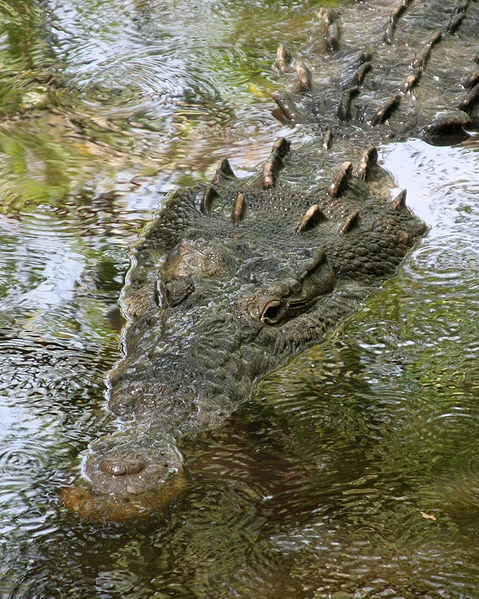
Analysis of miraculously preserved DNA fragments revealed that dinosaurs are closer to birds than to crocodiles. Yet crocodiles themselves are more closely related to pigeons than to lizards. Reptiles are a remarkably diverse group.
In truth, the Cretaceous Period was no longer exclusively the age of reptiles. Mammals had already emerged in the Triassic, around the same time as the ancestors of dinosaurs—the thecodonts. Pterosaurs were already sharing the skies with early birds. While most mammals were small and rat-like, some predators grew to the size of a large Great Dane.
Who would live and who would die was not decided immediately after the impact, which devastated all life (mammals, being less tolerant of famine, likely suffered even worse). The real outcome took shape later, as the planet recovered and survivors began carving out ecological niches anew. The exact dynamics of this post-apocalyptic reshuffle remain poorly understood, and its ultimate causes are still debated.
Feathered Dinosaurs 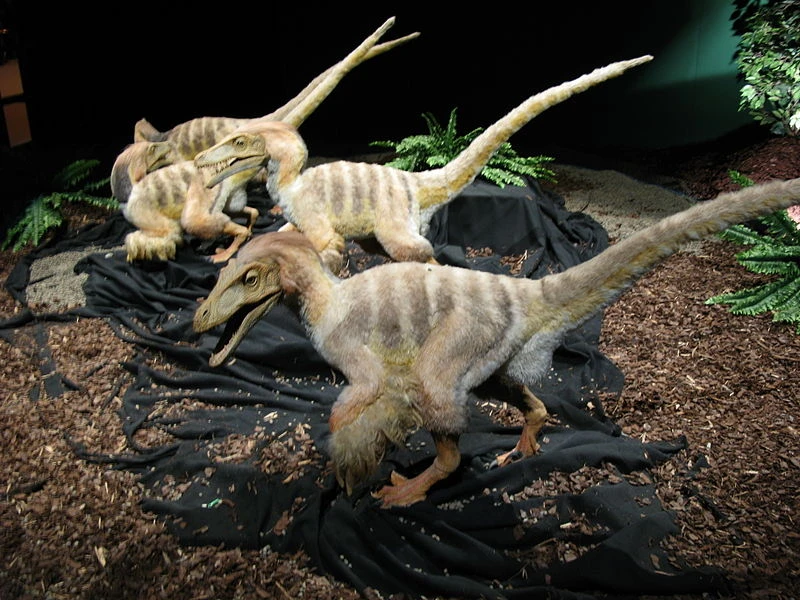
This is what the swift Velociraptor from *Jurassic Park* actually looked like.
The emergence of more advanced lifeforms—mammals and birds—marked the beginning of the end for the age of reptiles. Yet reptiles held their ground for tens of millions of years. To keep pace with changing times, they evolved several clever survival strategies.
Small predatory dinosaurs relied on classic reptilian advantages: surviving on minimal food and patiently waiting in ambush day after day without moving a muscle. It worked back then, and it still works today.
Other dinosaurs took the opposite route, betting on agility, intelligence, and environmental independence as they gradually became warm-blooded. To retain heat, they "invented" feathers and began incubating their eggs. These creatures eventually gave rise to Archaeopteryx and, later, modern birds. By the Cretaceous Period, these advanced feathered reptiles dominated the small-to-medium animal ecological niches. 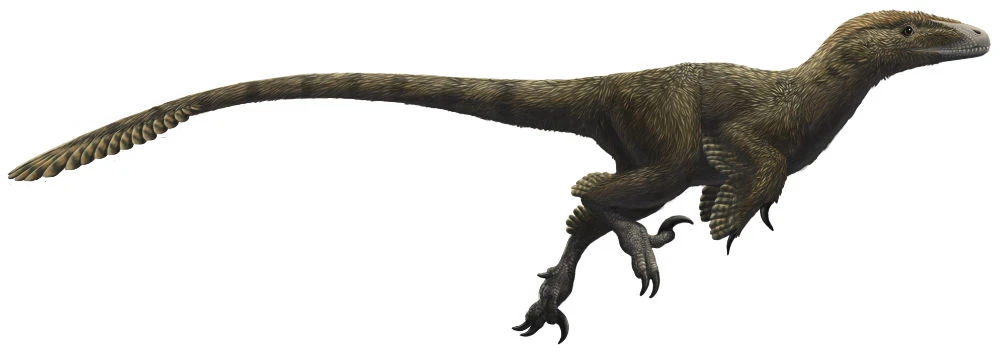
Even large carnivores like the seven-meter-long Utahraptor sported feathers.
The reasons for their eventual disappearance are fairly straightforward. By the end of the Cretaceous, small feathered dinosaurs were more like birds than modern reptiles. Direct competition ultimately drove them out. While scaly lizards successfully played to their unique strengths against mammalian weaknesses, feather-clad reptiles offered no real advantages over true birds. Had they survived, the best niche they could have hoped to occupy would be the one currently held by ostriches.
Giant Dinosaurs 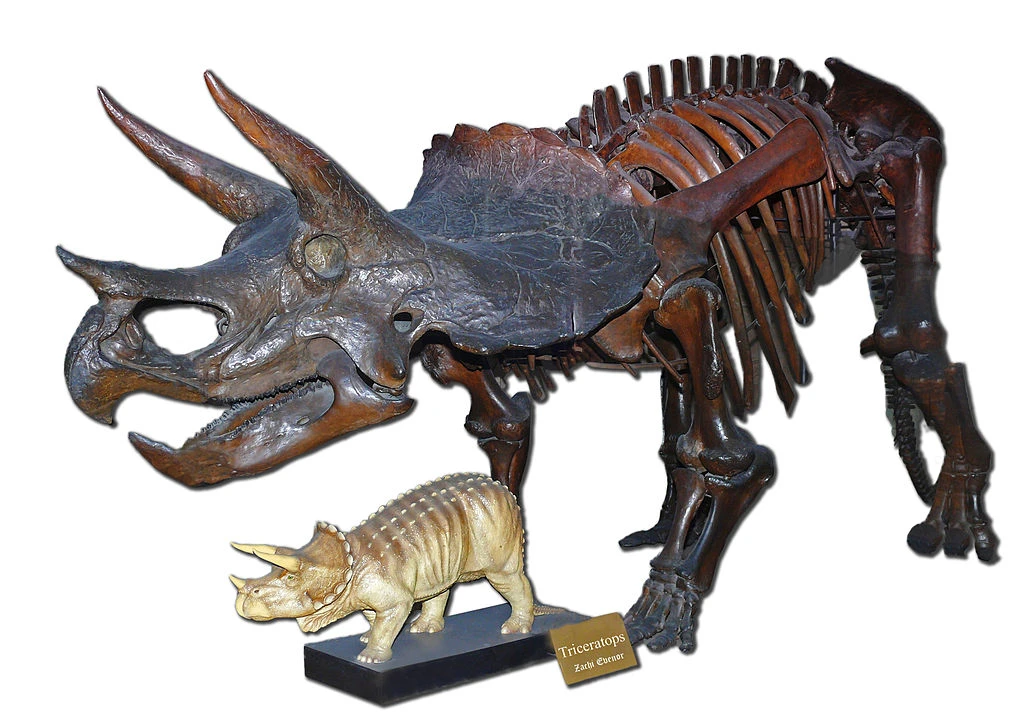
Because of its massive head, Triceratops might look stocky—like a heavy cow. In reality, it was twice the size of an elephant.
Another evolutionary strategy was gigantism. Land animals never reached such colossal proportions before or since. And this drive to grow as large as possible had a sound logical basis.
Because dinosaurs didn't spend energy generating their own body heat, absorbing warmth from their surroundings instead, they required far less food than mammals. Consequently, a given patch of land could support either several smaller animals or a single giant one. Reptiles chose the latter. A massive body with a low surface-area-to-volume ratio minimized heat loss, while sheer size—alongside heavy armor and natural weaponry—offered formidable defense against predators.
Centuries of relentless evolution along this unconventional path produced mind-boggling results: Diplodocus, Supersaurus, and Seismosaurus—monsters measuring up to 36 meters long and weighing upwards of 50 tons, whose lifestyle long remained a mystery to scientists. 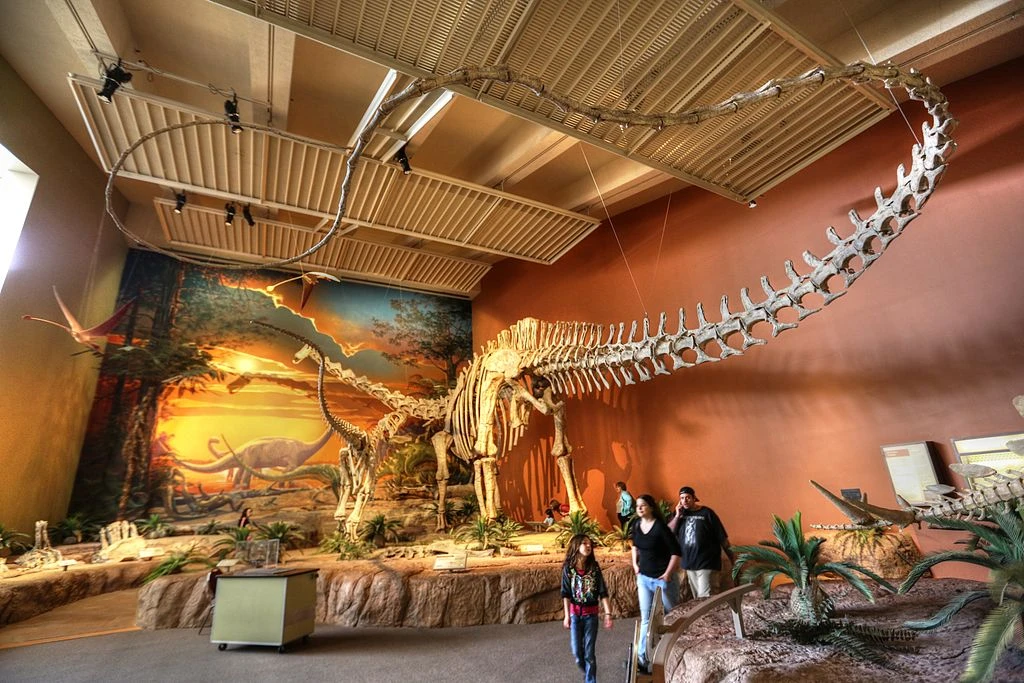
Seismosaurus, Supersaurus, Argentinosaurus—the competition for "biggest dinosaur" is far from over. Still, reconstructions of partial skeletons that yield 150-ton giants remain subject to debate.
Diplodocus is often depicted briskly striding across savannahs with its neck and tail held high. Yet biomechanical calculations show it couldn't hold its neck upright for long—it was simply too heavy. How did it move, then? Infrequently and sluggishly, it seems. The long neck was designed precisely so the animal could sweep a vast area of vegetation clean without taking a single step. It likely spent long stretches in one spot, occasionally shuffling forward a few paces to reach fresh greenery.
Every species faces pressure from competitors and predators. Had mammals displaced reptiles gradually, competition wouldn't have posed an immediate threat to herbivorous dinosaurs. In lush regions where food was abundant, they would have easily held their ground. Predators were another story—mammalian carnivores would have left smaller dinosaurs little chance.
However, that applies only to small and medium-sized species. The behemoths, which had no natural enemies in the Cretaceous, wouldn't have any today either. Provided they protected their egg clutches and young until they grew to the size of a bull, large dinosaurs could have comfortably survived in tropical regions. 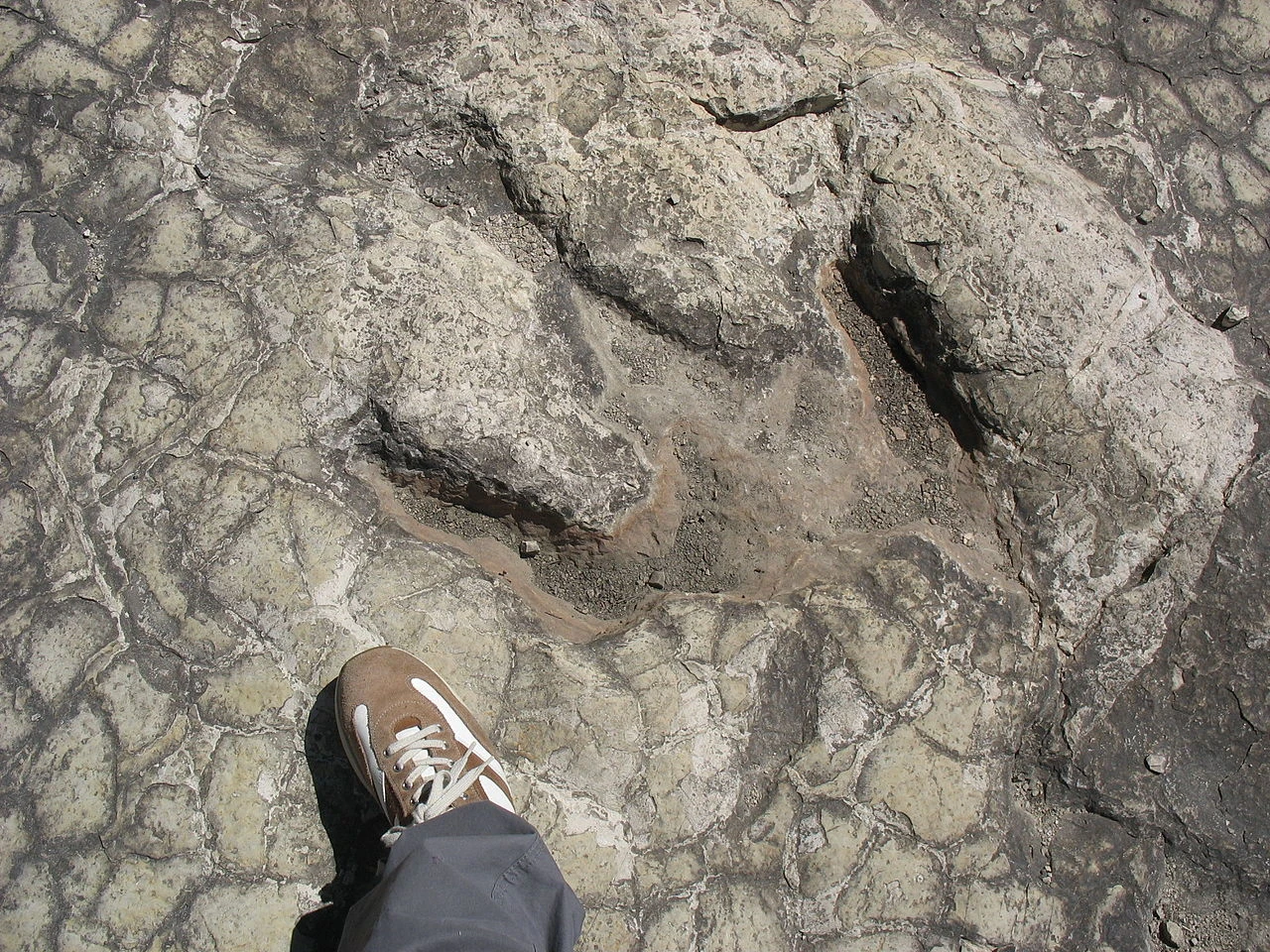
Footprints of giant dinosaurs reached up to a meter and a half in diameter and were sometimes deep enough to become fatal pitfall traps for smaller species.
What would this mean for humanity? For starters, a vast source of meat. Hunting reptiles is relatively straightforward. Taking down a Diplodocus without heavy artillery would be a challenge, but a purely technical one—Mesolithic humans were already hunting mammoths and whales. Humans might have even domesticated and farmed them, given that their food requirements are modest compared to modern livestock.
Yet that prospect has its caveats. Like tortoises, giant dinosaurs likely lived for centuries and grew far too slowly. As for using them for transport or war, that’s completely out of the question: they were simply too slow and far too dim-witted. 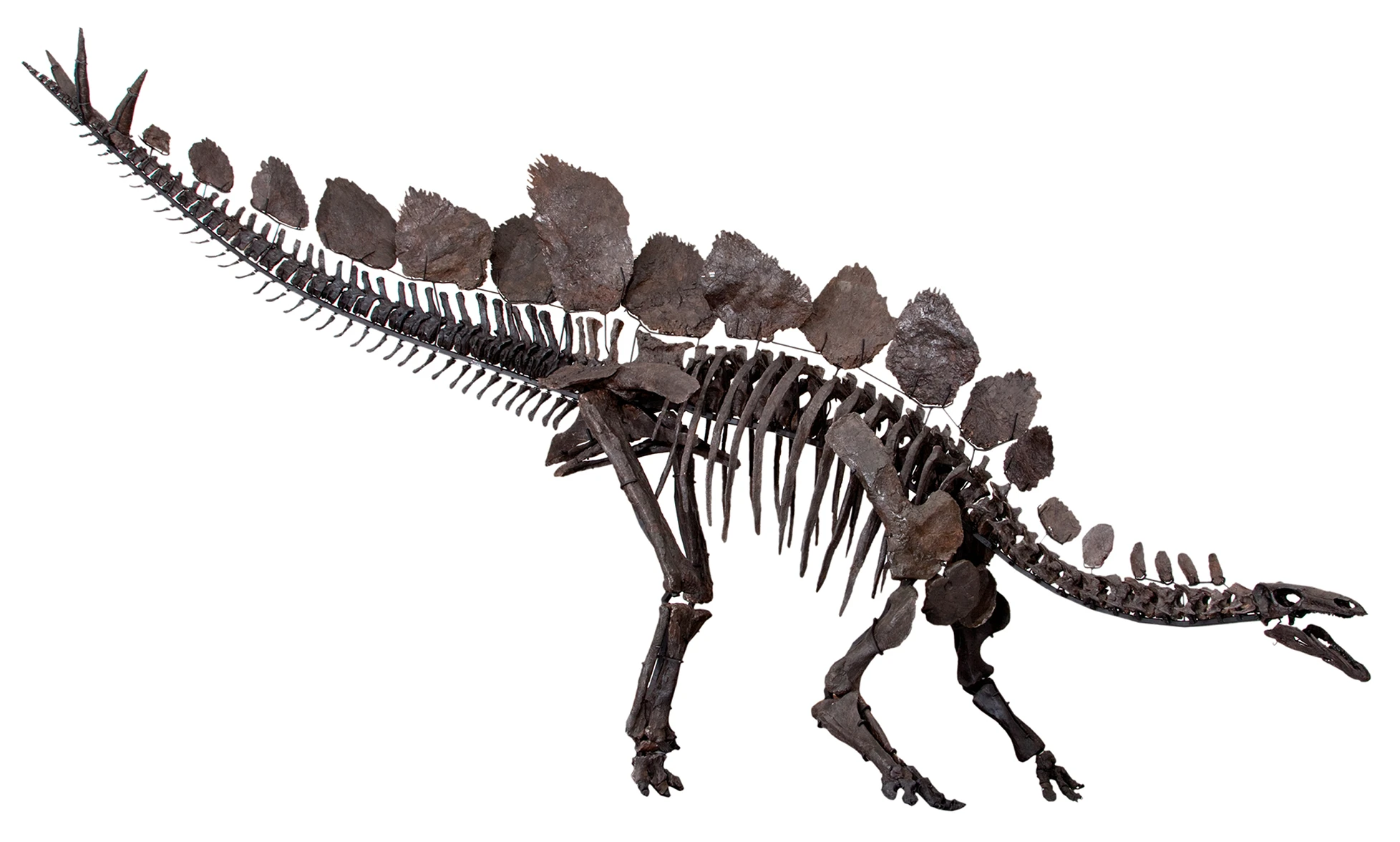
By the standards of its era, Stegosaurus was relatively small—about the size of an elephant—with a brain no bigger than a walnut. The theory that dinosaurs possessed a "second brain" in their hip socket has been debunked. They really were as dumb as they look.
Bipedal Predators
Gigantism among herbivores inevitably led to gigantism among predators, which were far less bloodthirsty back then than their terrifying appearance suggests. A monstrous seven-ton Tyrannosaurus rex got by on a hunting territory no larger than that of a pair of lions. It likely spent most of its time basking in contemplation, simply keeping an eye out to make sure rivals didn't trespass.
What T. rex actually hunted remains a mystery. Even mid-sized prey like the nine-ton Triceratops was a handful. Smaller prey—like elephant-sized Iguanodons—could easily outrun it, and stealth was hardly an option for a creature that size. It most likely used its bone-crushing jaws to break through the armor of slow-moving herbivores or scavenged carcasses, using its formidable teeth to dismantle massive remains and scare off rival scavengers. A single dead Diplodocus could feed a couple dozen T. rexes. 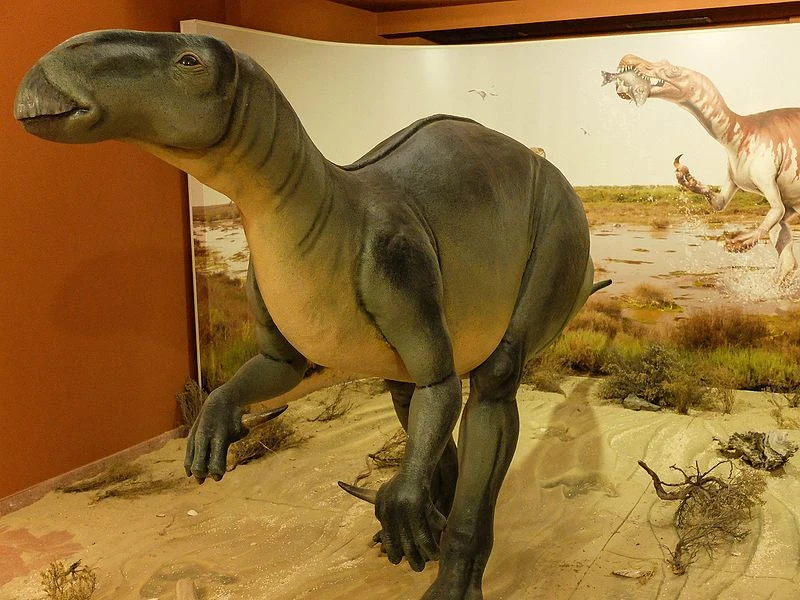
Bipedal locomotion was mastered not just by carnivores, but by many herbivores like Iguanodon. Running on four legs is faster, but it demands a far more complex motor coordination system.
If T. rex was primarily a scavenger, it would fare quite well in today's savannah. While its hunting prowess is debatable—few modern animals would be careless enough to fall prey to such a slow and conspicuous giant—no other predator, living or extinct, could ever bully a T. rex off its kill.
Living up to its tyrannical name, the beast would easily claim the lion's share of kills, establishing itself as the ecosystem's ultimate apex scavenger. T. rexes would even serve a useful role by crushing giant elephant and rhino bones that currently only porcupines can gnaw on—forcing porcupines to share. 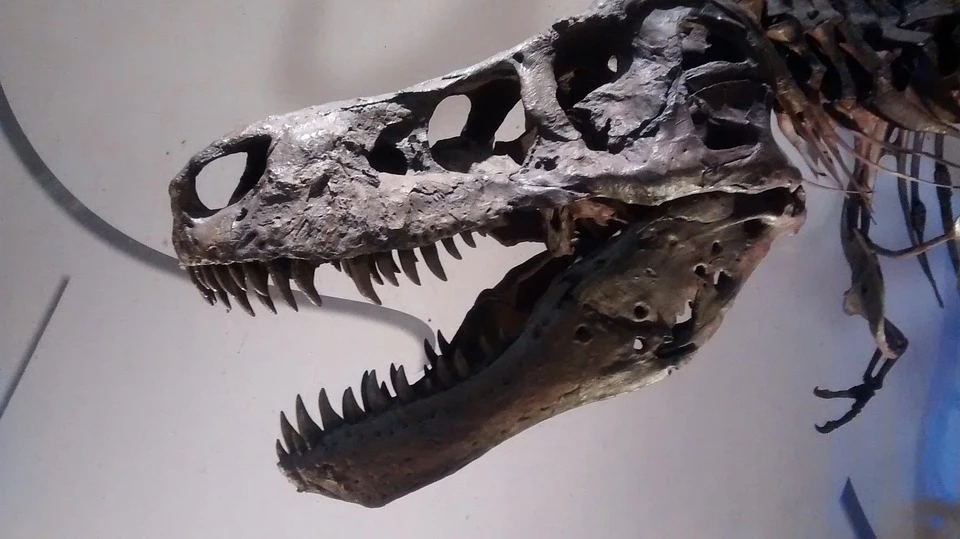
The theory that T. rex favored scavenging is supported by its hugely powerful jaws. Such crushing force isn't necessary just to make a kill, but it's perfect for cracking open the colossal bones of a Diplodocus.
Despite its dubious hunting credentials, a massive predator would pose a grave threat to human tribes. Humans are among the few creatures physically incapable of outrunning a T. rex—an unfortunate reality a hungry giant would quickly exploit when drawn to human settlements by the smell of meat. Driving off a beast too large and simple-minded to fear humans—and virtually invulnerable to primitive weapons—would be nearly impossible. Only fortified stone walls could keep it at bay. 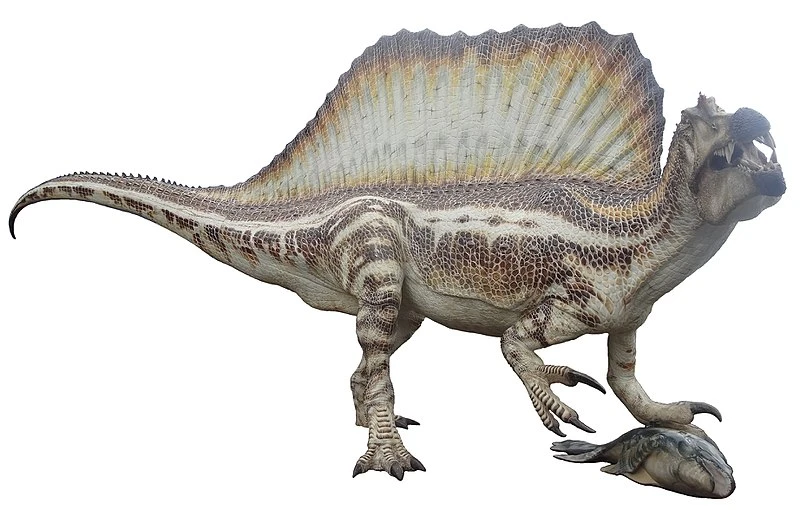
Spinosaurus could rival T. rex for the title of "most terrifying predator." Though lighter, it looked far larger thanks to the massive sail on its back.
Flying Reptiles
Most pterosaurs were bizarre creatures, yet lacked true dramatic grandeur. Ranging in size from sparrows to albatrosses and covered in downy fuzz, they hardly resembled "flying crocodiles." Like their feathered land-dwelling cousins, smaller pterosaurs were doomed by fierce competition: bird feathers proved aerodynamically far superior to leathery wing membranes.
Yet pterosaurs held trump cards of their own. This order produced giants like Pteranodon, boasting wingspans of 6 to 8 meters, as well as Ornithocheirus and Quetzalcoatlus—legendary behemoths with wingspans stretching 12 to 14 meters across. 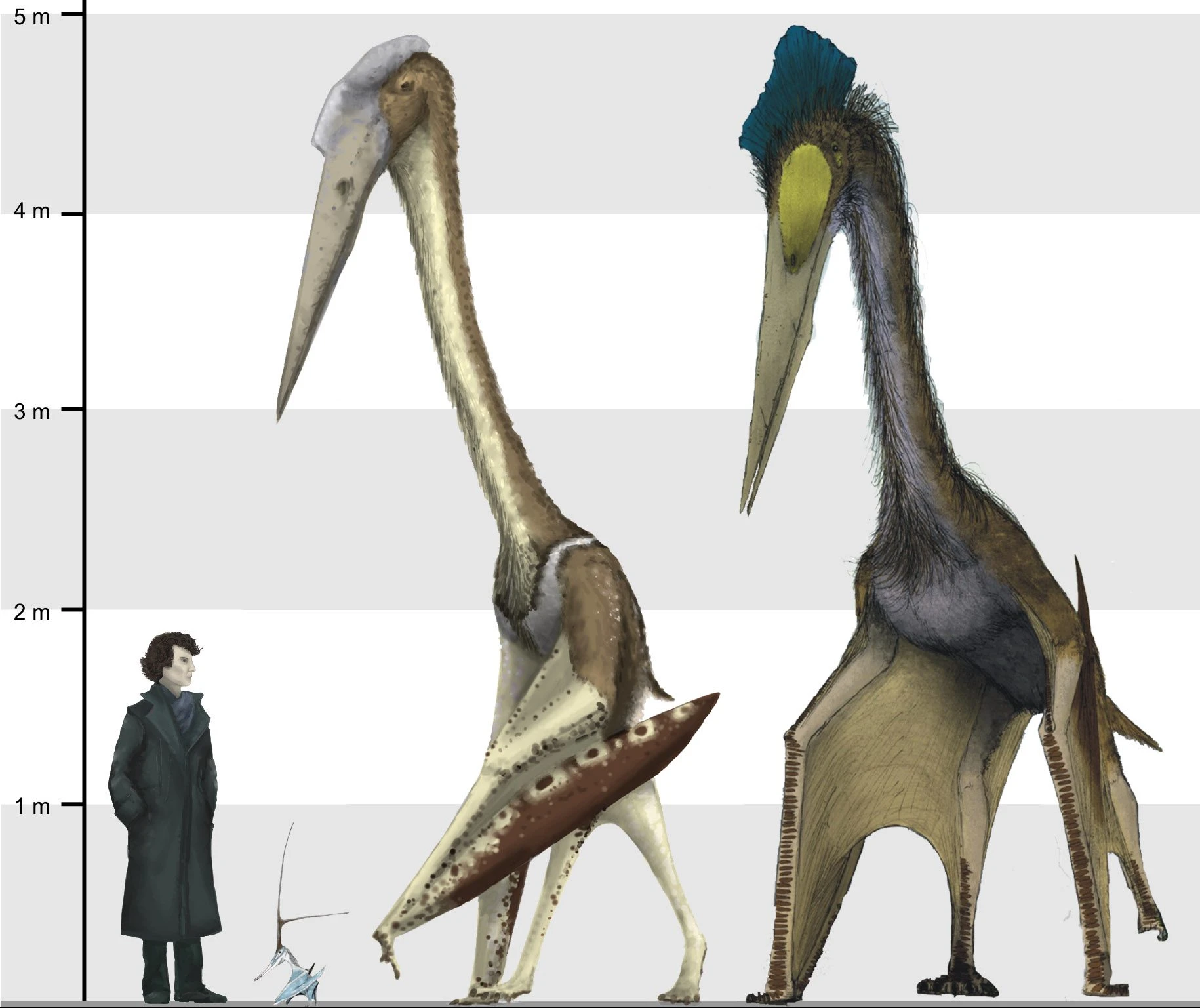
The colossal Quetzalcoatlus flew rarely, but was by no means defenseless on land or in water. Meanwhile, small pterodactyls, which likely swam back from fishing trips, formed a major part of marine reptiles' diet.
The sheer existence of giant pterosaurs long baffled researchers: theoretically, these creatures shouldn't have been able to fly at all. Because mass increases cubically while muscle power scales only quadratically, the power-to-weight ratio required for powered flight limits animals to around 16 kilograms. Quetzalcoatlus, however, weighed nearly a quarter of a ton. It most likely glided by launching off cliffs and riding thermals. While soaring conserved energy, maneuvers effortless for a seagull—diving to scoop up fish, regaining altitude, and returning home—were immensely difficult for a creature of that scale.
Their reptilian traits undoubtedly aided their survival. By preying on fish too large even for an albatross, giant pterosaurs faced no aerial competition. Their massive size—unreachable for feathered birds—kept them safe from natural predators, making them prime candidates to survive into the modern era. 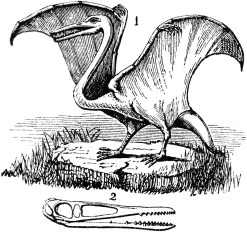
Historical versus modern depictions of pterodactyl appearance.
These living hang-gliders would pose no threat to humans—a giant beast wouldn't risk low-altitude flights over land—nor would they offer much value as game. Theoretically speaking, however, Quetzalcoatlus and Ornithocheirus are the only real-life flying creatures large enough to carry a human. Even if untamable, observing their soaring flight would have quickly inspired early humans to invent gliders. 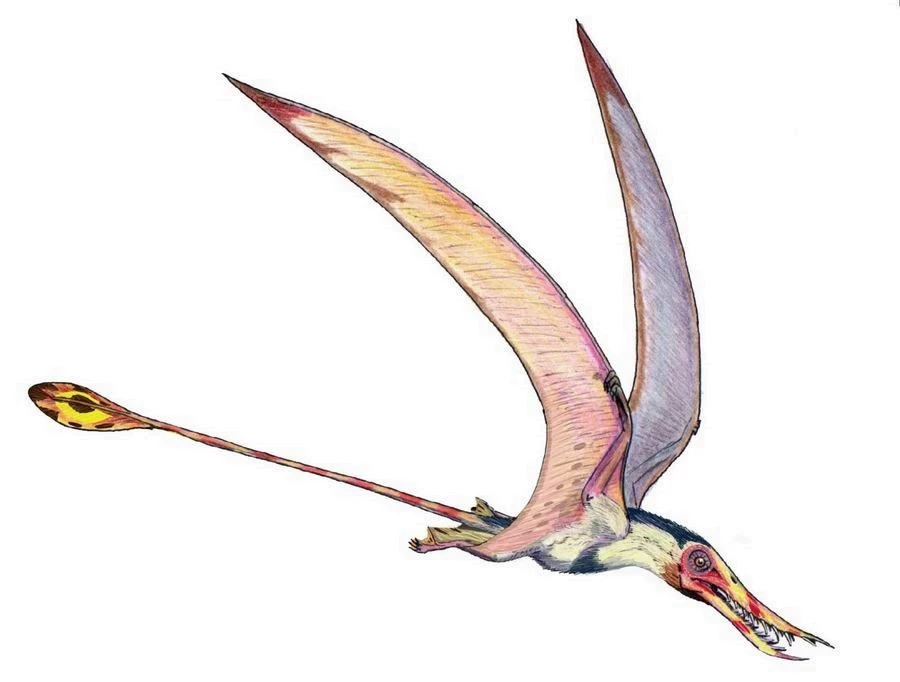
Pterosaurs fell into two main groups: pterodactyls and rhamphorhynchs. Pterodactyls used a canard aerodynamic configuration with control surfaces on their snout, while rhamphorhynchs favored a classic design, steering with their tails.
Sea Dragons
While the downfall of land dinosaurs seemed inevitable, science still struggles to explain the disappearance of marine reptiles. They should have easily survived the cataclysm and retained their upper hand in the evolutionary race.
To some extent, they did. Crocodilians not only survived but retained their dominance in tropical rivers, refusing to surrender the top of the food chain to mammals. Dolphins and manatees pushing inland from the sea met with only modest success against them. 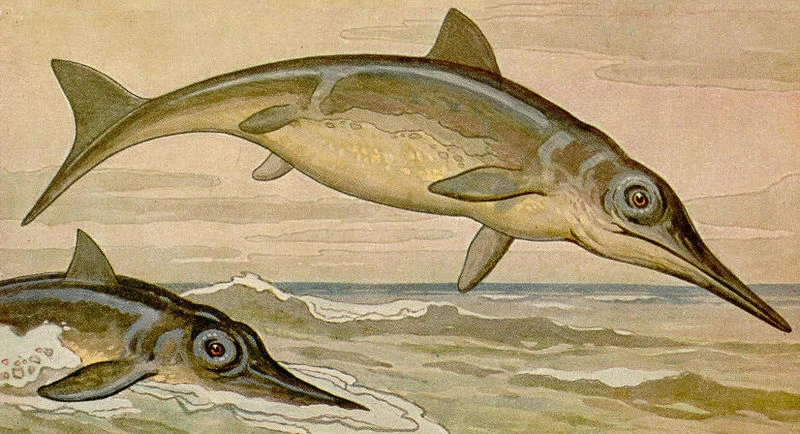
Whale-like ichthyosaurs reached up to 25 meters in length. For unknown reasons, they began dying out rapidly during the Early Cretaceous, vanishing long before the asteroid hit.
Reptiles thrive in the open ocean as well. Just a few centuries ago, massive fleets of sea turtles presented a genuine physical obstacle to sailing ships. For marine life, reptiles represent a perfect evolutionary compromise. Unlike fish, they breathe air with lungs—a huge advantage, considering pumping water through gill slits takes tremendous energy for very little oxygen. Unlike mammals, reptiles consume oxygen efficiently, needing to surface for air far less often.
Thus, the demise of ichthyosaurs, plesiosaurs, and pliosaurs looks less like evolutionary failure and more like a tragic fluke. They didn't even lose out to cetaceans—which evolved much later—they simply vanished. Had it not been for the asteroid impact (compounded by some unknown environmental factor), marine reptiles might still be swimming in our oceans today. 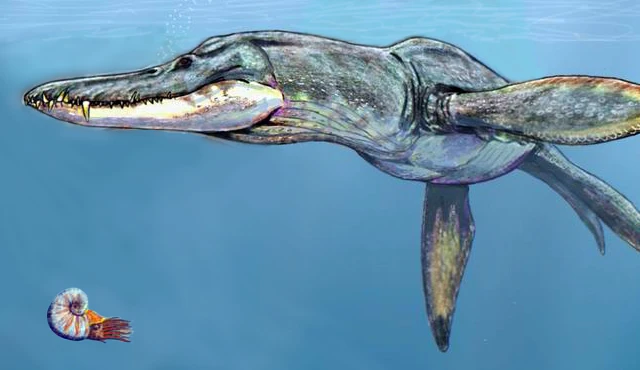
Pliosaurs differed from crocodiles in their mode of propulsion, swimming with flippers rather than tails. Entirely incapable of moving on land, they compensated for their relatively modest size (a mere 10–12 meters) with a record-shattering two-meter jaw.
What would our oceans look like had they survived? Whales would certainly be far less common, as aquatic mammals would have faced entrenched reptilian competition. That evolutionary transition might have occurred only in polar seas, where cold-blooded reptiles couldn't stake a claim. Even so, the rise of whales wouldn't have wiped out ichthyosaurs: the ocean is vast, food is plentiful, and species outcompeted in evolutionary struggles rarely disappear entirely—they simply adapt to smaller numbers.
Without that ancient catastrophe, the sharp dorsal fins of giant sea reptiles would still slice through tropical waves. Sheer size would afford them protection from killer whales, while deeper and longer dives would serve as an additional defense.
Still, it's hard to imagine any reptile holding its own against a sperm whale or a hunting pod of killer whales. Marine reptiles likely wouldn't retain the absolute top spot in open ocean food chains. Instead, plesiosaurs would continue to dominate warm, shallow coastal waters—a niche no large mammalian predator has ever claimed. As for sharks, marine reptiles would easily force them to yield space. 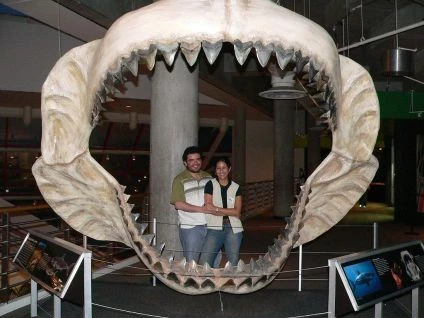
The sudden disappearance of marine reptiles handed total dominance of the ocean to sharks. Entering a new golden age, cartilaginous fish reached colossal sizes—*Carcharocles megalodon*, for instance, grew to 12 meters in length. 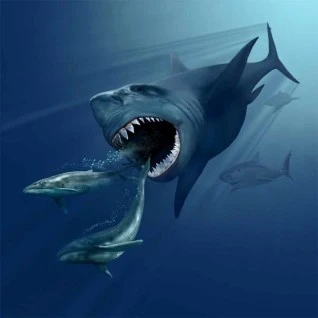 How would marine reptiles have shaped human history? Ichthyosaurs probably wouldn't have mattered much. In time, they might have caught the eye of whalers, but they'd be notoriously difficult prey. Staying deeper than whales and surfacing far less often, even spotting one would be a challenge. Besides, the payload was low: whales are hunted for blubber used in thermal insulation, whereas an ichthyosaur in thermal equilibrium with its environment offers little more than tough, lean meat.
Plesiosaurs, on the other hand, would be a game-changer. Driving sharks from coastal waters, they would add considerable peril to the lives of seafaring tribes. As with crocodiles, humans and plesiosaurs would share a mutual gastronomic interest. Coexisting with them, however, would be far more dangerous—because plesiosaurs had long necks. 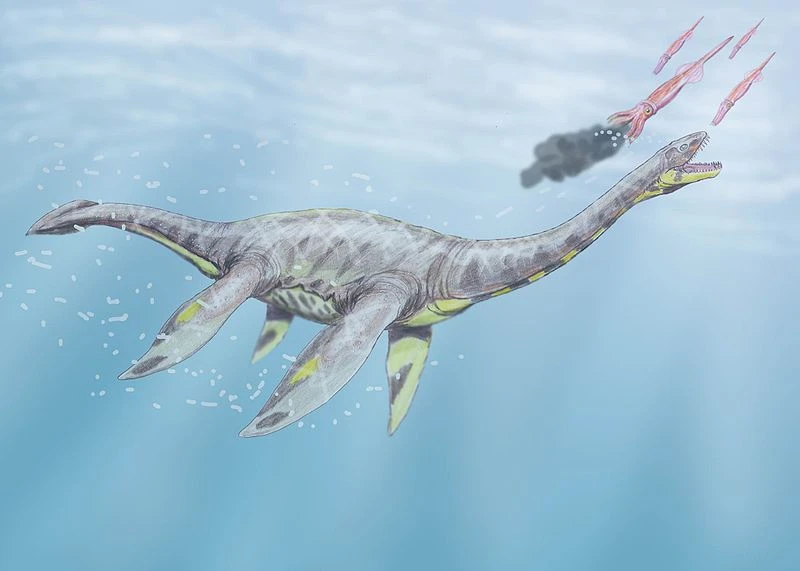
Plesiosaurs rarely exceeded 15 meters in length and possessed relatively modest jaws. Yet they remain perhaps the most charismatic of all marine reptiles.
The key lies in underwater hunting dynamics: long necks are useless submerged because water is too dense for quick lateral snapping movements. That's why crocodiles, whales, penguins, and even sea snakes lack long necks—their whole bodies are elongated instead. Plesiosaurs, by contrast, had compact bodies and long, flexible, swan-like necks. They hunted near the surface, plunging their heads downward in lightning-fast strikes to snag prey below.
Traversing southern seas and rivers on primitive rafts and dugouts for thousands of years was possible only because large aquatic creatures (hippo encounters aside) lacked the foresight to capsize fragile craft. Even a harpooned whale tries to flee rather than attack its pursuers. Viewed from below or along the waterline, a boat looks like a large, strange, non-living object—inedible and unthreatening. Only humans falling overboard faced danger.
A plesiosaur, however, scouted for prey from three or four meters *above* the waterline. From that vantage point, a canoe looks like a wooden serving platter filled with food. 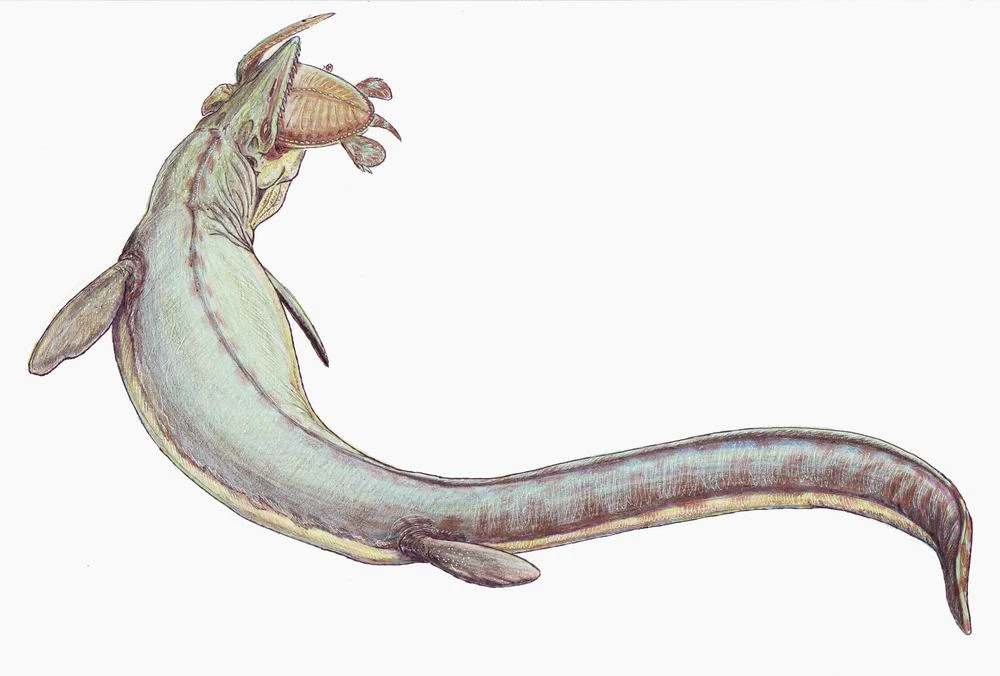
Lesser-known are the mosasaurs, which reached lengths of up to 17 meters. These "dragons" were fascinating because they weren't dinosaurs in the strict sense, but close relatives of modern monitor lizards.
Tension would follow humans to riverbanks as well. A lurking crocodile can only strike at point-blank range, posing little threat to anyone standing safely on shore. A plesiosaur, equally stealthy and patient, could snatch prey straight off the bank by launching its neck like a spring from beneath the water. While 15-meter monsters wouldn't haunt shallow creeks, smaller species could easily drag a human under and drown them—and spotting a smaller predator in time is far harder.
A world where aquatic predators threaten only swimmers is fundamentally different from one where leviathans routinely attack boats. A multi-ton beast, swift and virtually invisible in an element natural to it but alien to humans, would be nearly unbeatable. It's hard to imagine what ancient seafarers—even in the Iron Age—could offer in defense. While large, sturdy ships would be safe, maritime technology might never have progressed that far. In tropical regions where sea dragons thrived, people would fear to even step near the water. Encountering a plesiosaur at sea would mean almost certain death.
The asteroid impact didn't so much transform the animal world as impoverish it—a defining feature of all cataclysms. The cosmic rock merely accelerated the inevitable. Reptiles might have held off mammals for a long time, but not forever. Had the transition unfolded less dramatically, giant reptiles would have had time to adapt to a world dominated by mammals and birds. Surrendering their supremacy, they wouldn't have vanished entirely.