The Great Blue Hole: how it formed and what was found there (6 photos)
When viewed from above—from an airplane or satellite—this structure appears as a nearly perfect dark blue circle in the middle of turquoise shallow water. 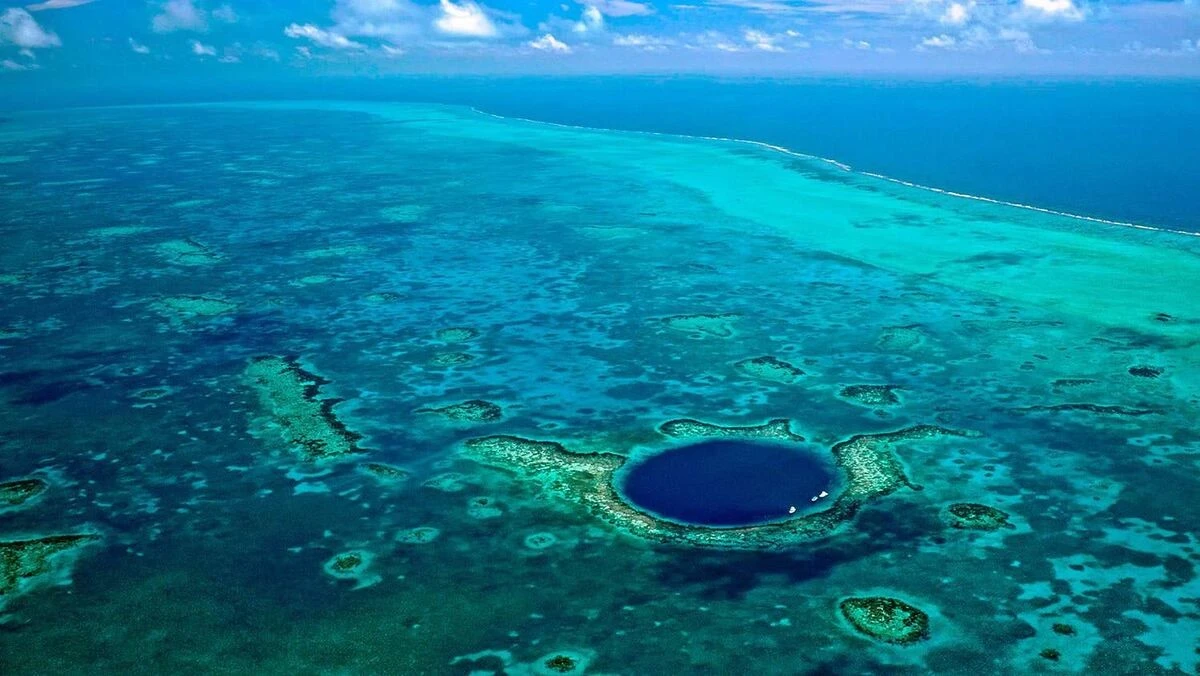
The Great Blue Hole off the coast of Belize. Shallow water with a coral reef surrounds it.
It seems perfectly logical that it should be called the Great Blue Hole, but most likely, when the term "Blue Hole" was introduced into the language, the translators didn't bother to look at the photographs and, without thinking twice, made "blue" sound like "light blue." Although in English, the meaning of the color blue depends on context. Well, since objects of this kind are officially called blue holes, I'll reluctantly call them that too.
The Great Blue Hole is located in the Caribbean Sea, approximately 70 kilometers off the coast of Belize, a country on the east coast of Central America. It is part of Lighthouse Reef and the Belize Barrier Reef, a UNESCO World Heritage Site. 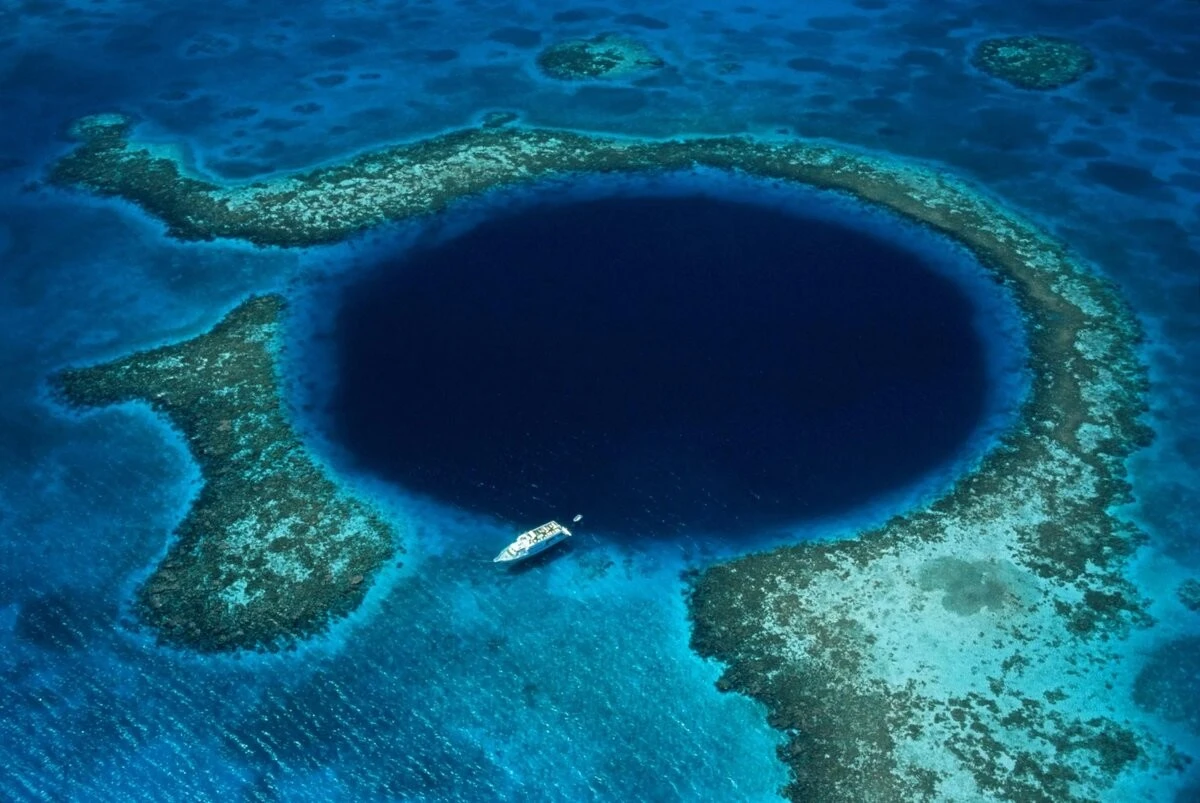
The structure's dimensions are impressive: approximately 318 meters in diameter and over 125 meters in depth. What we see here isn't just a depression in the seafloor, but a vertical cave—a sinkhole that plunges straight down through the limestone.
It's the depth that provides this piercing dark blue (not light blue) color. The surrounding shallows are turquoise and transparent. The contrast is so stark that from above, the hole looks artificial.
How it Formed
The history of the Great Blue Hole began not in the ocean, but on land—and not yesterday, but about 150,000 years ago.
During the Ice Ages, sea levels were significantly lower than they are today. The area that lies underwater today off the coast of Belize was once dry land—a limestone plateau. Karst caves, as often happens, formed in the limestone. Groundwater seeped through the rock, dissolving it from within, and gradually huge cavities with chambers and stalactites formed underground.
Then the glaciers began to melt, triggering a rise in sea levels. At some point, the roofs of some caves could not support the weight of the water and collapsed. Because the stresses in the limestone around such a cavity are distributed radially, the collapses were almost perfectly circular. This is how water-filled structures were formed, later called "blue holes." 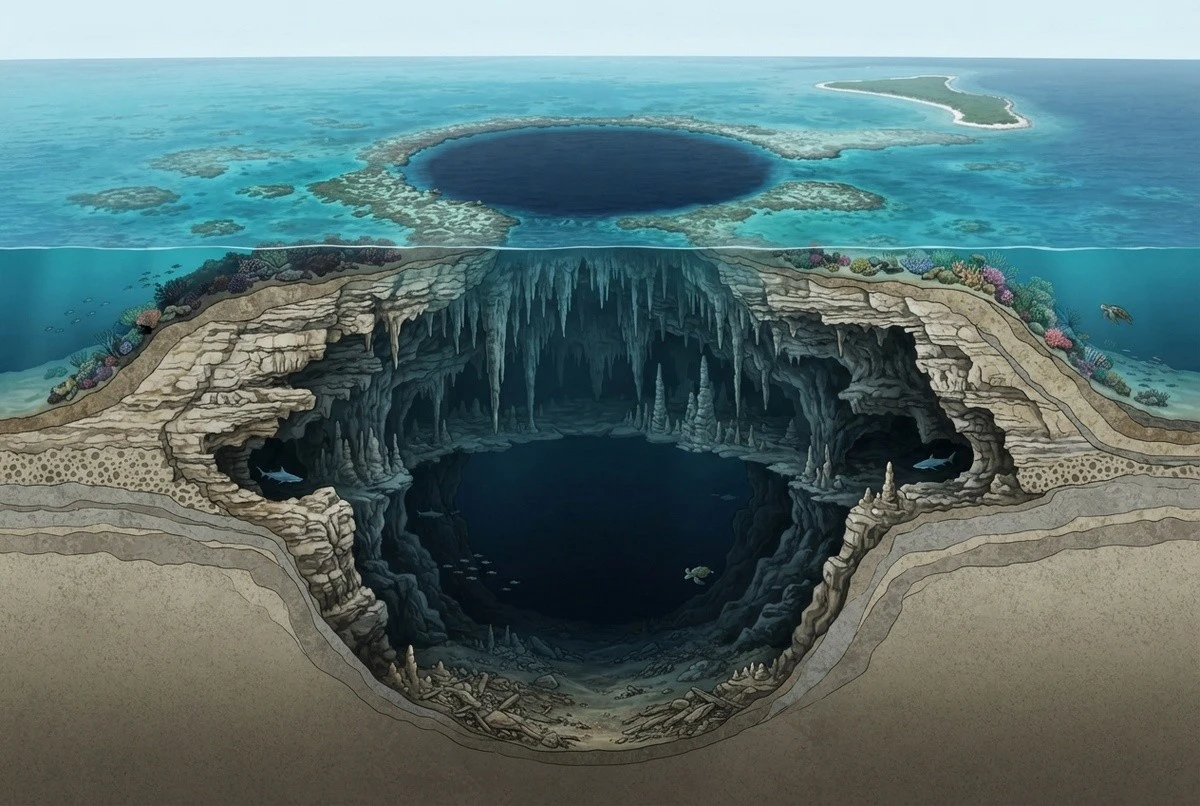
The Structure of the Great Blue Hole
And it's no coincidence that I use the plural: blue holes are found all over the world—off the coasts of Australia, Egypt, and the Bahamas. But the Great Blue Hole off Belize is the largest known.
Cousteau and World Fame
The general public learned about the Great Blue Hole thanks to Jacques-Yves Cousteau, the legendary French ocean explorer. In 1971, he brought his vessel, the Calypso, here and made a dive.
Cousteau was delighted. He included the Great Blue Hole in his list of the top ten diving spots in the world. After this, divers from all over the world flocked here, and the hole's fame became truly global. 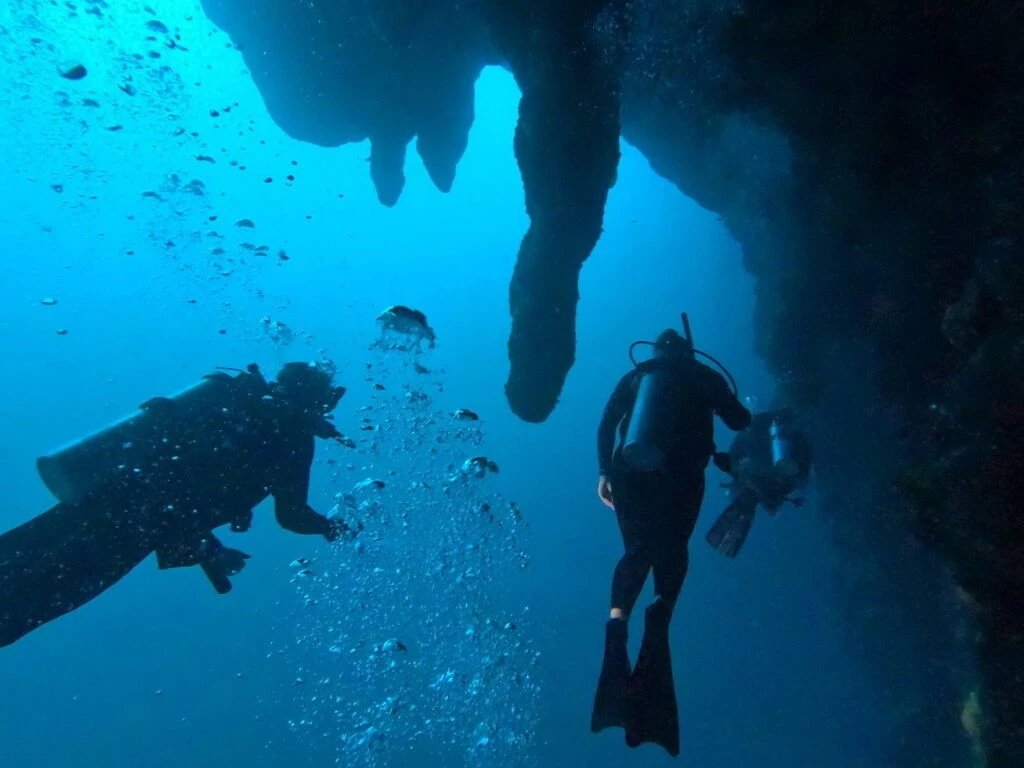
Divers explore the Great Blue Hole. Ancient stalactites within indicate that this enormous "sinkhole" was once a dry cavern until it was flooded by rising seas.
At a depth of about 40 meters, a stone overhang protrudes—the remains of an ancient cave ceiling. Stalactites that formed over millennia in the karst cave and are now frozen forever underwater can also be seen—silent witnesses to the ocean's destruction of the land.
Discovery in 2018
Despite decades of diver interest, the bottom of the Great Blue Hole has long remained a mystery. Below 90 meters, a dead zone begins: due to the lack of currents, the water there has not been renewed for millennia, turning into a toxic, oxygen-deprived environment. Regular divers do not dive to such depths.
But everything changed in 2018, when an expedition set out with entrepreneur Richard Branson, Fabien Cousteau (the grandson of Jacques-Yves Cousteau), National Geographic explorer Erika Bergman, and the pilot of a small submarine from Aquatica Submarines. This quartet made the first-ever dive to the bottom of the Great Blue Hole. 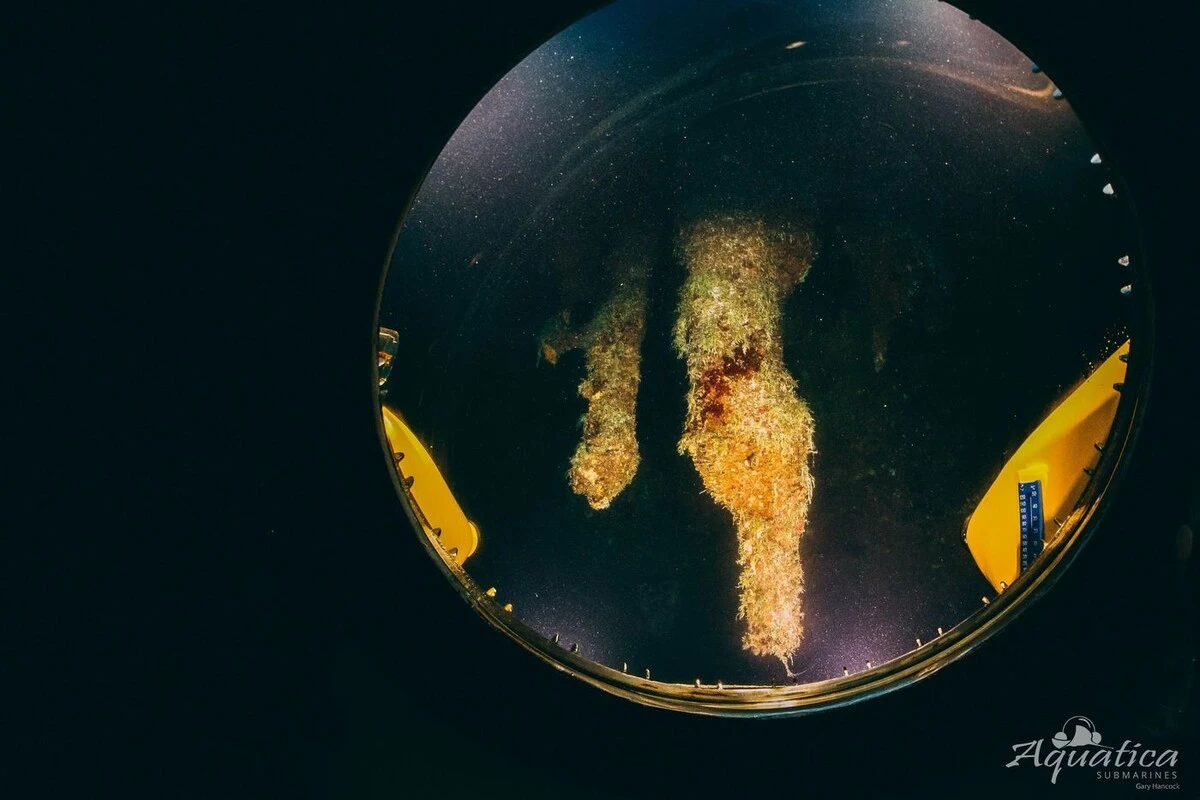
View from the submarine
The findings were both fascinating and terrifying.
The bottom was coated in a thick layer of hydrogen sulfide, an extremely toxic gas. Nothing alive. Absolute silence and darkness. However, everything that had fallen there was perfectly preserved: the remains of several hermit crabs and clams were found on the bottom; they had accidentally fallen into the hole and were unable to escape. Two of the three missing divers were also found; they had apparently gone too deep. Local authorities were promptly notified of the latter discovery, but they decided it was best to leave them alone, as "they had found peace." 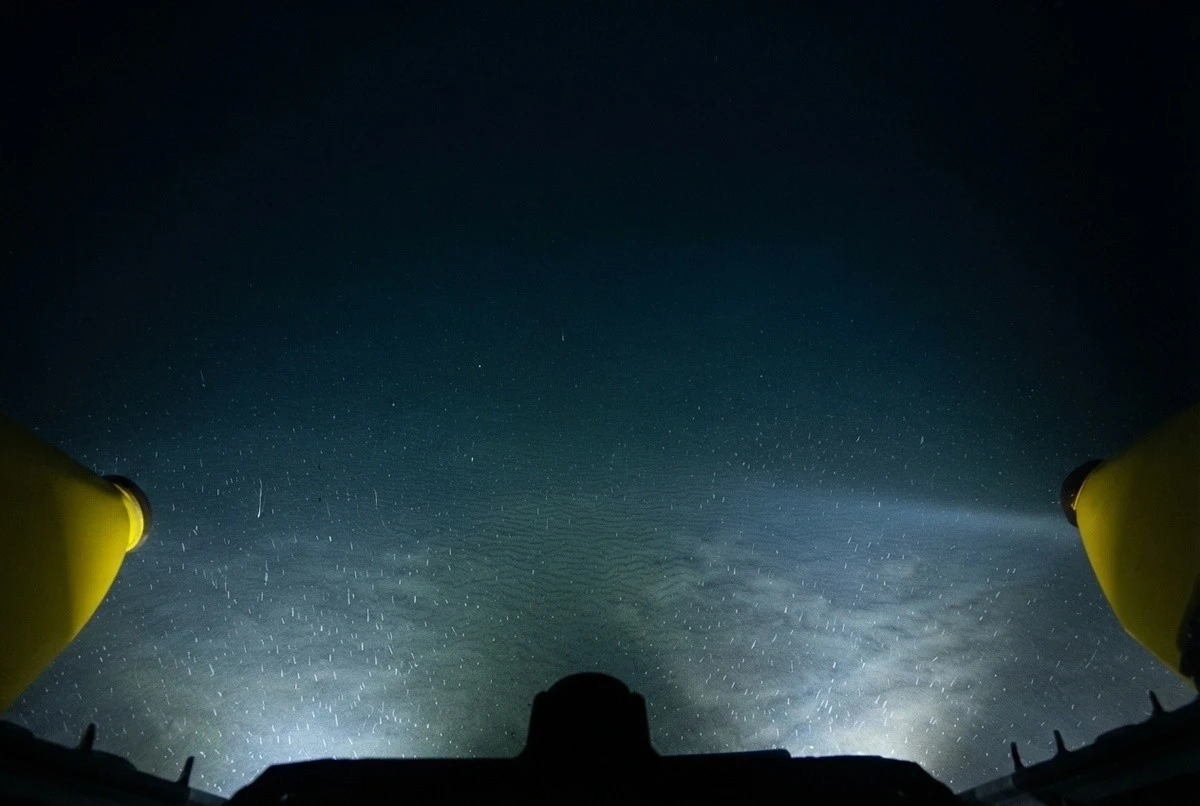
Hydrogen Sulfide Layer
But the most unexpected thing is that researchers discovered ceramic shards from the ancient Mayan civilization here. How did they get there? It's actually quite simple: the Mayans, who revered blue holes as gateways to the underworld, sailed to the Great Blue Hole in boats and made offerings—and what they threw into the water thousands of years ago has been preserved intact at the bottom.
Scientific Value
The Great Blue Hole is not just a natural amusement park for tourists and divers, but a natural time capsule.
The anoxic bottom preserves sediments intact for millennia. By studying these layers, scientists can reconstruct the region's climatic history with astonishing accuracy. For example, research in 2018 revealed that in the 9th century, a series of droughts struck the Yucatan Peninsula, which was one of the key factors in the collapse of the once-mighty Mayan civilization. Previously, the fact of its collapse had been the subject of endless debate and unscientific speculation. It turns out that the answer to one of the greatest mysteries of ancient history lay at the bottom of the cave.
Furthermore, the Great Blue Hole has astrobiological value: by studying the structure's anoxic zones, scientists are drawing parallels with the subglacial oceans on some potentially habitable moons of Jupiter and Saturn, where extreme conditions bordering on habitability may also exist. Estimating the limits of life on Earth means better understanding where to search in the solar system.