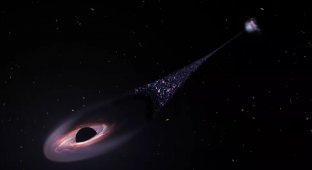
What happened to the "alien comet": how scientists explained the anomalies of object 3I/ATLAS (6 photos)
A year ago, half the internet searched for an alien ship inside 3I/ATLAS. Scientists took a less romantic approach: they spent seven hours listening to the iceberg with radio telescopes, hoping it would at least say hello.
The comet did indeed make contact. But instead of "hello from a distant galaxy," it said, "my water is evaporating." 
Many mistook the comet for an extraterrestrial ship flying to us for negotiations.
Now 3I/ATLAS is leaving the Solar System forever, and its "engine," nickel hull, and twenty other anomalies have received entirely terrestrial explanations. But the real sensation was discovered where almost no one was looking: water from an incredibly ancient and cold world has been preserved inside the comet.
It's almost tempting to say that only the lazy haven't written about this comet. But I didn't write either. While it was still a wave of hype, nothing meaningful could be said about it.
While the media and bloggers were earning millions of views on cheap news, scientists were actually trying to understand the oddities of this comet. 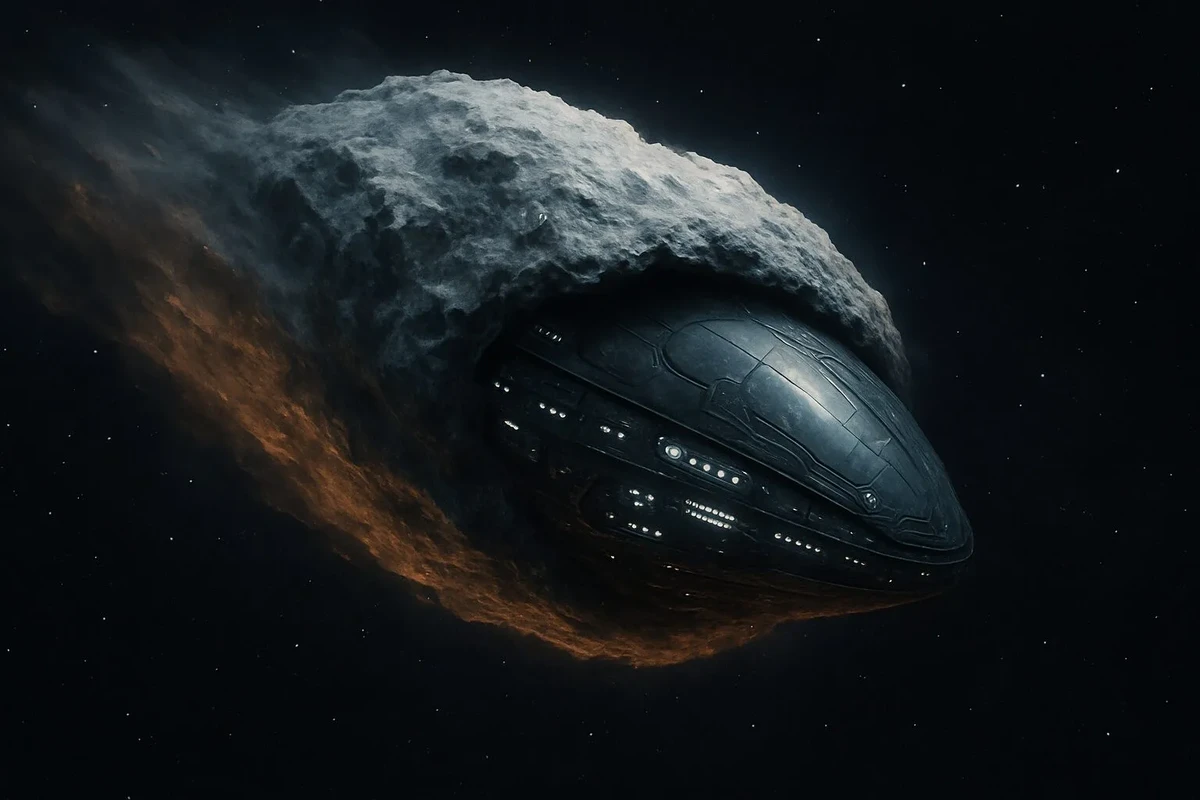
Popular illustrations online depicted the comet exactly like this.
It was obvious there were no aliens there. And some of the unexpected behavior was quite understandable.
And now I'm really interested in understanding it.
Let's figure out where 3I/ATLAS disappeared to, where its "22 anomalies" came from, and why this real sensation was discovered in a completely different place than we were looking for.
Where did the comet go?
It approached Earth on December 19th, and only to within 270 million kilometers. It posed no danger for a second.
Its orbit is hyperbolic, with an eccentricity of 6.14—the most "open" of the three known interstellar objects. The Sun wouldn't maintain such a trajectory, so whether 3I/ATLAS will return is a closed question. It will never return.
The comet hasn't yet crossed the physical boundary of the Solar System, but it's leaving the planetary region irreversibly and is fading with each passing week. The main observation window has closed. Discoveries are now coming not from a telescope, but from processing an already-collected archive—and they're still coming.
And now to the main question: why did they even start looking for aliens in a seemingly ordinary piece of ice?
Why the spaceship theory emerged
The spaceship theory didn't appear out of nowhere.
3I/ATLAS did indeed behave unusually: its gas contained an unusually high amount of carbon dioxide compared to water, its dust reflected light strangely, and nickel initially appeared to be much more abundant than iron.
The comet was also observed to have a weak acceleration, which couldn't be explained by gravity alone, and a dust trail directed toward the Sun. All of this required an explanation, but in itself didn't indicate any technical significance.
Early spectroscopy revealed an extremely high concentration of atomic nickel relative to iron. This is where the story of the "alien nickel processing plant" was born: on Earth, the volatile nickel compound is known from industrial metal refining. 
American astronomer Avi Loeb gained great fame from this story – his horror stories were quoted worldwide.
Harvard astronomer Avi Loeb compiled such features into a list of "22 3I/ATLAS anomalies." It included not only real measurements but also beautiful coincidences.
For example, the comet arrived from a direction just nine degrees from the location of the famous Wow! radio signal originated in 1977.
Wow! Signal It was interesting because it was very powerful, narrow-band, and arrived at a frequency close to the hydrogen line, leading many to consider it one of the most serious candidates for a possible technosignal from extraterrestrial intelligence.
Sounds suspicious.
Plus the story about the possible "engine" on this comet (I'll discuss it in a later chapter).
The noise arose from one unnecessary step: "this comet doesn't look like any we're familiar with" turned into "that means someone built it." Humans love to find patterns even where there's only a coincidence: faces appear in clouds and on star charts. The ship theory could have been verified quite simply—by listening to see if the object was transmitting artificial radio signals.
Seventy-four million signals and zero
The SETI Institute decided to test the artificial object theory. Comet 3I/ATLAS was listened to by the Allen Telescope Array radio telescopes five times, for a total of 7 hours and 15 minutes. During this time, the equipment collected 22 terabytes of data.
Only 211 signals from the comet reached manual verification. None were found to be artificial. Other observations yielded the same result: the Breakthrough Listen instrument and the Green Bank Telescope failed to detect a single suitable signal near the comet, even at very low power. 
Radio emission from the comet itself was detected, but it turned out to be typical for comets. The MeerKAT telescope detected traces of hydroxyl OH, a substance formed when sunlight breaks down water molecules.
3I/ATLAS seemed to be in contact, but instead of saying "we come in peace," it said something much less impressive: "I'm evaporating ice."
The transmitter's theory was not confirmed, leaving the comet's strange motion to explain.
The Engine That Wasn't There
3I/ATLAS was found to exhibit a slight non-gravitational acceleration—an additional motion that gravity alone couldn't explain. The wording sounds ominous, especially when read at night. 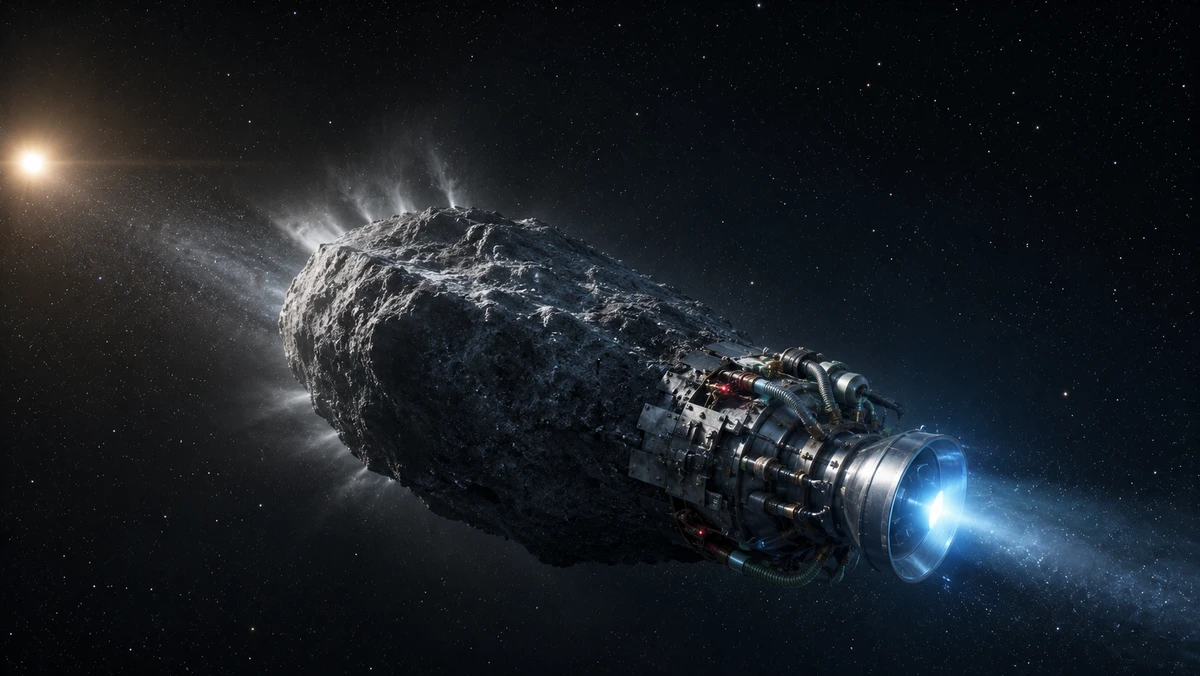
Avi Loeb suggested that the comet's unusual acceleration could have been caused by an internal engine. He compared the directed jets to the operation of nozzles, and the sudden blue coloration near the Sun to the heat of the engine or artificial light. The media quickly turned the cautious "maybe" into a resounding "the interstellar ship's engine has ignited."
But no one saw the engine itself. No structural components, no excess heat, no controlled maneuvers were found. The slight acceleration is easily explained by standard cometary physics: heated ice turns to gas, the gas escapes, and gently pushes the nucleus backward—almost like a weak natural jet engine.
This is expected for an active nucleus. The gas escapes asymmetrically and produces a weak recoil. This is how Halley's Comet behaves, and half the catalog does.
Non-gravitational doesn't mean unnatural. It's a motion in which gravity alone isn't enough to calculate the trajectory.
Some of the oddities, however, haven't gone away. They've simply ceased to be suspicious.
Water from an Alien Cold 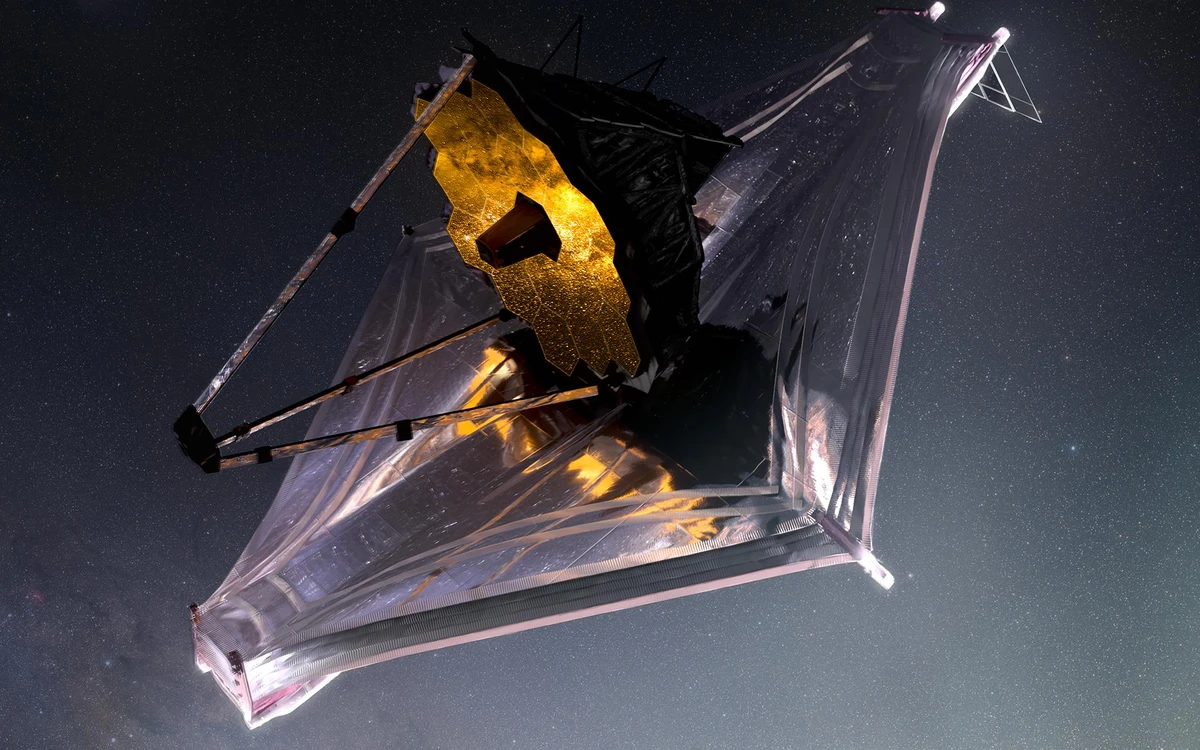
The James Webb spacecraft interrupted its scheduled observations to observe an interstellar comet. It was Webb that measured an anomalous proportion of heavy hydrogen in the 3I/ATLAS water.
The 3I/ATLAS water was found to contain an unusually high amount of deuterium, a heavy form of hydrogen. Normal hydrogen has one proton in its nucleus; deuterium adds a neutron. The colder the place where the ice formed, the more deuterium typically ends up in the water. Therefore, its proportion acts like an ancient thermometer.
First, the ALMA radio telescope showed that the comet contains at least 30 times more semi-heavy water than comets in the Solar System. Then the James Webb Space Telescope refined this result: the deuterium content of 3I/ATLAS's water was found to be approximately 30 times higher than the average cometary value. This doesn't mean that a third of the comet consists of heavy water. It merely indicates an unusually high proportion of deuterium among its hydrogen atoms.
This composition indicates that the ice formed at temperatures no higher than approximately 30 Kelvin, or about minus 243 degrees Celsius. It doesn't appear to have experienced significant heating later, which would have erased this chemical record. We don't know exactly where the comet has been flying for billions of years, but its water has retained the temperature of its birthplace.
The comet's material formed on the cold outskirts of an old star's system and may be twice as old as the Sun. Scientists can't pinpoint its exact age or its parent star, but its chemistry has revealed the conditions of its birth: it was extremely cold and happened incredibly long ago.
We expected a radio signal from 3I/ATLAS, an engine, or even a hint of alien intelligence. But what it brought back wasn't a message, but a chunk of ice that remembers the cold long before the Sun was born.