60 million stars in 26 hours: a new look at the center of the Milky Way (2 photos)
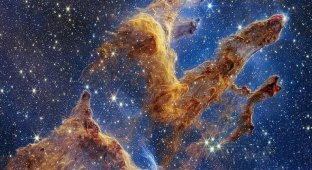
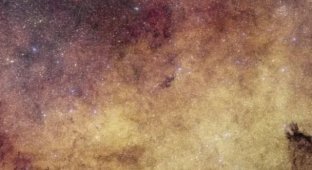
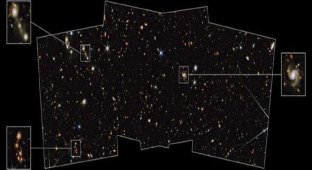
The Euclid space telescope, designed to study distant galaxies and the dark Universe, switched for a day to a completely different task: imaging the central region of the Milky Way near the galactic bulge. In just 26 hours, it captured a massive mosaic composed of nine images, revealing over 60 million stars, as well as nebulae and star clusters. 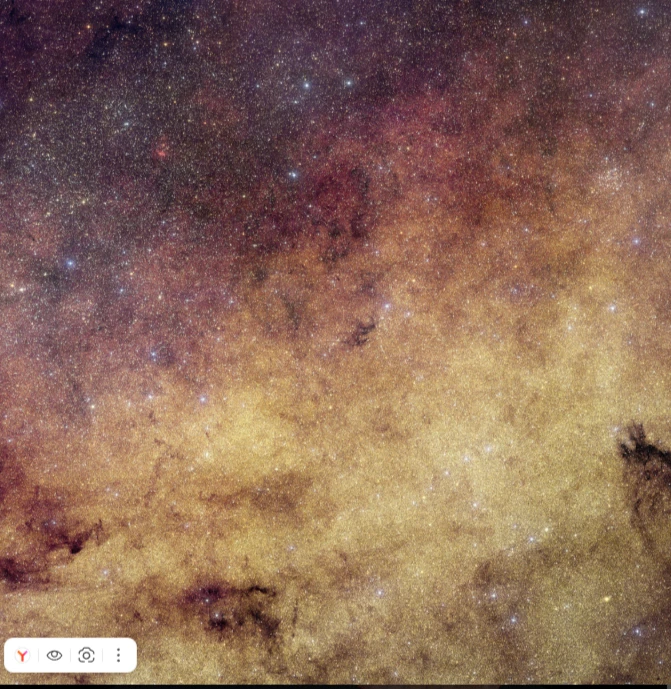
Each individual field of view captured by Euclid covers an area of the sky larger than the full Moon. In terms of resolution and sensitivity in visible light, the telescope is comparable to the Hubble Space Telescope; however, it can cover an area approximately 270 times larger than Hubble's field of view in just a few hours.
The primary goal of these observations was to search for and study exoplanets using the microlensing method. This requires astronomers to observe extremely dense star fields near the Galactic center.
The microlensing method relies on the gravitational lensing effect. When one star happens to pass in front of another, its gravity amplifies the light from the more distant star. If a planet is orbiting the foreground star, its gravity creates an additional, slight distortion in brightness. It is through these changes that an exoplanet can be detected.
Nearly 300 exoplanets have been discovered using this method over the past twenty years. However, recording a full microlensing event requires observing the same patch of sky for more than twenty days. Consequently, Euclid could not detect new microlensing events during its single day of this specific operation.
The value of the data obtained lies elsewhere. The image has become a sort of "reference point" for future observations. Euclid’s field of view already encompasses stars that will eventually undergo microlensing events and be observed by other instruments, including the upcoming Roman Space Telescope.
Since Euclid is capable of reliably resolving individual stars even in the extremely crowded regions of the Galactic Center, astronomers will be able to compare future data with this archival image. This will allow them to measure stellar proper motions, confirm the presence of exoplanets, and determine their masses more precisely. 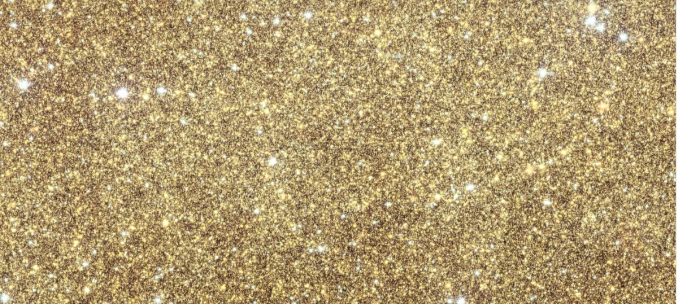
The resulting mosaic already contains 51 known planetary systems. Among them are the exoplanet OGLE-2005-BLG-390Lb, discovered nearly twenty years ago, and the OGLE-2013-BLG-341Lb system, which consists of two stars and one planet. Euclid’s new data will help refine the parameters of these objects.
Scientists note that the observational results will be useful for more than just the search for exoplanets. This dataset will also enable the study of brown dwarfs, binary stars, stellar motion in the central region of the Milky Way, and the distribution of interstellar dust.