Why is the Earth's core hotter than the surface of the Sun? (3 photos)
The Sun seems to symbolize absolute, unfathomable heat. It's impossible to look at it for long without protection; its light heats the planets and sustains life on Earth, while thermonuclear reactions have been continuously occurring within it for about 4.6 billion years. 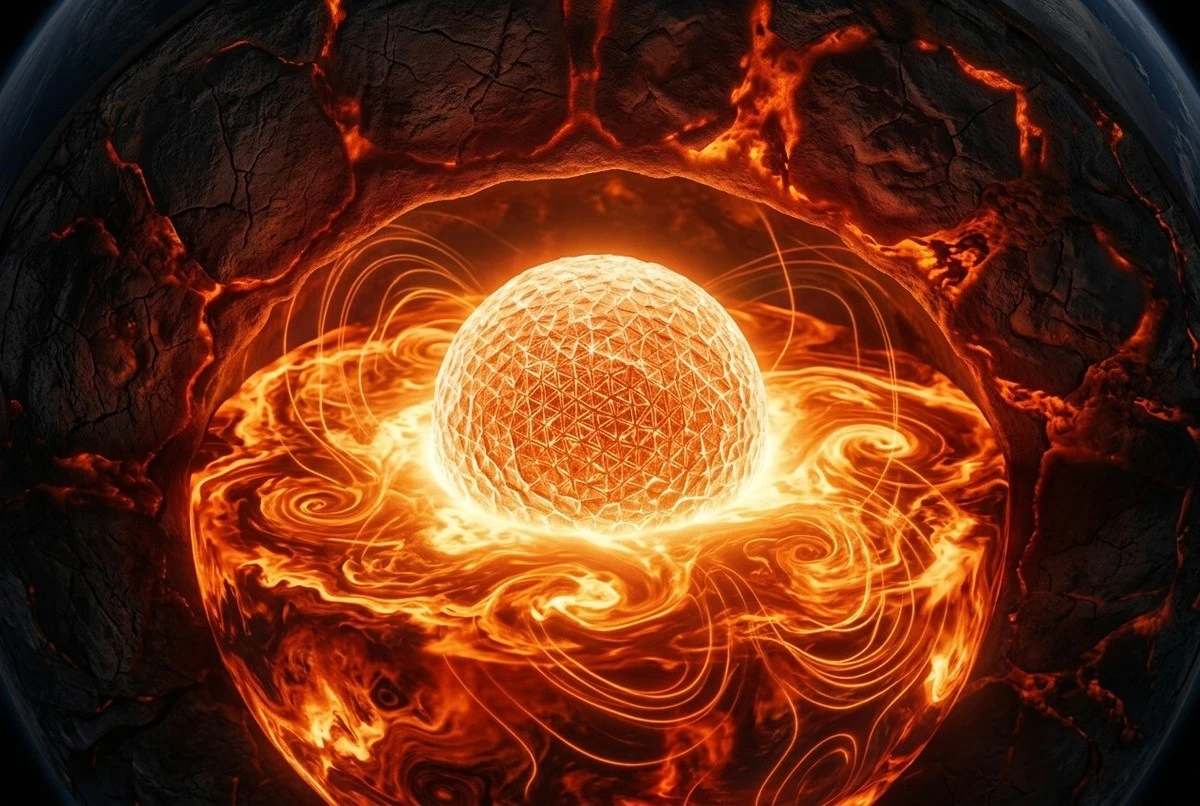
Therefore, the phrase "the Earth's core is hotter than the Sun's surface" may seem misleading.
However, there is no mistake here.
The visible surface of the Sun—the photosphere—has a temperature of about 5,500°C. The temperature at the Earth's center is approximately 6,000°C. That is, the deepest regions of our planet are indeed hotter than the solar surface.
The key word here is "surface." The Sun is not uniformly hot throughout its layers. Its photosphere is only the visible outer shell, and it is relatively "cold." But in the solar core, the temperature reaches 15 million degrees, which is nothing compared to the temperature of our planet's core.
And yet, the question posed in the title remains intriguing. The Earth's volume is approximately 1.3 million times smaller than the Sun's—so how could a small, rocky planet at its center have such a temperature?
Earth has stored some of its heat since its birth. About 4.54 billion years ago, our planet began to form from dust, clumped fragments, and debris of planetesimals that were less fortunate than the future Earth. The collisions during its formation were monstrous: the energy from the impacts was converted into heat, and the young Earth gradually heated up. 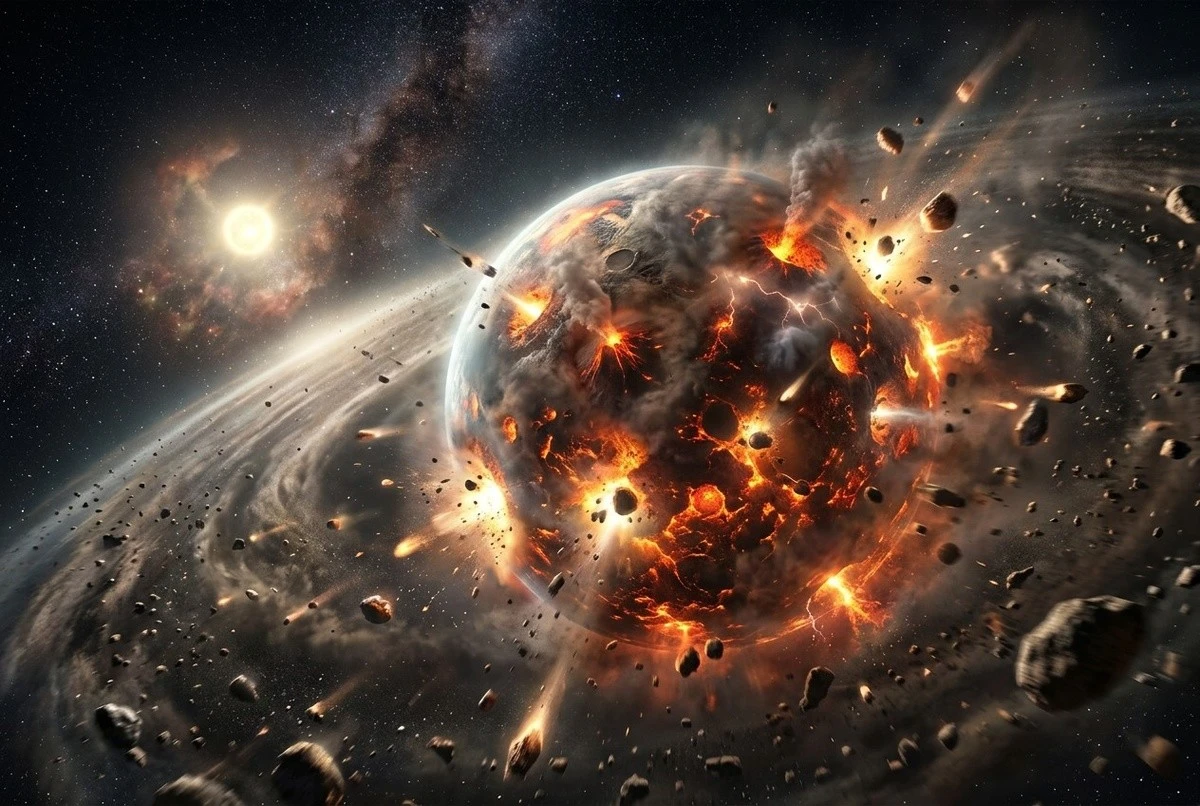
Later, heavier substances, primarily iron and nickel, began to sink toward the planet's center. This formed the metallic core. This process also released energy and made the Earth's interior even hotter.
But ancient heat is not the only source. Radioactive elements such as uranium, thorium, and potassium continue to decay deep within the planet. Their decay is accompanied by the release of energy, which replenishes the heat reserves of the Earth's depths.
Meanwhile, our planet is, of course, cooling, but very reluctantly: thousands of kilometers of rock act as extremely effective thermal insulation. The solar system will cease to exist before the interior of our planet cools to any appreciable temperature.
Equally interesting is the fact that the Earth's inner core remains solid. At first glance, this seems odd: the temperature is enormous, and iron should melt. But at depths of more than 5,000 kilometers, the pressure reaches millions of atmospheres. This compresses the iron atoms so tightly that they struggle to move freely relative to one another. Melting is precisely the transition to a state in which the atoms can move much more freely. At such pressures, melting requires a much higher temperature, so the inner core remains solid even under extreme heat.
Above this lies the outer core—it's liquid. Here, the pressure is lower than in the inner core, so the iron-nickel melt remains mobile. The movement of this conductive liquid contributes to the creation of the Earth's magnetic field.
The hot core isn't a strange relic of the past, but the "heart" of the entire planet. It stores the heat of the ancient Earth, maintains its internal dynamics, and helps create a magnetic shield, without which our planet would never have the diversity of flora and fauna we see today. 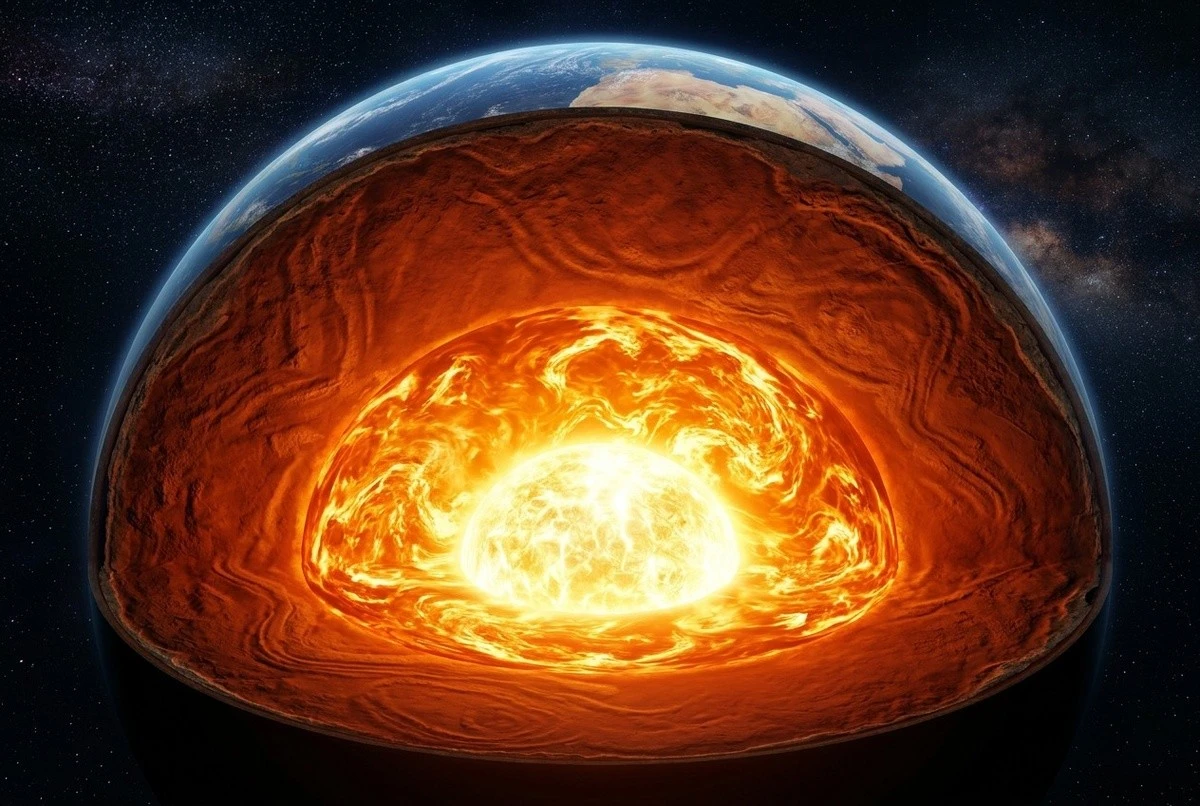
Anticipating statements from "experts in all fields of science" that only the Kola Superdeep exists and no one has ever gone deeper than 12 kilometers, I'll tell you in advance: scientists determine the temperature of the Earth's core using indirect methods.
They study how seismic waves from earthquakes—and, in the past, from underground nuclear tests—pass through the planet. The speed of these waves varies depending on the density, temperature, and state of the substance. These changes provide clues to what's happening deep within the Earth. To confirm these estimates, scientists also use experimental methods: they take iron and nickel, compress them to pressures comparable to those in the Earth's core, and heat them to determine the temperature at which the metal begins to melt.
Thus, core temperature estimates are based not on fantasy, but on seismology and the physics of matter under extreme conditions.