The sun is "shrinking," and the Earth is moving away. What will happen next? (3 photos)
Compared to human life and even entire civilizations, the Sun seems eternal and unchanging. However, our star is continuously losing mass, becoming millions of tons lighter every second—and this slowly changes the orbits of all objects in the Solar System, including Earth. 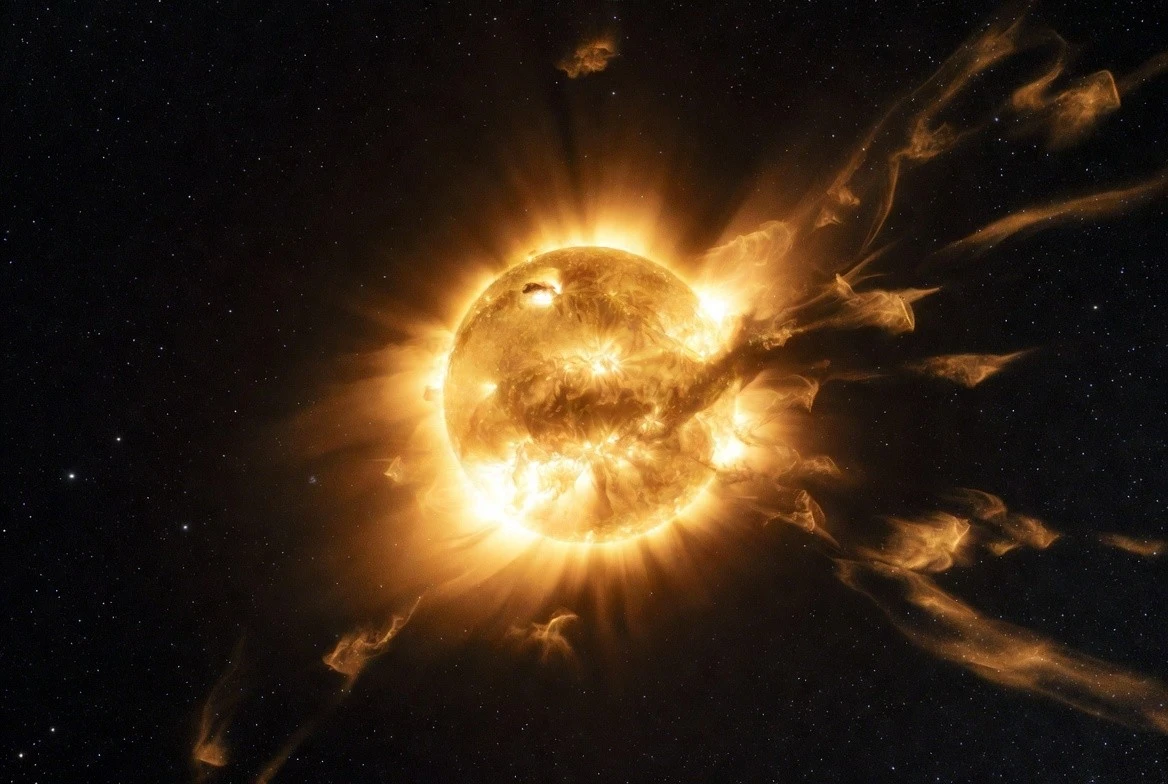
Why is the Sun "losing weight"?
Thermonuclear reactions occur in the Sun's core: hydrogen is converted into helium, releasing colossal energy. Part of the mass is converted into energy according to Einstein's formula E=mc²—an average of about four million tons per second. This mass doesn't vanish into thin air, but disperses throughout space as heat and light, some of which reaches Earth, making it habitable.
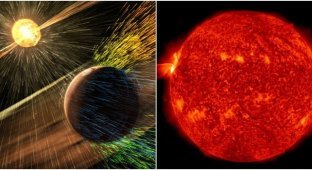
Furthermore, our star constantly emits a solar wind—a stream of charged particles that flies at tremendous speed throughout the Solar System. This process carries away approximately 1–2 million tons of matter per second. Thus, the Sun is "losing weight" by approximately 5–6 million tons per second, or approximately 430–520 billion tons per day.
For us, living on a speck of dust in the vast Universe, this may seem like an unimaginable amount. But in reality, it's negligible. Over a billion years, the Sun will lose only about 0.01% of its mass, so for the star, such losses are a drop in the ocean. But even this "drop" has consequences. 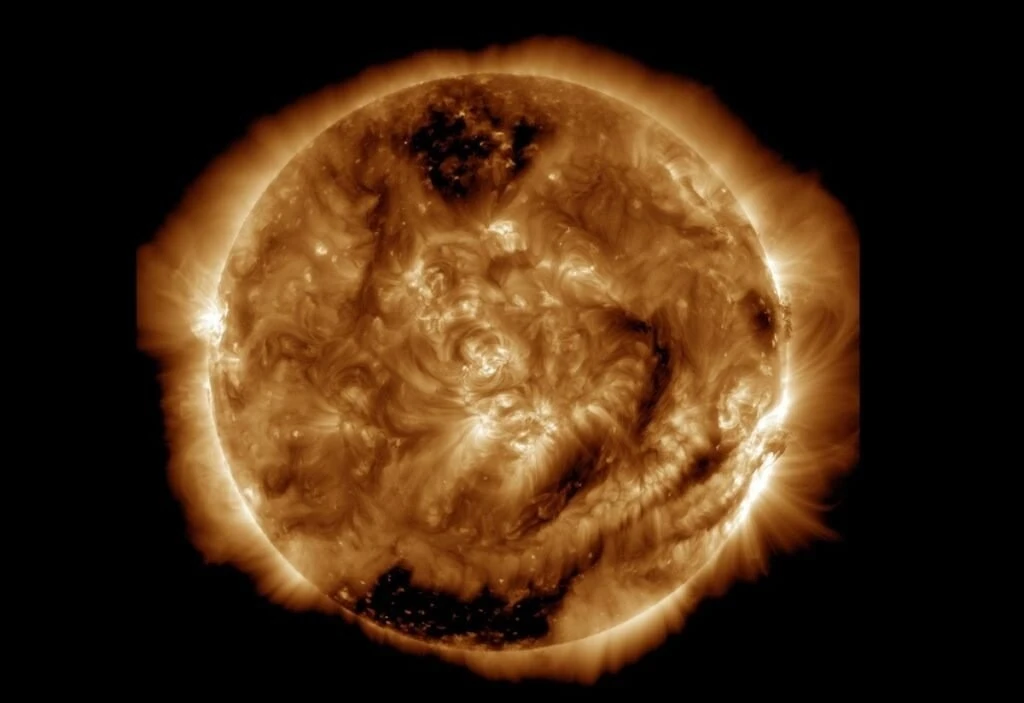
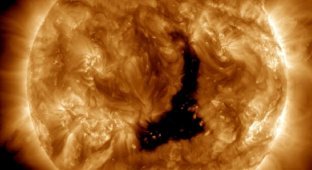
Image of the Sun taken by the Solar Dynamics Observatory (SDO)
The Sun's gravity holds objects in the Solar System in orbit. The smaller the star's mass, the weaker the pull—and their orbits begin to slowly but irreversibly expand. Earth, for example, is moving away from the Sun at a rate of about 1–2 centimeters per year.
Will this save the planet?
In about five billion years, when the hydrogen reserves in the Sun's core are exhausted, the star will begin to transform into a red giant, rapidly expanding and shedding its outer layers. It might seem that Earth's migration should provide salvation from such catastrophic changes, but... unfortunately, it won't.
The swelling Sun will engulf Mercury and Venus, and likely reach Earth's orbit, which by then will have "crawled" only 50,000-100,000 kilometers from its current position.
What will happen to Earth?
Even if Earth isn't physically engulfed by the dying Sun, conditions on it will become hellish long before the end. 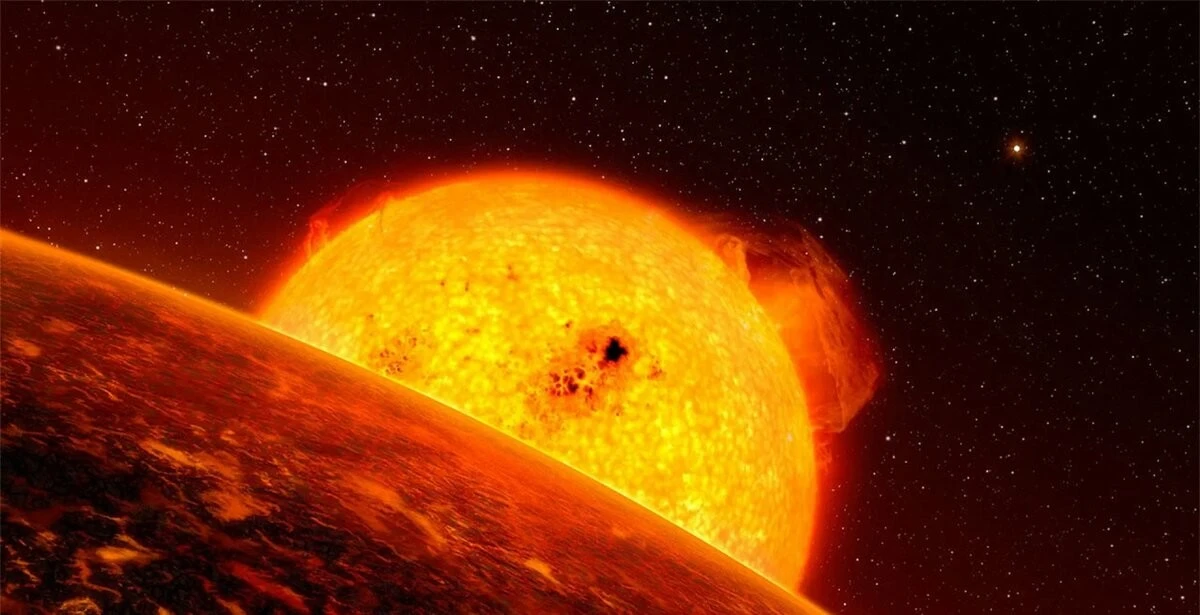
In about a billion years, the oceans will begin to evaporate, the atmosphere will collapse, and the surface will become scorching hot. Almost all life—except for some extremophiles living deep beneath the surface—will disappear long before the Sun reaches its maximum size.
"Nothing lasts forever, few things endure, and things have different ends, but everything that has a beginning has an end," wrote the Roman philosopher Lucius Annaeus Seneca.