On May 17, 1882, astronomers witnessed an incredible cosmic coincidence: a bright comet from the Kreutz family passed close to our sun during a total solar eclipse. 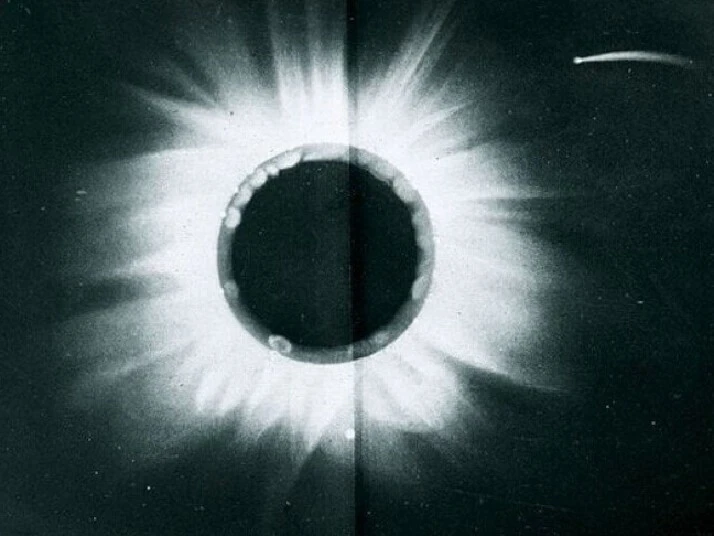
First-ever photograph of a comet during a solar eclipse
Comet X/1882 K1, later nicknamed the "Eclipse Comet," came within a record-breaking distance of the Sun—just 450,000 kilometers from the surface. For comparison, the average distance from Earth to the Moon is 384,400 kilometers. During this maneuver, the core of X/1882 K1 heated up to several thousand degrees.
The tail of the "Eclipse Comet" stretched for more than 100 million kilometers—two-thirds the distance from Earth to the Sun! The comet became so bright that it could be seen with the naked eye even during the day.
The giant tails of comets are formed by the action of solar wind and radiation. As a comet approaches the Sun, its core—a mixture of ice, dust, and rock (hence the nickname "dirty snowballs")—begins to heat up. The ice sublimates—immediately turning into gas, bypassing the liquid phase. Solar wind and radiation pressure sweep gas and dust particles away from the Sun, forming a characteristic tail that always points away from the star. 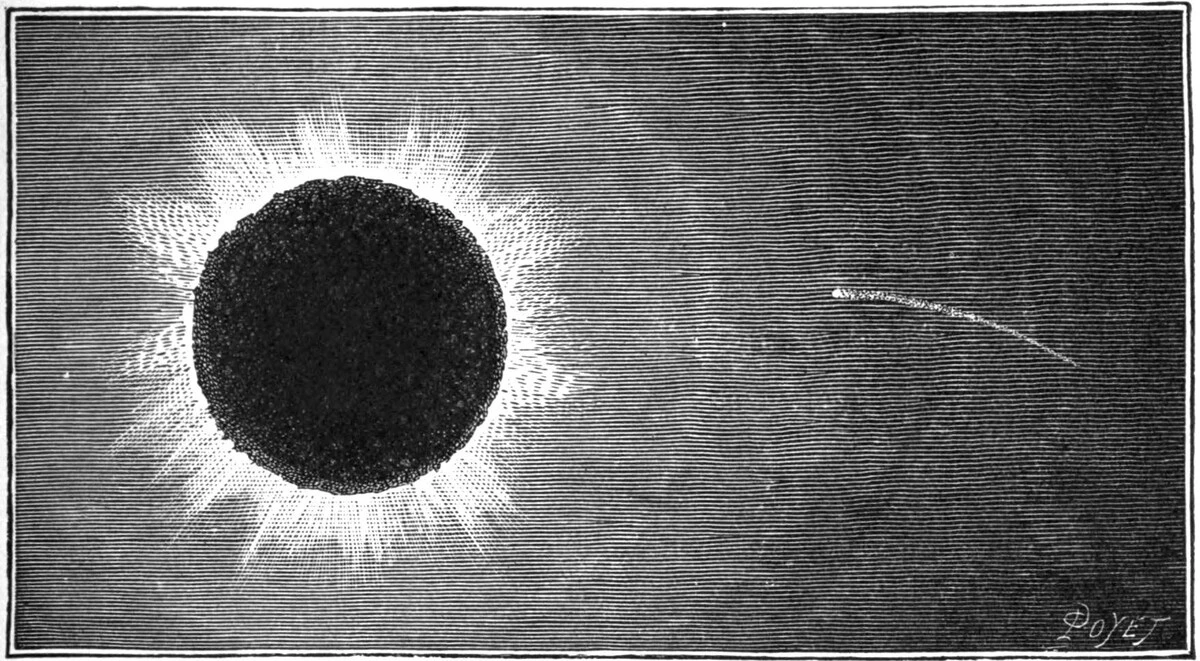
A sketch of the event by astronomer George Frederick Chambers, who was in Egypt at the time of the eclipse.
Kreutz family comets are a special group of comets formed by the disintegration of a giant comet about a thousand years ago. They are named after the German astronomer Heinrich Kreutz, who established a connection between these celestial bodies, proposing a theory of their common origin. All Kreutz family comets have similar orbits with periods of 500 to 900 years and regularly "dive" extremely close to the Sun.
To date, more than 2,000 Kreutz family comets are known, most of which were discovered by the NASA/ESA SOHO spacecraft. Remarkably, many of these comets are so small that they completely evaporate upon approaching the Sun.
The progenitor of all Kreutz comets was likely one of the largest comets in the Solar System, with a nucleus reaching tens of kilometers in diameter. When it disintegrated, it gave birth to an entire "dynasty" of comets that still remind us of this ancient cosmic cataclysm.
Add your comment
You might be interested in:













Persistence in achieving a goal

Not everyone is having fun on the amusement ride

A biker prevented a hit-and-run driver from escaping

17 Photos That Will Stop You in Your Tracks (18 Photos)

The cutest lunch delivery ever

Absolute perfection

Young women, Dancing and George Michael: nothing superfluous

An apology delivered with a running start

A steam locomotive for "big boys"
