The remains of another planet may be hiding in the depths of the Earth (3 photos)
Fragments of another world may be hidden within our planet. And while this sounds like science fiction, there's a very serious scientific hypothesis behind this idea. 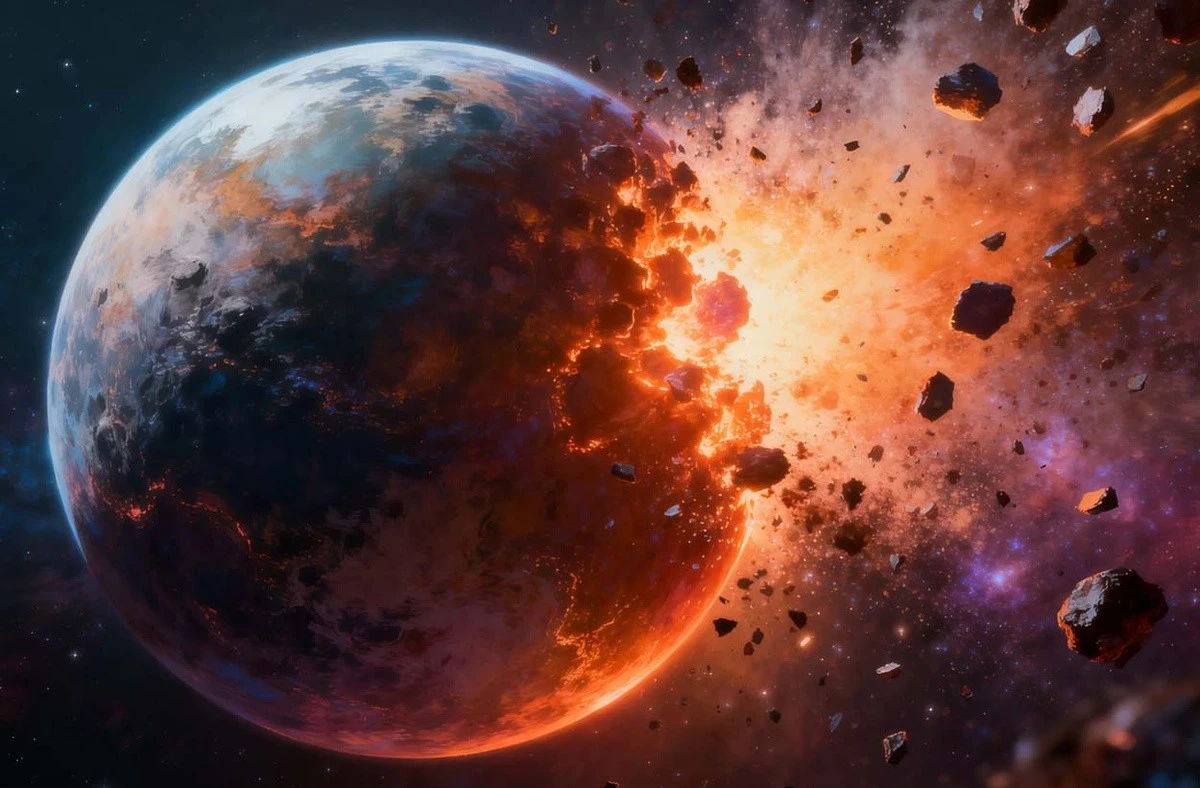
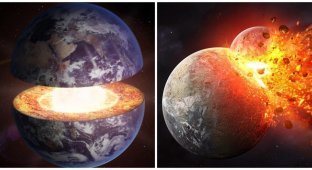
We're talking about Theia, a hypothetical protoplanet roughly the size of Mars. According to the generally accepted theory, about 4.5 billion years ago, it collided with the proto-Earth—Earth in a very early stage of its development. The impact was so powerful that some of the material was ejected into orbit, and the Moon was later formed from this debris.
But an important question arises: if Theia did indeed collide with Earth, where did most of its material go? After all, the Moon is almost half the size of Mars.
Two Giant Anomalies Deep in the Earth
Geophysicists have long known that there are two enormous anomalous regions in the Earth's lower mantle. One is located beneath Africa, the other beneath the Pacific Ocean. They are called Large Low-Shear-Velocity Provinces (LLSVPs).
LLSVPs are giant accumulations of material at the boundary of the outer core and mantle, located at a depth of approximately 2,900 kilometers below the surface. Seismic waves travel significantly slower through these regions than through the surrounding mantle, so scientists see them indirectly—from earthquake data. 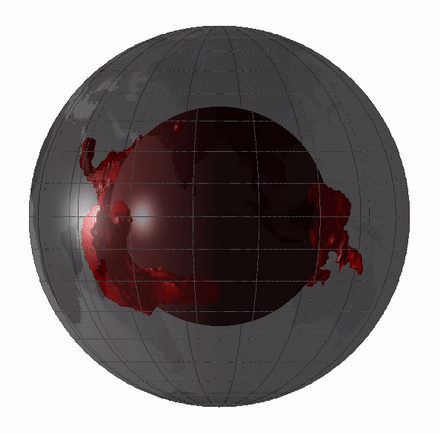
Animation of regions with low shear wave velocity
Because seismographs are located around the planet and operate continuously, the accumulated data allows us to visualize what is hidden from direct observation—a sort of planetary-scale "X-ray." The total volume of LLSVP is estimated to be approximately 6% of the Earth's total volume.
Theia's Footprints Beneath Our Feet
In 2023, an international team of researchers proposed a curious explanation: these deep anomalies could be remnants of material from Theia—the very protoplanet whose collision led to the formation of the Moon.
Modeling showed that if Theia's mantle was slightly denser than the proto-Earth's mantle and richer in iron, some of its material may not have fully mixed with Earth's mantle after the collision. Instead, it sank deeper and eventually ended up at the core-mantle boundary—where the LLSVPs are located today. The study's authors directly refer to these structures as possible "buried relics" of Theia's material, preserved after the giant impact.
This hypothesis is remarkable because it connects two mysteries: the origin of the Moon and the existence of giant structures deep within the Earth. If confirmed, our natural satellite will not be the only trace of an ancient collision. A second trace may lie deep beneath our feet. 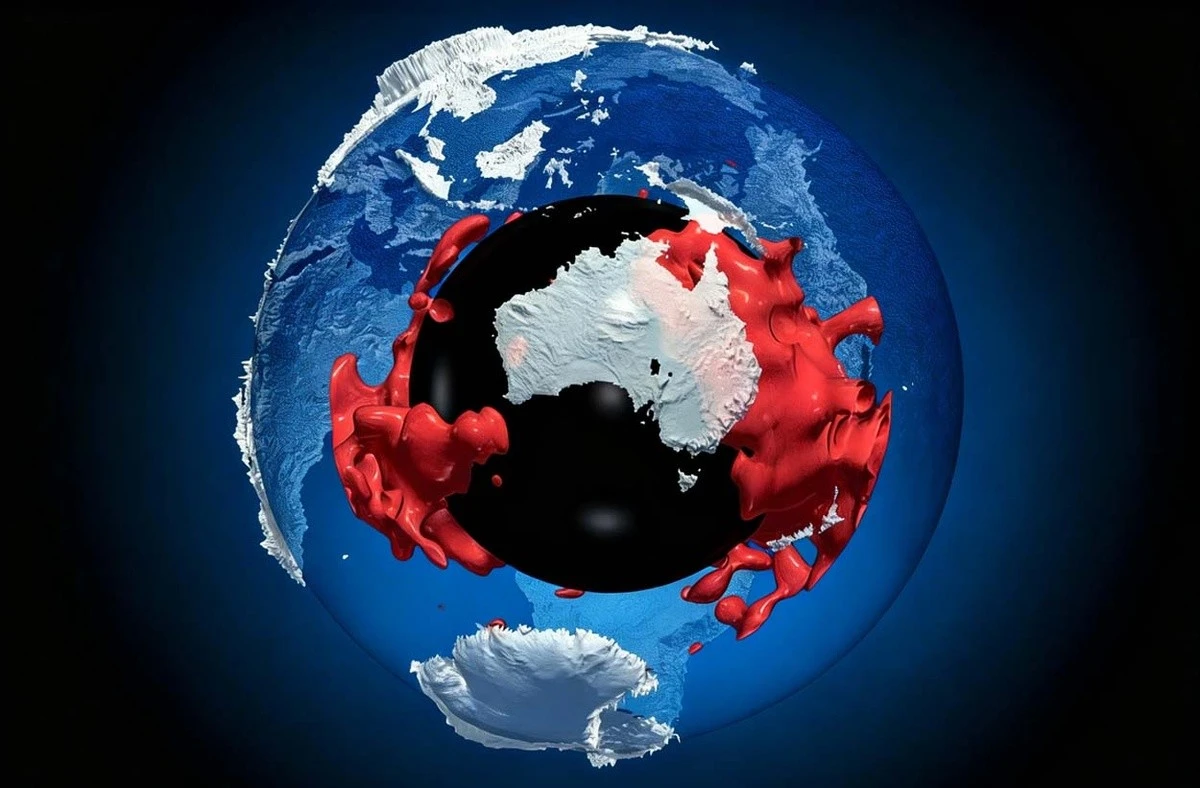
Visualization of seismic data showing large areas of reduced shear wave velocities in the Earth's lower mantle
Why this isn't just a fantasy
I can already foresee the armchair expert reaction along the lines of: "There's only the Kola Superdeep Borehole," "nobody knows it's deeper than 12 kilometers," "it's all just guesswork," "nobody's seen it with their own eyes," and so on.
But to detect a disease of the internal organs, a person isn't opened up on the operating table as part of a diagnosis. Doctors use ultrasound, MRI, CT scans, analysis, and other methods to see what's hidden inside the body. Exploring the Earth's interior using modern seismology, geodynamic modeling, and comparative analysis works in a similar way—on a planetary scale.
The existence of LLSVPs is a fact. However, their origin is not a proven truth, but a powerful scientific model.
If the study's authors are correct, our planet will turn out to be not just a body that survived an ancient collision, but a world that still contains fragments of a lost protoplanet.
And if we one day develop the technology to obtain samples of these fragments, we will be able to better understand not only the formation of the Moon but also how giant impacts influenced the internal structure of the planets in the Solar System, determining their subsequent evolutionary paths.
Perhaps these very events, which we would consider catastrophic today, played a vital role in the creation of habitable worlds, providing them with colossal reserves of energy.