This is what the Sun looks like in ultra-high resolution (2 photos)
This is the solar photosphere—the visible "surface" of the star, appearing as a dense mosaic of light granules and dark spaces between them. This is exactly what the surface of our star looks like in ultra-high resolution, where hot plasma continuously rises from the depths and transfers energy outward. 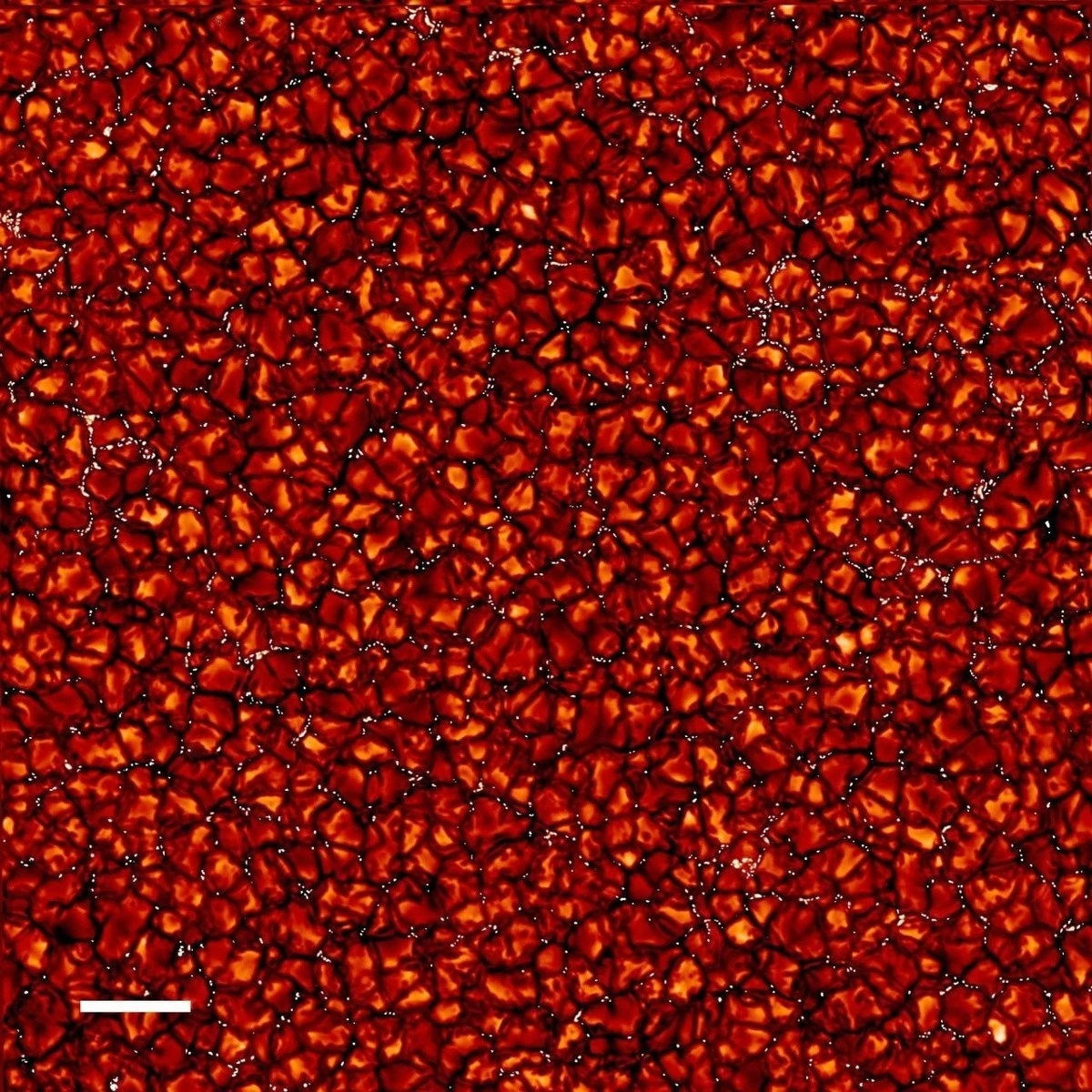
The Sun's Surface in Ultra-High Resolution
The light granules in the image are the tips of giant convection cells. The hottest, rising plasma resides at the center of these structures, while cooling matter, whose density increases and causes it to sink again, is located at the edges. This is why the boundaries between the granules appear darker: the plasma there is colder, denser, and moving downward. This is a direct manifestation of the solar system's vigorous, never-ending convection.
The tiny bright dots in the dark intergranular spaces deserve special attention. These are not imaging artifacts, but regions of very strong local magnetic fields. They appear brighter because magnetic pressure alters the plasma structure, allowing us to see the deeper, hotter layers of the star, lying below the photosphere. This is why these regions stand out in the image as tiny, sparkling "sparkles" among the darker mesh.
The white line in the lower left of the frame indicates the scale: its length is 5,000 kilometers. In the image below, I've added the Earth at its actual size relative to this image, so you can better appreciate how tiny elements by solar standards are actually colossal in size compared to our planet. Individual solar granules are comparable in size to the territories of large countries. 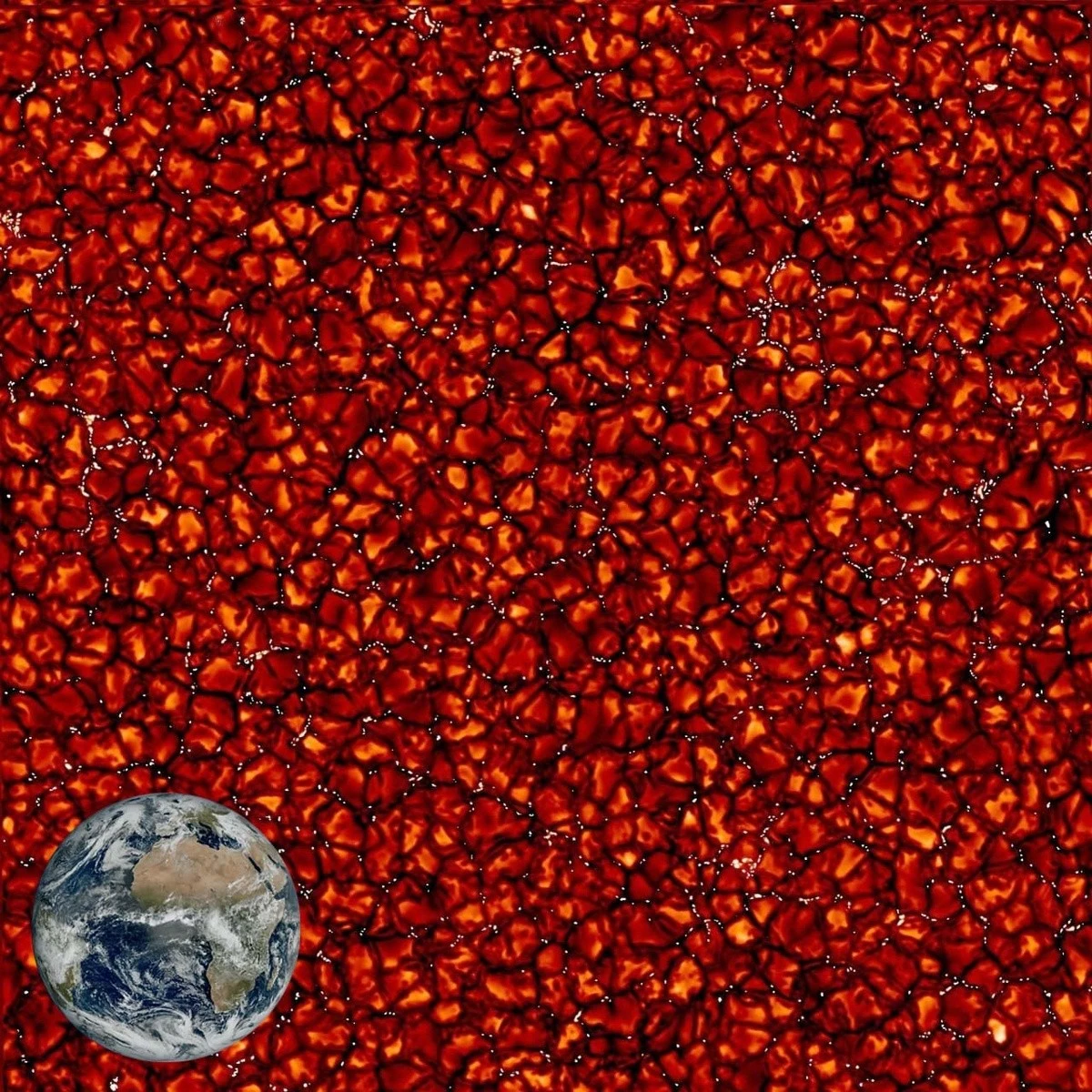
This image was taken in September 2007 using the Swedish 1-meter Solar Telescope (SST) on the Spanish island of La Palma. This instrument, located at the Roque de los Muchachos Observatory, is one of the most effective ground-based solar telescopes in the world. This exceptional detail is achieved not only through modern adaptive optics but also through sophisticated computer processing, which compensates for distortions caused by Earth's atmosphere.
Such observations allow scientists to literally see stellar physics in action. The more accurately we understand the behavior of plasma and magnetic fields on the Sun, the better we can understand the nature of solar flares, coronal mass ejections, and other space weather phenomena. This will ultimately help improve forecasts of events that could disrupt satellites, navigation, radio communications, and even disable ground-based infrastructure.