Gastropods are one of the most diverse and flexible groups of invertebrates, having colonized virtually all types of habitats, from the seafloor to dry terrestrial biotopes. Over the course of evolution, they have developed different types of sensory organ organization, especially visual ones. 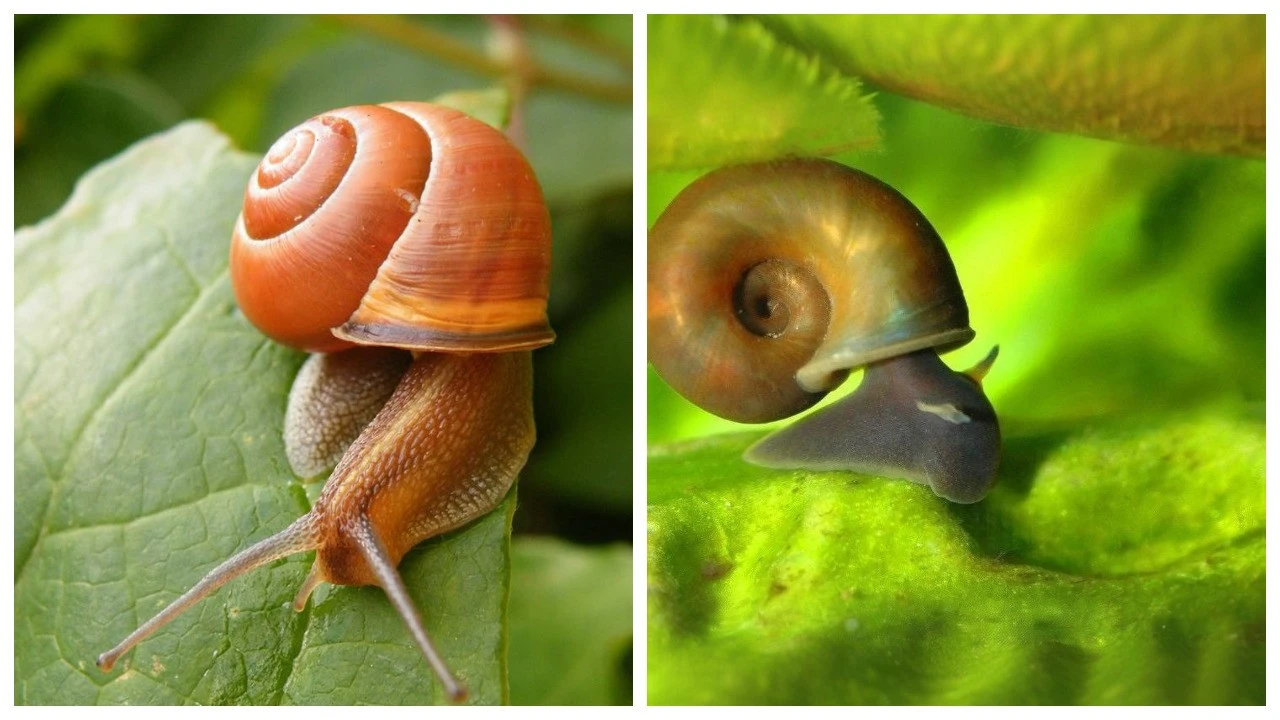
One of the most noticeable features separating terrestrial and aquatic forms is the position and structure of the eyes.
Some representatives—primarily terrestrial—have eyes located at the ends of mobile tentacles, providing a wide field of view and a flexible visual field. These forms are called stalked-eyed (Stylommatophora).
In others—primarily aquatic—the eyes are located at the base of the tentacles, remaining relatively immobile and simpler in structure. Such mollusks are classified as sessile-eyed (Basommatophora).
The difference between these two types is not limited to external features. It reflects profound ecological and functional differences: terrestrial forms have adapted to life in the air, where good visibility and light perception are required, while aquatic forms have retained a more ancient, conservative type of vision, dominated by tactile and chemical senses.
Stalked-eyed:
In most terrestrial gastropods, the visual organs are located at the ends of mobile stalks, which are elongated tentacles of the head. This organization is called stalked eyes. It is particularly characteristic of members of the superorder Stylommatophora—lung snails and slugs. Snails belonging to this order constitute the most highly organized group among gastropods. 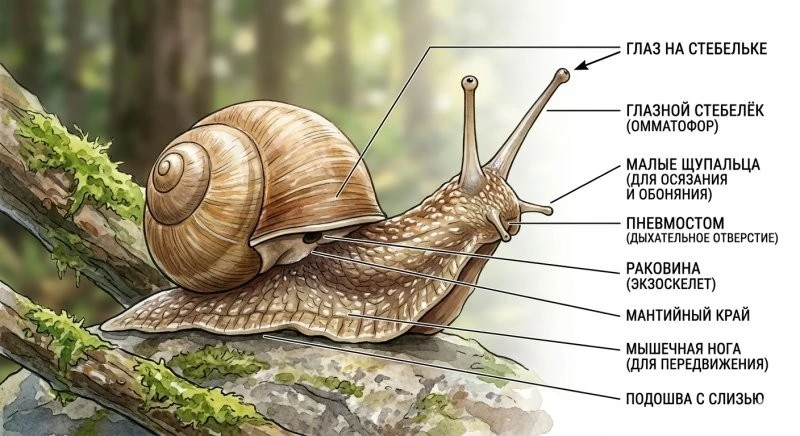
When moving, the snail extends two pairs of tentacles from its head. The upper, longer pair bears the eyes, while the lower pair serves primarily for olfaction and touch. Thanks to the mobility of the stalked eyes, the eyes can freely change direction, providing the animal with a wide field of view. This allows the snail to orient itself in space and perceive approaching threats without fully extending from its shell.
The structure of the eyes of stalked-eyed snails is relatively simple. They are closed, bubble-like structures containing the cornea, lens, and retina. Their vision is limited: they can only distinguish light levels and the outlines of large objects. However, their visual organs play an important role in behavior—the snails react to movement, shadows, and light direction.
A distinctive feature of these animals is the ability to retract their eyes into their tentacles when threatened. The optic stalk can be completely retracted into the tissue of the head, reducing the risk of damage to the eye. Moreover, when a tentacle is lost along with the eye, some species experience regeneration—the eye gradually recovers, including its main anatomical structures. 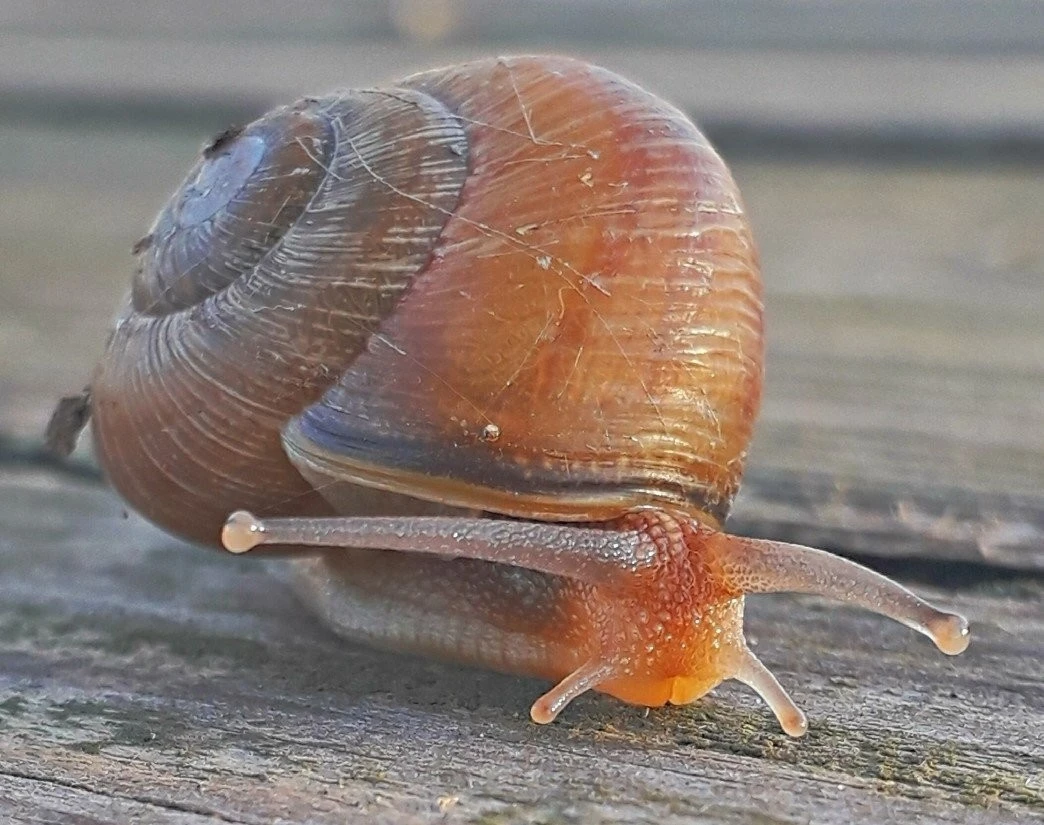
This type of visual organization is an example of adaptation to a terrestrial and sedentary lifestyle. Instead of complicating the eye's structure, evolution opted for increasing its mobility. Flexible eye stalks allowed for vision in various directions with minimal body movement.
Thus, stalked-eyed mollusks demonstrate a unique developmental pathway for their visual organs, combining structural simplicity with high functional efficiency for a slow, hidden existence.
Sessile-eyed:
Many gastropods have eyes not at the ends of mobile stalks, but at the base of the tentacles. This type of visual organization is called sessile-eyed. It is characteristic primarily of aquatic forms, particularly freshwater and marine snails of the superorder Basommatophora and some other groups.
In sessile-eyed mollusks, the eyes lack long stalks and are therefore less mobile. They are usually small dark spots on the side of the head, at the base of the tentacles. This arrangement limits the field of vision, but is quite effective for orientation in the water and perception of changes in illumination. 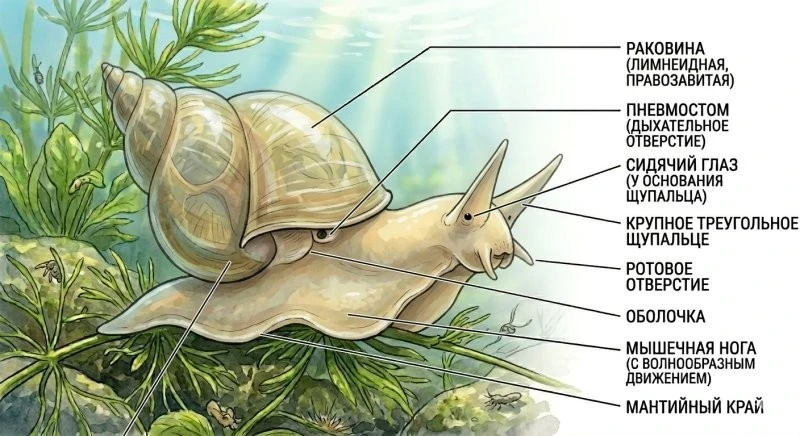
The eye structure of these species is also relatively simple. The visual organ is a closed epithelial vesicle with a primitive retina capable of distinguishing light intensity and the outlines of large objects. Despite their simplicity, these eyes play an important role in behavior—they facilitate phototaxis (movement toward or away from light) and help avoid sudden shadowing, often associated with the approach of a predator.
Unlike terrestrial stalked-eyed forms, sessile-eyed mollusks lead a primarily aquatic, more mobile lifestyle. In their environment, vision plays a supporting role, giving way to other senses—chemical perception and touch, which are especially important when searching for food and mates. 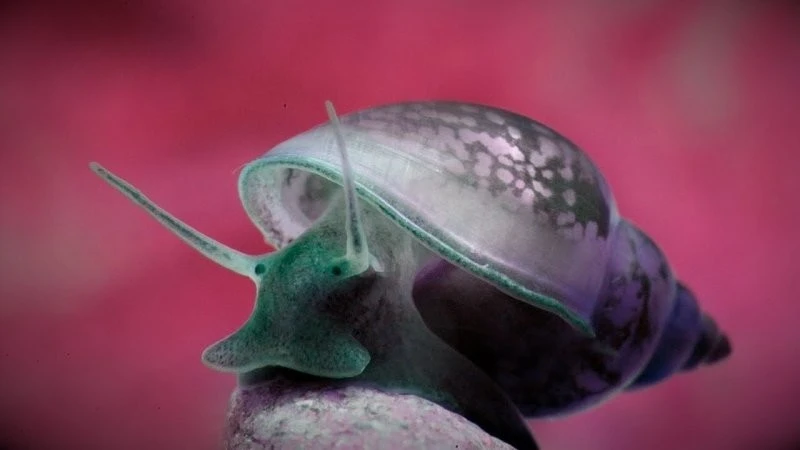
Evolutionarily, sessile-eyedness is considered a more ancient and conservative trait. The stalked eyes of land snails evolved later as an adaptation to life on land, where a wider field of view was required with limited body mobility. Thus, sessile-eyed forms reflect the original state of the gastropod visual organs, adapted to an environment where tactile and chemical stimuli, rather than visual ones, play a decisive role.
Some groups of pulmonate gastropods (order Pulmonata), which initially colonized land, later returned to aquatic environments during their evolution. Among them are the well-known freshwater genera Lymnaea, Planorbis, Physa, and others. These mollusks breathe air using a modified mantle that functions as a lung, but they nevertheless lead a fully or partially aquatic lifestyle. One characteristic consequence of this return was the reduction of the eyes—their simplification and the loss of their stalked structure.
Marine Species:
Among the true Pulmonata, there are no fully aquatic species that retain stalked eyes. All have sessile eyes at the base of the tentacles.
However, if we consider all gastropods more broadly, there are groups of marine non-pulmonate snails that also have eyes on stalks. These include sea conchs, cone snails, some cowries, and buri snails. 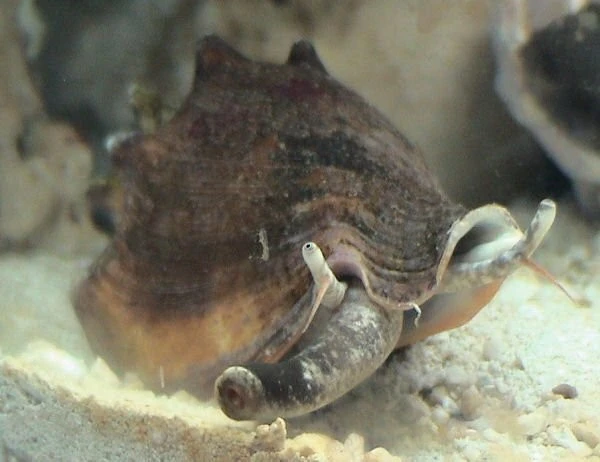
But these forms are not classified as Pulmonata—they have different anatomy, and their eyes evolved independently. Therefore, they cannot be considered "purely aquatic stalk-eyed lungfish", although they look similar in appearance.
Add your comment
You might be interested in:








Protective film Removing it with a power screwdriver
Precision carpentry

Looks like it's time to buy WinRAR
When a child plays hide-and-seek at a professional level
Athlete in Bavarian dress flies over a lake on a hydrofoil
How to hang wallpaper neatly
Man sets up bedroom camera and discovers the reason for his

Super dads who swoop in to save the day
The Terminator's tears: Figure decides to scrap its old
