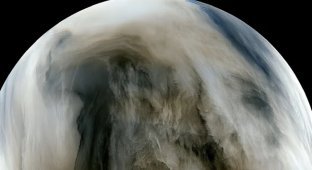
What are the clouds of Venus hiding: a look from the Akatsuki mission (4 photos)
The Japan Aerospace Exploration Agency's (JAXA) Akatsuki spacecraft, which orbited Venus from December 7, 2015, to the end of April 2024, transmitted thousands of images of its atmosphere in various wavelengths. These images provide invaluable scientific data, helping to better understand the structure of one of the most mysterious worlds in the Solar System. 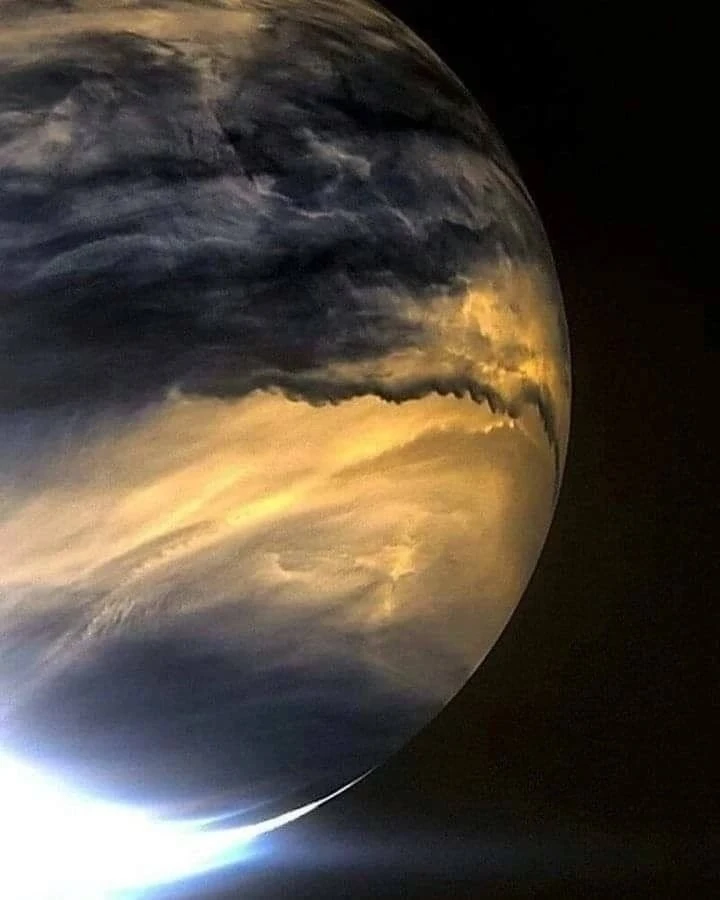
The Akatsuki mission officially ended on September 18, 2025, after unsuccessful attempts to reestablish contact with the spacecraft, which was lost in late April 2024. Even though we've lost our "eyes" on the second planet from the Sun, the data collected will be analyzed for many years to come.
Venus We Can't See
In visible light, which is visible to the human eye, Venus appears as a smooth white-yellow sphere. But in the ultraviolet range, dark streaks, vortices, and giant waves appear. These structures are located at an altitude of approximately 60-70 kilometers from the surface, where the temperature, despite the hellish conditions below, is approximately -40 degrees Celsius.
However, infrared images allow us to look even deeper. They record thermal radiation from the lower layers of the atmosphere and even the surface, penetrating through thinner cloud layers. This is why infrared images create the impression that the planet "glows from within."
This article presents composite images combining both wavelengths.
An Atmosphere with a Life of Its Own
One of Venus's key features is its so-called superrotation.
The planet rotates once every 243 Earth days. But its atmosphere moves much faster: winds in the upper cloud layers reach 300–360 km/h, causing them to circle the planet in about four Earth days. 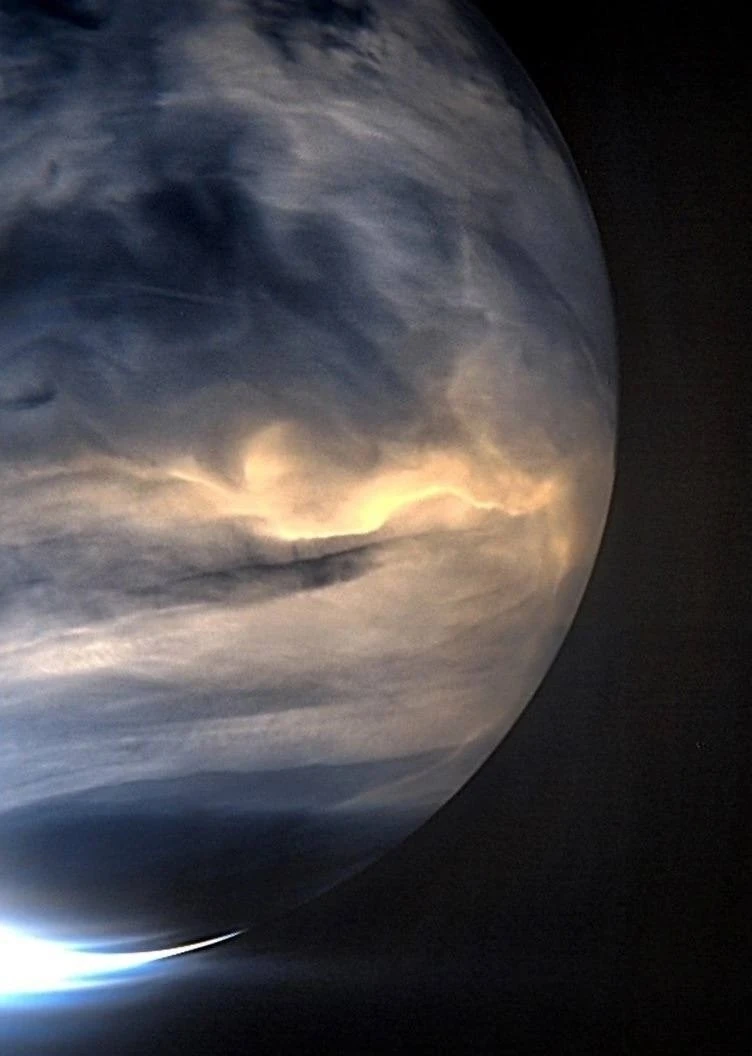
Akatsuki images clearly show characteristic Y-shaped structures. This is not simply a striking cloud pattern, but rather the traces of large-scale atmospheric waves, which may be associated with energy transfer and the maintenance of the atmosphere's ultra-fast motion.
Why the Venusian atmosphere behaves this way is not fully understood.
Hell Beneath the Clouds
Venus's atmosphere is 96% carbon dioxide. The surface pressure is approximately 92 times higher than Earth's, and the average temperature reaches 460 degrees Celsius—enough to melt tin, lead, and even zinc.
Venus's cloud layer is formed primarily by droplets of concentrated sulfuric acid mixed with water. It reflects most of the sunlight, making Venus one of the brightest celestial bodies in Earth's night sky. 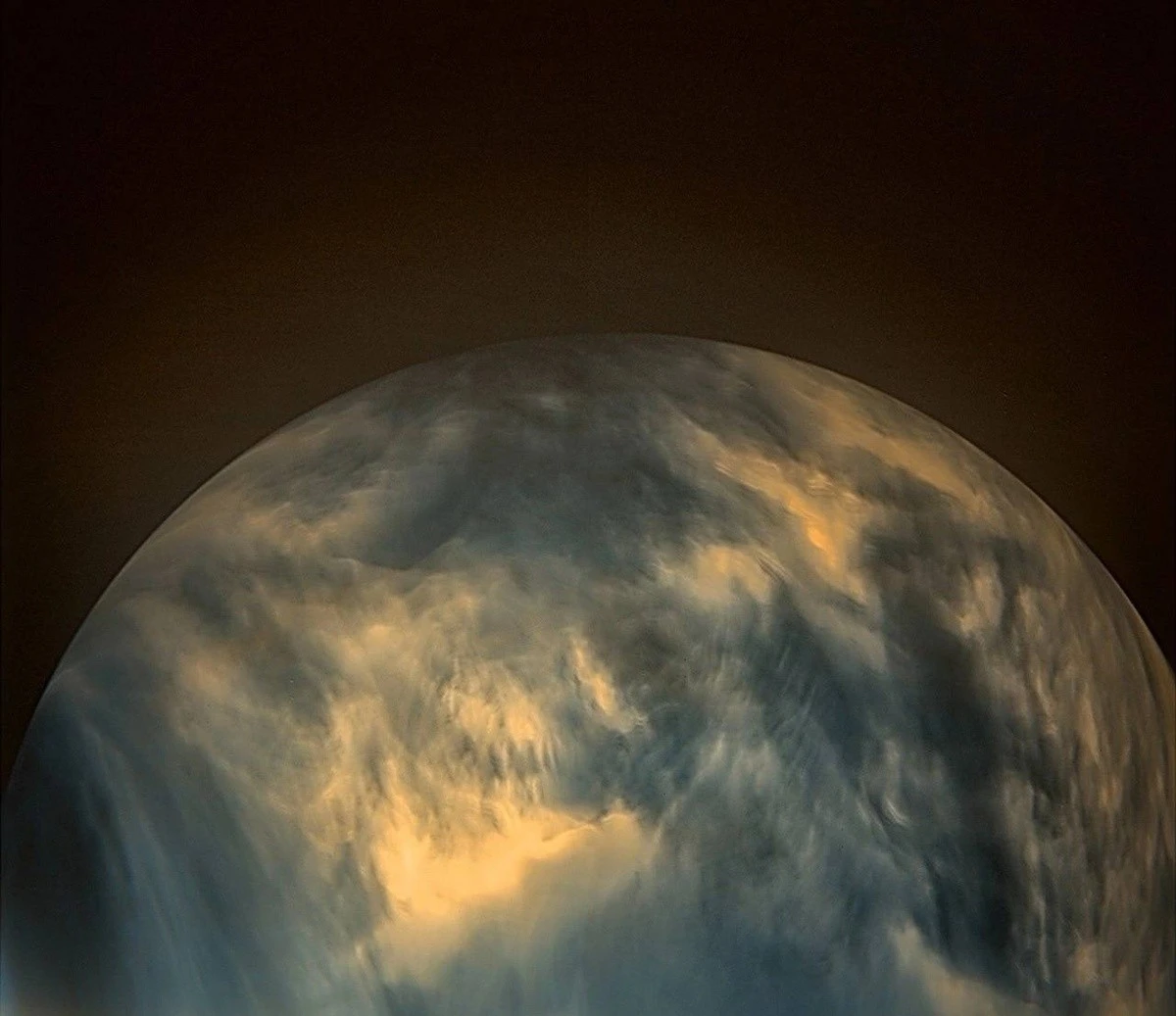
Interestingly, before the space age, Venus was often imagined as a "second Earth," hidden beneath dense clouds. The planet's surface was impossible to see, so some scientists speculated that oceans, swamps, and even tropical forests might lie beneath the clouds.
This idea was quickly adopted by 20th-century science fiction. But the first Soviet Venera probes, launched in the 1960s and 1970s, revealed that beneath the clouds lay not pristine jungles with bizarre flora and fauna, but a scorching, stony desert with monstrous pressure and temperatures. Venus became one of the most striking examples of how science fiction does not predict the future, but merely reflects the human expectations, fears, and dreams of its era.
Venus - A Warning
Venus is only slightly smaller than Earth in size and mass: its diameter is approximately 5% smaller, and its mass is approximately 81% that of Earth. But its evolution has taken a completely different path. 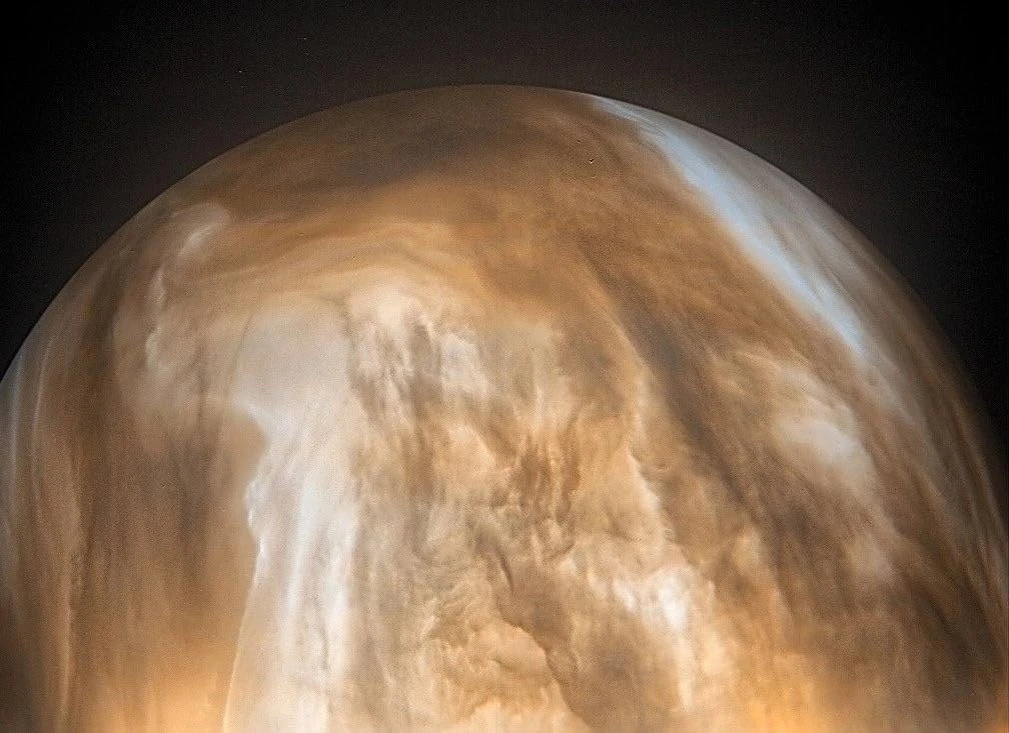
Perhaps in the distant past, liquid water existed on the surface of Venus—even oceans—and the climate was much milder than today. But then the greenhouse effect got out of control: the planet overheated, the oceans evaporated, and the resulting water vapor began to disintegrate under the influence of solar radiation. As a result, light hydrogen gradually left the planet. One possible reason for this is believed to be violent volcanic activity in Venus's early history. However, this is not entirely clear: according to other theories, Venus could have been a "hellish" world from the very beginning.
Studying Venus helps scientists better understand the potential consequences of planetary-scale climate change—despite the attempts of the uneducated to dismiss this topic as nothing more than a bogus scare tactic.