This is part of Valles Marineris, the largest canyon system in the solar system, captured by China's Tianwen-1 orbiter in early 2022. The image was taken from an altitude of 762 kilometers as part of a comprehensive mapping of the planet's surface. 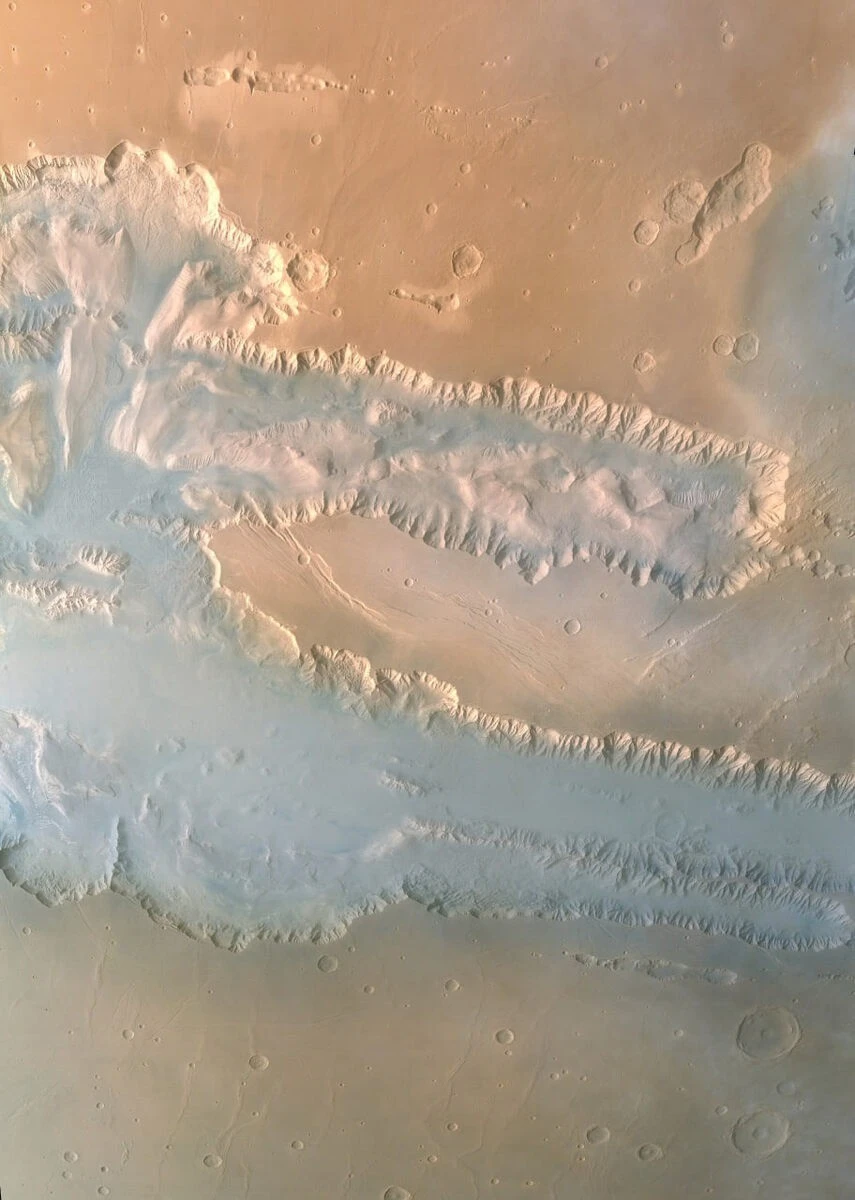
The Valles Marineris stretches over 4,000 kilometers—almost a quarter of the Red Planet's circumference—and reaches a depth of about 11 kilometers. For comparison, the Grand Canyon in the United States is 10 times shorter and almost 5 times shallower. If this structure were on Earth, it would stretch from Moscow to Tashkent.
The formation of the Valles Marineris is believed to have begun billions of years ago as a tectonic fault associated with the formation of the Tharsis Volcanic Plateau (a vast volcanic plateau west of the Valles Marineris, home to four giant extinct volcanoes, including Olympus Mons). Erosion—both water and wind—then deepened and widened the original fault, creating the colossal canyon system we see today.
The Tianwen-1 spacecraft arrived at Mars on February 10, 2021, and on May 14, it launched the Zhurong rover—China's first and immediately successful exploration of the Red Planet. The orbiter completed its full mapping mission in June 2022, completing 1,344 orbits.
Add your comment
You might be interested in:















Protective film Removing it with a power screwdriver

Precision carpentry

Looks like it's time to buy WinRAR

When a child plays hide-and-seek at a professional level

Athlete in Bavarian dress flies over a lake on a hydrofoil

How to hang wallpaper neatly

Man sets up bedroom camera and discovers the reason for his

Super dads who swoop in to save the day

The Terminator's tears: Figure decides to scrap its old
