Aircraft carrier Kaga: From battleship blueprints to the fiery inferno at Midway (6 photos)
At the beginning of the 20th century, the Japanese Empire was one of the world's most powerful naval powers. While the main battles of World War I were being fought in Europe, Japan was strengthening its position in the East. The Imperial Navy faced no serious adversary in this theater of war. Nevertheless, it was necessary to build up its forces to keep up with its future rivals: the United States and Great Britain. 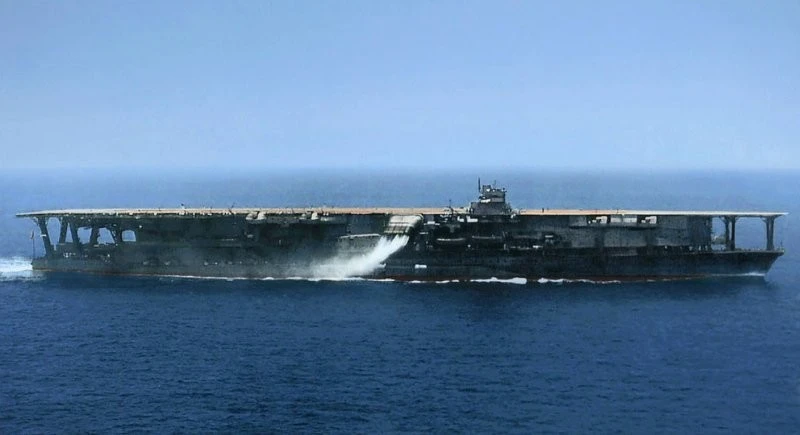
Colorized photo of the aircraft carrier Kaga
During the war, new battleships were ordered: Nagato, Mutsu, Tosa, and Kaga. However, the last two were not completed due to the Washington Naval Conference held in 1922. As a result, the Imperial Japanese Navy's battleships were severely limited in tonnage. Furthermore, the alliance with Great Britain was dissolved. Japan was now forced to abandon the construction of two battleships and eight battlecruisers. At the same time, the Japanese fleet acquired the world's first aircraft carrier, the Hosho. It provided invaluable experience in the construction of ships of this class.
Nevertheless, it was decided not to scrap the battleships already under construction. The original plan was for the battlecruisers Amagi and Akagi to serve as aircraft carriers, but the powerful earthquake of 1923 altered the plan. Amagi's hull was severely damaged, and Kaga was chosen as its replacement.
When deciding on the design of the future aircraft carrier, the Japanese primarily drew on the experience of their former allies, the British. They already had the completed aircraft carrier Furious, whose distinguishing feature was its two flight decks. The Japanese designers adopted this concept. The main deck was used for takeoffs and landings, while the auxiliary deck, located at the bow, was used only for takeoffs. The ship had no superstructure, and the funnels ran along the hull to the stern and pointed slightly downwards.
The ship's hull was 238 meters long, 29 meters wide, and had a draft of approximately 8 meters. It had a double bottom, and the greater length of the hull was covered by a 152 mm armor belt. The propulsion plant was protected by a 38 mm thick deck, and the storage areas for aviation fuel and ammunition were covered by 76 mm of armor. The aircraft carrier's propulsion system consisted of four turbo-gear units, powered by eight boilers. Both oil and coal were used as fuel. The total supply was sufficient for 8,000 nautical miles at a fuel-efficient cruising speed. The ship's maximum speed was 27.5 knots. The carrier's peacetime crew consisted of 1,340 personnel.
Without a doubt, the carrier's primary armament is its air groups. At the time of its commissioning, Kaga carried 16 Nakajima A1N fighters, 28 Mitsubishi B1M torpedo bombers, and 16 Mitsubishi 2MR reconnaissance aircraft. All 60 aircraft were stored in hangars and were delivered to the flight deck using two lifts. 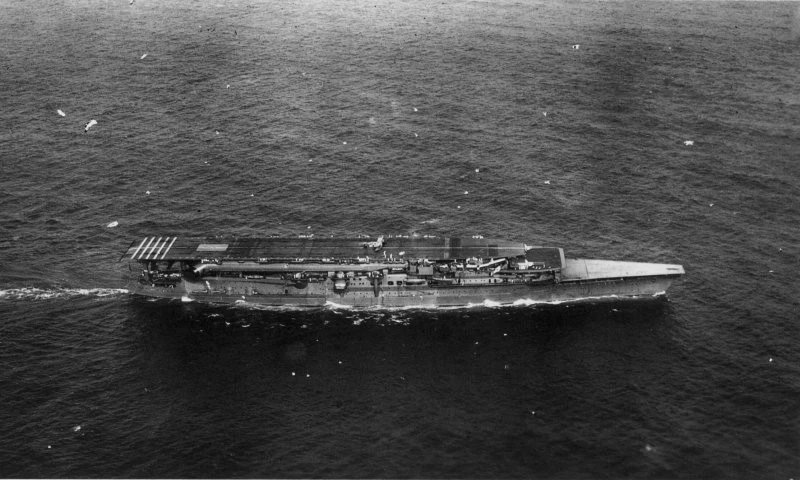
Aircraft carrier Kaga before her 1936 modernization
Originally, even aircraft carriers were expected to carry artillery armament. Therefore, Kaga had six casemate 200mm guns aft and two twin turrets on the second deck at the bow. These could fire at a range of up to 24 km with a rate of fire of 5 rounds per minute. However, the ammunition supply was rather limited, only 30 rounds per gun. Three twin 120mm general-purpose mounts were located in the central hull on each side. The original design lacked short-range air defense.
The battleship Kaga was laid down in the summer of 1920, and its completion as an aircraft carrier began in the second half of the decade. In November 1929, the carrier was commissioned into the Imperial Navy. It took about a year for her air groups to be completed, and the ship was not fully operational until the fall of 1930. By that time, the first carrier division had already been formed, with Kaga designated as its new flagship.
In the early 1930s, tensions between Japan and China were rising. The naval command dispatched the first carrier division to the East China Sea. It included the carriers Kaga and Hosho. This escalation of tension triggered the "Shanghai Incident"—a series of battles that took place in January and February 1932. Deck-based aircraft from Japanese carriers struck Chinese troop concentrations, providing support for their ground forces. This was the first time in history that carrier-based aircraft were used to strike targets on land.
Chinese aircraft attempted to intervene, but the Japanese outnumbered them and outsmarted them. After about a month of fighting, Imperial Navy pilots achieved a decisive victory, losing only a few of their own aircraft. After the armistice, the First Division was ordered to return to base.
By the mid-1930s, Japan's aircraft industry was operating at full capacity. New aircraft were being designed and built, faster and larger than those in service. Existing aircraft carriers required significant modifications to accommodate modern aircraft. Designers and engineers also took into account the lessons learned during the conflict with China. As a result, in the summer of 1934, Kaga was scheduled for a two-year modernization. 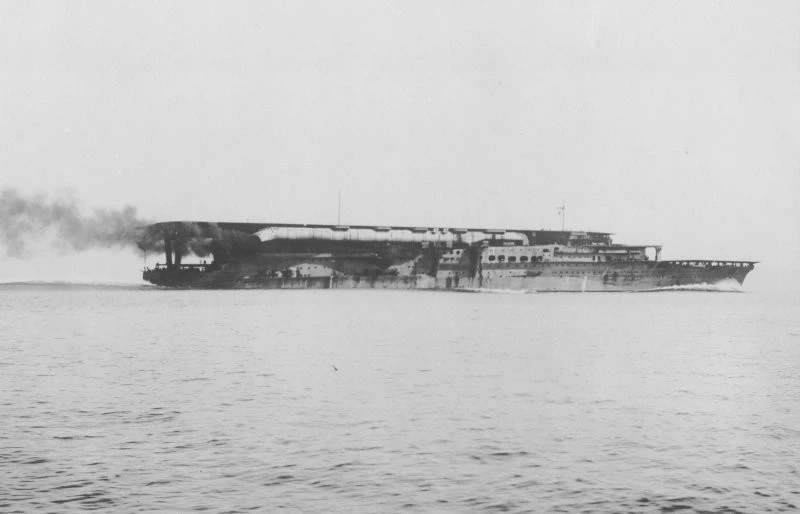
The aircraft carrier Kaga shortly after entering service with the Imperial Japanese Navy
The main changes to the carrier's design were as follows. The deck became continuous, running the entire length of the ship. This allowed the hangar capacity to be increased by 50%. Up to 90 aircraft could now be accommodated on board, and the number of elevators was increased to three. The propulsion system underwent significant modifications. The old mixed-heat boilers were replaced with eight new oil-fired ones. Additional fuel tanks were installed in place of the coal pits. A small superstructure was also added, and the smokestacks were slightly repositioned.
The ship's defenses were also enhanced by the installation of anti-torpedo bulges. The secondary armament still consisted of 200mm guns, but their placement was changed. Now, all of them were housed in casemates closer to the stern of the aircraft carrier. The old 120mm guns were replaced with dual-purpose twin 127mm mounts, four per side. Short-range air defense systems were also added—eleven twin-barreled 25mm machine guns.
In June 1935, the refurbished Kaga rejoined the First Carrier Division. The following year, war with China began, and the carrier headed for duty in the East China Sea. At that time, her air wing consisted of nine Mitsubishi A5M fighters, 18 Yokosuka B4Y torpedo bombers, and 45 Aichi D1A dive bombers. Around this time, minor skirmishes between carrier-based aircraft and the Chinese Air Force occurred. The attack aircraft provided support to ground forces by bombing enemy positions. During the Sino-Japanese War, Kaga was stationed in Taiwan. Overall, the Japanese pilots' performance was considered successful. 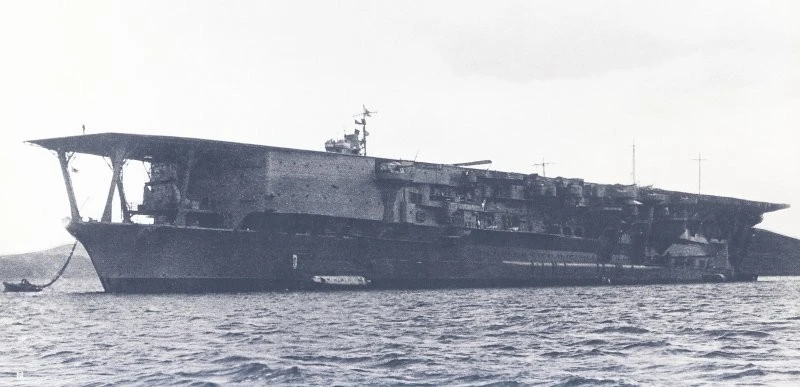
Aircraft carrier Kaga after modernization
In 1941, command began forming the first carrier fleet, which was to include the first division. This was all part of preparations for a major war with the United States. Kaga's air groups were replaced. The air wing now included 18 Mitsubishi A6M fighters, 27 Nakajima B5N torpedo bombers, and 27 Aichi D3A dive bombers.
At the end of November, the Imperial Navy's strike force, comprising six aircraft carriers, departed for the staging point in the Kuril Islands. A few days later, on December 2, orders were received to advance toward the Hawaiian Islands. Maintaining complete radio silence, the force approached its target. On December 7, 1941, all carriers scrambled their squadrons to strike Pearl Harbor. From Kaga, aircraft took off in two waves of 35 aircraft each. The pilots reported hits on the battleships Tennessee, California, West Virginia, and Nevada. Having accomplished their mission, the Japanese fleet turned and headed for home shores. On December 23, all ships returned to base in triumph.
The first battle was won, but the war had only just begun. Just a week after the New Year, Kaga and Akagi departed to strike Allied forces in the South Pacific. Meanwhile, Japanese forces were rapidly advancing, capturing more and more islands and archipelagos. Soon, the Imperial Navy attacked Australia for the first time. The decision was made to attack the port of Darwin. This operation was assigned to the First and Second Carrier Divisions, comprising four carriers: Kaga, Akagi, Hiryu, and Soryu. On the morning of February 19, more than 240 aircraft attacked the Australian port. In 25 minutes, 11 ships were sunk and 30 Allied aircraft destroyed, while the Japanese lost only four aircraft. Over the following days, several more sorties were flown to attack targets within Australia.
The last combat operation in this region in which Kaga participated took place on March 5, 1942. Japanese aircraft struck the port of Cilacap on the island of Java, sinking eight ships. The carrier then returned home for scheduled repairs. While Kaga was in Japan, the Imperial Navy carried out a successful raid into the Indian Ocean.
By that time, the American fleet had recovered from the shock of Pearl Harbor and began to engage in increasingly active operations. In early May, the first carrier battle took place – the Battle of the Coral Sea. The Japanese were victorious, but their plans to capture Port Moresby were thwarted.
Meanwhile, the General Staff had prepared a new plan, the goal of which was to seize the American base at Midway Atoll. For this purpose, the Imperial Navy allocated a powerful force, including the First and Second Carrier Divisions under the command of Admiral Chuichi Nagumo. They were covered by a battleship force commanded personally by Admiral Isoroku Yamamoto. American intelligence quickly uncovered the Japanese plans. Commander Chester Nimitz ordered the carriers Enterprise, Hornet, and Yorktown to advance toward the atoll.
On June 4, 1942, one of the most famous battles in the Pacific Theater of Operations began. Early in the morning, over 70 Japanese carrier-based aircraft attacked the base on Midway Atoll without causing serious damage. Several bombers soon took off from the airfield to retaliate against the Japanese force. The attack was unsuccessful, and the attackers suffered heavy losses.
At approximately 7-8 AM, the American carriers launched their aircraft. Over the next several hours, torpedo bombers and bombers from the carriers attempted to break through to the Japanese ships, but were unsuccessful. For example, at approximately 9:45 AM, Kaga was attacked by 14 torpedo bombers, but none scored a hit. 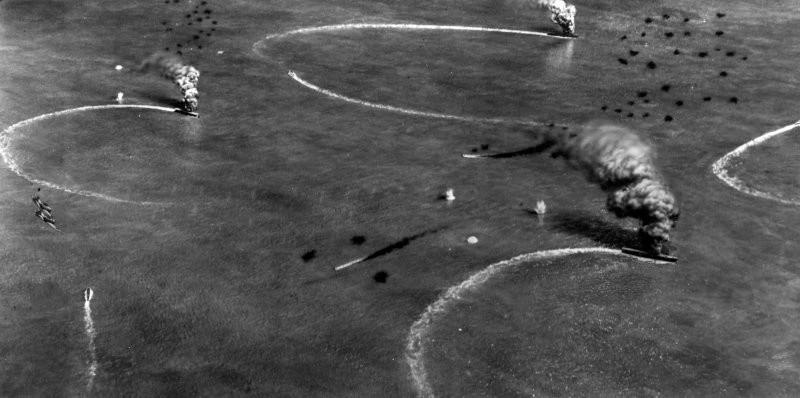
Burning Imperial Navy aircraft carriers – Kaga, Akagi, Soryu
At 10:20, Dountless dive bombers appeared over Nagumo's force. The Japanese fighter escorts were busy hunting the torpedo bombers and were unable to respond quickly to the threat. The situation was exacerbated by the fact that the attack aircraft were being rearmed and prepared in the hangars at that moment. At 10:24, nine American dive bombers targeted Kaga. The first 1,000-pound bomb hit the aft elevator, then three more hit the bow near the conning tower, and the last hit the center of the hull. The destruction inside the ship was monstrous, with fires raging everywhere. Most of the senior officers perished. The battle to save the carrier raged until almost evening, but the situation was critical. At approximately 4:40 PM, the senior officer gave the order to abandon ship.
The burning hulk of the carrier remained afloat until 7:25 PM, when it was struck by torpedoes from Japanese destroyers and sank. Approximately 800 of the 2,000 crew perished.
Thus ended the story of one of the Imperial Japanese Navy's most famous aircraft carriers. In October 2019, the hull of the Kaga was discovered by Paul Allen's expedition. The ship rests on its keel at a depth of over 5 km.