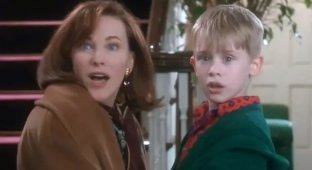
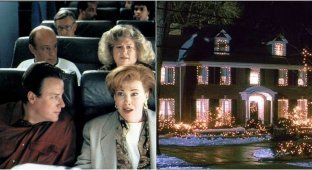
A scientist calculated the likelihood that the plot of the comedy "Home Alone" could have happened in reality (3 photos)
By the end of the year, some people work three times harder to finish all their unfinished business. And others theorize about "Why did the parents oversleep in the 1990 family comedy?" 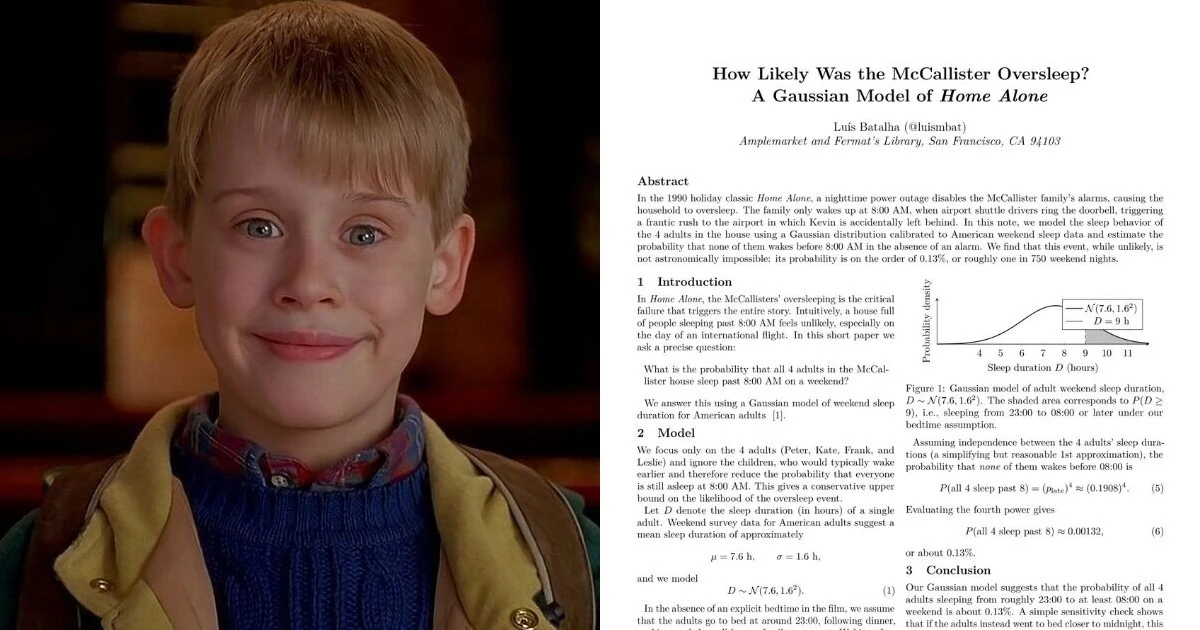
The very serious physicist Luis Batalha apparently put all his work aside for "after the holidays" and decided to rewatch "Home Alone." When you know the plot by heart, you start thinking about all sorts of little details while watching. Which is exactly what Batalha did.
I rewatched "Home Alone," and now I'm no longer bothered by one question: How plausible is it that the McCallisters overslept and left Kevin at home? So, I wrote a short research paper and did the necessary calculations. Merry Christmas! 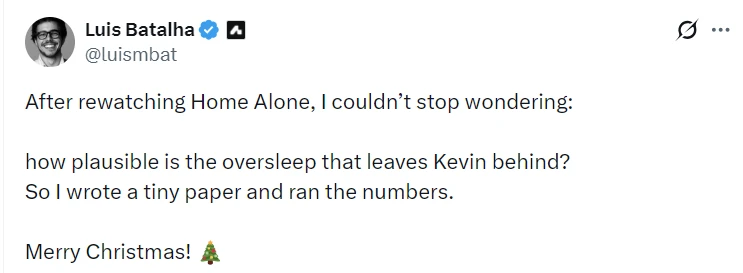
Here's the article 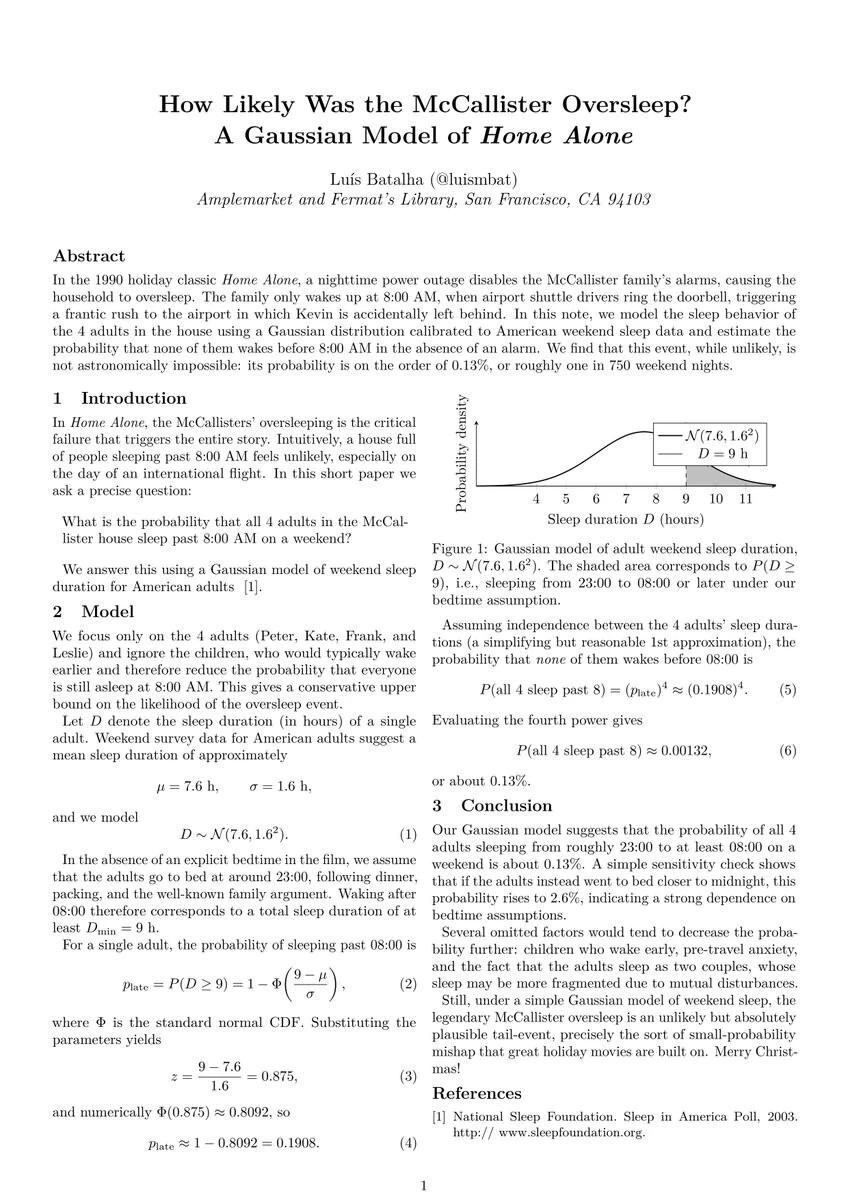
In the classic 1990 Christmas film Home Alone, an overnight power outage disables the McCallister family's alarm clocks, causing everyone in the house to oversleep on the plane. The family only awakens at 8:00 AM when the airport taxi drivers ring the doorbell, triggering a frantic rush in which Kevin is accidentally forgotten. In this paper, we model the sleep behavior of four adults in a house using a Gaussian distribution calibrated to American weekend sleep data and estimate the probability that none of them will wake up before 8:00 AM in the absence of an alarm clock. We find that this event, while unlikely, is not astronomically impossible: its probability is about 0.13%, or about one in 750 weekend nights.
So, Batalha calculated that the plot of Home Alone could occur approximately once in 750 weekend nights. If we consider that the characters went to bed after midnight, the probability increases to 2.6%. Simply put, Kevin was very "lucky."
Users appreciated the scientific humor, and one of the physicist's colleagues even reviewed his work:
I have carefully reviewed this manuscript and concluded that it should not be accepted in its current form, in any plausible future version, or even that it should never have been written. The main problem is that all of the authors' assumptions are WRONG, which is especially troubling because they state them explicitly, which only makes it easier for me to be outraged by them.
Please reproduce the conditions in the McCallister home in a controlled experiment, including a power outage corresponding to the period, four adults, several children, flight anxiety, and a doorbell sound stimulus at 8:00 AM, repeated over N ≥ 10,000 holiday weekends, while controlling for weather conditions.
Alternatively, derive the exact distribution from first principles using a mechanistic model of Christmas logistics and narrative entropy.