Breakthrough technologies that had no impact whatsoever. Japanese Sentoku-class submarine aircraft carriers (4 photos)
The start of the Pacific War was going quite well for the Land of the Rising Sun. In addition to seizing territory in Southeast Asia, Japanese admirals were also planning direct attacks on the American coast. These daring plans were to be implemented using a new type of ship – special-purpose submarine aircraft carriers. 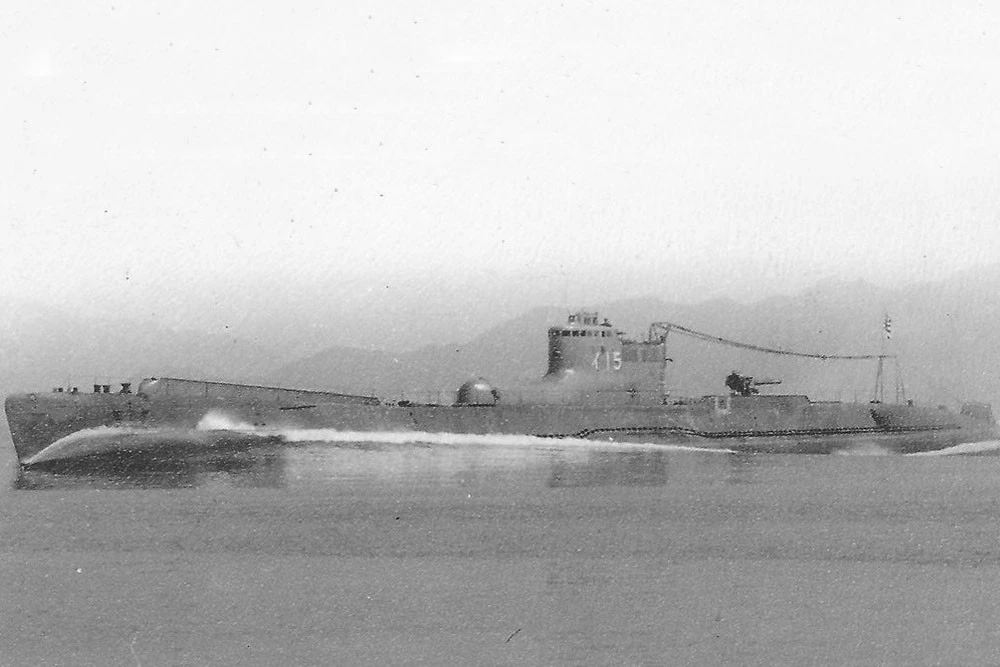
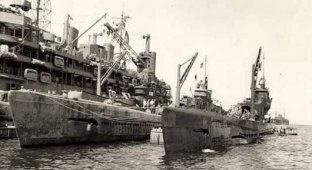
I-15 Submarine
Classified "Top Secret."
Bombs fell on the United States even before the advent of these specialized ships. For example, on September 9, 1942, a Yokosuka E14Y reconnaissance floatplane launched from the submarine I-25 dropped two incendiary bombs on Oregon. This started a forest fire, which was quickly extinguished. While the material damage was minimal, the psychological impact of this raid was far greater. American citizens, who had previously believed the war was far away and unrelated, finally felt its impact. However, this bombing of the continental United States was the only one of its kind in World War II, excluding the bombing of Dutch Harbor in the Aleutian Islands.
The technical specifications for the new class of submarine aircraft carriers were issued in January 1942. It was developed by an officer on the staff of the Commander-in-Chief of the Combined Fleet. The main requirements for the project were a record-breaking 40,000-mile cruising range and a large hangar capable of accommodating two bombers. Naturally, the development was classified top secret.
The complex requirements and specific purpose did not derail the project, as often happened. In May 1942, the designs were finally approved, and by January of the following year, construction began on the lead ship of the series, named Sentoku and numbered I-400. Nearly two dozen submarines were planned, but due to the death of Admiral Yamamoto, the order was reduced to nine. Later, the Japanese began to encounter problems with the necessary materials, and the series was reduced again, this time to just three ships. 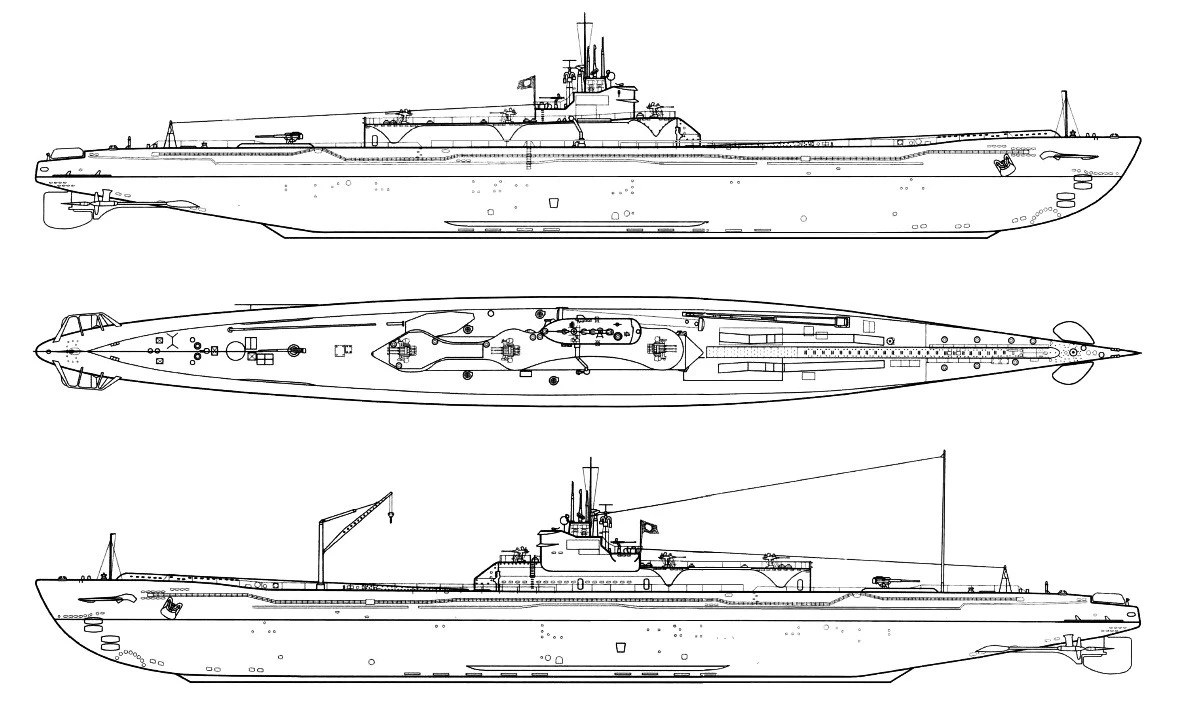
I-400 Series
Complex technical solutions were required to accommodate a large hangar, as well as fuel and ammunition for the aircraft, on the submarine. Japanese designers explored numerous options. During this process, it became clear that the submarine would have a displacement of over five thousand tons, making a traditional hull layout impossible given the planned dimensions. This is how the characteristic features of the pressure hull of submarine aircraft carriers emerged.
Largest Submarines of World War II
The twin-hull design was the key feature of the I-400 series. The hull, composed of two cylinders, looked like the figure "8" when sectioned horizontally, and the cylinders themselves were connected by a strong bulkhead. This design allowed Japanese engineers to widen the submarine and minimize its draft, which still exceeded seven meters. Thus, the Sentokus became the largest submarines of World War II. At 122 meters long, their surface displacement exceeded 5,307 tons, and their submerged displacement exceeded 6,670 tons. Only 16 years later would the US Navy launch the larger submarine USS Triton.
A rubber hatch seal ensured watertightness during submersion. The cylindrical aircraft hangar was 37.5 meters long and 3.5 meters wide. The air group consisted of three Aichi M6A1 Seiran floatplane torpedo bombers, developed specifically for the Sentokus. They were stored folded in the hangar. The air wing's ammunition complement included twelve 250-kg bombs, three 800-kg bombs, and four torpedoes. 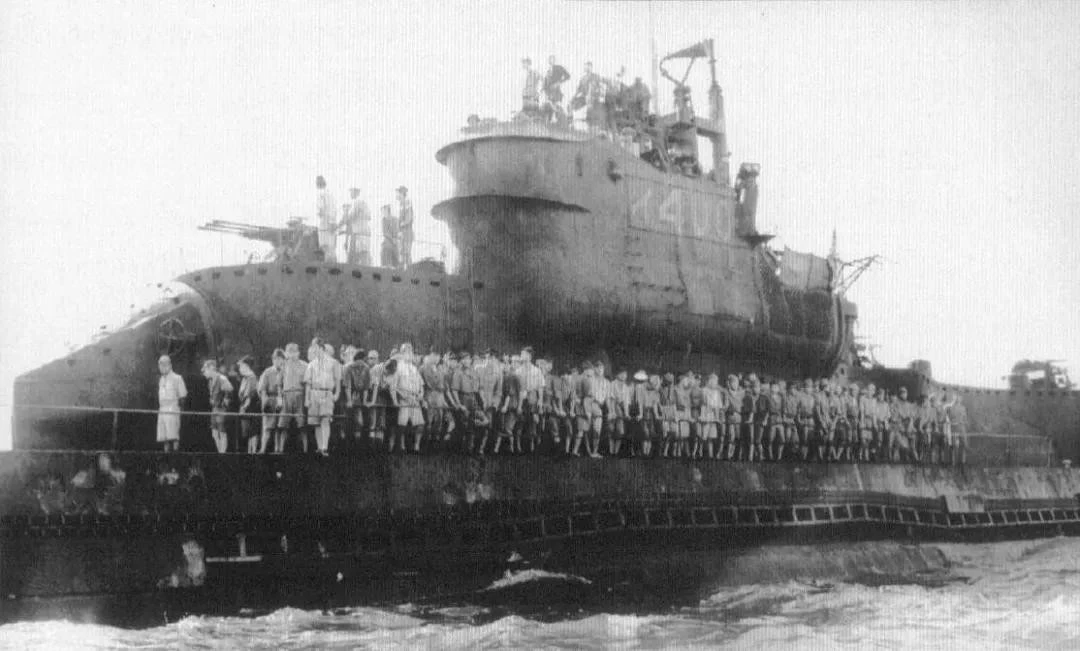
Crew on the deck of the I-400
The aircraft received mixed reviews from experts. They had poor maneuverability, the floats seriously limited their top speed, and their small arms were quite weak when they entered service. The aircraft were armed with only a single 13mm Type 2 machine gun (a licensed copy of the German MG-131) in a movable turret at the rear. Undoubtedly, this greatly limited the air group's combat potential.
The aircraft's takeoff was divided into several stages. While the submarine was surfaced, the hangar hatch was opened, and the partially disassembled aircraft was rolled out onto the foredeck. There, it was assembled and placed on the catapult. After takeoff and combat operations, the bomber landed in the water, from where it was hoisted onto the submarine's deck by crane.
Specifications
Such a submarine, of course, required a corresponding propulsion system, consisting of four diesel engines with a total output of 7,700 horsepower. The fuel supply was sufficient for surface cruising for up to 40,000 miles. In fact, Sentoku submarines could reach anywhere on the planet without refueling. When submerged, electric motors with a total output of 2,400 horsepower took over. The submarine could submerge in about a minute, and its submerged range reached 60 miles.
The submarine carrier's crew numbered between 140 and 160 people. Their working conditions could hardly be called comfortable, which, incidentally, was typical for the entire Japanese fleet. The lack of an effective ventilation system and incredibly small cabins made life very difficult for the submariners. The submarines had neither flush toilets nor refrigeration, making the crew's food rations very meager. There was also a shortage of berths, so some of the crew were forced to sleep on deck or in the passageways.
In addition to aircraft armament, the submarine also carried torpedoes and artillery. Eight 533mm torpedo tubes were mounted on the bow. Their ammunition complement consisted of 20 torpedoes. The artillery consisted of one 140mm gun, three triple-barreled, and one single-barreled 25mm Type 96 anti-aircraft gun. By the end of the Pacific War, only three Sentoku-class submarines were commissioned: the lead submarine, I-400, as well as I-401 and I-402. The latter was completed five weeks before the country's surrender. Japanese know-how arrived too late and, of course, could not have influenced the outcome of the war. 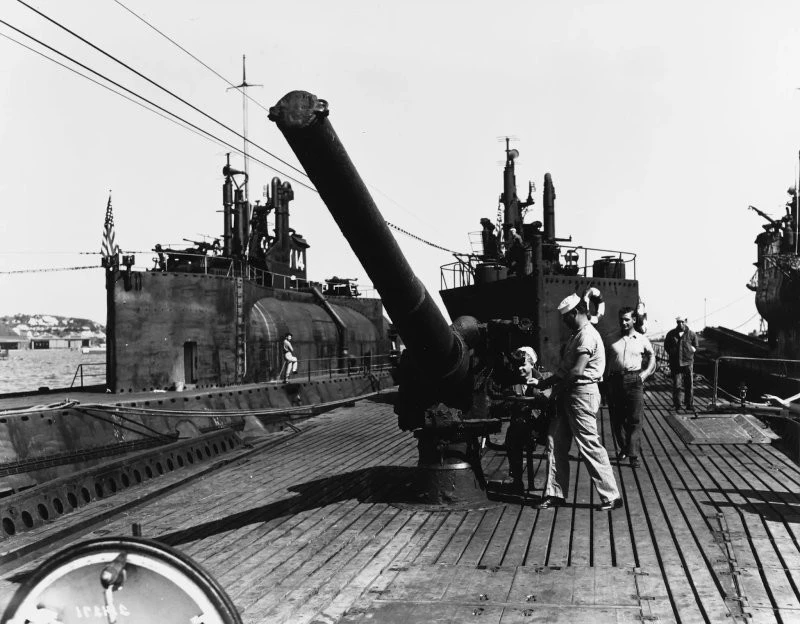
American sailors near the 140mm gun of the I-400 Sentoku
All three submarines fell into US hands and, it's worth noting, made a lasting impression on American admirals and shipbuilders. After extensive study, the I-400 and I-401 were sunk near Oahu, Hawaii, while the I-402 sank near Goto Island. The destruction of these submarine aircraft carriers was part of a special operation called "Dead End." The data obtained during the study of the Sentoku was classified to prevent it from falling into Soviet hands. This information was later used by the Americans in developing submarines capable of launching nuclear missiles.
Japan became the only country to combine the seemingly incompatible capabilities of air and underwater navigation, not just on paper. The Sentoku-series submarines were technically and technologically groundbreaking. But during World War II, Japan needed more than just three submarines carrying a few aircraft to achieve victory on its fronts. Therefore, they proved to be far more interesting innovations than weapons of superiority.