A sea snail's shell grows along the aperture—the opening through which its body extends. As the mollusk grows, it deposits new material while leaving older whorls untouched. Paleontologist David Raup used this process as the foundation for a geometric model. 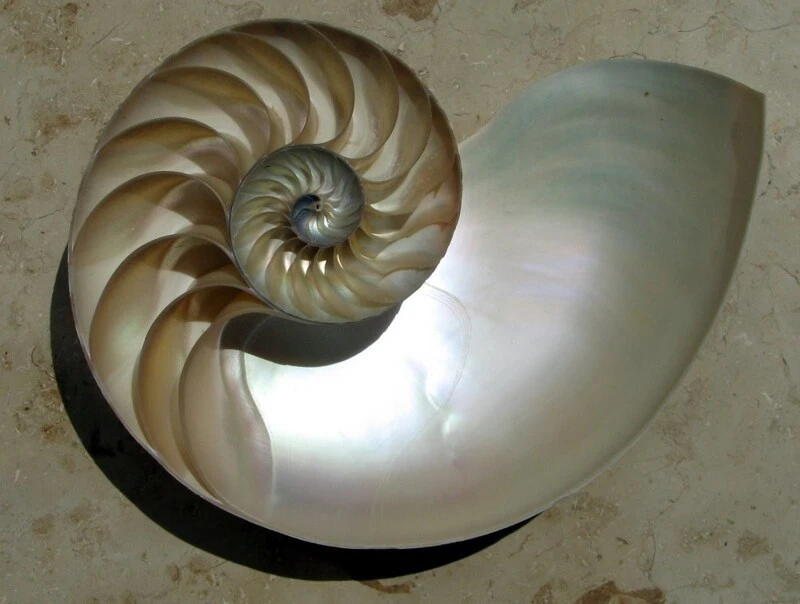
A cross-section of a nautilus.
The model uses three main parameters. The first sets how much the whorl expands with each full revolution. The second defines the cross-section's distance from the coiling axis, and the third dictates how far the whorl shifts along that axis. 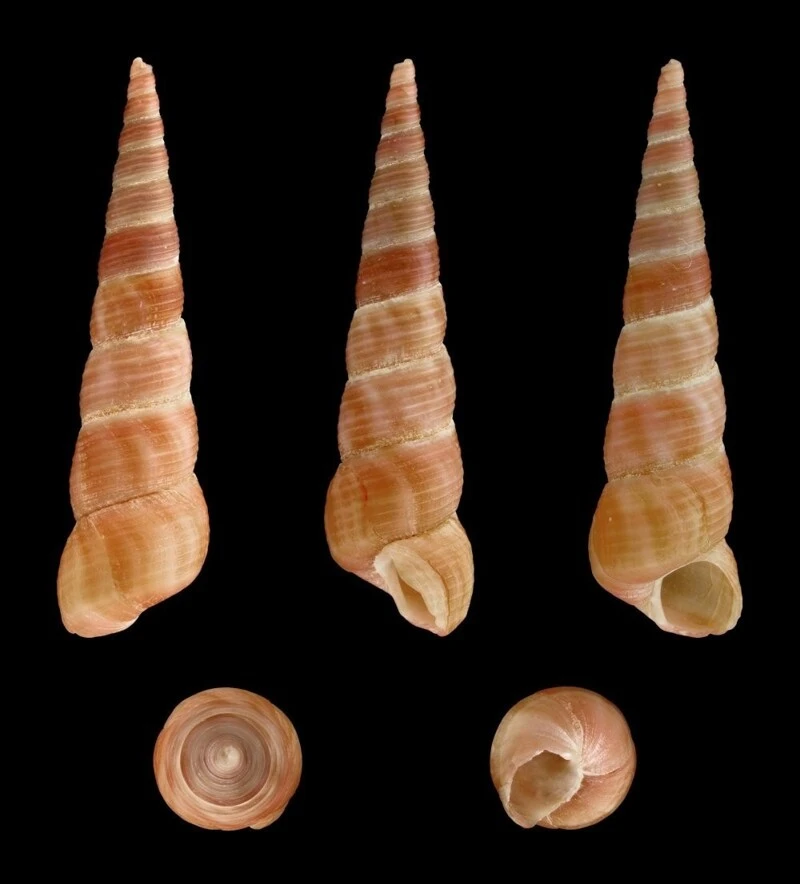
Multiple views of the elongated shell of the sea snail Turritella communis.
With minimal vertical shift, the shell forms a nearly flat spiral, like that of a nautilus. Increasing the shift causes the whorls to stack into a tall spire, as seen in Turritella. While the model helps compare overall shell forms, real-world shells often change their growth direction over time.
Add your comment
You might be interested in:











In Ukraine there is a famous buyer for the most extreme

Desert Dynamics buggy with a Chevrolet V8 engine that can

A young Ukrainian itishnik became the owner of the McLaren

The dog demonstrated his accuracy

Fiat turns a fastback concept into a new Panda model (2

A video showed the packaging of charging cables at a

Maldives for locals – how 200 meters decide your fate (7
Why did ancient Greek athletes use aryballos? (11 photos)

The neural network created clothes from food - and this is

The King They’d Rather Forget: How Queen Elizabeth II’s

6 Events That Have Happened Only Once in History (7 Photos)

Techno music played on classical instruments

Captivating Photos from the Past You Need to See (41 photos)

20 Mixed-Race Women Whose Beauty Is Simply Stunning (21

22 Photos of Mind-Blowing Things That Actually Exist in

These Places Have Stood for Centuries—But Only Side-by-Side

Spanish is easy, right?

A sea breeze at sunset
