How People Beat the Heat Before Air Conditioning (17 Photos)
We use so many everyday conveniences without giving much thought to where they came from, who invented them, who first used them, or how people ever managed without them. 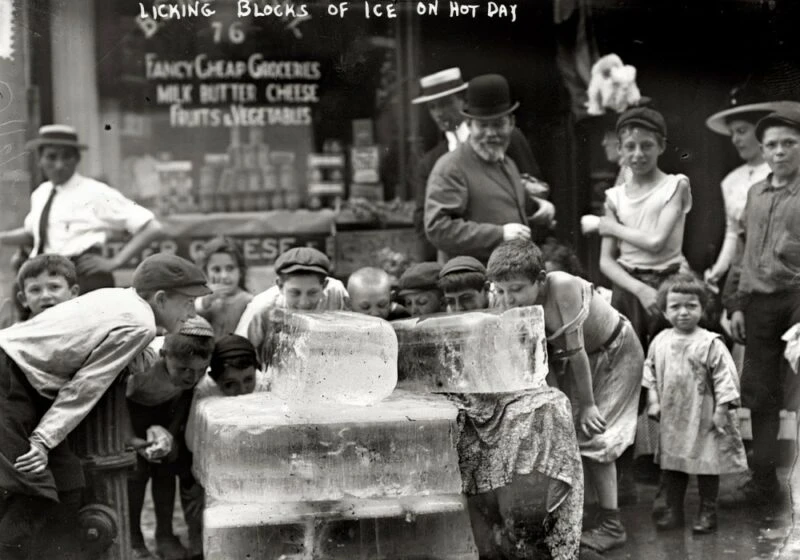
Take the air conditioner, for example. To people living in temperate climates, AC might seem like a bit of a luxury—nice to have, sure, but hardly essential. In the United States, however, it completely transformed the nation. While we usually think of air conditioners simply as appliances that cool down a room, their impact goes far beyond indoor temperatures. Air conditioning reshaped architecture, redefined where people lived, and fundamentally altered daily life. In many ways, AC created the modern American lifestyle. 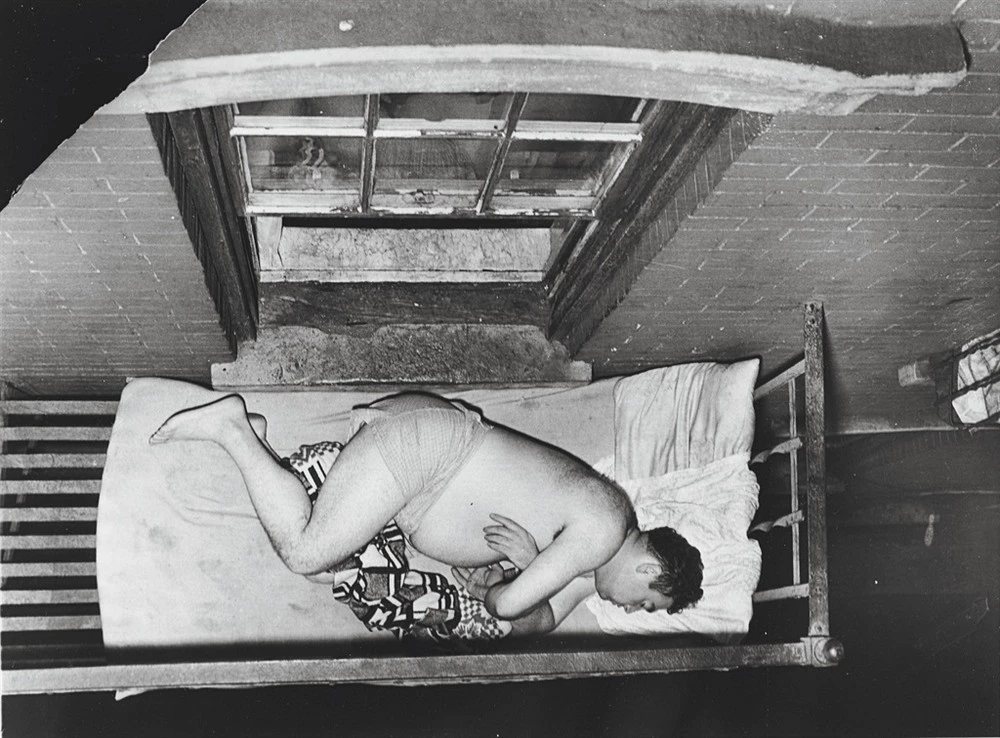
Before mechanical cooling came along, people were constantly devising clever ways to beat the heat at home. Unfortunately, most methods were either ineffective or prohibitively expensive. Ice was widely used, but buying it regularly was a luxury only a few could afford.
In the winter, ice was harvested from frozen lakes and ponds across New England and shipped all over the United States, as well as to the Caribbean and even India! For a long time, low population density, abundant greenery, and towns built near large bodies of water helped keep things manageable. Furthermore, people were in no rush to move to the sweltering South. That is part of the reason why almost all major American cities were established in the cooler, more temperate North. 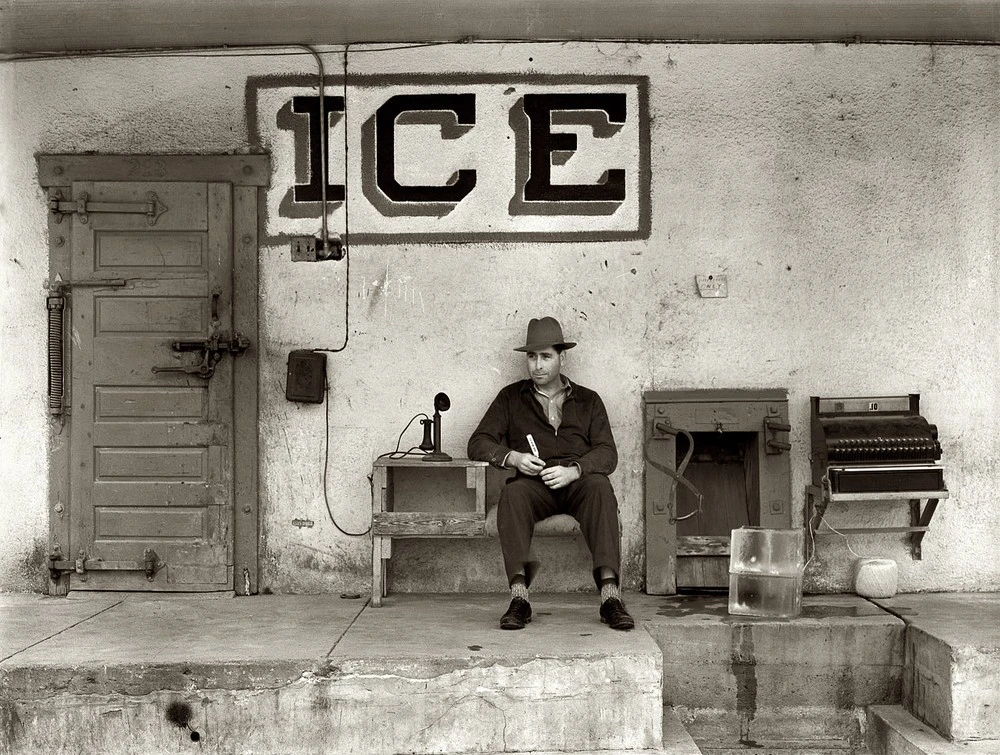
An iceman. Texas, 1939.
Look at any photo of New York City from the early 20th century: a booming metropolis packed with high-rises, paved streets, electric lighting, indoor plumbing, public transit, elevated and underground subways, schools, and libraries. Yet during the scorching summer months, relief came down to three things: a block of ice, an open window, and an electric fan. Strict dress codes only made matters worse—women wore full-length dresses, while men sweltered in full suits and mandatory hats. Unsurprisingly, body odor was pretty much unavoidable. 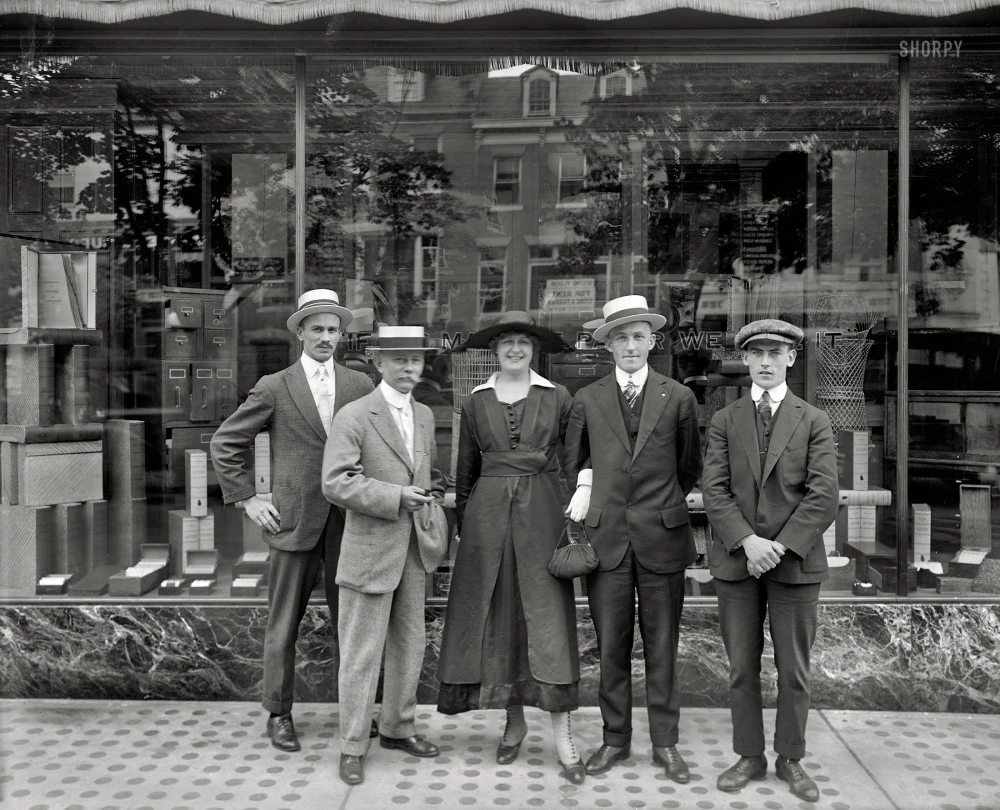
Employees of Andrews Paper Co. in summer attire, Washington, D.C., 1917.
Air conditioning revolutionized American architecture, especially residential design. Before AC, homes were built with thick stone and brick walls, which offered better thermal insulation. Ceilings were high so hot air would rise above eye level, keeping the living space below relatively cool. Later, ceiling fans helped circulate air—pulling heat up in the summer and pushing it down in the winter. 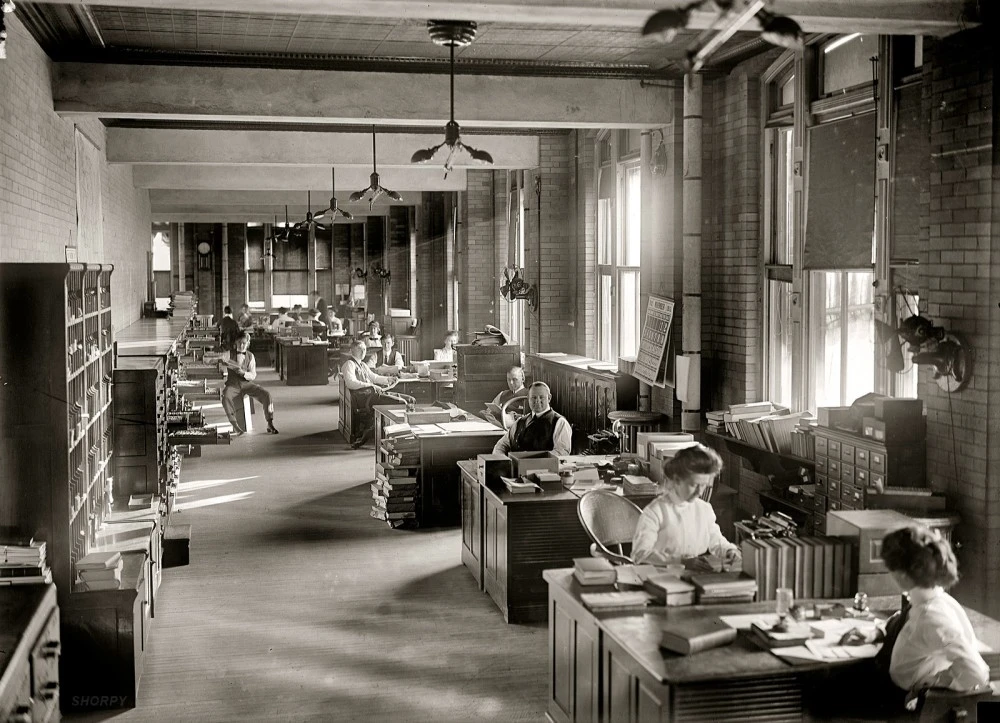
Office workers in 1912. The only cooling available was wall-mounted fans.
Most houses were two stories tall. Bedrooms were located upstairs and used exclusively for sleeping at night with the windows wide open, while daily life revolved around the ground floor. Windows were placed on all sides of the house to create cross-breezes, and transoms—small hinged windows above interior doorways—were added to keep air moving from room to room. 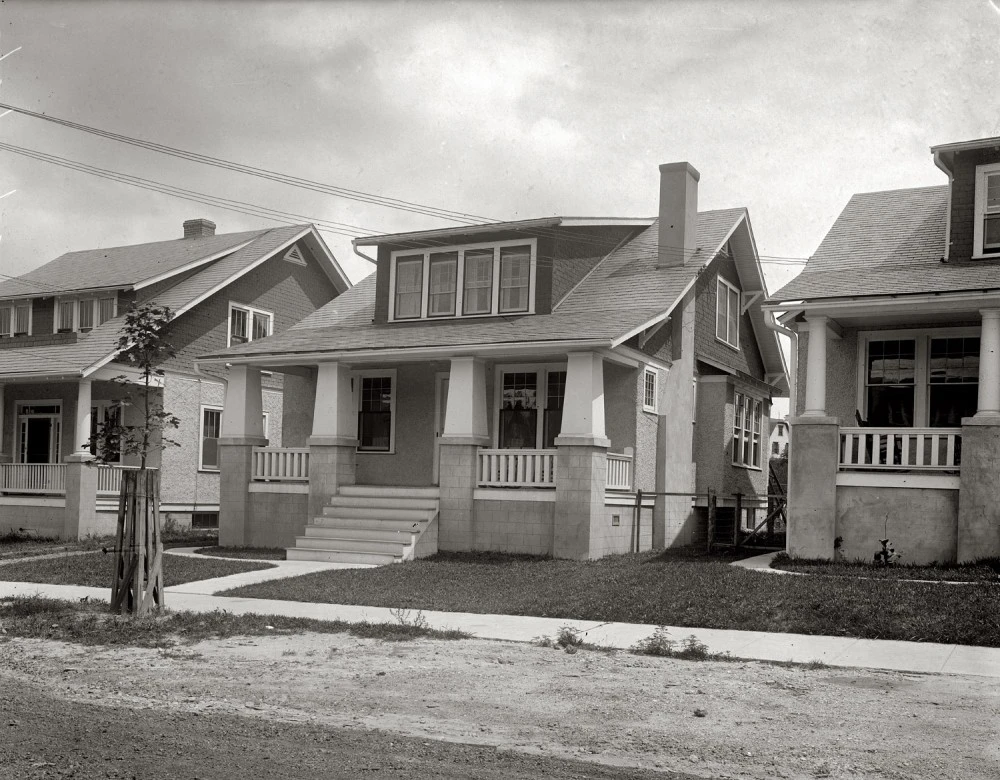
Residential houses in Washington, D.C., 1920.
Shade trees were strategically planted on the south side of homes to block direct sunlight in the summer while letting light through during winter after dropping their leaves. Urban planning followed suit: city streets were lined with leafy trees to cast broad shadows. Buildings took advantage of the stack effect, using open stairwells to draw hot air up and out. Even small backyards filled with greenery served a purpose—by carefully opening and closing specific doors and windows, residents could pull cooler air from the yard while pushing hot air out the front. Shutters and heavy drapes kept solar heat from warming interior walls and furniture, and large covered porches provided a cool spot to sleep outdoors on sweltering nights. 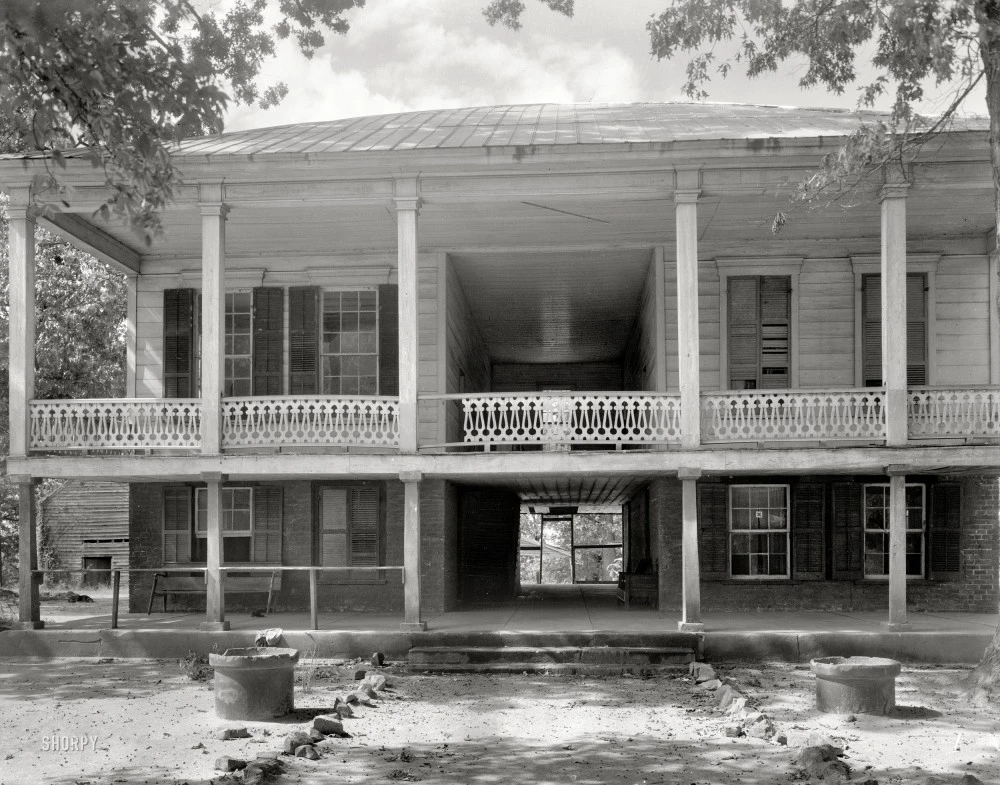
A house in Georgia, 1944.
City dwellers had it much tougher. During heatwaves, people sought relief in public pools and any nearby body of water, crowding beaches to capacity. At night, many slept on fire escapes or out in the open air. 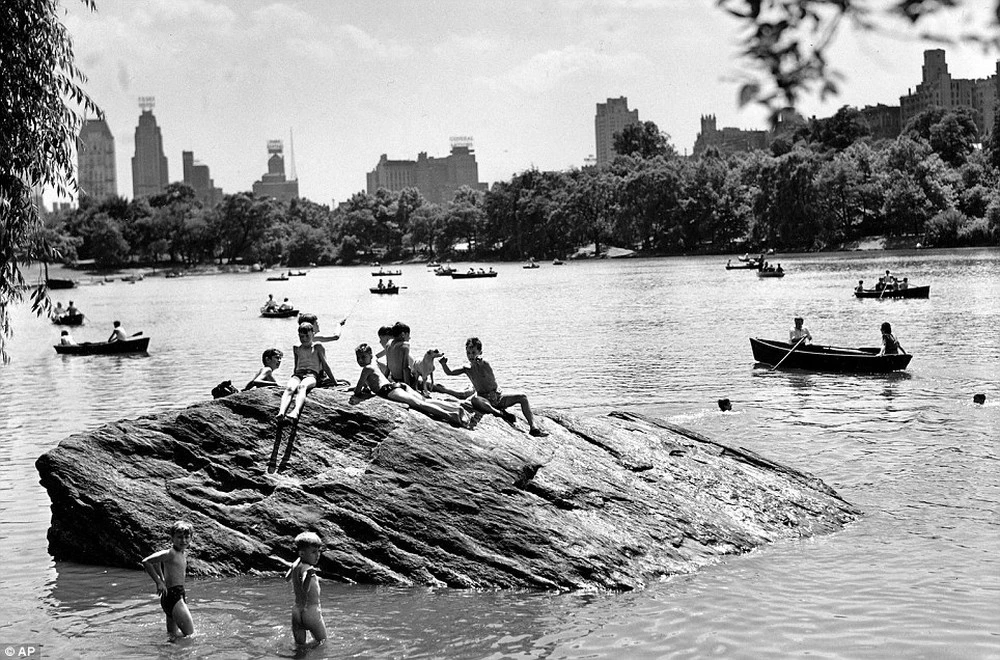
Children swimming in Central Park, 1944. 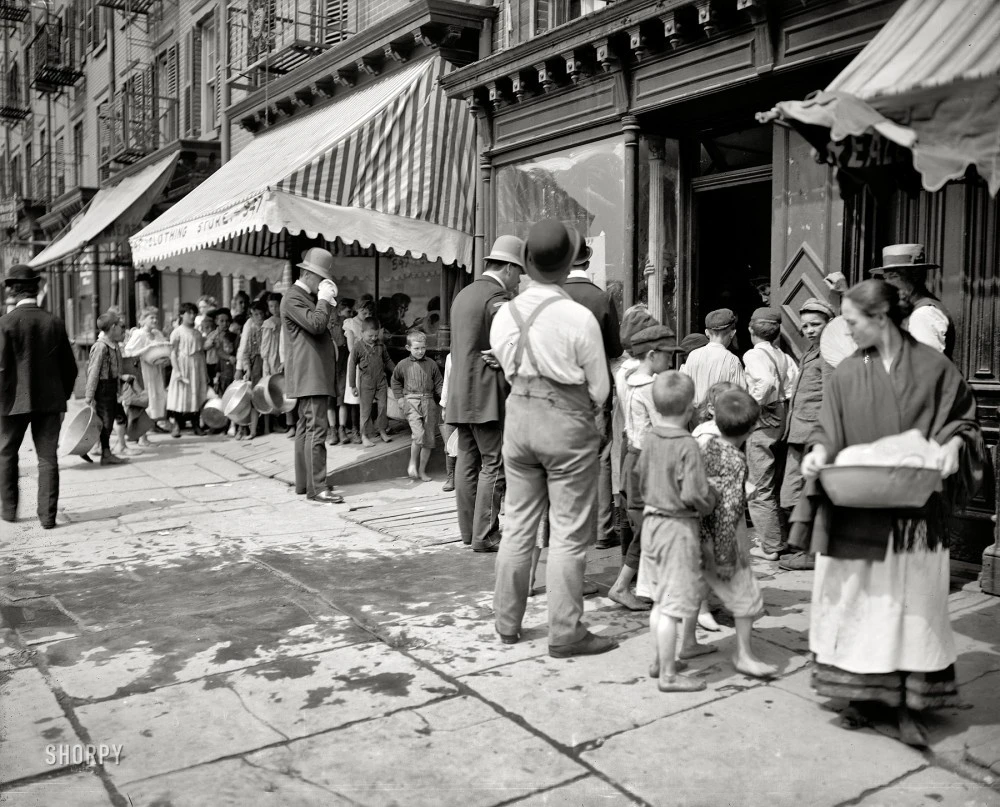
A line for free ice during a heatwave. New York City, 1900.
In New York, fire hydrants weren't just for fighting fires—they were also used to cool off residents. 
Children playing in hydrant water. New York City, 1939.
Older high-rises were often designed in U- or H-shapes to maximize natural light and airflow for interior rooms. Well into the 1940s, many Manhattan skyscrapers featured fabric awnings over their windows to block harsh sunlight, while electric fans hummed inside, circulating the humid, stifling air. 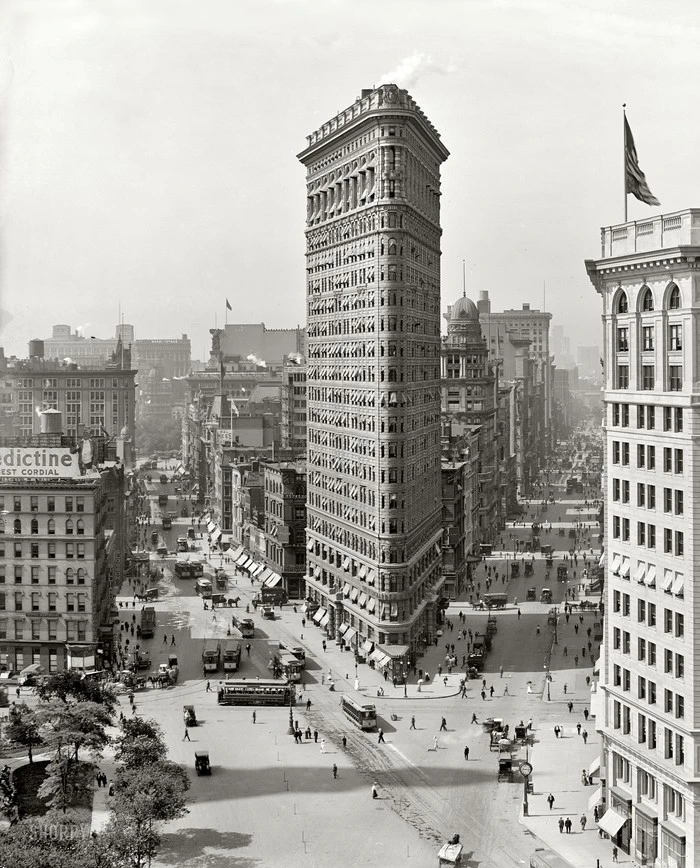
The Flatiron Building, 1909.
Most Southern towns and many Northern cities emptied out during the summer months as residents fled the oppressive heat. Many headed to coastal resorts lined with apartment hotels. The nation's capital virtually turned into a ghost town every summer. 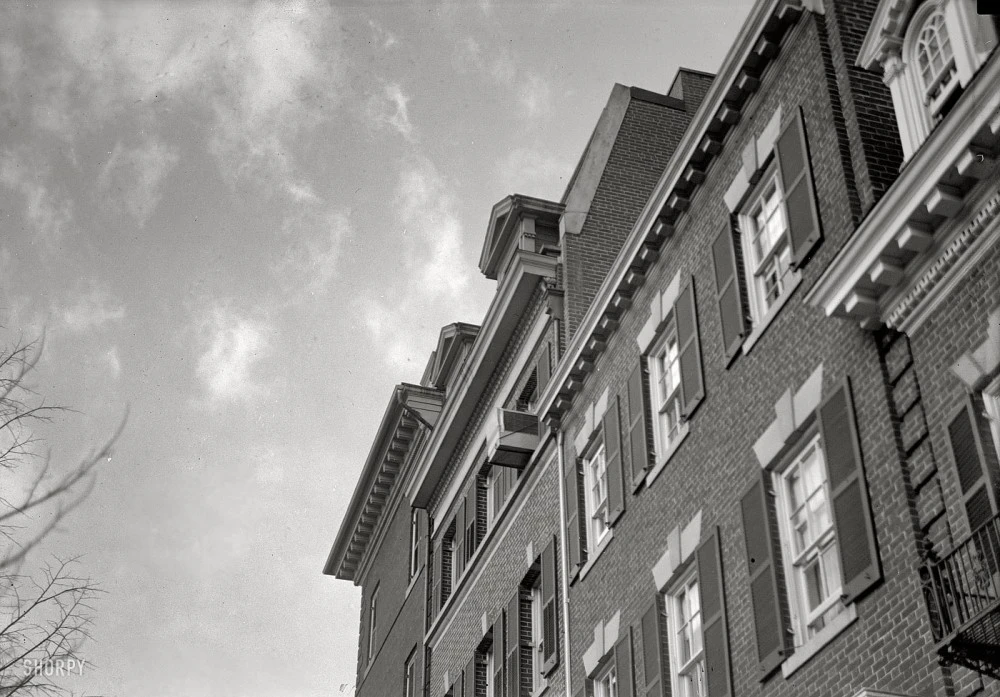
The box in the window isn't an AC unit—it's actually a baby cage.
Desperate for even a slight breeze, people would ride open-top double-decker buses or open-air streetcars for hours. 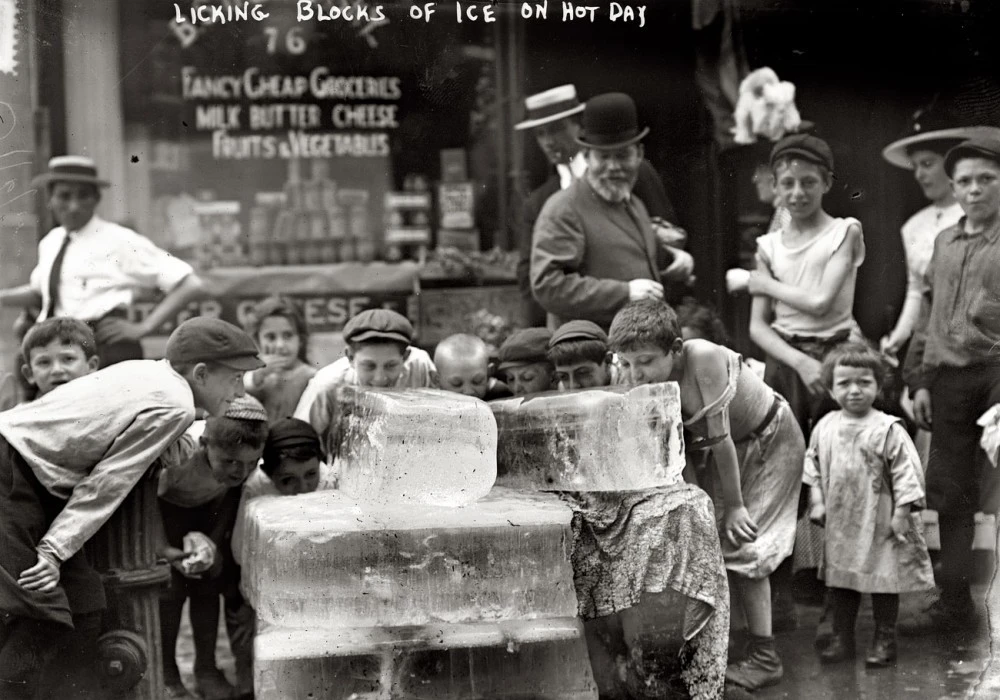
Children licking ice during a heatwave, summer of 1911.
The man who changed America forever was 25-year-old Willis Carrier, an engineer from Buffalo, New York, working for the Buffalo Forge Company. In 1902, while trying to solve a humidity problem at a Brooklyn printing plant, he designed and installed a machine in the basement that became the world's first modern air conditioner. It was hardly the sleek, compact unit we know today—it was a massive rig that took up nearly the entire basement. That same year, the New York Stock Exchange ordered a system of its own, becoming one of the first institutions to install AC purely for employee comfort rather than industrial needs. From there, adoption accelerated. The Armour Building in Kansas City, Missouri, became the first office building designed with central air conditioning, featuring individual thermostats in every room. 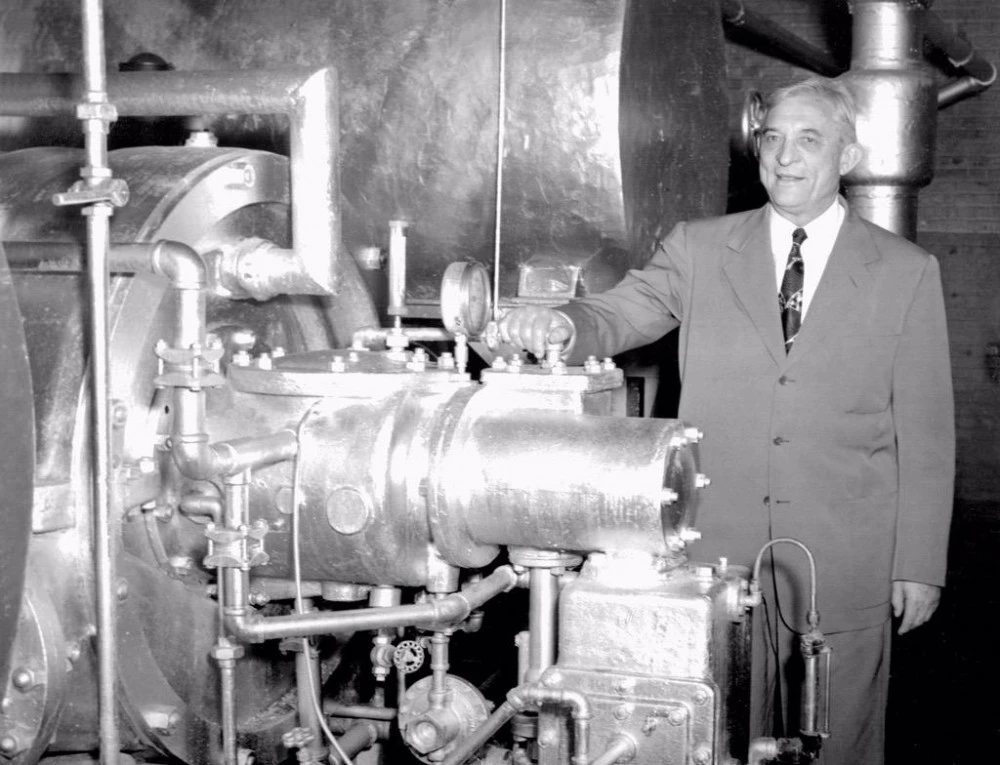
Willis Carrier with his invention.
The first home air conditioning system was installed in 1914. It was far from compact. Built by Carrier, it was fitted in the mansion of Charles Gates, son of barbed-wire tycoon John W. Gates. Ironically, the mansion was located in Minneapolis, Minnesota—a Northern city hardly known for blistering heat. Due to their immense size and astronomical cost, air conditioners remained an exclusive perk of big business for decades. They were installed in department stores, movie theaters, and high-end hotels, remaining a rare sight in private residences for a long time. 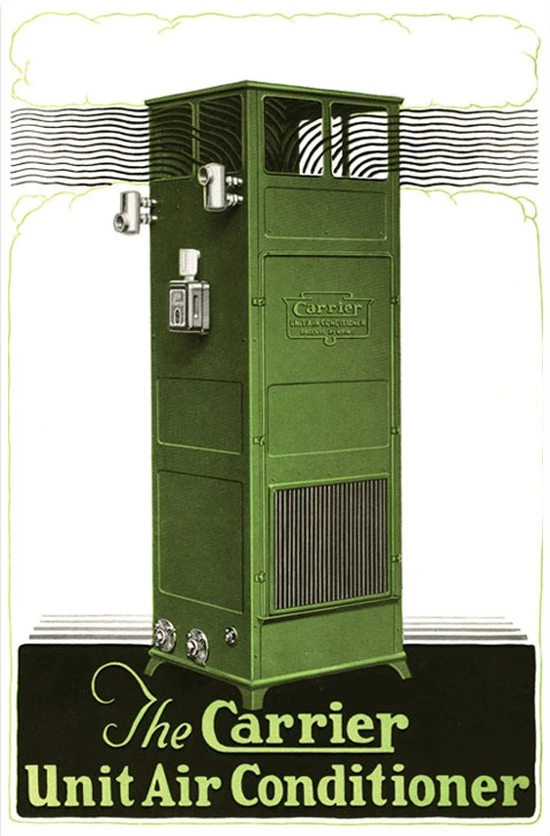
A Carrier air conditioner, 1928.
The Rivoli Theatre in New York City, owned by Paramount Pictures, became the first movie theater to install air conditioning. When Carrier fitted the system in 1925, ticket sales skyrocketed. Prior to this, theaters struggled every summer because audiences refused to sit in stuffy, hot auditoriums, leaving box offices severely depleted. Air conditioning solved the problem overnight. Theaters packed in crowds, with people coming as much for the cool air as for the movie itself. This shifted Hollywood's release strategy, turning summer into blockbuster season. The benefits were so undeniable that within five years, Carrier systems were installed in over 300 theaters nationwide. Soon, AC spread to offices, retail stores, hospitals, factories, and train cars—boosting worker productivity, making summer travel comfortable, and opening up previously uninhabitable regions for year-round living. 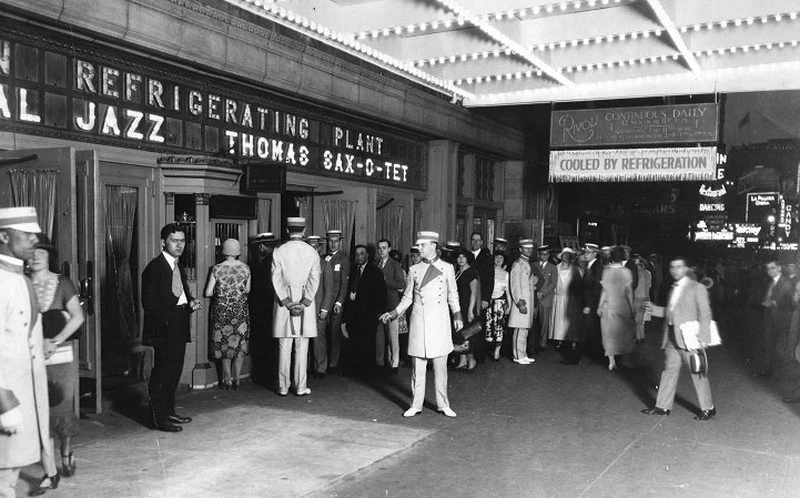
The Rivoli Theatre, 1925.
In 1931, the first window-unit air conditioner was introduced—though it cost more than some houses. Window units didn't become widely affordable until the 1950s, but once they did, they reshaped the country's demographics and real estate market. The migration out of the South that had characterized the first half of the 20th century reversed into a massive population boom. States across the Sun Belt—Florida, California, Texas, Georgia, New Mexico, and beyond—saw explosive growth. Cheap suburban housing developments popped up around major cities, equipped with window AC units, driving suburbanization and reshaping American culture. People spent more time indoors, a shift accelerated by the rise of television. Long summer beach vacations shrank to short weekend getaways. Traditional resort destinations like Coney Island and Atlantic City fell into decline, while cars, commercial flights, and air conditioning made far-flung destinations like Florida, Mexico, and the Caribbean newly accessible. 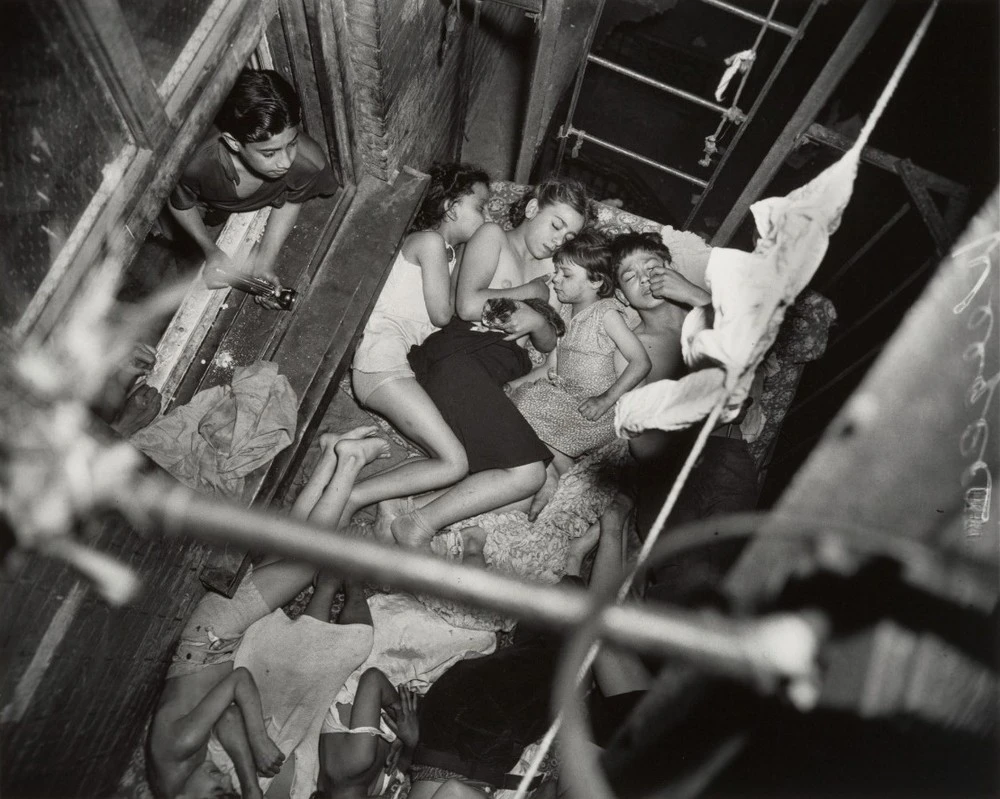
The creators of the fan blog for The New Yorker magazine, newyorker_ru, translated a wonderful essay by Arthur Miller detailing what life was like in the era before air conditioning.
I don't recall the exact year—1927 or 1928—but the heat in September was simply insane. It showed no sign of letting up even after school started, just as we returned from our summer place in Rockaway Beach. Every window in New York was thrown wide open, and the streets were filled with horse-drawn carts selling crushed ice or shaved ice sprinkled with colored sugar for a couple of pennies. As children, we would hop onto the back of these slow-moving carts and swipe a chunk or two of ice; it smelled faintly of manure, but it cooled your hands and mouth.
The people west of 110th Street, where I lived, were too respectable to sit out on their fire escapes, but from 111th Street on, as soon as night fell, entire families brought out mattresses and settled onto their iron balconies dressed in nothing but their underwear.
Even at night, the heat refused to break. Together with a couple of other kids, I would walk down 110th toward Central Park and wander among hundreds of people sleeping on the grass, alone or in family groups, next to large alarm clocks ticking away in a quiet cacophony—one clock syncopating with another. Children cried in the dark, men whispered in low tones, and every so often a woman's sudden laugh echoed near the lake. I can only recall white people lying on the grass back then; Harlem started above 116th Street.
Later, during the Great Depression in the 1930s, the summers felt even hotter. Out West, it was a time of scorching sun and dust storms, with entire drought-stricken farms uprooted. The 'Okies' immortalized by Steinbeck were making their desperate treks to the Pacific. My father ran a small coat factory on 39th Street back then, where about a dozen men worked at sewing machines. Just watching them handle heavy wool winter coats in that heat was torture. The cutters were paid piece rate—strictly by the seam—so their lunch breaks were brief, fifteen or twenty minutes at most. They brought their own food: a bunch of radishes, tomatoes, cucumbers, and a jar of thick sour cream. They would chop it all into bowls kept under their machines, tear off chunks of dark rye bread, and use the bread like a spoon to scoop up the vegetables and sour cream.
The men sweat constantly, and I remember one worker whose sweat dripped in a most peculiar way. He was a tiny fellow who scorned scissors, biting the thread at the end of every seam instead of cutting it. Bits of thread stuck to his lower lip, so that by the end of the day he had grown a multicolored thread beard. Sweat would run down these dangling threads and drip onto the fabric, which he kept wiping with a rag.
Given the relentless heat, people naturally smelled, though some much worse than others. One cutter reeked like a horse, and my father—who normally had no sense of smell whatsoever (nobody ever figured out why)—claimed he could smell this man and always addressed him from a safe distance. Driven to make as much money as possible, this cutter worked from 5:30 in the morning until midnight. He owned several apartment buildings in the Bronx and land in Florida and New Jersey—he struck you as a greedy, half-mad character. He was powerfully built with erect posture, unruly hair, and heavy stubble shadowing his cheeks. He snorted like a horse as he guided the cutter through roughly eighteen layers of cloth. One late evening, blinding sweat stung his eyes as he held the fabric with his left hand while pushing the reciprocating razor-sharp blade with his right. The blade sliced through his index finger at the second knuckle. Muttering angrily, he refused to go to the hospital, held his severed finger under the tap, wrapped his hand in a towel, and went right back to work, snorting and reeking. When blood soaked through the towel, my father shut off his machine and ordered him to the hospital. But the next morning he was back at his station, working early to late as usual, building up his stash for the next apartment building.
In those days, elevated trains still ran along 2nd, 3rd, 6th, and 9th Avenues, and many cars had wooden bodies with open windows. Open-sided streetcars ran down Broadway, where you could at least catch a breeze, warm though it was. Desperate people, unable to bear the heat in their apartments, would spend a nickel and ride the streetcars aimlessly for hours just to get a little cool air. As for Coney Island, on weekends every square inch of sand was so packed that you could barely find a spot to sit down, let alone lay down a book or a hot dog.
My first encounter with air conditioning came in the 1960s, when I stayed at the Hotel Chelsea. The management had mounted an AC unit on wheels, which erratically cooled—or sometimes heated—the air depending on how many pitchers of water you poured into it. When filled, it would spray water all across the room, so you had to point it toward the bathroom instead of the bed.
A gentleman from South Africa once told me that August in New York was hotter than anywhere he had ever been in Africa, yet people here still dressed as though living in a Northern city. He had considered wearing shorts, but feared he might be arrested for indecent exposure.
The stifling heat inspired bizarre accommodations: linen suits that creased heavily whenever you bent an arm or leg, and stiff straw hats—rigid as matzo—resembling stiff yellow flowers that bloomed across the city every year in early June. The hats left deep red ridges on men's foreheads, while the rumpled suits, meant to keep you cool, had to be constantly pulled and shifted just to let the skin breathe.
In summer, the city drifted through a haze where delirious souls incessantly repeated that foolish greeting: 'Hot enough for ya? Ha-ha.' It felt like the last joke before the world dissolved into a sea of sweat.
Arthur Miller