The Evolution of the Sword: From Persia to Rome (33 Photos)
How infantry weapons evolved in antiquity. A detailed deep dive with 33 photos.
Bronze Swords
Before iron and steel became widespread, swords were crafted from copper and later from copper alloys containing tin or arsenic—known as bronze. Because bronze is highly resistant to corrosion, numerous archaeological specimens have survived. However, precise attribution and dating often prove challenging. 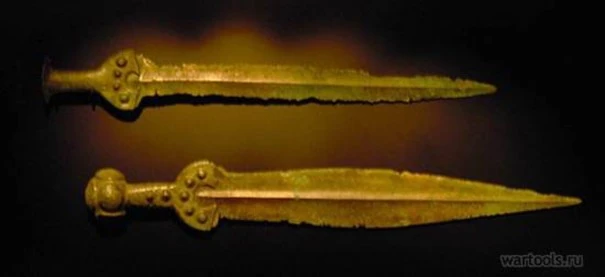
Bronze is a fairly durable metal that holds an edge well. In most cases, smiths used bronze with a tin content of around 10%, which provided moderate hardness and relatively high ductility. In China, however, bronze with up to 20% tin was used—yielding harder but far more brittle blades (sometimes hard bronze was reserved for the edges, while the core was made of softer alloy).
Bronze Swords 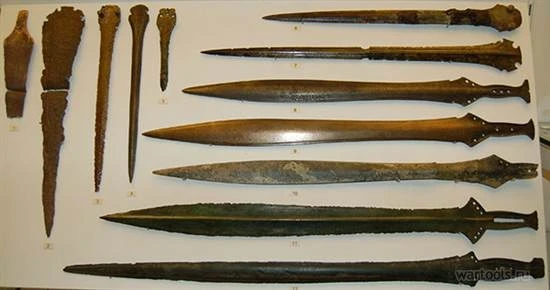
As a precipitation-hardening alloy, bronze cannot be quenched like steel. However, its cutting edges can be significantly hardened through cold working (hammering). Bronze lacks the springiness of quenched steel, but a bronze blade can bend considerably without snapping or losing its properties—once straightened, it remains fully functional. To prevent bending, blades were often cast with heavy central ridges.
Long bronze blades were particularly prone to bending, which made them relatively rare; typical bronze swords rarely exceeded 60 centimeters in length. Still, calling short bronze swords strictly thrusting weapons is a misconception. Modern tests demonstrate impressive slashing capabilities, with their modest length serving only to limit combat range.
Bronze sword. 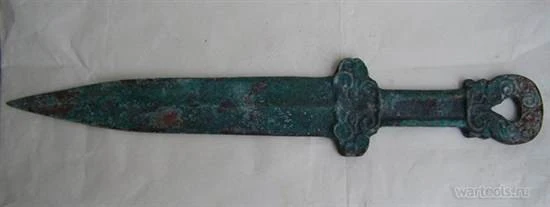
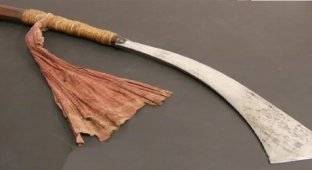
Notably, one of the earliest mass-produced bladed weapons designed specifically for battle was the Assyrian sappara. It was a modified sickle—the symbol of Ninurta, god of war and agriculture. Just as a sickle harvested grain, the sappara reaped human lives. The blade was sharpened along its outer edge and partially on the inner curve. The Assyrian army, which fought successfully across Mesopotamia, Asia Minor, and the Caucasus Mountains, made neighboring nations acutely aware of its lethal design.
While the weapon may trace its roots back to ancient Sumer, it reached its full military potential in Assyria. From there, the sappara spread across neighboring regions, including Egypt.
Assyrian sappara. 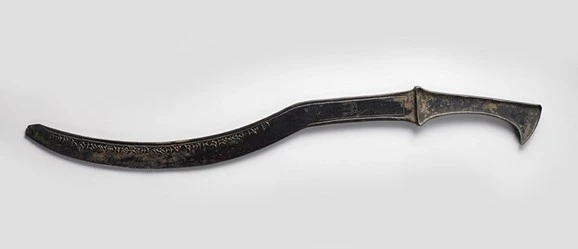
History remembers these swift invaders as the Hyksos—the chariot lords. Sweeping into the lands of the pharaohs, they overwhelmed the Egyptian army by raining arrows from fast-moving chariots before cutting down retreating forces with sapparas. Hyksos rule lasted for two centuries. Unbearable as this foreign yoke was, the Egyptians emerged into the New Kingdom equipped with war chariots, composite bows, and their own sickle-shaped swords: the khopesh.
Since casting was the primary method for shaping bronze, producing complex curved blades was relatively straightforward. As a result, bronze weapons from ancient civilizations often featured single-edged curved designs—such as the Egyptian khopesh, the Greek machaira, and the kopis, which the Greeks adapted from the Persians. Under modern classification systems, these are technically categorized as sabers or cleavers rather than true swords. 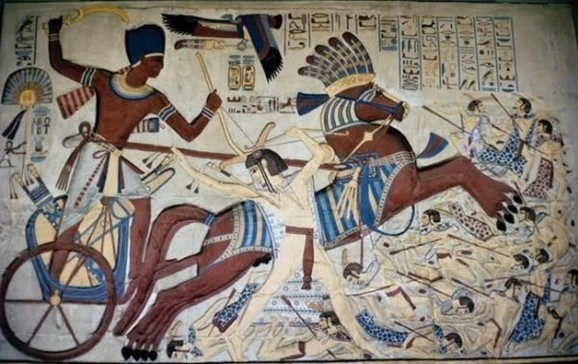
Weighing around two kilograms and measuring roughly 70 centimeters long, this heavy bronze blade was a formidable weapon for its era. It could be wielded effectively both in infantry formations and from war chariots. It hacked through shields with ease at a time when armor in ancient Egypt was virtually nonexistent.
The word khopesh translates to "leg of an animal," as its shape closely resembled the hind leg of an antelope. Because bronze is difficult to sharpen to a fine edge, the khopesh had a wedge-shaped cross-section, making it a powerful hybrid between a sword and an axe. Remarkably, the bronze alloy used for these blades contained trace amounts of ferrosilicon and ferrosilico-manganese. These alloying agents increased the hardness of the otherwise soft bronze. While these additives might seem accidental, ancient metallurgists likely knew exactly what they were doing. Ancient technology still holds many secrets.
Khopesh. 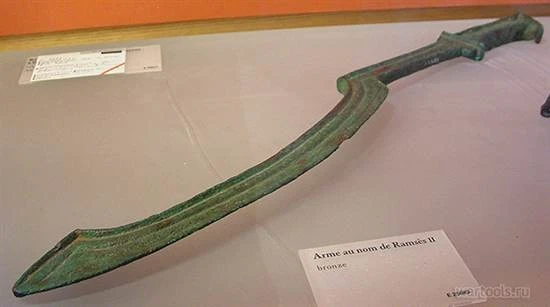
The New Kingdom period marked the peak of Egyptian power. In addition to their native troops, pharaohs hired mercenary units from across the Mediterranean, including Hellas (modern Greece). Arriving with their own weapons and fighting styles, these foreign warriors inevitably influenced Egyptian doctrine—just as they absorbed and adapted the military innovations of their powerful hosts. In this way, the cradle of European civilization developed its own take on the foreign blade: the kopis.
Kopis (modern replica) 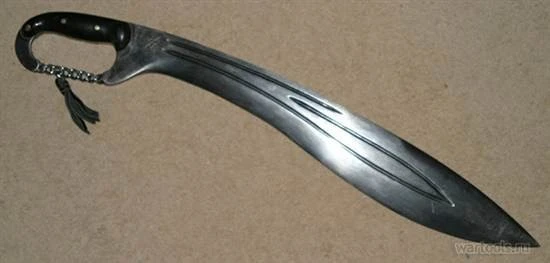
A close relative of the kopis in ancient Greece was the machaira. In ancient Greek, the word meant "battle tool," whereas in modern Greek it simply translates to "knife." While many equate the khopesh with the machaira, the two are not identical. Machaira is a broader term, with the kopis being a specific variant. Generally, a machaira featured a much less pronounced curve. Coincidentally, a machaira is believed to be the weapon Apostle Peter used to strike off the ear of the high priest's servant—or perhaps a broken blade of one.
Machaira. 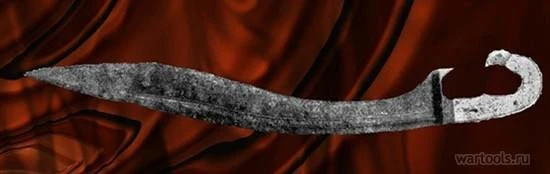
By this time, iron blades were rapidly gaining ground alongside traditional bronze. Iron was forged, folded, cut, and re-forged repeatedly until smiths produced a workable billet. Although far inferior to modern steels, these iron blades saw heavy action. Designed for devastating chopping strikes, the machaira frequently snapped in combat. Yet broken blades retained value: they were either resmelted or, if a substantial pointed section remained, fashioned into a curved dagger known as a sica.
A duel between a Greek hoplite and a Persian. Both are armed with machairas. 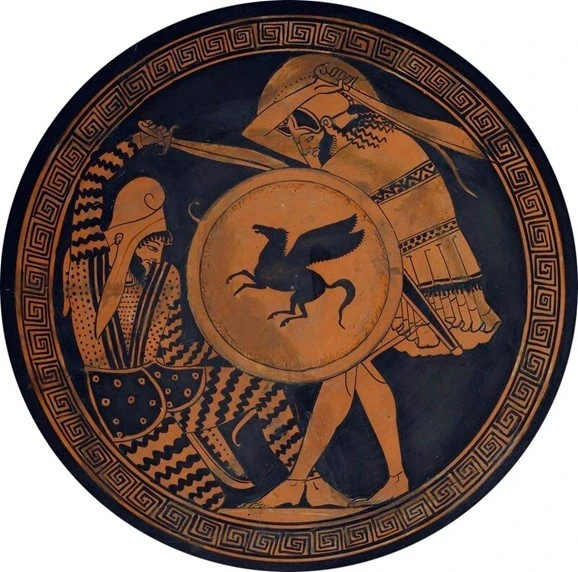
Contrary to popular modern misconceptions, the primary sword of the hoplites was not the long, curved "kopis" made famous by movies (which was neither long nor widely used in reality), but the short, straight "xiphos."
The Greeks, who rarely bothered with fancy names for military gear, named the sword after its primary function: xiphos literally translates to "thrusting" or "piercing" weapon. The xiphos is notable not only as one of the oldest Greek weapons, but also because early versions migrated to the Italian peninsula centuries before the founding of Rome.
Crucially, the xiphos was among the first weapons to be forged from iron. Initially, iron xiphoi mirrored earlier Mycenaean bronze swords—so much so that late bronze models are sometimes called xiphoi—though the term properly refers to the iron variant.
The xiphos may have served as the prototype for the Roman gladius. 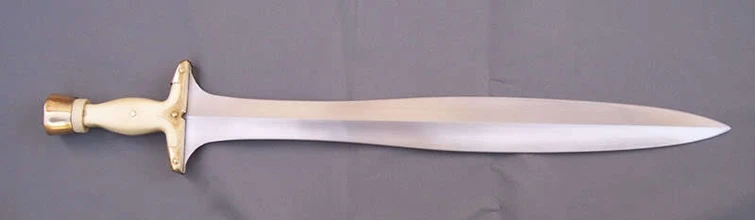
In Rome, the kopis (known locally as the *copis*) was well known. Like many Greek innovations, it was adopted by the Romans, though it remained unpopular for infantry use. The straight gladius dominated the ranks of the legionaries who conquered half the known world. Instead, the heavy chopping kopis found its niche in the cavalry, where a weighty downward slash was devastating. However, early Roman armies lacked dedicated battle cavalry, relying instead on allied horsemen for scouting and flank support.
Everything changed when Roman legions encountered the Iberians. Native to the Iberian Peninsula (modern Spain), these master horsemen refined the kopis by adding a contoured hilt that ensured a secure grip. Known in Rome as the "Iberian sword"—and later dubbed the "falcata" in the 19th century—it was an unmatched weapon. The steel used in falcatas surpassed both Greek and Roman equivalents in hardness, elasticity, and edge retention. Falcatas sheared through legionary helmets and armor, striking terror into Roman infantry. True to form, the Romans quickly learned their lesson and adopted the Iberian sword for their own cavalry.
The blade shape of the machaira eventually evolved into the yatagan and the kukri. In a sense, descendants of the Assyrian sappara remain in service to this day.
The Iberian falcata sword. 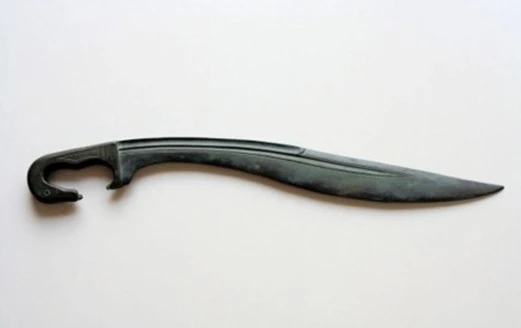
Notable archaeological finds of ancient swords.
The title of the world's oldest known sword currently belongs to a bronze weapon discovered by archaeologist A.D. Rezepkin in the Republic of Adygea, inside a stone tomb belonging to the Novosvobodnaya culture. This artifact is now on display at the Hermitage Museum.
This bronze proto-sword (measuring 63 cm overall, with an 11 cm hilt) dates to the second third of the 4th millennium BCE. By modern standards, it resembles a long dagger rather than a full sword, though its design clearly allowed for slashing strikes. Notably, the weapon was symbolically bent prior to its placement in the megalithic tomb.
Bent bronze sword. 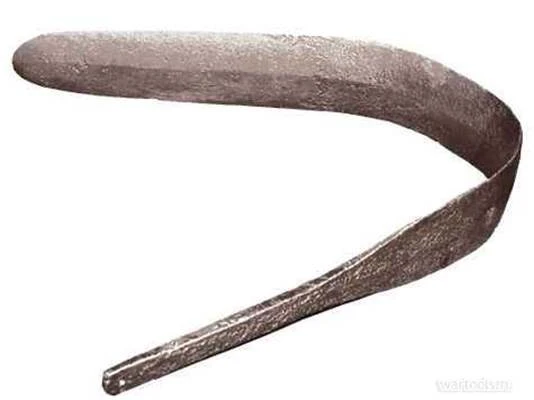
Prior to this discovery, the oldest known swords were those uncovered by Italian archaeologist Marcella Frangipane/ Palmieri in the upper Tigris region at the ancient palace of Arslantepe (Malatya). The cache included spearheads and several swords (or long daggers) ranging from 46 to 62 cm in length, dating to the late 4th millennium BCE.
This arsenical bronze sword is approximately 5,000 years old, making it one of the oldest in the world. 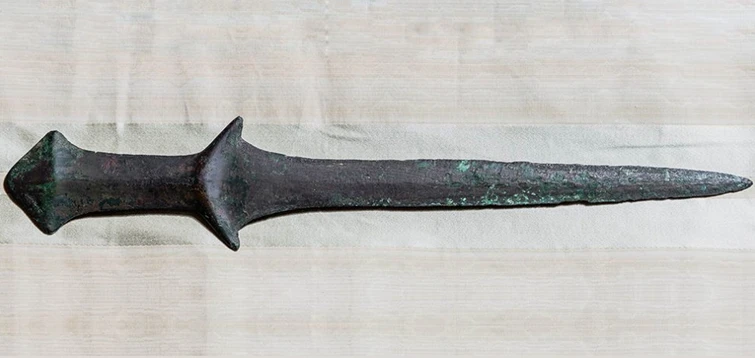
Ancient swords: 5,000–5,250 years old.
These swords were discovered in a burial at Aslantepe ("Lion Hill") in southeastern Anatolia (modern Turkey). A total of 9 swords and 11 spearheads, all cast from arsenical bronze, were retrieved from a palace wall. Ranging from 45 to 60 cm in length, they date back to 3350–3000 BCE and are believed to have served a ceremonial function. The destruction of the palace around 3000 BCE helped firmly establish their age.
Sword from Lion Hill (3D reconstruction). 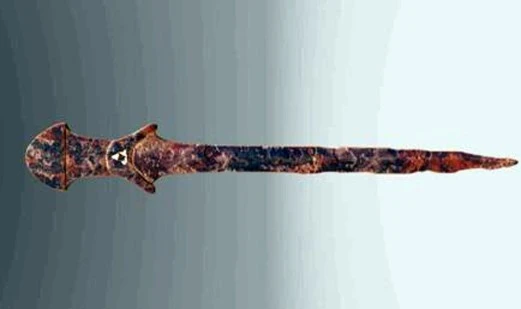
In March 2020, a sword that may be among the world's oldest was identified at an Armenian monastery in Venice. It has been dated to approximately 5,000 years old.
A standard bronze sword (top) and the Rørby sword (bottom), crafted from arsenical bronze. The Rørby sword is discussed further below. 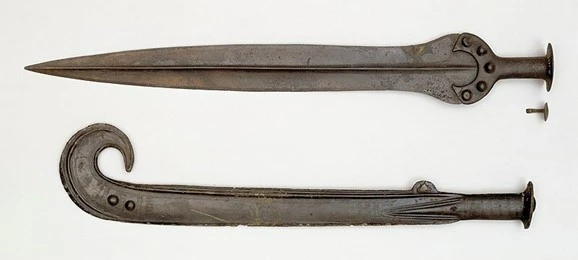
A sword unearthed near Beit Dagan (near Jaffa), dating to 2400–2000 BCE, measured roughly 1 meter in length and was forged from nearly pure copper with trace amounts of arsenic.
Copper sword from Beit Dagan, c. 2400–2000 BCE. British Museum collection. 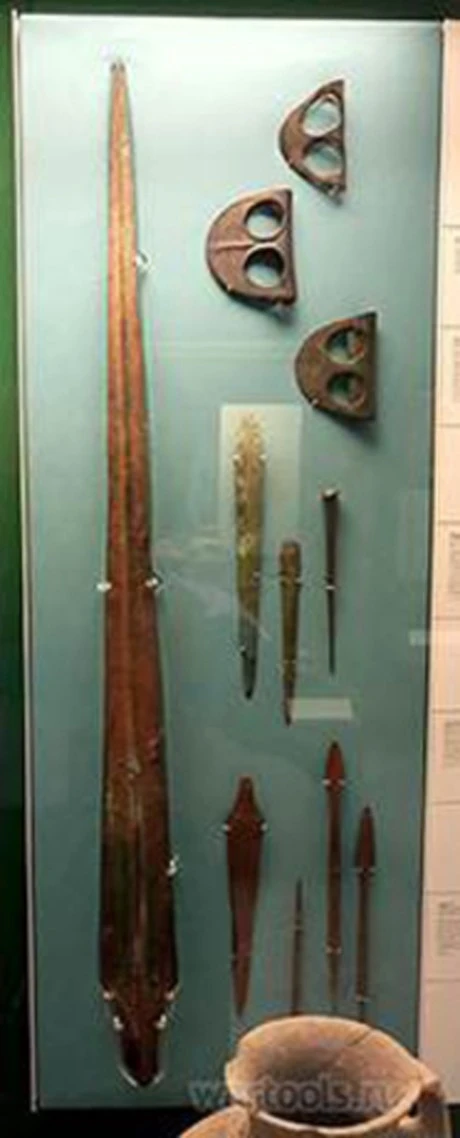
The oldest "rapiers": 4,000 years old.
These are the famous "Mycenaean rapiers"—bronze weapons that could reach up to 1,065 mm in length, though standard examples measured 80–90 cm. Dubbed "rapiers" because they were designed primarily for thrusting rather than slashing, some specimens nevertheless bear impact marks that suggest defensive parrying.
Scholars often refer to them as "horned swords" due to the distinctive shape of the blade shoulders, which were cast to double as a handguard. Their combat use is undisputed: numerous contemporary depictions show warriors wielding them. For instance, a 13th-century BCE Egyptian relief depicts the Battle of Sais (1208 BCE), where Pharaoh's forces fought off the "Sea Peoples."
Mycenaean rapier blades on display in Greece (originals). 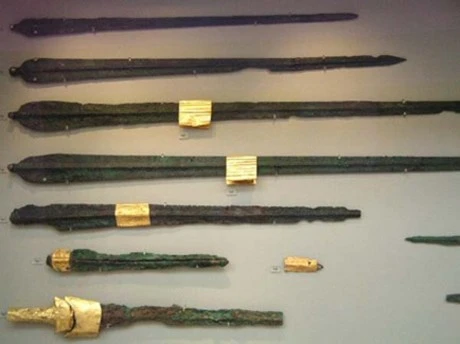
Long bronze swords dating to around 1700 BCE have also been discovered within the Minoan sphere. Designated as "Type A" swords, these weapons reached lengths of 1 meter or more. Featuring sharply tapered blades, they were designed primarily for thrusting against armored opponents.
Modern reconstructions of various Mycenaean sword types, including the top two "Type A" models. 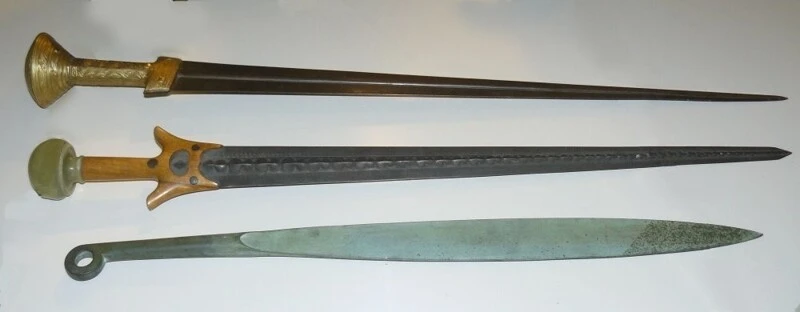
Exceptionally ancient swords have been recovered from Harappan (Indus Valley) sites, with some dating back as far as 2300 BCE. Similarly, numerous swords dating to 1700–1400 BCE have been uncovered across the Ochre Coloured Pottery culture area.
Bronze sword, 62 cm, 1300–1100 BCE. 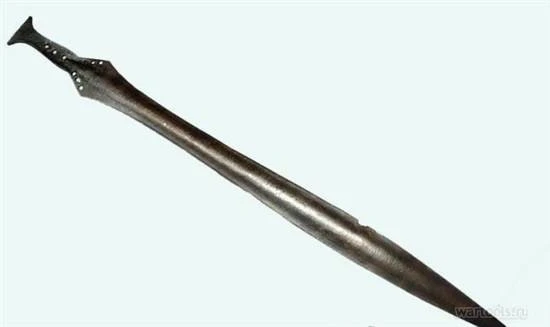
The oldest "shashka": 3,500–3,000 years old.
Three specimens of this unique weapon (two bronze, one flint) were unearthed in 1952 in Rørby, Western Zealand. Based on decorative motifs on the bronze items, scholars date them to between 1600 and 1500 BCE and suspect a ceremonial function.
Renowned arms historian Ewart Oakeshott disagreed, writing in *The Archaeology of Weapons*: "The reader can see for himself what a strange weapon this is, yet how effective! Cast in one piece, the blade is nearly half an inch thick at the back... It is an awkward but potentially lethal sword... The flint copy looks absurd yet charming—it seems as though, against all odds, craftsmen tried to replicate a modern metal product."
While these weapons cannot be classified as true *shashkas* in the modern sense, they certainly share striking design features.
The Rørby curved blades. 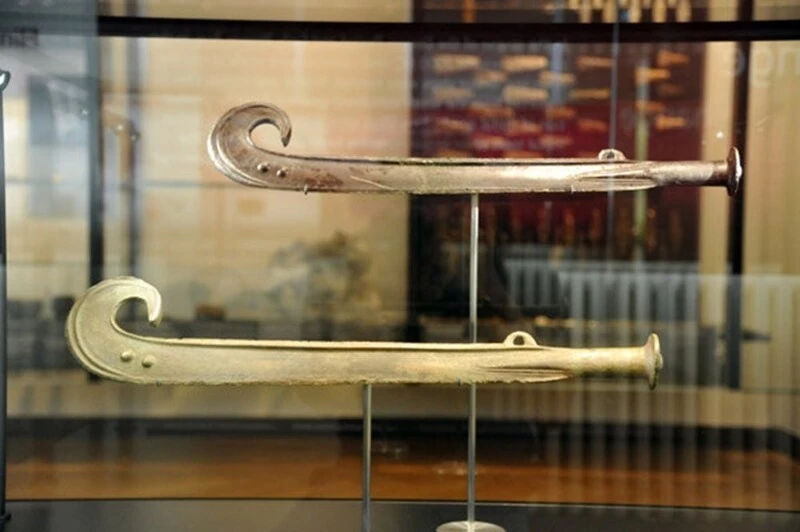
Bronze swords were known in China at least as early as the Shang dynasty, with the earliest finds dating to around 1200 BCE.
Ancient Chinese bronze sword. 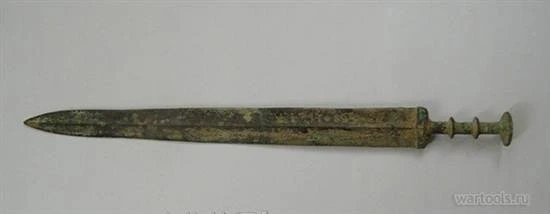
Numerous Celtic bronze swords have been recovered across Great Britain.
Celtic bronze swords in the National Museum of Scotland. 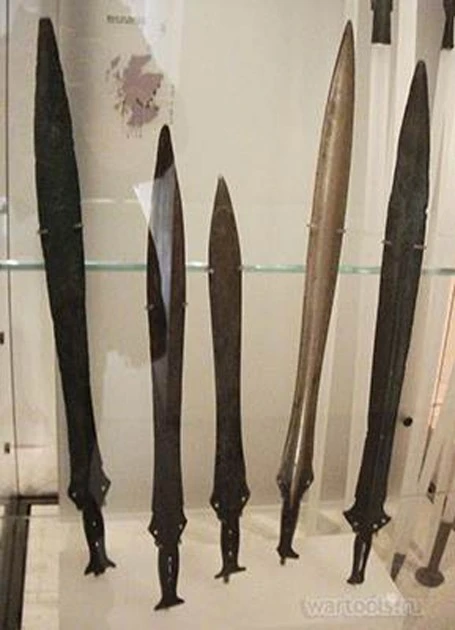
Iron swords date back to at least the 8th century BCE and entered widespread use by the 6th century BCE. Although unhardened iron offered little structural advantage over bronze, iron weapons quickly became cheaper and more accessible: iron ore was abundant, whereas the tin required for bronze was mined in only a few ancient locations.
Polybius noted that 3rd-century BCE Gallic iron swords frequently bent in battle, forcing warriors to straighten them with their feet. Some historians argue Polybius misinterpreted the Gallic custom of ritually bending sacrificed weapons; nevertheless, bending without snapping is a key characteristic of unhardened, low-carbon iron swords (unlike hardened steel, which breaks under extreme stress).
Ancient iron sword. 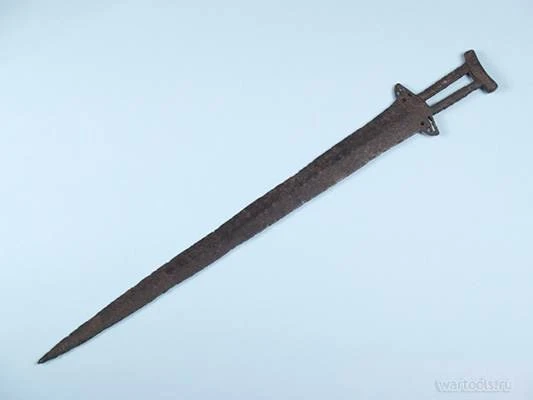
In China, steel swords superior to both bronze and iron appeared toward the end of the Western Zhou period, though they did not become widespread until the Qin or early Han dynasties in the late 3rd century BCE.
Chinese Dao sword from the late Qing dynasty. 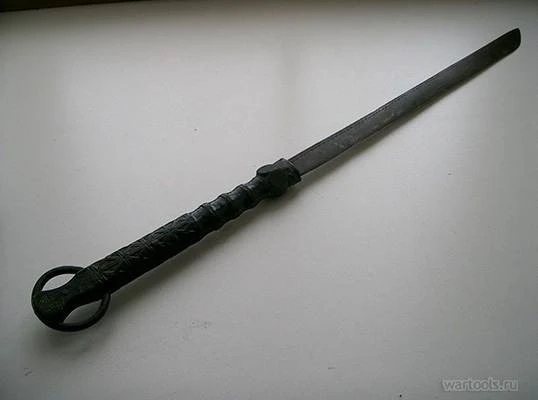
Around the same time, metallurgists in India began producing steel weapons, including early pattern-welded variants. According to the *Periplus of the Erythraean Sea*, Indian steel blades were exported to Greece and Rome by the 1st century CE.
An Etruscan sword from the 7th century BCE found in Vetulonia was forged by combining sections with different carbon contents: the blade core contained around 0.25% carbon, while the edges had under 1%.
Another Romano-Etruscan sword from the 4th century BCE contained up to 0.4% carbon,
indicating the use of carburization. Nevertheless, both swords suffered from poor metal quality and high impurity levels.
Etruscan swords. 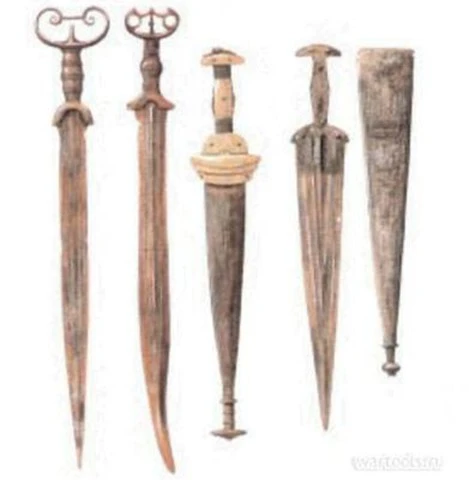
In Africa, iron weapons like the *mambele* remained in use well into the 19th century. Ironworking had ancient roots on the continent; outside the Mediterranean coast, Egypt, and Nubia, sub-Saharan Africa bypassed the Bronze Age entirely, transitioning directly to iron metallurgy.
Mambele. 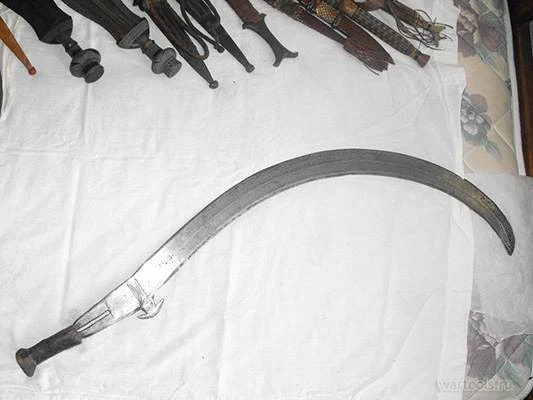
The most famous cut-and-thrust swords of classical antiquity include:
Xiphos. 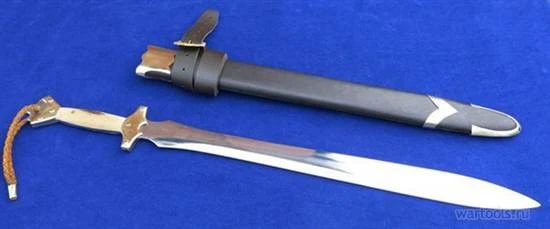
An ancient Greek sword under 70 cm long, featuring a leaf-shaped or straight blade;
Gladius.
The general Roman term for sword, now specifically associated with the short weapon of the legionary; 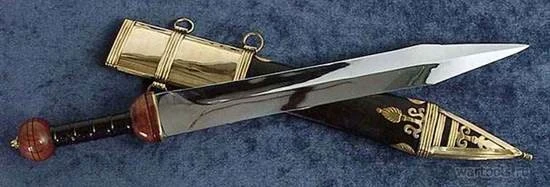
Akinakes.
The Scythian sword, in use from the 7th century BCE; 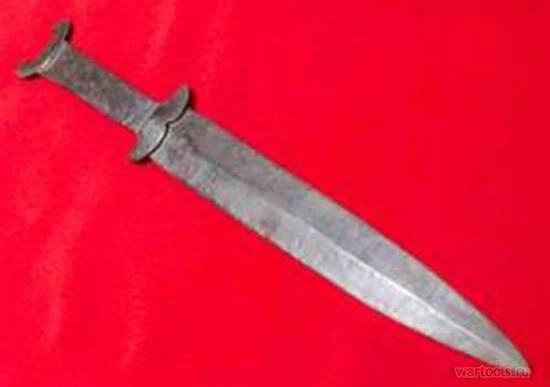
Mitsiya: the Maeotian sword, used from the 5th to 2nd century BCE. 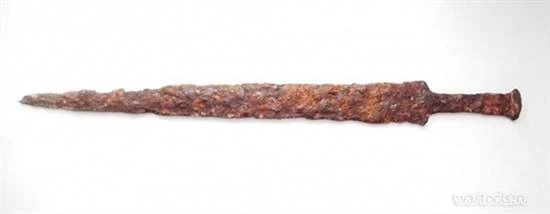
Later, cutting swords were adopted by the Celts and Sarmatians. The Sarmatians used swords in mounted combat, with lengths reaching up to 110 cm. A Sarmatian sword featured a narrow crossguard (only 2–3 cm wider than the blade), a long grip (15+ cm), and a ring-shaped pommel.
Sarmatian swords. 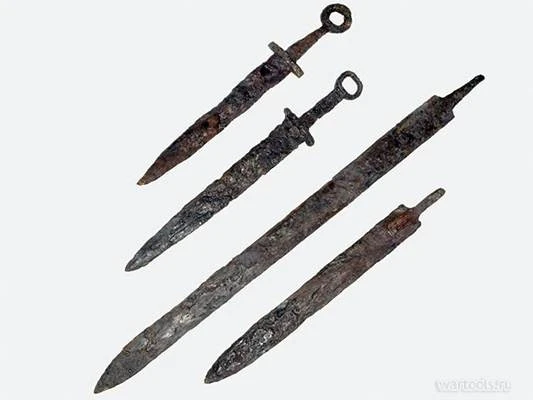
The spatha, of Celtic origin, was used by both infantry and cavalry. Reaching lengths up to 90 cm, it lacked a crossguard and featured a heavy, spherical pommel. Early spathas lacked a sharp point.
Spatha. 
Modern reconstruction of a 2nd-century CE cavalry spatha. 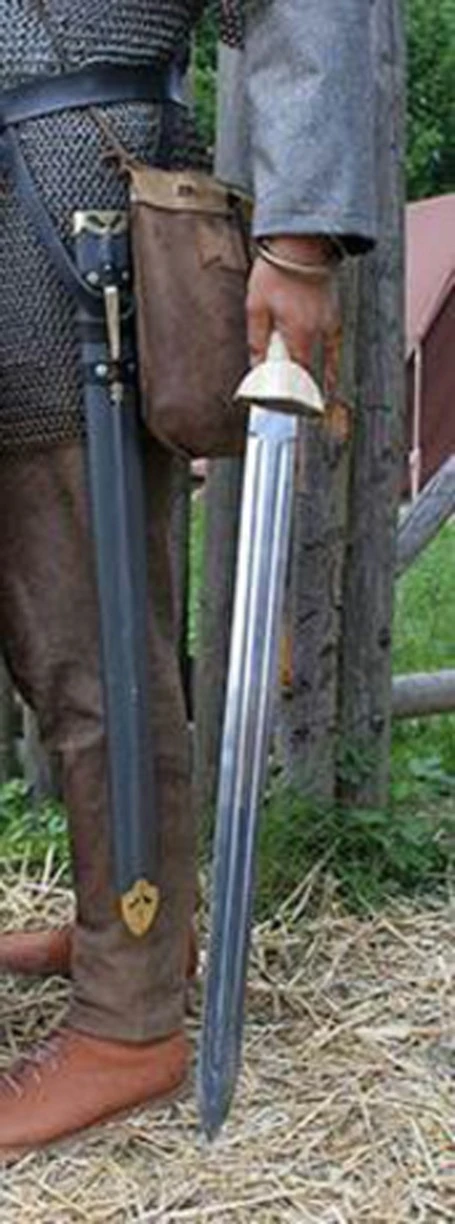
During the final century of the Roman Empire, the spatha became the standard sidearm for legionaries—both cavalrymen and infantrymen (who used a shorter variant known as the *semispatha*). This latter design is considered the transitional link between ancient swords and medieval weaponry.
That's all, folks! Thanks for reading. This article was compiled from five different sources, so I won't list them individually.