"We can make a fortune, but thousands of babies will die." Without missing a beat, the capitalist replied: "Break out the abacus, it's time to count our money!" (3 photos)
In the 1840s and 1850s, New York City was experiencing a massive population boom. The city was expanding at a staggering pace, fueled by hundreds of thousands of impoverished immigrants—mostly Irish fleeing the Great Famine, along with Germans. Industrial plants and overcrowded tenement buildings rapidly consumed the urban landscape. 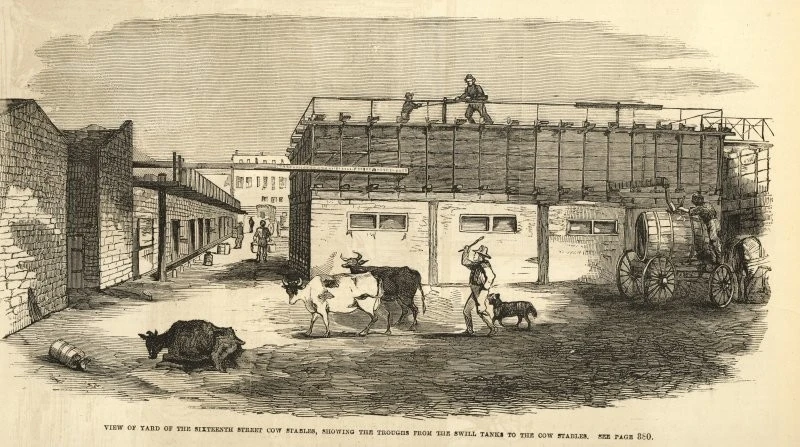
A sketch drawn in the Sixteenth Street stables, showing how crammed the cows were and how they lay in foul-smelling filth.
Railroads were still in their infancy, and horse-drawn wagons moved painfully slowly. In those days, concepts like "certification," "sanitary standards," or "consumer protection" simply did not exist, and food ingredients were entirely unregulated by law. Fresh milk from country farms would curdle after just a few hours in the summer heat. Pure, high-quality suburban milk delivered chilled on ice cost an exorbitant 10 to 12 cents a quart—a luxury reserved strictly for the wealthy. Meanwhile, "swill milk" went for just 3 to 5 cents. For destitute immigrants scraping by on pennies, it was the only option they could afford.
Tens of thousands of working-class women lived in the city. Laboring long hours in factories, they had no time to breastfeed, while harsh living conditions and malnutrition often caused their milk to dry up altogether. The growing metropolis urgently needed tons of cheap infant food.
It turned out to be a waste-disposal scheme with a 100% profit margin. Distillery owners producing whiskey and bourbon faced a purely logistical problem: the distillation process left behind mountains of hot, fermenting grain mash known as "swill." Dumping such massive quantities into the river was banned, and hauling it away was costly. Swill was treated as useless trash. But businessmen noticed that if you fed this hot slop to a cow, the animal didn't drop dead on the spot—at least not immediately—and actually produced an abundance of milk. Why? Normally, a sick animal stops producing milk. But swill was rich in protein and residual sugars. This high-calorie cocktail triggered severe hormonal disruption in the cows, prompting an unnatural surge in milk yield. At first, the cows refused to touch it. The owners would starve them of water for days until the desperate animals relented. Given the residual alcohol, the cows quickly became intoxicated, lethargic, and heavily addicted, refusing any other feed.
Feed costs plummeted to zero. Distilleries secured free raw materials for a lucrative side business. Stables were erected right next to the distilleries, with pipes delivering hot mash straight to the feed troughs.
The milk produced by these intoxicated cows was unmarketable in its natural state. Malnourishment made it watery, with a distinct bluish-gray tint. Worst of all was the stench of foul brewery mash mingled with pus. Exposed to air, the liquid separated almost instantly. To make this slop resemble real milk, vendors doctored it with cheap industrial ingredients: plaster of Paris, chalk, molasses, eggs to create a frothy top layer, and artificial colorings.
The cows' tails would rot from dry gangrene caused by appalling unsanitary conditions. The high acidity of the swill rapidly dissolved their tooth enamel, causing their teeth to decay or fall out within months. When a half-dead animal lost the use of its legs, it was suspended by a sling under its belly. Literally hanging in midair with hooves barely touching the manure-soaked floor, the cow continued to be milked.
To a modern reader, it seems unthinkable: how could anyone knowingly feed their child pus-ridden slop mixed with chalk? But New Yorkers at the time had neither alternatives nor knowledge. Germ theory was still unknown—people had no concept of bacteria, tuberculosis bacilli, or cholera vibrios. When an infant died of diarrhea or severe dehydration, it was attributed to "bad air," "God's will," or teething. No one connected the deaths to the milk. Vendors' wagons and barrels boasted slogans like "Pure Country Milk" or "Fresh Farm Milk," and unsuspecting parents genuinely believed they were buying wholesome dairy directly off the street.
This adulterated concoction dealt a deadly blow to the most vulnerable—infants being formula-fed or given cow's milk. According to historical records from The New York Times, a staggering 8,000 infants died every year throughout the 1850s as a result.
Infants were literally starving to death on full stomachs. The "milk" contained virtually no proteins or fats essential for growth. Chalk, plaster, and starch clogged their bowels, causing severe constipation, indigestion, and bloating. Babies wasted away—their skin grew thin, their bones brittle, and their kidneys failed. Toxic byproducts from the distillery waste caused severe poisoning, vomiting, and convulsions. Because the cows were kept in squalor and riddled with tuberculosis, their contaminated milk served as a breeding ground for deadly bacteria. Waves of infant cholera, pulmonary and intestinal tuberculosis, and severe dysentery swept through the city.
By 1858, the infant mortality rate in New York had reached such horrific proportions that it could no longer be blamed on "miasma" or divine providence. Frank Leslie, publisher and editor of the popular weekly Leslie’s Illustrated Newspaper, set out to uncover the truth. Leslie hired a team of reporters and illustrators who essentially went undercover, spying on distilleries across Brooklyn and Manhattan. 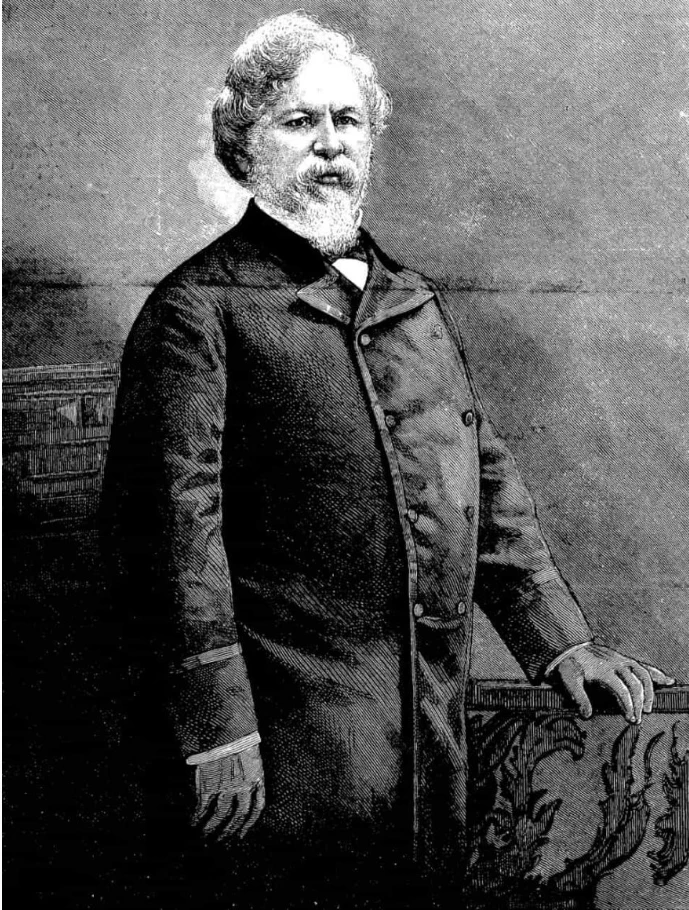
Frank Leslie
The investigative team trailed milk wagons to map their routes from origin to delivery. Posing as buyers or laborers, they infiltrated restricted distillery grounds.
In May 1858, Leslie published his first bombshell exposé, complete with full-page woodcut illustrations. For the first time, New Yorkers saw the grim reality behind the idyllic farm wagons: tailless, emaciated cows suspended in slings above pools of manure, and intoxicated workers pouring a bluish liquid into filthy vats. 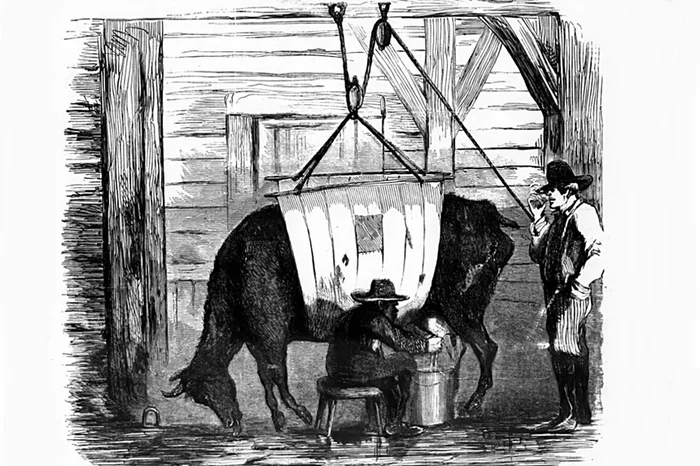
An illustration exposing the swill milk trade, published in the May 15, 1858 issue of Frank Leslie’s Illustrated Newspaper.
The publication hit like a bombshell. Issues sold out instantly, passed from hand to hand as a wave of fury swept the city. Mothers who had unknowingly fed their infants this poison and buried them one after another realized they had been cruelly deceived. "Milk riots" broke out in the streets. Enraged crowds intercepted delivery wagons, beat the drivers, and dumped the toxic liquid into the gutters. Activists and outraged physicians rallied outside distilleries, demanding an immediate shutdown. Such a massive scandal should have led to closures and prison sentences. But Tammany Hall intervened—the powerful, corrupt Democratic Party machine that held absolute sway over New York City. The "swill milk barons" were major political donors, paying lavish bribes to city officials, judges, and police officers. In return, Tammany guaranteed them complete immunity.
Bowing to public pressure, the mayor was forced to establish an investigative committee. However, it was placed under the leadership of Alderman Michael Tuomey, a thoroughly corrupt politician. Tuomey conducted an "official investigation": he visited the distilleries, dined lavishly with the owners, glanced briefly at the cows with a blind eye, and declared that the press was lying. His official verdict stated that swill was "excellent, highly nutritious feed," the cows appeared "healthy and contented," and their milk was "entirely safe." To top it off, Tuomey accused Frank Leslie of orchestrating a smear campaign to destroy honest businesses.
Undeterred, the magazine continued publishing weekly exposés featuring new evidence, naming corrupt officials, and revealing the locations of "death stables." Realizing that justice was unattainable in New York City courts controlled by Tammany Hall, civic activists and reform-minded doctors took the fight to the state level in Albany. In 1861, a special state commission conducted an independent chemical analysis of swill milk. The findings shocked state senators.
In 1862, New York State passed its first strict legislation outlawing the production and sale of milk from cows fed on distillery waste. Adulterating milk with chalk or plaster now carried heavy fines and prison sentences. The abhorrent practice was finally eradicated by the early 1870s, as mandatory pasteurization and reliable milk shipments from rural farms were established.
New York's "swill milk scandal" stands as a grim monument to an era when human life was valued less than a barrel of distillery waste. The tragedy clearly demonstrated that without strict regulatory oversight, corporations in pursuit of excessive profits can turn even infant food into a deadly poison. To grasp the scale of the catastrophe: during those years, more than half of all children under five from working-class families who couldn't afford pure milk died from this toxic mixture.
And the most horrific part of all: not a single person ever served real prison time for it.